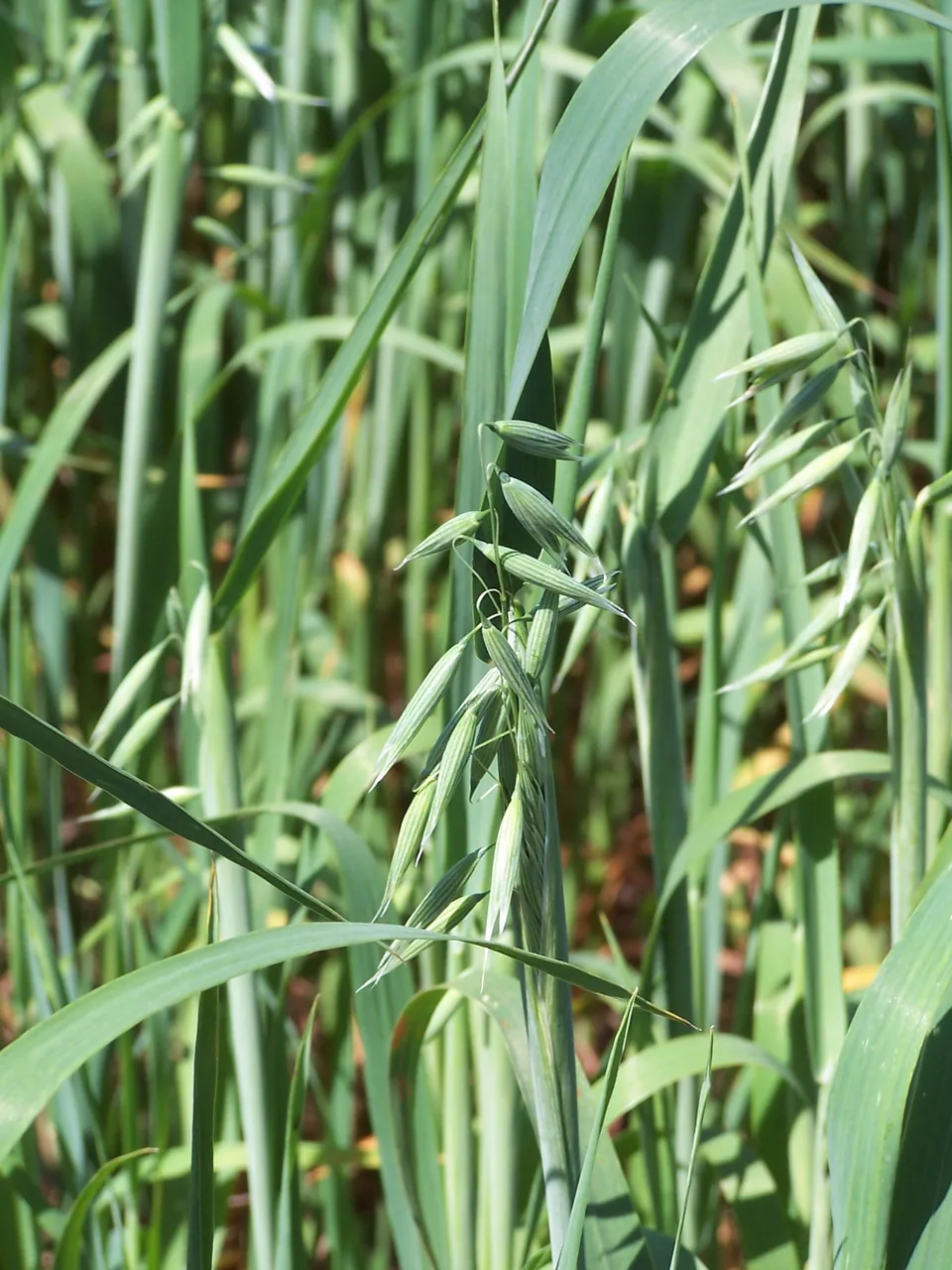


How to Grow and Care for Oat
Avena sativa
Written by Emilio Marruso · last checked
At a glance
Oats are an easy, generous grain to grow: sow the seeds in fall, 1–2 inches deep, and let them cover your soil through the winter as a cover crop. Give them full sun, 6 or more hours a day, and in spring you can harvest an edible grain, ready for your kitchen once it's cooked.
- Sun
Full sun: 6 or more hours a day
What the sources say (1)
Light: Full sun (6 or more hours of direct sunlight a day)
Full sun (6 or more hours of direct sunlight a day)
— Avena sativa (Oats) | North Carolina Extension Gardener Plant Toolbox [1] - Soil
Slightly acidic to alkaline soil, pH 6.0–8.0
What the sources say (2)
Soil pH, minimum: 6.0
Soil Texture: Clay High Organic Matter Loam (Silt) Sand Soil pH: Neutral (6.0-8.0) Soil Drainage: Good Drainage
— Avena sativa (Oats) | North Carolina Extension Gardener Plant Toolbox [1] Soil pH, maximum: 8.0
Soil Texture: Clay High Organic Matter Loam (Silt) Sand Soil pH: Neutral (6.0-8.0) Soil Drainage: Good Drainage
— Avena sativa (Oats) | North Carolina Extension Gardener Plant Toolbox [1] - Feeding
Don't give more nitrogen than needed; yellow leaves in spring mean it is short of nitrogen
What the sources say (3)
Avoid: Nitrogen rates higher than required: nitrogen loss, environmental effects and reduced economic return
The correct fertilizer-N rate is important as applying lower than required reduces economic return while higher rate can lead to N loss, potential negative environmental effects, and reduced economic return.
— [4] Signs of deficiency: Nitrogen deficiency: general yellowing (chlorosis) of the leaves and reduced vigor and growth, most often in spring; at flowering, stunted plants with fewer tillers and smaller heads
Deficiency symptoms are frequently characterized by general chlorosis (yellowing) of leaves and a reduction in overall plant vigor and growth.
— [3] At flowering, N deficient plants are stunted and have fewer tillers and smaller heads than healthy plants.
— [3] - Harvest
Harvest in spring; the grain is edible but must be cooked first
What the sources say (1)
Harvest: Spring
Fruit Value To Gardener: Edible Display/Harvest Time: Spring Fruit Type: Caryopsis Fruit Length:
— Avena sativa (Oats) | North Carolina Extension Gardener Plant Toolbox [1] - Watch out
It stops other seeds sprouting: wait 3 weeks after it dies down before sowing vegetables or flowers
- Size
2–4 ft tall and 6 in to 1 ft wide
What the sources say (2)
Mature height: 61-122 cm (2-4 ft)
Height: 2 ft. 0 in. - 4 ft. 0 in.
— Avena sativa (Oats) | North Carolina Extension Gardener Plant Toolbox [1] Mature width: 15-30 cm (6 in - 1 ft)
Width: 0 ft. 6 in. - 1 ft. 0 in.
— Avena sativa (Oats) | North Carolina Extension Gardener Plant Toolbox [1] - Propagation
Grows from seed
What the sources say (1)
Propagation: Seed
Life Cycle: Annual Recommended Propagation Strategy: Seed Country Or Region Of Origin: Iran and Iraq
— Avena sativa (Oats) | North Carolina Extension Gardener Plant Toolbox [1] - Sowing
Sow in fall as a winter cover crop, 1–2 in deep
What the sources say (2)
Sowing: Fall (as a fall-sown winter cover crop)
The home gardener is apt to grow oats, which are members of the grass family (Poaceae), as a fall-sown, winter cover crop.
— Avena sativa (Oats) | North Carolina Extension Gardener Plant Toolbox [1] Sowing depth: 2.5-5 cm (1-2 in)
Sow oat seeds 1 to 2 inches deep in drills.
— Avena sativa (Oats) | North Carolina Extension Gardener Plant Toolbox [1]
Overview
Oats are annual grasses grown as a cover crop, for forage, or for their grain. [1] Oats grow best in full sun and adapt to a variety of well-drained soil types. [1]
This record is incomplete: the sources we read do not cover every field yet.
Not yet covered by our sources: Watering, Spacing
Oat care
How to water Oat
Not stated in the sources we read.
How much light Oat needs
Full sun (6 or more hours of direct sunlight a day)
What the sources say (1)
Full sun (6 or more hours of direct sunlight a day)Best soil for Oat
Soil pH, minimum
6.0
What the sources say (1)
Soil Texture:
Clay
High Organic Matter
Loam (Silt)
Sand
Soil pH:
Neutral (6.0-8.0)
Soil Drainage:
Good DrainageSoil pH, maximum
8.0
What the sources say (1)
Soil Texture:
Clay
High Organic Matter
Loam (Silt)
Sand
Soil pH:
Neutral (6.0-8.0)
Soil Drainage:
Good DrainageWhere to grow Oat
Not stated in the sources we read.
How to propagate Oat
Seed
What the sources say (1)
Life Cycle:
Annual
Recommended Propagation Strategy:
Seed
Country Or Region Of Origin:
Iran and IraqHow to grow Oat
The plant
Life cycle
annual
What the sources say (1)
Oats are annual grasses grown as a cover crop, for forage, or their grain.Family
Poaceae
What the sources say (2)
The home gardener is apt to grow oats, which are members of the grass family (Poaceae), as a fall-sown, winter cover crop.Scientific Family Poaceae Plant type Grasses Riparian NoMature height
61-122 cm (2-4 ft)
What the sources say (1)
Height: 2 ft. 0 in. - 4 ft. 0 in.Mature width
15-30 cm (6 in - 1 ft)
What the sources say (1)
Width: 0 ft. 6 in. - 1 ft. 0 in.Sowing and growth
Sowing depth
2.5-5 cm (1-2 in)
What the sources say (1)
Sow oat seeds 1 to 2 inches deep in drills.Fertilizing
Mineral fertilizers
The sources give different values depending on region, zone or growing conditions.
What each source says
field trials in Montana, recommendation drawn from them: Nitrogen fertilizer to reach 67.3 kg [148.4 lb]/ha of available N (soil plus fertilizer) where 20.3 cm [8 in] of available water is expected in the growing season
field trials in Montana, recommendation drawn from them: Nitrogen requirement rises by 8.97 kg [19.8 lb]/ha for each additional 2.54 cm [1 in] of available water
What the sources say (2)
field trials in Montana, recommendation drawn from them: sufficient fertilizer N should be applied to achieve 60 lbs available N/a where 8 inches of available water (soil water +
rainfall) is expected during the growing season.field trials in Montana, recommendation drawn from them: Nitrogen requirements for maximum return increase 8 lbs/a per inch increase in water.Avoid
Nitrogen rates higher than required: nitrogen loss, environmental effects and reduced economic return
What the sources say (1)
The correct fertilizer-N rate is important as applying lower than required reduces economic return while higher rate can lead to N loss, potential negative environmental effects, and reduced economic return.Signs of deficiency
Nitrogen deficiency: general yellowing (chlorosis) of the leaves and reduced vigor and growth, most often in spring; at flowering, stunted plants with fewer tillers and smaller heads
What the sources say (2)
Deficiency symptoms are frequently
characterized by general chlorosis (yellowing) of leaves and a reduction in overall plant vigor and growth.At flowering, N deficient
plants are stunted and have fewer tillers and smaller heads than healthy plants.Oat pests and problems
Allelopathy
Symptom: Oats release chemicals into the soil that inhibit the germination of other plants.
What to do: Wait at least three weeks after the oat cover crop has died down before sowing annual vegetable or ornamental seeds.
What the sources say (1)
Wait at least three weeks after the oat cover crop has died down before sowing annual vegetable or ornamental seeds, as this will give time for the inhibitory chemicals to degrade.
— Avena sativa (Oats) | North Carolina Extension Gardener Plant Toolbox [1]
Remedies
Each remedy shows what official sources say about it; traditional remedies without an official source are marked as such. Harmful ones are listed so you know to avoid them.
Treating the plant
aphids
insecticidal soap Works
When “oils and soaps” are mentioned in UC IPM publications, we are referring to commercially available oils and soaps that are formulated specifically for use as pesticides- not household oils and soaps meant for cooking, cleaning, or other purposes.
— ucanr.edu [7] How: Insecticidal soaps are among the usual methods of control; check the product label for usage guidelines prior to use.
insecticidal soaps or oils such as neem or canola oil are usually the best method of control
— plantvillage.psu.edu [5] What the evidence says For example, insecticidal soap is a safe, effective organic insecticide with minimal environmental impact.
— extension.psu.edu [6]
stink bugs
removing weeds around the crop Official source, not independently tested
How: Remove weeds around the crop, which may act as overwintering sites for stink bugs, and practice good weed management throughout the year.
Remove weeds around crop which may act as overwintering sites for stink bugs and practice good weed management throughout the year
— plantvillage.psu.edu [5]
Calendar
Sowing
Fall (as a fall-sown winter cover crop)
What the sources say (1)
The home gardener is apt to grow oats, which are members of the grass family (Poaceae), as a fall-sown, winter cover crop.Harvest
Spring
What the sources say (1)
Fruit Value To Gardener:
Edible
Display/Harvest Time:
Spring
Fruit Type:
Caryopsis
Fruit Length:Months as given by the sources, which are mostly from the United States (northern hemisphere). In the southern hemisphere they shift by about six months.
Edibility
Reported by the source, quoted verbatim. Do not eat a plant on the basis of this page alone: identification mistakes can be dangerous.
Oats are an edible grain. It must be cooked before consumption.
[1]
Indicative values
Values from a secondary source, not checked word for word like the rest of this page. Use them as a starting point.
- Watering
- AverageIndicative value, adapt it to your climate · Secondary source
- Drought tolerant
- yesIndicative value, adapt it to your climate · Secondary source
- Care level
- MediumIndicative value, adapt it to your climate · Secondary source
- Growth rate
- HighIndicative value, adapt it to your climate · Secondary source
- Pruning
- February, March, AprilIndicative value, adapt it to your climate · Secondary source
Similar plants
- Common barley Hordeum vulgare
- Corn Zea mays
- Giant Cane Arundinaria gigantea
- Rye Secale cereale
- Sorghum Sorghum bicolor
- Wheat Triticum aestivum
- Teff Eragrostis tef
- African lovegrass Eragrostis curvula
Sources
Every value above is quoted from these documents. Links lead to the original publisher.
- Avena sativa (Oats) | North Carolina Extension Gardener Plant Toolbox · plants.ces.ncsu.edu, consulted
- Avena sativa - common oat | Yavapai County Native and Naturalized Plants · yavapaiplants.extension.arizona.edu, consulted
- landresources.montana.edu · landresources.montana.edu
- extension.sdstate.edu · extension.sdstate.edu
- plantvillage.psu.edu · plantvillage.psu.edu
- extension.psu.edu · extension.psu.edu
- ucanr.edu · ucanr.edu
Written by Emilio Marruso · last checked