
How to Grow and Care for Bush allamanda
Allamanda schottii
Written by Emilio Marruso · last checked
At a glance
Allamanda schottii is an easygoing plant for beginners: give it full to partial sun and well-drained soil, and it handles some dry spells without fuss. It grows 4 feet tall or more, so leave at least 3 feet around it, or grow it in a container. Prune it in spring, in late March or early April.
- Sun
Full to partial sun
What the sources say (1)
Light: Full to partial sun
They're moderate growers that like full to partial sun and do best in Zone 10.
— Bush Allamanda [5] - Water
Handles some dry spells; don't let water pool around the roots
What the sources say (1)
Watering notes: Well-drained soil; somewhat drought tolerant
Water: well-drained soil, somewhat drought tolerant
— UNF: Allamanda schottii [1] - Cold
Survives winters down to 30 °F (−1.1 °C)
Half hardy: mild winters or an unheated greenhouse · USDA 10 · RHS H3 · Z10
What the sources say (2)
Hardiness, coldest zone: 10 [winter low −1.1 to 4.4 °C (30 to 40 °F)]
They're moderate growers that like full to partial sun and do best in Zone 10.
— Bush Allamanda [5] Hardiness, warmest zone: 10 [winter low −1.1 to 4.4 °C (30 to 40 °F)]
They're moderate growers that like full to partial sun and do best in Zone 10.
— Bush Allamanda [5] - Soil
Well-drained soil
What the sources say (1)
Watering notes: Well-drained soil; somewhat drought tolerant
Water: well-drained soil, somewhat drought tolerant
— UNF: Allamanda schottii [1] - Spacing
Plant no closer than 3 ft apart
What the sources say (1)
Spacing: No closer than 91.4 cm (3 ft)
Allamanda bushes grow wider at the top, so place them no closer than 3 feet apart.
— Bush Allamanda [5] - Pruning
Prune in spring, in late March or early April
What the sources say (1)
Pruning: Spring (late March or early April)
Trim as needed to shape and cut back in spring (late March or early April) for size.
— Bush Allamanda [5] - Size
4 ft tall or more
What the sources say (1)
Mature height: 121.92 or more (four feet [1.2 m] or more)
## Size: Medium-sized shrub to four feet tall or more.
— UNF: Allamanda schottii [1] - Containers
Grows in containers too
What the sources say (1)
In containers: Yes
These shrubs can be grown in large containers.
— Bush Allamanda [5]
Overview
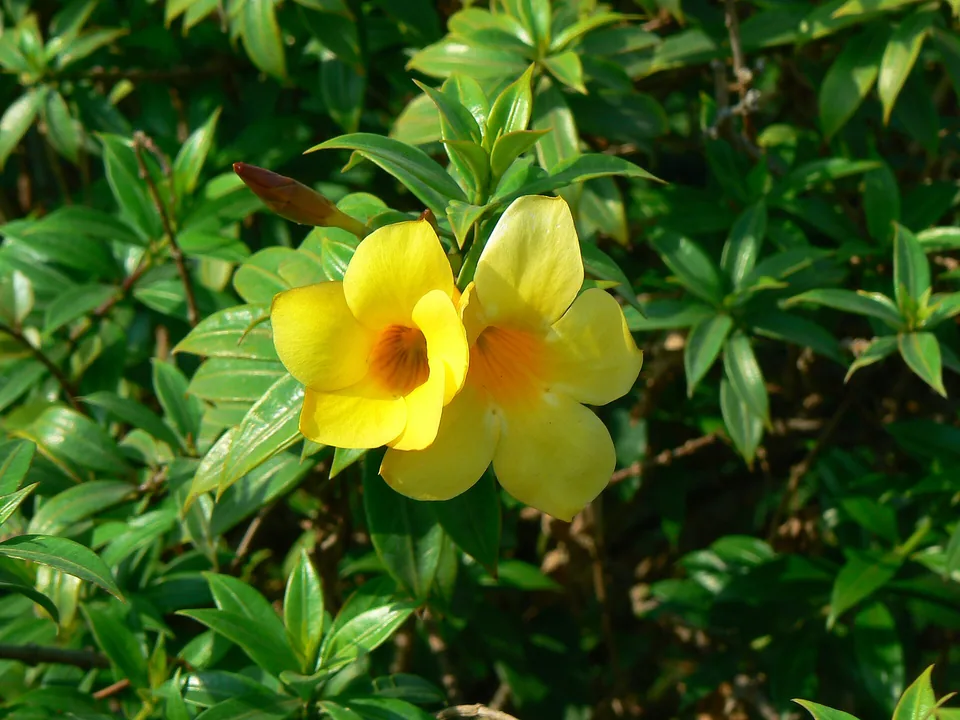
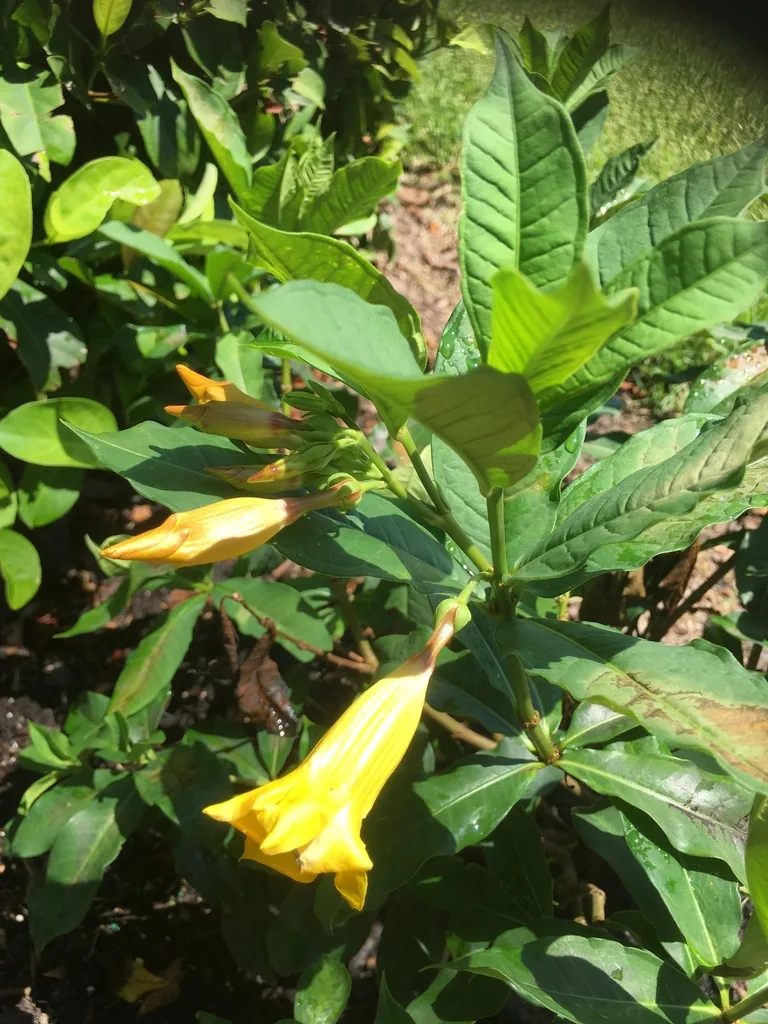
Bush allamanda is an evergreen shrub with bright yellow, trumpet-shaped flowers. [5][1] It is grown in sun and well-drained soil. [1] Its stems and leaves contain an irritant milky sap. [4]
This record is incomplete: the sources we read do not cover every field yet.
Not yet covered by our sources: Watering, Propagation
Bush allamanda care
How to water Bush allamanda
Watering
Not stated in the sources we read.
Watering notes
Well-drained soil; somewhat drought tolerant
What the sources say (1)
Water: well-drained soil, somewhat drought tolerantHow much light Bush allamanda needs
Full to partial sun
What the sources say (1)
They're moderate growers that like full to partial sun and do best in Zone 10.How much cold Bush allamanda can take
Hardiness, coldest zone
10 [winter low −1.1 to 4.4 °C (30 to 40 °F)]
What the sources say (1)
They're moderate growers that like full to partial sun and do best in Zone 10.Hardiness, warmest zone
10 [winter low −1.1 to 4.4 °C (30 to 40 °F)]
What the sources say (1)
They're moderate growers that like full to partial sun and do best in Zone 10.Where to grow Bush allamanda
In containers
Yes
What the sources say (1)
These shrubs can be grown in large containers.Spacing
No closer than 91.4 cm (3 ft)
What the sources say (1)
Allamanda bushes grow wider at the top, so place them no closer than 3 feet apart.How to propagate Bush allamanda
Not stated in the sources we read.
How to grow Bush allamanda
The plant
Family
Apocynaceae
What the sources say (1)
## Family Apocynaceae
## Description:
About twelve species of Allamanda are native to Central and South America.Mature height
121.92 or more (four feet [1.2 m] or more)
What the sources say (1)
## Size:
Medium-sized shrub to four feet tall or more.Remedies
Each remedy shows what official sources say about it; traditional remedies without an official source are marked as such. Harmful ones are listed so you know to avoid them.
First aid
First aid: not a substitute for a doctor
skin contact with sap
wash with running water and soap Official source, not independently tested
Seek medical attention if exposure results in symptoms.
— poisonsinfo.health.qld.gov.au [7] If eaten, it may cause diarrhoea and vomiting. Skin contact may cause dermatitis.
— poisonsinfo.health.qld.gov.au [7] How: Wash the area thoroughly with plenty of running water and soap.
Wash the area thoroughly with plenty of running water and soap.
— poison.org [6]
Calendar
Spring (late March or early April)
What the sources say (1)
Trim as needed to shape and cut back in spring (late March or early April) for size.Months as given by the sources, which are mostly from the United States (northern hemisphere). In the southern hemisphere they shift by about six months.
Indicative values
Values from a secondary source, not checked word for word like the rest of this page. Use them as a starting point.
- Life cycle
- PerennialIndicative value, adapt it to your climate · Secondary source
- Watering
- FrequentIndicative value, adapt it to your climate · Secondary source
- Soil pH
- 5.5-6.5Indicative value, adapt it to your climate · Secondary source
- Care level
- MediumIndicative value, adapt it to your climate · Secondary source
- Growth rate
- HighIndicative value, adapt it to your climate · Secondary source
- Propagation
- Cutting, Layering Propagation, Grafting Propagation, Air Layering Propagation, Division, Seed PropagationIndicative value, adapt it to your climate · Secondary source
Similar plants
- Allamanda Allamanda cathartica
- Asiatic Jasmine Trachelospermum asiaticum
- Bladderflower Araujia sericifera
- Blue Star Amsonia hubrichtii
- Butterfly Weed Asclepias tuberosa
- Carolina Spinypod Matelea carolinensis
- Cinnamon Hoya Hoya lacunosa
- Clasping Milkweed Asclepias amplexicaulis
Sources
Every value above is quoted from these documents. Links lead to the original publisher.
- UNF: Allamanda schottii · unf.edu, consulted
- Allamanda schottii / [Species detail] / Plant Atlas · florida.plantatlas.usf.edu, consulted
- Allamanda schottii (PROSEA) - Pl@ntUse · uses.plantnet-project.org, consulted
- Allamanda schottii - Botany Brisbane · botanybrisbane.com, consulted
- Bush Allamanda · south-florida-plant-guide.com, consulted
- poison.org · poison.org
- poisonsinfo.health.qld.gov.au · poisonsinfo.health.qld.gov.au
Written by Emilio Marruso · last checked