
How to Grow and Care for Pink rock-rose
Cistus creticus
Written by Emilio Marruso · last checked
Toxic to: People · Why
At a glance
Rock rose is a tough sun lover: give it a sunny spot and, once settled in, it shrugs off dry spells with ease. Its leaves can even be brewed as a tea substitute. It flowers so freely that it can wear itself out, but in a spot it likes it often sows new plants on its own.
- Sun
A sunny spot
What the sources say (1)
Light: Sunny position
Cistus species generally grow best in a sunny position in a well-drained light sandy soil
— Cistus creticus - Useful Temperate Plants [2] - Water
Very drought tolerant once established
What the sources say (1)
Watering: Very drought tolerant once established
Established plants are very drought tolerant
— Cistus creticus - Useful Temperate Plants [2] - Harvest
The leaves can be used as a tea substitute
- Watch out
Heavy flowering wears it out, so it is short-lived; in a good spot it often self-sows
- Propagation
By seed, or by cuttings in a cold frame in summer or fall
What the sources say (2)
Propagation: Seed (gather when ripe and store dry, surface sow); cuttings of softish to half-ripe wood in a frame in summer; cuttings of almost mature wood in a frame in autumn
Seed - gather when ripe and store dry
— Cistus creticus - Useful Temperate Plants [2] Cuttings of softish to half-ripe wood, 8cm long with a heel or at a node, early to late summer in a frame.
— Cistus creticus - Useful Temperate Plants [2] - Sowing
Sow on the soil surface in a greenhouse in late winter
What the sources say (3)
Sowing: Late winter (surface sown in a greenhouse)
Surface sow in late winter in a greenhouse
— Cistus creticus - Useful Temperate Plants [2] Propagation: Seed (gather when ripe and store dry, surface sow); cuttings of softish to half-ripe wood in a frame in summer; cuttings of almost mature wood in a frame in autumn
Seed - gather when ripe and store dry
— Cistus creticus - Useful Temperate Plants [2] Cuttings of softish to half-ripe wood, 8cm long with a heel or at a node, early to late summer in a frame.
— Cistus creticus - Useful Temperate Plants [2] - Safety
Only one case of allergy to this plant has been reported
Overview
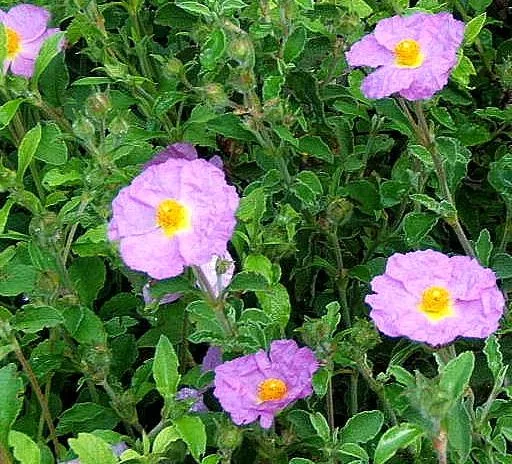
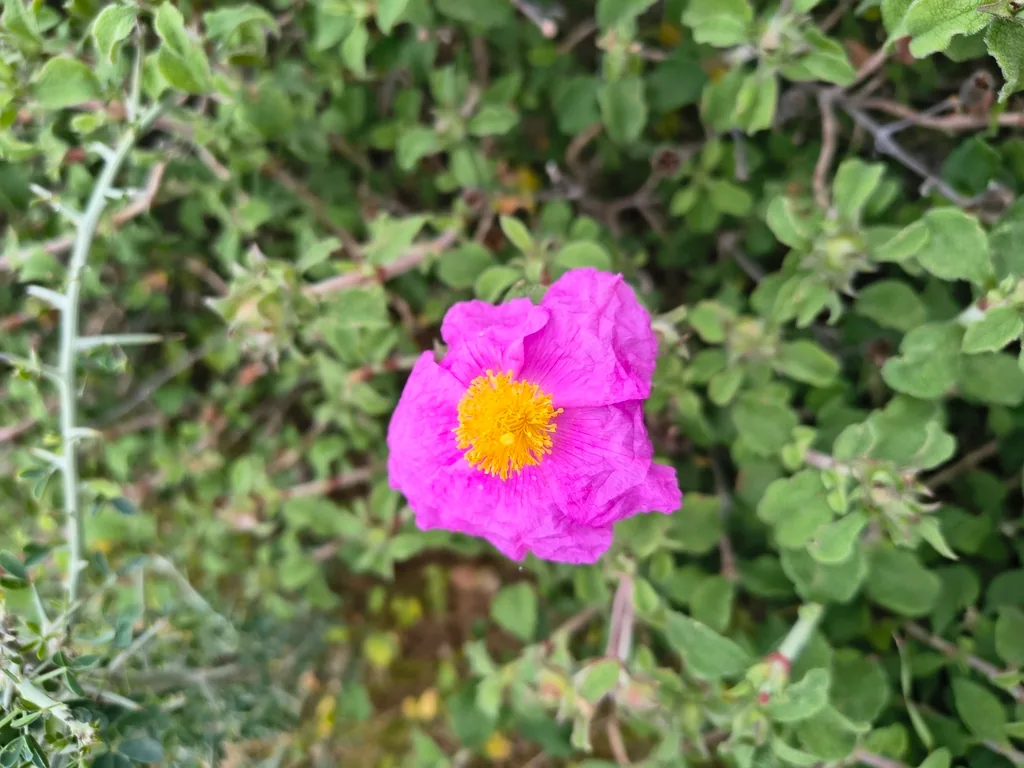
Cistus creticus is a much-branched, compact, evergreen shrub growing 60 - 120cm [24–47 in] tall. [2] It is considered the most prolific producer of the fragrant gum ladanum among the Cistus species. [2] The flowers are purplish-pink, 4-6 cm [1.6–2.4 in] across, and appear from late March to June in Greece. [3]
This record is incomplete: the sources we read do not cover every field yet.
Not yet covered by our sources: Hardiness, coldest zone, Hardiness, warmest zone, Pruning
Pink rock-rose care
Measurements in square brackets are our conversion into the other unit system; the quoted text is unchanged.
How to water Pink rock-rose
Very drought tolerant once established
What the sources say (1)
Established plants are very drought tolerantHow much light Pink rock-rose needs
Sunny position
What the sources say (1)
Cistus species generally grow best in a sunny position in a well-drained light sandy soilHow much cold Pink rock-rose can take
Hardiness, coldest zone
Not stated in the sources we read.
Hardiness, warmest zone
Not stated in the sources we read.
How to propagate Pink rock-rose
Seed (gather when ripe and store dry, surface sow); cuttings of softish to half-ripe wood in a frame in summer; cuttings of almost mature wood in a frame in autumn
How to grow Pink rock-rose
The plant
Family
Cistaceae
What the sources say (1)
Cistus creticus (Cistaceae), is given with several subspecies (Lukas et al., 2021): Cistus creticus subsp. creticus Greuter & BurdetPink rock-rose pests and problems
Short life in cultivation
Symptom: Plants exhaust themselves by very free flowering
What to do: Plants often self-sow when growing in a suitable position
What the sources say (1)
This is usually a short-lived plant in cultivation, it probably exhausts itself by its very free-flowering habit
— Cistus creticus - Useful Temperate Plants [2]
Remedies
Each remedy shows what official sources say about it; traditional remedies without an official source are marked as such. Harmful ones are listed so you know to avoid them.
First aid
First aid: not a substitute for a doctor
allergic contact dermatitis
avoid the allergen and protect hands with gloves Official source, not independently tested
Seek dermatology input for further advice.
— dermnetnz.org [5] How: Wear appropriate gloves to protect hands from touching allergenic materials.
Identification and avoidance of offending allergens and potential cross-reacting agents is the principal management strategy.
— dermnetnz.org [5]
Is Pink rock-rose poisonous?
Reported by the source, quoted verbatim. This is not medical or veterinary advice: if a person or an animal may have eaten this plant, contact a poison control centre or a veterinarian.
Calendar
Sowing
Late winter (surface sown in a greenhouse)
What the sources say (1)
Surface sow in late winter in a greenhousePruning
Not stated in the sources we read.
Months as given by the sources, which are mostly from the United States (northern hemisphere). In the southern hemisphere they shift by about six months.
Edibility
Reported by the source, quoted verbatim. Do not eat a plant on the basis of this page alone: identification mistakes can be dangerous.
Similar plants
- Cistus albidus Cistus albidus
- Montpelier cistus Cistus monspeliensis
- Cistus laurifolius Cistus laurifolius
- Salvia cistus Cistus salviifolius
- Common rock-rose Helianthemum nummularium
- Aaron's Beard Hypericum calycinum
- Abies grandis Abies grandis
- Abraham Trachystemon orientalis
Sources
Every value above is quoted from these documents. Links lead to the original publisher.
- Cistus creticus - Trees and Shrubs Online · treesandshrubsonline.org, consulted
- Cistus creticus - Useful Temperate Plants · temperate.theferns.info, consulted
- · cretanflora.com, consulted
- Official address Domenico Scarlattilaan 6 ● 1083 HS Amsterdam ● The Netherlands · ema.europa.eu, consulted
- dermnetnz.org · dermnetnz.org
Written by Emilio Marruso · last checked