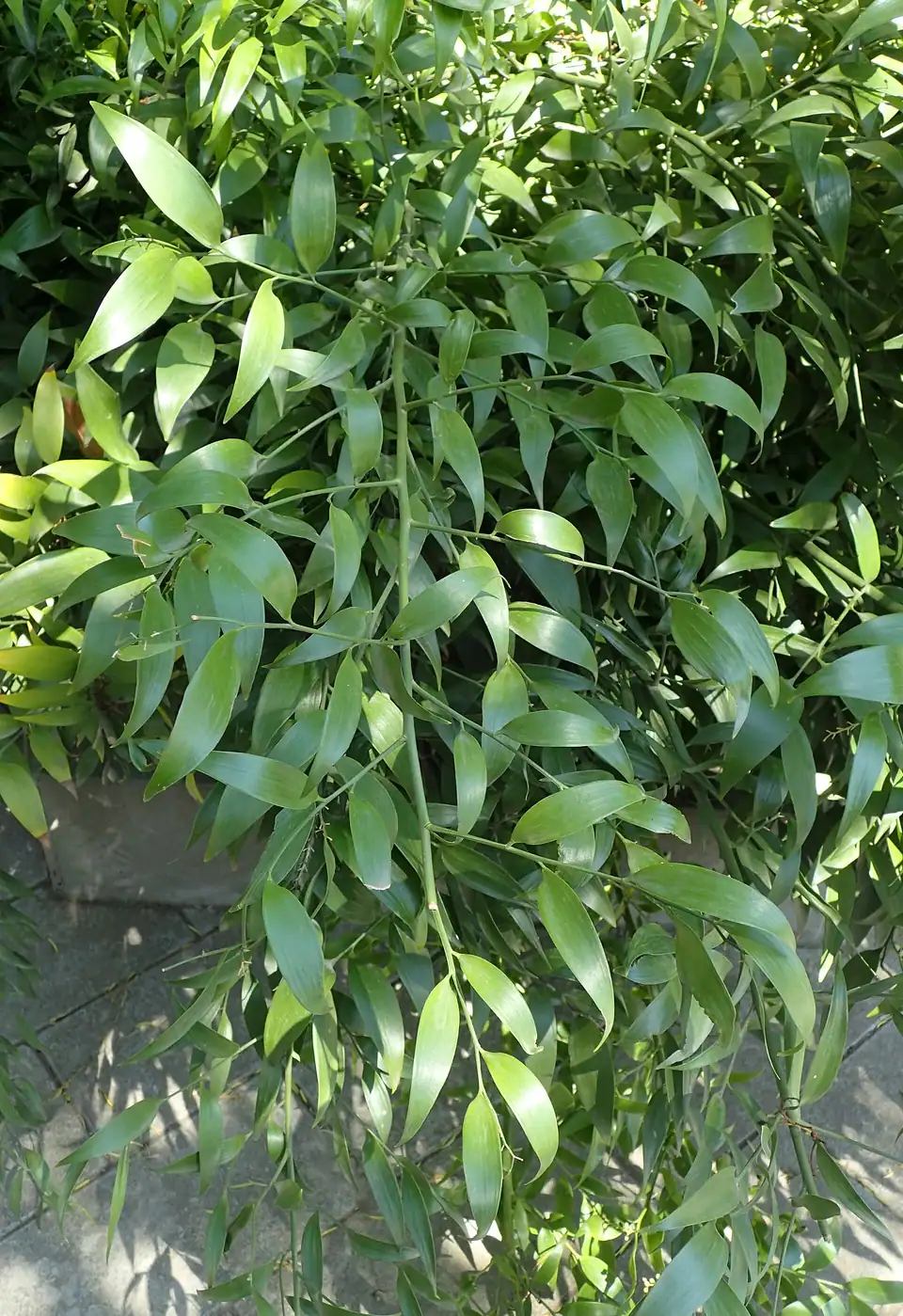


How to Grow and Care for Poet's Laurel
Danae racemosa
Written by Emilio Marruso · last checked
At a glance
Looking for something to fill a shady corner? Danae racemosa is a perennial that thrives in partial to full shade, forming lush foliage 2–4 ft tall and 3–4 ft wide. Give it moist, well-drained soil rich in organic matter; once established it handles dry spells fairly well, and it grows happily in a container too.
- Sun
Partial to full shade
What the sources say (2)
Light: Partial to full shade
Its lush foliage discolors in full sun so keep it in partial to full shade.
— Danae racemosa (Alexandria laurel, Alexandrian Laurel, Poet's Laurel) | North Carolina Extension Gardener Plant Toolbox [1] Light: Dappled Sunlight (Shade through upper canopy all day) Partial Shade
— Danae racemosa (Alexandria laurel, Alexandrian Laurel, Poet's Laurel) | North Carolina Extension Gardener Plant Toolbox [1] - Water
Handles dry spells fairly well once established
What the sources say (1)
Watering: Fairly drought tolerant once established
Once it is established, it is fairly drought tolerant.
— Danae racemosa (Alexandria laurel, Alexandrian Laurel, Poet's Laurel) | North Carolina Extension Gardener Plant Toolbox [1] - Cold
Survives winters down to 5 °F (−15 °C)
Hardy in cold winters · USDA 7b · RHS H5 · Z7
What the sources say (2)
Hardiness, coldest zone: 7b [winter low −15 to −12.2 °C (5 to 10 °F)]
USDA Plant Hardiness Zone: 7b, 8a, 8b, 9a, 9b
— Danae racemosa (Alexandria laurel, Alexandrian Laurel, Poet's Laurel) | North Carolina Extension Gardener Plant Toolbox [1] Hardiness, warmest zone: 9b [winter low −3.9 to −1.1 °C (25 to 30 °F)]
USDA Plant Hardiness Zone: 7b, 8a, 8b, 9a, 9b
— Danae racemosa (Alexandria laurel, Alexandrian Laurel, Poet's Laurel) | North Carolina Extension Gardener Plant Toolbox [1] - Soil
Moist, well-drained soil rich in organic matter; clay or sand is fine if kept moist
What the sources say (1)
Watering notes: Prefers moist, well-drained soil enriched with organic matter; tolerates clay and sand as long as there is adequate moisture
It prefers moist, well-drained soil enriched with organic matter, though it tolerates the elusive dry shade. It tolerates clay and sand as long as there is adequate moisture.
— Danae racemosa (Alexandria laurel, Alexandrian Laurel, Poet's Laurel) | North Carolina Extension Gardener Plant Toolbox [1] - Pruning
If a stem dies back, cut it out
- Watch out
In full sun the leaves lose their color: keep it in the shade
- Size
2–4 ft tall and 3–4 ft wide
What the sources say (2)
Mature height: 60.96-121.92 cm (2-4 ft)
Height: 2 ft. 0 in. - 4 ft. 0 in. Width: 3 ft. 0 in. - 4 ft. 0 in.
— Danae racemosa (Alexandria laurel, Alexandrian Laurel, Poet's Laurel) | North Carolina Extension Gardener Plant Toolbox [1] Mature width: 91.44-121.92 cm (3-4 ft)
Height: 2 ft. 0 in. - 4 ft. 0 in. Width: 3 ft. 0 in. - 4 ft. 0 in.
— Danae racemosa (Alexandria laurel, Alexandrian Laurel, Poet's Laurel) | North Carolina Extension Gardener Plant Toolbox [1] - Propagation
Divide the plant or grow it from seed
What the sources say (1)
Propagation: Division; seed
Recommended Propagation Strategy: Division Seed
— Danae racemosa (Alexandria laurel, Alexandrian Laurel, Poet's Laurel) | North Carolina Extension Gardener Plant Toolbox [1] - Containers
Grows in containers too
What the sources say (1)
In containers: Yes
Landscape Location: Container Pond Rock Wall Walkways
— Danae racemosa (Alexandria laurel, Alexandrian Laurel, Poet's Laurel) | North Carolina Extension Gardener Plant Toolbox [1]
Overview
Poet's laurel is a broadleaf evergreen shrub in the asparagus family native to western Asia, with bright orange-red berries in late fall and winter. [1] It prefers moist, well-drained soil and is fairly drought tolerant once established. [1]
This record is incomplete: the sources we read do not cover every field yet.
Not yet covered by our sources: Pruning
Poet's Laurel care
How to water Poet's Laurel
Watering
Fairly drought tolerant once established
What the sources say (1)
Once it is established, it is fairly drought tolerant.Watering notes
Prefers moist, well-drained soil enriched with organic matter; tolerates clay and sand as long as there is adequate moisture
What the sources say (1)
It prefers moist, well-drained soil enriched with organic matter, though it tolerates the elusive dry shade. It tolerates clay and sand as long as there is adequate moisture.How much light Poet's Laurel needs
Partial to full shade
What the sources say (2)
Its lush foliage discolors in full sun so keep it in partial to full shade.Light:
Dappled Sunlight (Shade through upper canopy all day)
Partial ShadeHow much cold Poet's Laurel can take
Hardiness, coldest zone
7b [winter low −15 to −12.2 °C (5 to 10 °F)]
What the sources say (1)
USDA Plant Hardiness Zone:
7b, 8a, 8b, 9a, 9bHardiness, warmest zone
9b [winter low −3.9 to −1.1 °C (25 to 30 °F)]
What the sources say (1)
USDA Plant Hardiness Zone:
7b, 8a, 8b, 9a, 9bWhere to grow Poet's Laurel
Yes
What the sources say (1)
Landscape Location:
Container
Pond
Rock Wall
WalkwaysHow to propagate Poet's Laurel
Division; seed
What the sources say (1)
Recommended Propagation Strategy:
Division
SeedHow to grow Poet's Laurel
The plant
Life cycle
perennial
What the sources say (1)
Whole Plant Traits:
Plant Type:
Herbaceous Perennial
Shrub
Woody Plant Leaf Characteristics:
Broadleaf EvergreenFamily
Asparagaceae
What the sources say (1)
Poet's laurel is a broadleaf evergreen shrub in the asparagus family (Asparagaceae) native to western Asia.Mature height
60.96-121.92 cm (2-4 ft)
What the sources say (1)
Height: 2 ft. 0 in. - 4 ft. 0 in.
Width: 3 ft. 0 in. - 4 ft. 0 in.Mature width
91.44-121.92 cm (3-4 ft)
What the sources say (1)
Height: 2 ft. 0 in. - 4 ft. 0 in.
Width: 3 ft. 0 in. - 4 ft. 0 in.Poet's Laurel pests and problems
Foliage discoloration in full sun
Symptom: Lush foliage discolors in full sun
What to do: Keep it in partial to full shade.
What the sources say (1)
Its lush foliage discolors in full sun so keep it in partial to full shade.
— Danae racemosa (Alexandria laurel, Alexandrian Laurel, Poet's Laurel) | North Carolina Extension Gardener Plant Toolbox [1] Stem dieback
Symptom: Occasional stem dieback
What to do: Prune out those stems.
What the sources say (1)
There is occasional stem dieback so prune out those stems.
— Danae racemosa (Alexandria laurel, Alexandrian Laurel, Poet's Laurel) | North Carolina Extension Gardener Plant Toolbox [1]
Remedies
The sources we checked give no remedies for this plant.
Calendar
Pruning
Not stated in the sources we read.
Months as given by the sources, which are mostly from the United States (northern hemisphere). In the southern hemisphere they shift by about six months.
Similar plants
- Butcher's Broom Ruscus aculeatus
- Cast Iron Plant Aspidistra elatior
- Dwarf Solomon's Seal Polygonatum humile
- Japanese Sacred Lily Rohdea japonica
- Lilyturf Liriope muscari
- Mondo Grass Ophiopogon japonicus
- Palm Lily Cordyline rubra
- Spanish Bluebell Hyacinthoides hispanica
Sources
Every value above is quoted from these documents. Links lead to the original publisher.
- Danae racemosa (Alexandria laurel, Alexandrian Laurel, Poet's Laurel) | North Carolina Extension Gardener Plant Toolbox · plants.ces.ncsu.edu, consulted
- Poet's Laurel - Danae racemosa | North Carolina Extension Gardener Plant Toolbox · plants.ces.ncsu.edu, consulted
Written by Emilio Marruso · last checked