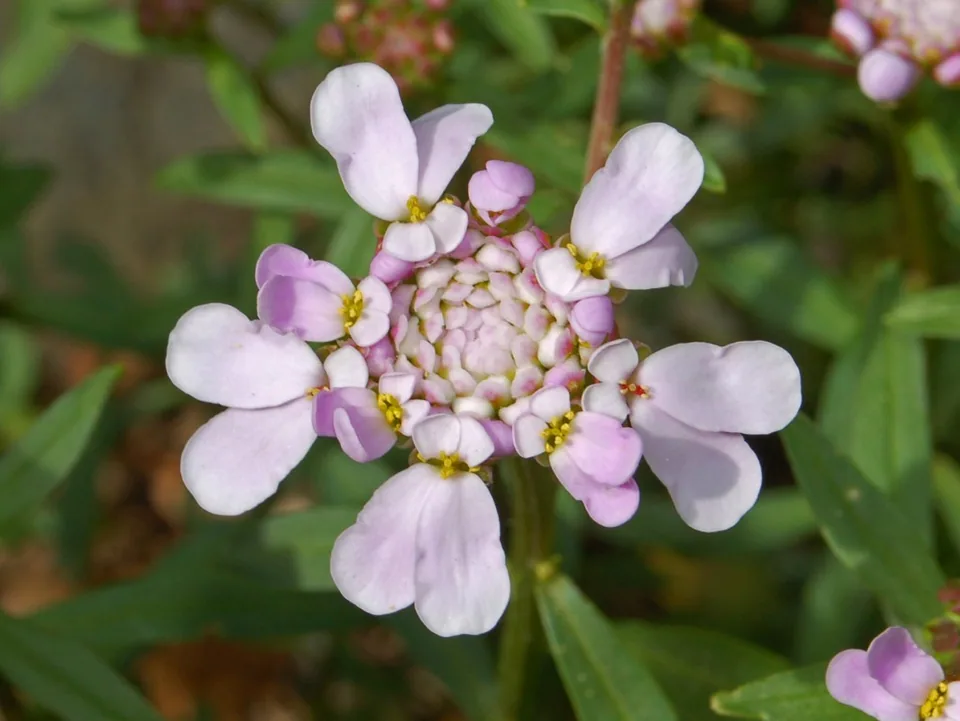


How to Grow and Care for Annual Candytuft
Iberis umbellata
Written by Emilio Marruso · last checked
At a glance
Globe candytuft is an easy annual that grows from seed in full sun or partial shade. Sow it in spring after the last frost for summer flowers, or in fall for next year. It needs little water, has no significant pest or disease problems, grows happily in containers and even self-seeds, so it often comes back on its own.
- Sun
Full sun to partial shade
What the sources say (2)
Light: Full sun to partial shade
Light: Full sun (6 or more hours of direct sunlight a day) Partial Shade (Direct sunlight only part of the day, 2-6 hours)
— Iberis umbellata (Annual Candytuft, Globe Candytuft) | North Carolina Extension Gardener Plant Toolbox [1] Best flowering is in full sun and do not overwater.
— Iberis umbellata (Annual Candytuft, Globe Candytuft) | North Carolina Extension Gardener Plant Toolbox [1] - Water
Water lightly: do not overwater
What the sources say (1)
Watering: Do not overwater
Best flowering is in full sun and do not overwater.
— Iberis umbellata (Annual Candytuft, Globe Candytuft) | North Carolina Extension Gardener Plant Toolbox [1] - Pests
No significant pest or disease problems
- Size
6 to 12 inches wide
What the sources say (1)
Mature width: 15-30 cm (6-12 in)
Dimensions: Height: 1 ft. 0 in. - 1 ft. 6 in. Width: 0 ft. 6 in. - 1 ft. 0 in.
— Iberis umbellata (Annual Candytuft, Globe Candytuft) | North Carolina Extension Gardener Plant Toolbox [1] - Propagation
Grows from seed; collect the seeds or let it self-seed
What the sources say (3)
Propagation: Seed (self-seeds)
Seeds can be collected or the plant will self-seed.
— Iberis umbellata (Annual Candytuft, Globe Candytuft) | North Carolina Extension Gardener Plant Toolbox [1] Family: Brassicaceae Life Cycle: Annual Recommended Propagation Strategy: Seed
— Iberis umbellata (Annual Candytuft, Globe Candytuft) | North Carolina Extension Gardener Plant Toolbox [1] Saving seeds: Seeds can be collected, or the plant will self-seed.
Seeds can be collected or the plant will self-seed.
— Iberis umbellata (Annual Candytuft, Globe Candytuft) | North Carolina Extension Gardener Plant Toolbox [1] - Sowing
Sow in spring after the last frost for summer flowers, or in fall for next year
What the sources say (1)
Sowing: Spring after the last frost for summer flowering, or fall for next year's crop
Sow seeds in spring after the last frost for summer flowering or in the fall for next year's crop.
— Iberis umbellata (Annual Candytuft, Globe Candytuft) | North Carolina Extension Gardener Plant Toolbox [1] - Containers
Grows in containers too
What the sources say (1)
In containers: Yes
or also works on sunny slopes or as a container plant.
— Iberis umbellata (Annual Candytuft, Globe Candytuft) | North Carolina Extension Gardener Plant Toolbox [1]
Overview
Annual candytuft is an annual of the mustard family native to the Mediterranean region. [1] It requires well-drained soil and flowers best in full sun. [1] It suits cottage, rock, pollinator and drought-tolerant gardens and containers. [1]
This record is incomplete: the sources we read do not cover every field yet.
Not yet covered by our sources: Hardiness, coldest zone, Hardiness, warmest zone, Pruning
Annual Candytuft care
How to water Annual Candytuft
Do not overwater
What the sources say (1)
Best flowering is in full sun and do not overwater.How much light Annual Candytuft needs
Full sun to partial shade
What the sources say (2)
Light:
Full sun (6 or more hours of direct sunlight a day)
Partial Shade (Direct sunlight only part of the day, 2-6 hours)Best flowering is in full sun and do not overwater.How much cold Annual Candytuft can take
Hardiness, coldest zone
Not stated in the sources we read.
Hardiness, warmest zone
Not stated in the sources we read.
Where to grow Annual Candytuft
Yes
What the sources say (1)
or also works on sunny slopes or as a container plant.How to propagate Annual Candytuft
Seed (self-seeds)
What the sources say (2)
Seeds can be collected or the plant will self-seed.Family:
Brassicaceae
Life Cycle:
Annual
Recommended Propagation Strategy:
SeedHow to grow Annual Candytuft
The plant
Life cycle
annual
What the sources say (1)
Candytuft is an annual flowering plant of the mustard family (Brassicaceae) native to the Mediterranean region found mainly along the coasts from Spain to Greece.Family
Brassicaceae
What the sources say (1)
Candytuft is an annual flowering plant of the mustard family (Brassicaceae) native to the Mediterranean region found mainly along the coasts from Spain to Greece.Mature height
Mature width
15-30 cm (6-12 in)
What the sources say (1)
Dimensions: Height: 1 ft. 0 in. - 1 ft. 6 in. Width: 0 ft. 6 in. - 1 ft. 0 in.Harvest and storage
Saving seeds
Seeds can be collected, or the plant will self-seed.
What the sources say (1)
Seeds can be collected or the plant will self-seed.Annual Candytuft pests and problems
Pests and diseases
Symptom: No significant problems are listed.
What to do: None needed.
What the sources say (1)
Insects, Diseases, and Other Plant Problems: No significant problems
— Iberis umbellata (Annual Candytuft, Globe Candytuft) | North Carolina Extension Gardener Plant Toolbox [1]
Remedies
Each remedy shows what official sources say about it; traditional remedies without an official source are marked as such. Harmful ones are listed so you know to avoid them.
Treating the plant
aphids
lacewing and ladybird beetle predators Works
How: naturally occurring predators such as green lacewing larvae, ladybird beetles and parasitic wasps control aphids
There are several naturally occurring predators for aphid control, such as green lacewing larvae, ladybird beetles (adults and larvae), and parasitic wasps.
— hgic.clemson.edu [2] What the evidence says There are several naturally occurring predators for aphid control, such as green lacewing larvae, ladybird beetles (adults and larvae), and parasitic wasps.
— hgic.clemson.edu [2] insecticidal soap spray Works
we are referring to commercially available oils and soaps that are formulated specifically for use as pesticides- not household oils and soaps meant for cooking, cleaning, or other purposes.
— ucanr.edu [4] How: if an insecticide is necessary for control, use a spray of horticultural summer oil or insecticidal soap
If an insecticide is necessary for control, use a spray of horticultural summer oil or insecticidal soap.
— hgic.clemson.edu [2] What the evidence says insecticidal soap is a safe, effective organic insecticide with minimal environmental impact.
— extension.psu.edu [3]
powdery mildew and leaf spots
drip irrigation and plant spacing Works
How: proper spacing to encourage air movement, removal of dead plant material, and drip irrigation instead of sprinkler irrigation
so cultural practices, such as proper spacing to encourage air movement, removal of dead plant material, and utilizing drip irrigation instead of sprinkler irrigation, will reduce the risk for infection.
— hgic.clemson.edu [2] What the evidence says so cultural practices, such as proper spacing to encourage air movement, removal of dead plant material, and utilizing drip irrigation instead of sprinkler irrigation, will reduce the risk for infection.
— hgic.clemson.edu [2]
slugs and snails
handpicking Works
How: remove slugs and snails by handpicking
When found, these pests can be removed by handpicking or by making simple, effective traps.
— hgic.clemson.edu [5] What the evidence says When found, these pests can be removed by handpicking or by making simple, effective traps.
— hgic.clemson.edu [5] stale beer trap Official source, not independently tested
How: trap snails and slugs in shallow pans of stale beer sunken so that the lip of the container is even with the soil surface; replace the beer when it dries up or is diluted
Trap snails and slugs in shallow pans of stale beer sunken so that the lip of the container is even with the soil surface.
— hgic.clemson.edu [5] diatomaceous earth Partly works
How: protect young seedlings by sprinkling diatomaceous earth around the plants
Protect young seedlings by sprinkling diatomaceous earth around the plants.
— hgic.clemson.edu [5] What the evidence says Diatomaceous earth is very sharp and scratches the skin of these soft-bodied critters, resulting in dehydration and death. It must be reapplied after rain or watering.
— hgic.clemson.edu [5]
clubroot
lime to raise soil pH Works
How: raising the soil pH makes it more difficult for the spores to replicate
Raising your soil’s pH is another option as most spores find replication more difficult in more alkaline conditions
— irishexaminer.com [6] What the evidence says Maintain soil pH at 7.0–7.2 where clubroot is a concern. Lime well ahead of planting and incorporate thoroughly.
— ipm.cahnr.uconn.edu [7] soil solarisation Not verified
Traditional remedy, not verified by an official source.
How: tarp the affected area with clear plastic sheets to raise the soil temperature to levels that kill the fungal spores
winter rye green manure Not verified
Traditional remedy, not verified by an official source.
How: grow winter rye, which is not affected by the spores and seems to diminish the viability of clubroot spores over a growing season
Calendar
Sowing
Spring after the last frost for summer flowering, or fall for next year's crop
What the sources say (1)
Sow seeds in spring after the last frost for summer flowering or in the fall for next year's crop.Pruning
Not stated in the sources we read.
Months as given by the sources, which are mostly from the United States (northern hemisphere). In the southern hemisphere they shift by about six months.
Relative to frost
Less precise estimate: there is no weather station within 300 km.
Find frost dates by ZIP code or city
Sow outdoors: around the last frost
Sow seeds in spring after the last frost for summer flowering or in the fall for next year's crop.
— Iberis umbellata (Annual Candytuft, Globe Candytuft) | North Carolina Extension Gardener Plant Toolbox [1]
Count from the average frost dates where you live.
Similar plants
- Candytuft Iberis amara
- Candytuft Iberis sempervirens
- Iberis semperflorens Iberis semperflorens
- American Yellow Rocket Barbarea orthoceras
- Basket-of-Gold Aurinia saxatilis
- Cabbage Brassica oleracea
- Caucasian Rockcress Arabis caucasica
- Cut-leafed Toothwort Cardamine concatenata
Sources
Every value above is quoted from these documents. Links lead to the original publisher.
- Iberis umbellata (Annual Candytuft, Globe Candytuft) | North Carolina Extension Gardener Plant Toolbox · plants.ces.ncsu.edu, consulted
- hgic.clemson.edu · hgic.clemson.edu
- extension.psu.edu · extension.psu.edu
- ucanr.edu · ucanr.edu
- hgic.clemson.edu · hgic.clemson.edu
- irishexaminer.com · irishexaminer.com
- ipm.cahnr.uconn.edu · ipm.cahnr.uconn.edu
Written by Emilio Marruso · last checked