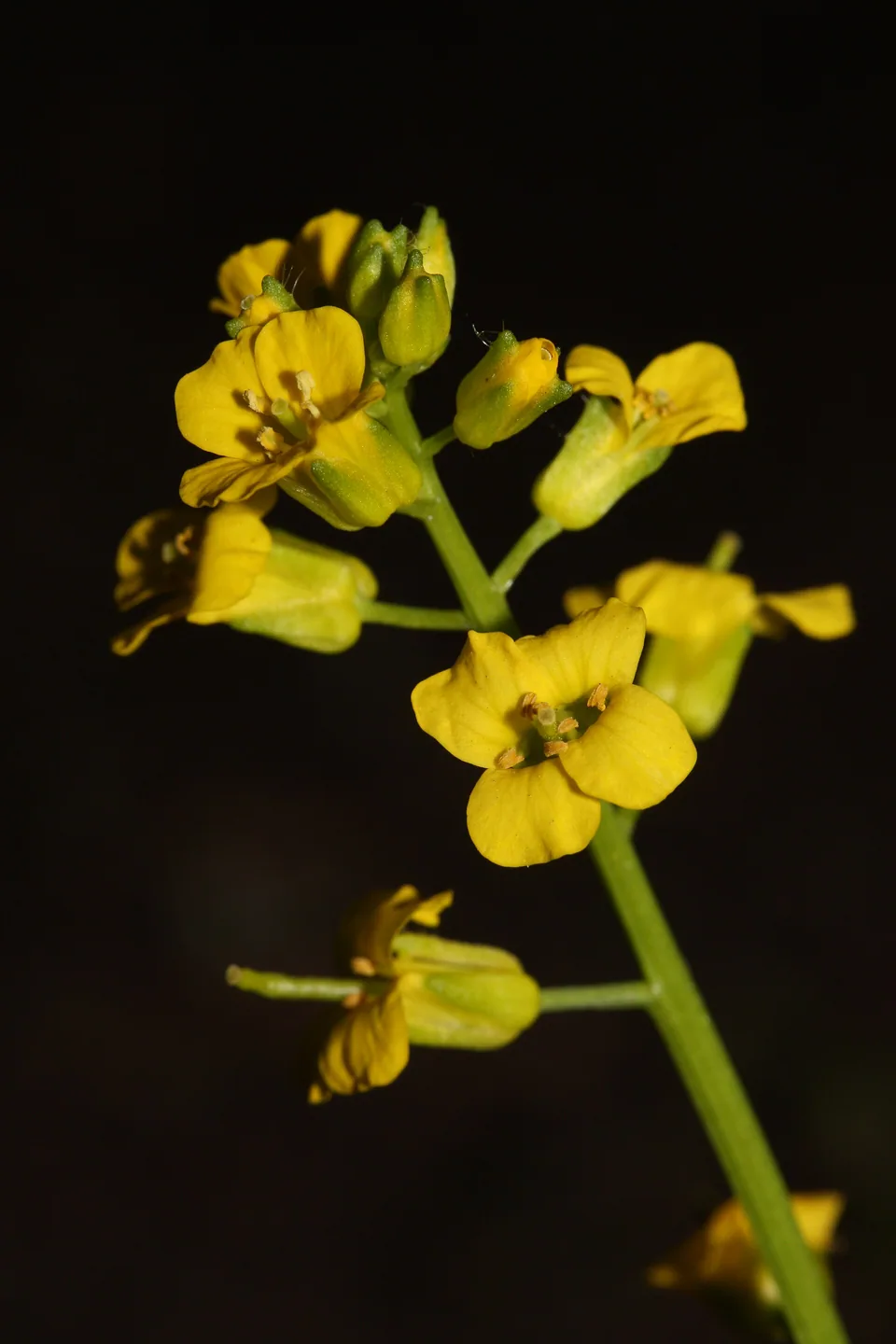


How to Grow and Care for American Yellow Rocket
Barbarea orthoceras
Written by Emilio Marruso · last checked
Toxic to: Horses, People · Why
At a glance
This biennial grows in full sun or partial shade and does best where the soil stays moist. Its leaves are the prize: eat them raw or cooked, in moderation, and enjoy their hot, cress-like flavor. It reaches 1 to 3 feet tall and 1 foot wide, and you can grow it from seed.
- Sun
Full sun to partial shade
What the sources say (1)
Light: Full sun to partial shade
Light: Full sun (6 or more hours of direct sunlight a day) Partial Shade (Direct sunlight only part of the day, 2-6 hours)
— Barbarea orthoceras (American Rocket, American Wintercress, American Yellow Rocket, Erectpod Wintercress, Wintercress, Winter Cress) | North Carolina Extension Gardener Plant Toolbox [1] - Water
Grows best when the soil stays moist
What the sources say (1)
Watering: Grows best in moist conditions
American Yellow Rocket grows best in moist conditions with sun or light shade in slightly acidic, well-drained soil.
— Barbarea orthoceras (American Rocket, American Wintercress, American Yellow Rocket, Erectpod Wintercress, Wintercress, Winter Cress) | North Carolina Extension Gardener Plant Toolbox [1] - Cold
Survives winters down to −40 °F (−40 °C)
Very hardy · USDA 3a · RHS H7 · Z3
What the sources say (2)
Hardiness, coldest zone: 3a [winter low −40 to −37.2 °C (−40 to −35 °F)]
USDA Plant Hardiness Zone: 3a, 3b, 4a, 4b, 5a, 5b, 6a, 6b, 7a, 7b
— Barbarea orthoceras (American Rocket, American Wintercress, American Yellow Rocket, Erectpod Wintercress, Wintercress, Winter Cress) | North Carolina Extension Gardener Plant Toolbox [1] Hardiness, warmest zone: 7b [winter low −15 to −12.2 °C (5 to 10 °F)]
USDA Plant Hardiness Zone: 3a, 3b, 4a, 4b, 5a, 5b, 6a, 6b, 7a, 7b
— Barbarea orthoceras (American Rocket, American Wintercress, American Yellow Rocket, Erectpod Wintercress, Wintercress, Winter Cress) | North Carolina Extension Gardener Plant Toolbox [1] - Harvest
Eat the leaves raw or cooked, in moderation; they taste hot, like cress
- Size
1 to 3 ft tall and 1 ft wide
What the sources say (2)
Mature height: 30.48-91.44 cm (1-3 ft)
It will grow 1-3 feet tall and 1 foot wide. Propagation is by seeds.
— Barbarea orthoceras (American Rocket, American Wintercress, American Yellow Rocket, Erectpod Wintercress, Wintercress, Winter Cress) | North Carolina Extension Gardener Plant Toolbox [1] Mature width: 30.48 cm (1 ft)
It will grow 1-3 feet tall and 1 foot wide. Propagation is by seeds.
— Barbarea orthoceras (American Rocket, American Wintercress, American Yellow Rocket, Erectpod Wintercress, Wintercress, Winter Cress) | North Carolina Extension Gardener Plant Toolbox [1] - Propagation
Grow new plants from seed
What the sources say (1)
Propagation: Seed
It will grow 1-3 feet tall and 1 foot wide. Propagation is by seeds.
— Barbarea orthoceras (American Rocket, American Wintercress, American Yellow Rocket, Erectpod Wintercress, Wintercress, Winter Cress) | North Carolina Extension Gardener Plant Toolbox [1] - Safety
Eat the leaves only in moderation: they may affect the kidneys; harmful to horses
Overview
American yellow rocket is a biennial or short-lived perennial herb of the mustard family, native to western North America. [1] It grows best in moist conditions with sun or light shade and will not do well in the southeast. [1] The leaves can be eaten in moderation, and the plant is listed as a problem for horses. [1]
This record is incomplete: the sources we read do not cover every field yet.
Not yet covered by our sources: Pruning
American Yellow Rocket care
How to water American Yellow Rocket
Grows best in moist conditions
What the sources say (1)
American Yellow Rocket grows best in moist conditions with sun or light shade in slightly acidic, well-drained soil.How much light American Yellow Rocket needs
Full sun to partial shade
What the sources say (1)
Light:
Full sun (6 or more hours of direct sunlight a day)
Partial Shade (Direct sunlight only part of the day, 2-6 hours)How much cold American Yellow Rocket can take
Hardiness, coldest zone
3a [winter low −40 to −37.2 °C (−40 to −35 °F)]
What the sources say (1)
USDA Plant Hardiness Zone:
3a, 3b, 4a, 4b, 5a, 5b, 6a, 6b, 7a, 7bHardiness, warmest zone
7b [winter low −15 to −12.2 °C (5 to 10 °F)]
What the sources say (1)
USDA Plant Hardiness Zone:
3a, 3b, 4a, 4b, 5a, 5b, 6a, 6b, 7a, 7bHow to propagate American Yellow Rocket
Seed
What the sources say (1)
It will grow 1-3 feet tall and 1 foot wide. Propagation is by seeds.How to grow American Yellow Rocket
The plant
Life cycle
biennial, short-lived perennial
What the sources say (1)
American Yellow Rocket is a biennial or short-lived perennial flowering herb in the mustard family (Brassicaceae) native to western North AmericaFamily
Brassicaceae
What the sources say (1)
American Yellow Rocket is a biennial or short-lived perennial flowering herb in the mustard family (Brassicaceae) native to western North AmericaMature height
30.48-91.44 cm (1-3 ft)
What the sources say (1)
It will grow 1-3 feet tall and 1 foot wide. Propagation is by seeds.Mature width
30.48 cm (1 ft)
What the sources say (1)
It will grow 1-3 feet tall and 1 foot wide. Propagation is by seeds.Remedies
Each remedy shows what official sources say about it; traditional remedies without an official source are marked as such. Harmful ones are listed so you know to avoid them.
First aid
First aid: not a substitute for a doctor
plant swallowed
remove remaining pieces and wash out mouth Official source, not independently tested
Call the Poisons Information Centre on 13 11 26 for further information.
— poisonsinfo.nsw.gov.au [4] How: If the plant was swallowed, remove remaining pieces and wash out the mouth.
If the plant was swallowed, remove remaining pieces and wash out child's mouth.
— poisonsinfo.nsw.gov.au [4]
Getting rid of it
unwanted wintercress
removing plants by hand or mowing Not verified
Traditional remedy, not verified by an official source.
How: Remove the plants by hand or mow them early, before the flowers produce seeds.
Is American Yellow Rocket toxic to pets?
Reported by the source, quoted verbatim. This is not medical or veterinary advice: if a person or an animal may have eaten this plant, contact a poison control centre or a veterinarian.
Animals
#problem for horses #biennial #herbaceous perennial #edible leaves
[1]The source flags the risk for this animal but does not explain why.
People
Calendar
Pruning
Not stated in the sources we read.
Months as given by the sources, which are mostly from the United States (northern hemisphere). In the southern hemisphere they shift by about six months.
Edibility
Reported by the source, quoted verbatim. Do not eat a plant on the basis of this page alone: identification mistakes can be dangerous.
Indicative values
Values from a secondary source, not checked word for word like the rest of this page. Use them as a starting point.
- Hours of sun
- 8-10 hoursIndicative value, adapt it to your climate · Secondary source
- Drought tolerant
- yesIndicative value, adapt it to your climate · Secondary source
- Soil pH
- 6-7.5Indicative value, adapt it to your climate · Secondary source
- Growth rate
- LowIndicative value, adapt it to your climate · Secondary source
- Pruning
- May, June, July, MayIndicative value, adapt it to your climate · Secondary source
Similar plants
- Early yellowrocket Barbarea verna
- Yellow Rocket Barbarea vulgaris
- Annual Candytuft Iberis umbellata
- Basket-of-Gold Aurinia saxatilis
- Black Mustard Brassica nigra
- Broadleaved pepperweed Lepidium latifolium
- Brown Mustard Brassica juncea
- Cabbage Brassica oleracea
Sources
Every value above is quoted from these documents. Links lead to the original publisher.
- Barbarea orthoceras (American Rocket, American Wintercress, American Yellow Rocket, Erectpod Wintercress, Wintercress, Winter Cress) | North Carolina Extension Gardener Plant Toolbox · plants.ces.ncsu.edu, consulted
- American Rocket - Barbarea orthoceras | North Carolina Extension Gardener Plant Toolbox · plants.ces.ncsu.edu, consulted
- American Yellow Rocket - Barbarea orthoceras | North Carolina Extension Gardener Plant Toolbox · plants.ces.ncsu.edu, consulted
- poisonsinfo.nsw.gov.au · poisonsinfo.nsw.gov.au
Written by Emilio Marruso · last checked