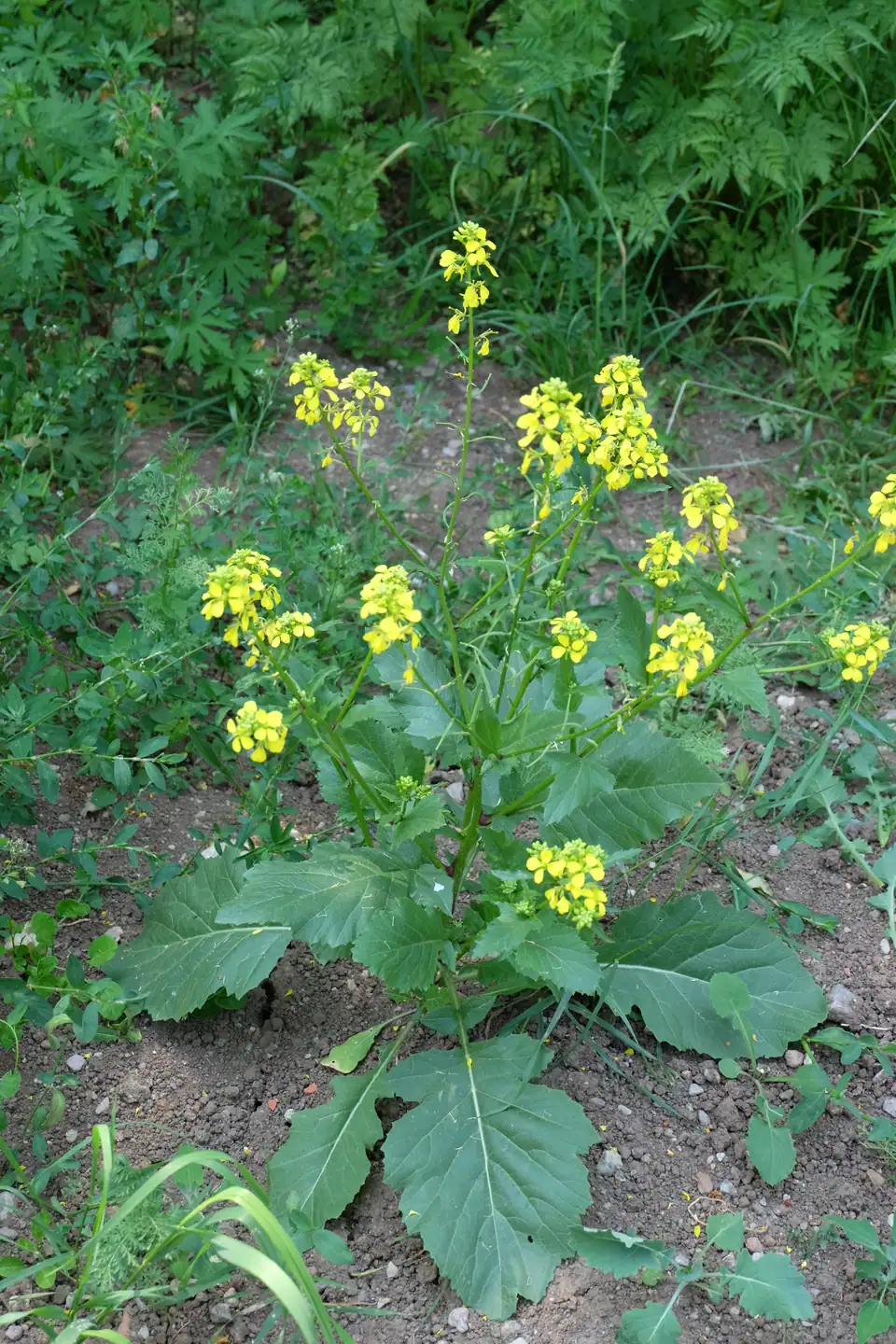


How to Grow and Care for Black Mustard
Brassica nigra
Written by Emilio Marruso · last checked
Toxic to: Horses, People · Why
At a glance
Black mustard is a plant you can enjoy in many ways: its leaves, stems, flowers and seeds all have a pungent, spicy flavor. Toss the leaves raw into salads, cook the stems like broccoli, or grind the seeds into hot mustard. Plant it in fall when the weather cools, in sun or partial shade, and it even grows in containers.
- Sun
Full sun, partial shade or dappled sunlight
What the sources say (1)
Light: Full sun, partial shade or dappled sunlight
Light: Dappled Sunlight (Shade through upper canopy all day) Full sun (6 or more hours of direct sunlight a day) Partial Shade (Direct sunlight only part of the day, 2-6 hours)
— Brassica nigra (Black Mustard, Brown Mustard, Mostaza, Red Mustard, True Mustard) | North Carolina Extension Gardener Plant Toolbox [1] - Water
Keep the soil moist
What the sources say (1)
Watering notes: Does best in moist, amended, well-drained soil
They do best planted in the fall when the weather cools in moist amended well-drained soil.
— Brassica nigra (Black Mustard, Brown Mustard, Mostaza, Red Mustard, True Mustard) | North Carolina Extension Gardener Plant Toolbox [1] - Soil
Rich, improved soil that drains well
What the sources say (1)
Watering notes: Does best in moist, amended, well-drained soil
They do best planted in the fall when the weather cools in moist amended well-drained soil.
— Brassica nigra (Black Mustard, Brown Mustard, Mostaza, Red Mustard, True Mustard) | North Carolina Extension Gardener Plant Toolbox [1] - Planting
Plant in fall when the weather cools; it does not like hot weather
What the sources say (1)
Planting: Fall, when the weather cools
They do best planted in the fall when the weather cools in moist amended well-drained soil.
— Brassica nigra (Black Mustard, Brown Mustard, Mostaza, Red Mustard, True Mustard) | North Carolina Extension Gardener Plant Toolbox [1] - Harvest
Eat the leaves raw or cooked, the stems like broccoli; grind the seeds for hot mustard
- Watch out
Spreads like a weed and can be invasive in some regions; it can hold back nearby plants
- Size
2–4 ft tall and 1–2 ft wide
What the sources say (2)
Mature height: 61-122 cm (2-4 ft)
This plant will grow 2-4 feet tall and 1-2 feet wide and prefers a Mediterranean-type climate.
— Brassica nigra (Black Mustard, Brown Mustard, Mostaza, Red Mustard, True Mustard) | North Carolina Extension Gardener Plant Toolbox [1] Mature width: 30-61 cm (1-2 ft)
This plant will grow 2-4 feet tall and 1-2 feet wide and prefers a Mediterranean-type climate.
— Brassica nigra (Black Mustard, Brown Mustard, Mostaza, Red Mustard, True Mustard) | North Carolina Extension Gardener Plant Toolbox [1] - Propagation
Grows from seed
What the sources say (1)
Propagation: Seed
Life Cycle: Annual Recommended Propagation Strategy: Seed Country Or Region Of Origin: Europe, China, Africa
— Brassica nigra (Black Mustard, Brown Mustard, Mostaza, Red Mustard, True Mustard) | North Carolina Extension Gardener Plant Toolbox [1] - Containers
Grows in containers too
What the sources say (1)
In containers: Yes
Grow in the edible garden or in a container.
— Brassica nigra (Black Mustard, Brown Mustard, Mostaza, Red Mustard, True Mustard) | North Carolina Extension Gardener Plant Toolbox [1] - Safety
Can irritate the skin of some people; a problem for children and horses
Overview
Black mustard is a winter annual in the Brassicaceae native to Europe, Africa and Asia. [1] It does best planted in the fall in moist, amended, well-drained soil and does not do well in hot weather. [1] Its leaves, seeds, flowers and stems are edible, and it may cause contact dermatitis. [1]
This record is incomplete: the sources we read do not cover every field yet.
Not yet covered by our sources: Watering, Harvest, Spacing
Black Mustard care
How to water Black Mustard
Watering
Not stated in the sources we read.
Watering notes
Does best in moist, amended, well-drained soil
What the sources say (1)
They do best planted in the fall when the weather cools in moist amended well-drained soil.How much light Black Mustard needs
Full sun, partial shade or dappled sunlight
What the sources say (1)
Light:
Dappled Sunlight (Shade through upper canopy all day)
Full sun (6 or more hours of direct sunlight a day)
Partial Shade (Direct sunlight only part of the day, 2-6 hours)Where to grow Black Mustard
In containers
Yes
What the sources say (1)
Grow in the edible garden or in a container.Spacing
Not stated in the sources we read.
How to propagate Black Mustard
Seed
What the sources say (1)
Life Cycle:
Annual
Recommended Propagation Strategy:
Seed
Country Or Region Of Origin:
Europe, China, AfricaHow to grow Black Mustard
The plant
Life cycle
annual
What the sources say (1)
Black Mustard is a winter annual in the Mustard family (Brassicaceae) native to Europe, Africa and Asia.Family
Brassicaceae
What the sources say (1)
Black Mustard is a winter annual in the Mustard family (Brassicaceae) native to Europe, Africa and Asia.Mature height
61-122 cm (2-4 ft)
What the sources say (1)
This plant will grow 2-4 feet tall and 1-2 feet wide and prefers a Mediterranean-type climate.Mature width
30-61 cm (1-2 ft)
What the sources say (1)
This plant will grow 2-4 feet tall and 1-2 feet wide and prefers a Mediterranean-type climate.Black Mustard pests and problems
Weediness
Symptom: Invasive in the Pacific western states and in MI; listed as weedy and allelopathic
What the sources say (2)
It was introduced to the Pacific western states and has since become invasive there and in MI.
— Brassica nigra (Black Mustard, Brown Mustard, Mostaza, Red Mustard, True Mustard) | North Carolina Extension Gardener Plant Toolbox [1] Problems: Allelopathic Contact Dermatitis Problem for Children Problem for Horses Weedy
— Brassica nigra (Black Mustard, Brown Mustard, Mostaza, Red Mustard, True Mustard) | North Carolina Extension Gardener Plant Toolbox [1] Heat
Symptom: Does not do well in hot weather
What to do: Plant in the fall when the weather cools
What the sources say (1)
It will not do well in hot weather.
— Brassica nigra (Black Mustard, Brown Mustard, Mostaza, Red Mustard, True Mustard) | North Carolina Extension Gardener Plant Toolbox [1]
Remedies
Each remedy shows what official sources say about it; traditional remedies without an official source are marked as such. Harmful ones are listed so you know to avoid them.
First aid
First aid: not a substitute for a doctor
contact dermatitis
rinsing the skin with warm water and emollient Official source, not independently tested
See a GP if you have persistent, recurrent or severe symptoms of contact dermatitis.
— nhs.uk [4] How: If you come into contact with an allergen or irritant, rinse the affected skin with warm water and an emollient as soon as possible.
if you come into contact with an allergen or irritant, rinse the affected skin with warm water and an emollient as soon as possible
— nhs.uk [4]
Treating the plant
flea beetles
floating row covers Partly works
How: Cover newly seeded areas or young transplants with floating row covers and secure the edges with soil or heavy objects.
Cover newly seeded areas or young transplants with floating row covers to prevent attacks. Be sure to secure the edges with soil or heavy objects to prevent flea beetles from getting inside.
— gardening.usask.ca [5] What the evidence says Floating row covers or other screening can be used to exclude the beetles during seedling establishment of high-value crops.
— pnwhandbooks.org [6] trap crops Not proven
How: Sow early trap crops of mustard or arugula two weeks earlier, at least 3 m from the main crop; destroy trap plants and beetles after infestation.
Sow early trap crops of mustard or arugula two weeks earlier than the direct seeded plants emerge or transplants are planted. Place trap crops at least 3 m away from your main crop.
— gardening.usask.ca [5] What the evidence says "Trap crops" such as radish or daikon may help lure flea beetles away from the main crop. This has not been tested in the Pacific Northwest.
— pnwhandbooks.org [6] vacuuming beetles Partly works
How: Put 1 cm of water in the canister of a wet/dry shopvac and vacuum the insects with a soft brush attachment.
A vacuum is an effective way to reduce the number of insects on unprotected plants. If you have a wet/dry shopvac, place 1 cm of water in the canister
— gardening.usask.ca [5] What the evidence says Flea beetles can be vacuumed off foliage, but this must be repeated frequently. Reinvasion of plants can be rapid.
— pnwhandbooks.org [6]
aphids
firm water spray Not verified
Traditional remedy, not verified by an official source.
How: Wash aphids off with a firm spray of water.
harlequin bugs
handpicking into soapy water Not verified
Traditional remedy, not verified by an official source.
How: Handpick the bugs and drop them in soapy water.
Getting rid of it
black mustard
shallow tillage of seedlings Not verified
Traditional remedy, not verified by an official source.
Shallow tillage is preferred over deep tillage because deep tillage can bury weed seeds to depths where they can remain dormant for many years.
— wiki.bugwood.org [7] How: Till while the plants are at the seedling stage and before they set seed; shallow tillage is preferred over deep tillage.
removing stands and planting natives Not verified
Traditional remedy, not verified by an official source.
How: Systematically remove the black mustard stands and quickly plant natives in their place.
Is Black Mustard toxic to pets?
Reported by the source, quoted verbatim. This is not medical or veterinary advice: if a person or an animal may have eaten this plant, contact a poison control centre or a veterinarian.
Animals
Problems: Allelopathic Contact Dermatitis Problem for Children Problem for Horses Weedy
[1]The source flags the risk for this animal but does not explain why.
People
Seed pods follow that split and contain black and dark brown seeds. It may cause contact dermatitis for some.
[1]
Calendar
Planting
Fall, when the weather cools
What the sources say (1)
They do best planted in the fall when the weather cools in moist amended well-drained soil.Harvest
Not stated in the sources we read.
Months as given by the sources, which are mostly from the United States (northern hemisphere). In the southern hemisphere they shift by about six months.
Edibility
Reported by the source, quoted verbatim. Do not eat a plant on the basis of this page alone: identification mistakes can be dangerous.
Indicative values
Values from a secondary source, not checked word for word like the rest of this page. Use them as a starting point.
- Watering
- FrequentIndicative value, adapt it to your climate · Secondary source
- Soil pH
- 6-7.5Indicative value, adapt it to your climate · Secondary source
- Care level
- MediumIndicative value, adapt it to your climate · Secondary source
- Growth rate
- HighIndicative value, adapt it to your climate · Secondary source
- Pruning
- April, July, MayIndicative value, adapt it to your climate · Secondary source
Similar plants
- Brown Mustard Brassica juncea
- Cabbage Brassica oleracea
- Rape Brassica napus
- Field mustard Brassica rapa
- Mediterranean cabbage Brassica fruticulosa
- American Yellow Rocket Barbarea orthoceras
- Broadleaved pepperweed Lepidium latifolium
- Crested wartycabbage Bunias erucago
Sources
Every value above is quoted from these documents. Links lead to the original publisher.
- Brassica nigra (Black Mustard, Brown Mustard, Mostaza, Red Mustard, True Mustard) | North Carolina Extension Gardener Plant Toolbox · plants.ces.ncsu.edu, consulted
- Black Mustard - Brassica nigra | North Carolina Extension Gardener Plant Toolbox · plants.ces.ncsu.edu, consulted
- True Mustard - Brassica nigra | North Carolina Extension Gardener Plant Toolbox · plants.ces.ncsu.edu, consulted
- nhs.uk · nhs.uk
- gardening.usask.ca · gardening.usask.ca
- pnwhandbooks.org · pnwhandbooks.org
- wiki.bugwood.org · wiki.bugwood.org
Written by Emilio Marruso · last checked