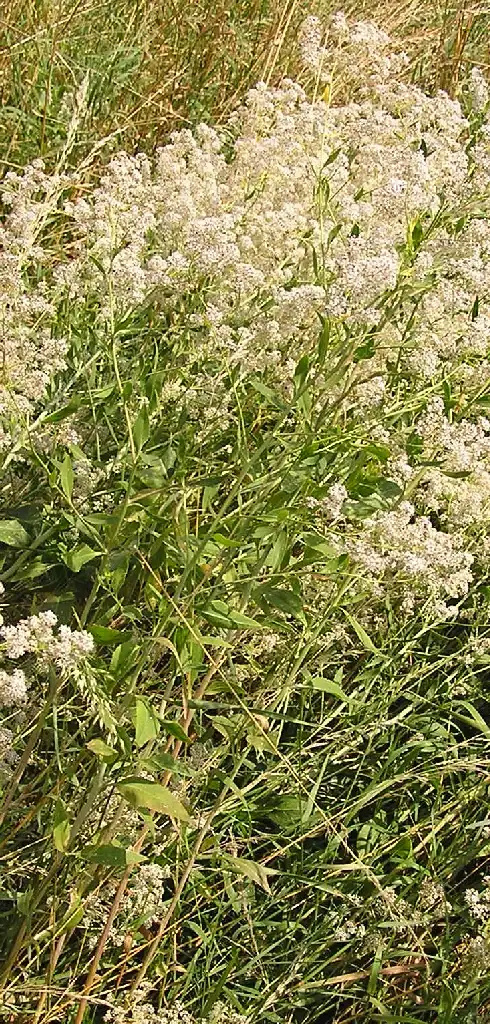
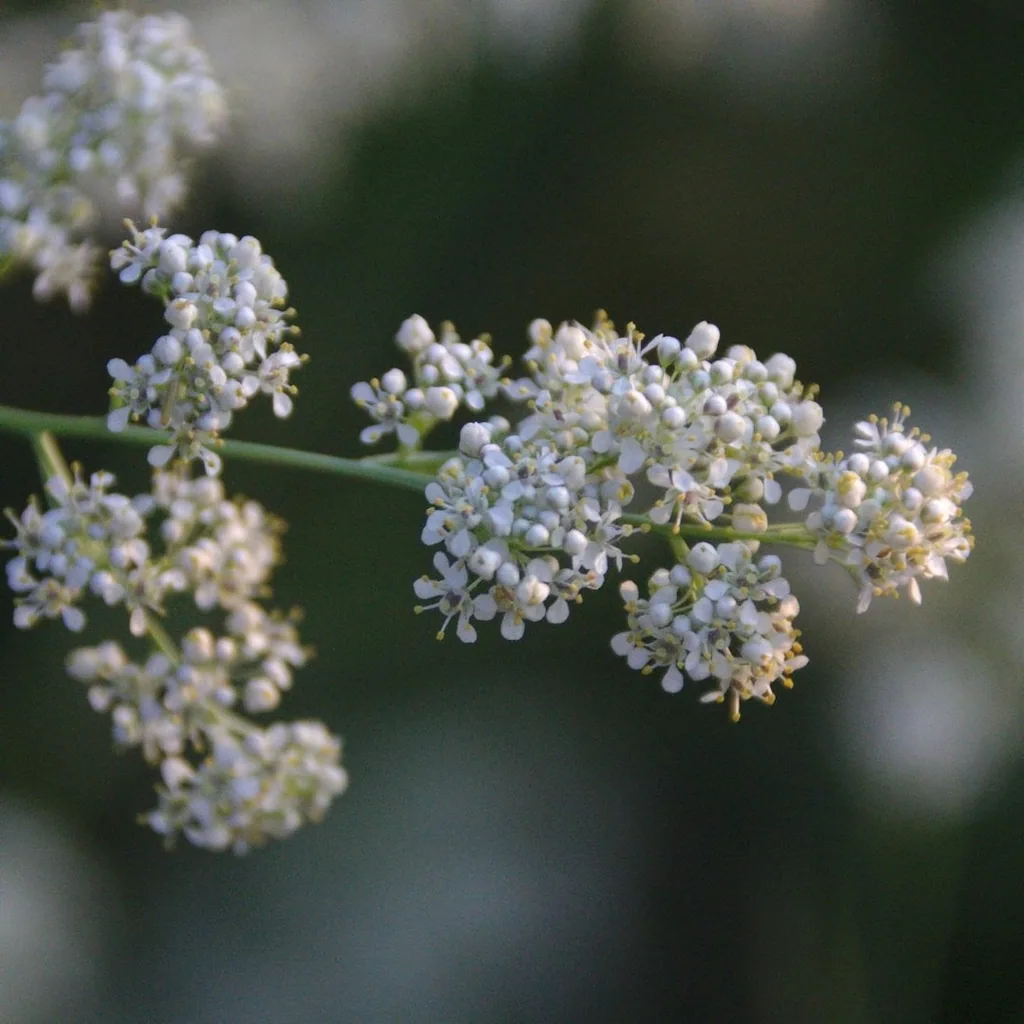

How to Grow and Care for Broadleaved pepperweed
Lepidium latifolium
Written by Emilio Marruso · last checked
At a glance
This perennial brings a very hot, cress-like flavor to your kitchen: young leaves spice up salads in late winter, and the grated root makes a sauce you can use like horseradish. It likes full sun to light shade and moderate watering, and it even tolerates salty soil. Just give it room, because its roots creep far and sprout new shoots.
- Sun
Full sun to light shade
What the sources say (2)
- Water
Moderate watering; it does not like drought but tolerates salty soil
What the sources say (2)
Watering: Moderate
Light full sun Shade tolerance light shade Water moderate Hardiness Zone 6+
— Dittander (Lepidium latifolium) — Practical Plants [2] Watering notes: Drought intolerant; salinity tolerant
Tolerates Nutritionally Poor Soil No Drought intolerant Salinity tolerant
— Dittander (Lepidium latifolium) — Practical Plants [2] - Cold
Survives winters down to −10 °F (−23.3 °C)
Very hardy · USDA 6 · RHS H7 · Z6
What the sources say (1)
Hardiness, coldest zone: 6 [winter low −23.3 to −17.8 °C (−10 to 0 °F)]
Light full sun Shade tolerance light shade Water moderate Hardiness Zone 6+
— Dittander (Lepidium latifolium) — Practical Plants [2] - Planting
Plant in spring
What the sources say (2)
Planting: Spring
Seed - sow spring in a cold frame. When they are large enough to handle, prick the seedlings out into individual pots and plant them out in the spring.
— Dittander (Lepidium latifolium) — Practical Plants [2] Division in spring. Plant them out direct into their permanent positions. Division is very simple and succeeds at almost any time of the year[K].
— Dittander (Lepidium latifolium) — Practical Plants [2] - Harvest
Pick young leaves in late winter for salads; grate the root for a horseradish-like sauce
What the sources say (2)
Harvest: Young leaves in late winter, very early in the year
It produces new growth early in the year and so can be a useful salad ingredient in late winter[K].
— Dittander (Lepidium latifolium) — Practical Plants [2] though they have always seemed to be too strong for us to want to try this[K]. The leaves are available very early in the year[K].
— Dittander (Lepidium latifolium) — Practical Plants [2] - Watch out
Roots creep up to 10 ft sideways, and root pieces sprout new plants
What the sources say (4)
Root system: Extensive, energy-storing root system of long, minimally branched roots enlarged at the soil surface into a semi-woody crown; creeping roots spread laterally up to 3.05 m [10 ft] and root segments produce buds that form new shoots
Established perennial pepperweed plants develop an extensive root system capable of storing large amounts of energy.
— Perennial Pepperweed / Home and Landscape / UC Statewide IPM Program (UC IPM) [3] Roots are long, minimally branched, and enlarged at the soil surface forming a semi-woody crown.
— Perennial Pepperweed / Home and Landscape / UC Statewide IPM Program (UC IPM) [3] It is important to extend the plastic tarp at least 10 feet on all sides of the infested area as creeping roots can spread laterally up to 10 feet.
— Perennial Pepperweed / Home and Landscape / UC Statewide IPM Program (UC IPM) [3] Root segments also produce random buds capable of generating new shoots .
— Perennial Pepperweed / Home and Landscape / UC Statewide IPM Program (UC IPM) [3] - Propagation
Grow new plants from seed, by dividing clumps or from root pieces
What the sources say (2)
Propagation: Seed; division; root fragments
Division in spring. Plant them out direct into their permanent positions. Division is very simple and succeeds at almost any time of the year[K].
— Dittander (Lepidium latifolium) — Practical Plants [2] It reproduces both by seed and vegetatively from its roots and small root fragments.
— Lepidium latifolium Profile – California Invasive Plant Council [4] - Sowing
Sow in spring in a cold frame
What the sources say (1)
Sowing: Spring, in a cold frame
Seed - sow spring in a cold frame. When they are large enough to handle, prick the seedlings out into individual pots and plant them out in the spring.
— Dittander (Lepidium latifolium) — Practical Plants [2]
Overview
Perennial pepperweed is a perennial herb of the mustard family native to Eurasia that is a listed noxious weed in California and other western US states. [4] It reproduces by seed and from its roots and small root fragments, forming dense colonies that exclude native species. [4] Its young leaves have a hot cress-like flavour and have been eaten raw or cooked, and the grated root has been used as a horseradish substitute. [2]
This record is incomplete: the sources we read do not cover every field yet.
Not yet covered by our sources: Hardiness, warmest zone
Broadleaved pepperweed care
How to water Broadleaved pepperweed
Watering
Moderate
What the sources say (1)
Light
full sun
Shade tolerance
light shade
Water
moderate
Hardiness
Zone 6+Watering notes
Drought intolerant; salinity tolerant
What the sources say (1)
Tolerates Nutritionally Poor Soil
No
Drought
intolerant
Salinity
tolerantHow much light Broadleaved pepperweed needs
Full sun to light shade
How much cold Broadleaved pepperweed can take
Hardiness, coldest zone
6 [winter low −23.3 to −17.8 °C (−10 to 0 °F)]
What the sources say (1)
Light
full sun
Shade tolerance
light shade
Water
moderate
Hardiness
Zone 6+Hardiness, warmest zone
Not stated in the sources we read.
How to propagate Broadleaved pepperweed
Seed; division; root fragments
What the sources say (2)
Division in spring. Plant them out direct into their permanent positions. Division is very simple and succeeds at almost any time of the year[K].It reproduces both by seed and vegetatively from its roots and small root fragments.How to grow Broadleaved pepperweed
The plant
Life cycle
perennial
What the sources say (1)
Perennial pepperweed is a long-lived herbaceous perennial that thrives in seasonally wet areas or areas with a high water table.Family
Brassicaceae
What the sources say (1)
Perennial pepperweed is a member of the mustard family, Brassicaceae.Roots
Root system
Extensive, energy-storing root system of long, minimally branched roots enlarged at the soil surface into a semi-woody crown; creeping roots spread laterally up to 3.05 m [10 ft] and root segments produce buds that form new shoots
What the sources say (4)
Established perennial pepperweed plants develop an extensive root system capable of storing large amounts of energy.Roots are long, minimally branched, and enlarged at the soil surface forming a semi-woody crown.It is important to extend the plastic tarp at least 10 feet on all sides of the infested area as creeping roots can spread laterally up to 10 feet.Root segments also produce random buds capable of generating new shoots .Remedies
Each remedy shows what official sources say about it; traditional remedies without an official source are marked as such. Harmful ones are listed so you know to avoid them.
Getting rid of it
invasive spread
hand pulling with as much root as possible Partly works
New and very small patches can be hand-pulled but this species has a huge root system that is difficult to remove once established. Plants can grow back from root fragments.
— kingcounty.gov [5] Removal is not recommended; may spread by breaking off root fragments
— jeffco.us [6] How: Pull scattered plants in landscaped areas immediately, removing as much of the root as possible.
Pulling plants (try and remove as much of the root as possible) is an effective way of controlling a few scattered plants growing within landscaped areas.
— Perennial Pepperweed / Home and Landscape / UC Statewide IPM Program (UC IPM) [3] What the evidence says Seedlings are easily controlled by hand pulling or tillage, but these techniques do not control established plants because shoots quickly resprout from the vast root reserves.
— Perennial Pepperweed / Home and Landscape / UC Statewide IPM Program (UC IPM) [3] repeated deep digging Not verified
Traditional remedy, not verified by an official source.
New plants readily sprout from root fragments, so hand-pulled or dug areas must be monitored frequently and new growth pulled or dug as soon as it appears.
— carsonnow.org [7] How: Where the infestation is small, dig deeply and repeatedly for two or three years; works best in moist loose soils.
tarping with thick black plastic Partly works
It is important to extend the plastic tarp at least 10 feet on all sides of the infested area as creeping roots can spread laterally up to 10 feet.
— Perennial Pepperweed / Home and Landscape / UC Statewide IPM Program (UC IPM) [3] How: Secure thick black plastic over the infested area for two growing seasons, extending it at least 10 feet beyond the patch; mowing and tilling first improves control.
The best control with tarping was obtained using thick, black plastic secured over the infested area for two growing seasons.
— Perennial Pepperweed / Home and Landscape / UC Statewide IPM Program (UC IPM) [3] What the evidence says Perennial pepperweed is less affected by tarping and solarization than annual species due to its large perennial root structure.
— Perennial Pepperweed / Home and Landscape / UC Statewide IPM Program (UC IPM) [3] tent solarization of pulled plants Official source, not independently tested
How: After hand pulling, solarize the pulled plants under a plastic tent to kill seeds and roots when they cannot be disposed of.
Tent solarization can be used to kill seeds and roots after hand pulling if disposal of pulled plants is not possible.
— Perennial Pepperweed / Home and Landscape / UC Statewide IPM Program (UC IPM) [3] mowing alone Not proven
Mowing also stimulates perennial pepperweed plants to resprout and produce new growth.
— Perennial Pepperweed / Home and Landscape / UC Statewide IPM Program (UC IPM) [3] How: Mowing only removes the plants temporarily; mow first and treat the regrowth.
Mowing or cutting alone is not effective. Plants will only be gone temporarily and may come back even worse.
— kingcounty.gov [5] What the evidence says Mowing and burning are not effective in reducing perennial pepperweed stands, but they are helpful in removing accumulated thatch.
— Perennial Pepperweed / Home and Landscape / UC Statewide IPM Program (UC IPM) [3] landscape fabric or mulch and dense planting Official source, not independently tested
How: Once the plant stops resprouting, lay landscape fabric or mulch and set closely spaced herbaceous plants; hand pull any resprouts.
Once perennial pepperweed ceases to resprout, apply landscape fabric or mulch and transplant closely spaced herbaceous plants to prevent invasion.
— Perennial Pepperweed / Home and Landscape / UC Statewide IPM Program (UC IPM) [3] disposal of flowering plants in the garbage Official source, not independently tested
Plants may re-root in an at-home compost if it doesn’t get hot enough to completely compost the tough roots and stems.
— kingcounty.gov [5] How: Put flowering or seeding plants in the garbage; non-flowering parts go to municipal compost or yard waste, not a home compost heap.
If the plant is flowering or in seed, dispose of all plant parts in the garbage. If the plant is seeding, be very careful not to spread seeds.
— kingcounty.gov [5]
Calendar
Sowing
Spring, in a cold frame
What the sources say (1)
Seed - sow spring in a cold frame. When they are large enough to handle, prick the seedlings out into individual pots and plant them out in the spring.Planting
Spring
What the sources say (2)
Seed - sow spring in a cold frame. When they are large enough to handle, prick the seedlings out into individual pots and plant them out in the spring.Division in spring. Plant them out direct into their permanent positions. Division is very simple and succeeds at almost any time of the year[K].Harvest
Young leaves in late winter, very early in the year
What the sources say (2)
It produces new growth early in the year and so can be a useful salad ingredient in late winter[K].though they have always seemed to be too strong for us to want to try this[K]. The leaves are available very early in the year[K].Months as given by the sources, which are mostly from the United States (northern hemisphere). In the southern hemisphere they shift by about six months.
Edibility
Reported by the source, quoted verbatim. Do not eat a plant on the basis of this page alone: identification mistakes can be dangerous.
Young leaves - raw or cooked [5] [8] [9] . A very hot cress-like flavour[K]. The leaves are nice when used in small quantities as a flavouring in salads[K].
[2]Root - it can be grated and made into a sauce which is used as a horseradish substitute [5] [7] [4] . It has a pungently hot flavour.
[2]It has a pungently hot flavour. Seed - used as a condiment [3] [4] .
[2]
Similar plants
- Gardencress pepperweed Lepidium sativum
- American Yellow Rocket Barbarea orthoceras
- Black Mustard Brassica nigra
- Brown Mustard Brassica juncea
- Cabbage Brassica oleracea
- Crested wartycabbage Bunias erucago
- Cultivated radish Raphanus sativus
- Dame's Rocket Hesperis matronalis
Sources
Every value above is quoted from these documents. Links lead to the original publisher.
-  · renzweedscience.cals.wisc.edu, consulted
- Dittander (Lepidium latifolium) — Practical Plants · practicalplants.org, consulted
- Perennial Pepperweed / Home and Landscape / UC Statewide IPM Program (UC IPM) · ipm.ucanr.edu, consulted
- Lepidium latifolium Profile – California Invasive Plant Council · cal-ipc.org, consulted
- kingcounty.gov · kingcounty.gov
- jeffco.us · jeffco.us
- carsonnow.org · carsonnow.org
Written by Emilio Marruso · last checked