

How to Grow and Care for Prairie Blazing Star
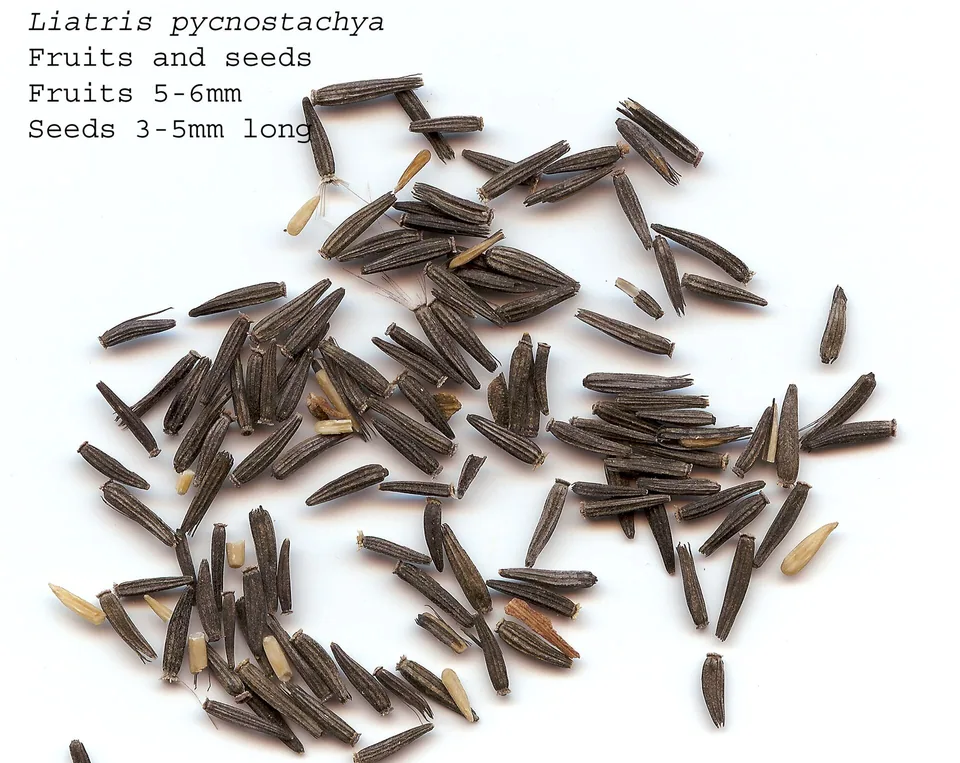
Liatris pycnostachya
Written by Emilio Marruso · last checked
At a glance
Prairie blazing star is a sturdy perennial from the daisy family that loves full sun and sends up tall flower spikes, usually 2–4 ft and up to 5 ft. Feed it lightly before new growth starts in spring, since soil that is too rich makes the spikes flop. Give it soil that never stays wet in winter, and it will come back year after year.
- Sun
Full sun
What the sources say (2)
Light: Full sun
Light: Full sun (6 or more hours of direct sunlight a day)
— Liatris pycnostachya (Cattail Blazing Star, Prairie Blazing Star) | North Carolina Extension Gardener Plant Toolbox [1] Soil Conditions Moist, Well-Drained Exposure/Light Requirements Full Sun
— Prairie Blazing Star (Liatris pycnostachya)-Hort Answers - University of Illinois Extension [2] - Water
Keep the soil from staying wet in winter: it can't stand it
What the sources say (1)
Watering notes: Does not tolerate wet winter soils
It may also be found in damp prairies and tolerates poor soils, drought and heat conditions. It does not tolerate wet winter soils.
— Liatris pycnostachya (Cattail Blazing Star, Prairie Blazing Star) | North Carolina Extension Gardener Plant Toolbox [1] - Cold
Survives winters down to −40 °F (−40 °C)
Very hardy · USDA 3a · RHS H7 · Z3
What the sources say (2)
Hardiness, coldest zone: 3a [winter low −40 to −37.2 °C (−40 to −35 °F)]
USDA Plant Hardiness Zone: 3a, 3b, 4a, 4b, 5a, 5b, 6a, 6b, 7a, 7b, 8a, 8b, 9a, 9b
— Liatris pycnostachya (Cattail Blazing Star, Prairie Blazing Star) | North Carolina Extension Gardener Plant Toolbox [1] Hardiness, warmest zone: 9b [winter low −3.9 to −1.1 °C (25 to 30 °F)]
USDA Plant Hardiness Zone: 3a, 3b, 4a, 4b, 5a, 5b, 6a, 6b, 7a, 7b, 8a, 8b, 9a, 9b
— Liatris pycnostachya (Cattail Blazing Star, Prairie Blazing Star) | North Carolina Extension Gardener Plant Toolbox [1] - Feeding
Feed before new growth starts in spring; too much fertilizer makes the flower spikes flop
What the sources say (4)
When: Before new growth begins in spring
Fertilize before new growth begins in the spring using a commercial fertilizer that you can purchase at a local garden center.
— Fact sheet: Liatris - UF/IFAS Extension Nassau County [5] Plants will rot if the soil is too moist. Fertilize before new growth begins in spring.
— Liatris – Wisconsin Horticulture [4] Avoid: Overfertilizing: in some varieties grown in overly fertile soils the flower spikes flop over
DO NOT overfertilize (check the label of the fertilizer that you select to determine an appropriate amount); in some varieties, flower spikes will flop over if plants are grown in overly fertile soils.
— Fact sheet: Liatris - UF/IFAS Extension Nassau County [5] Signs of excess: Flower spikes flop over
DO NOT overfertilize (check the label of the fertilizer that you select to determine an appropriate amount); in some varieties, flower spikes will flop over if plants are grown in overly fertile soils.
— Fact sheet: Liatris - UF/IFAS Extension Nassau County [5] - Size
Usually 2–4 ft tall, up to 5 ft
What the sources say (1)
Mature height: usually 61-122 (2-4 ft [0.6–1.2 m]); maximum 152 (5 ft [1.5 m])
Prairie blazing star is an herbaceous perennial in the Asteraceae (daisy) family. Often grown as an ornamental, prairie blazing star reaches a maximum height of 5 feet but usually 2-4 feet.
— Liatris pycnostachya (Cattail Blazing Star, Prairie Blazing Star) | North Carolina Extension Gardener Plant Toolbox [1]
Overview
Prairie blazing star is an herbaceous perennial in the daisy family that usually reaches 2-4 feet [0.6–1.2 m]. [1] It grows in full sun in average well-drained moist to occasionally dry soil and does not tolerate wet winter soils. [1] The flowers attract hummingbirds and butterflies and birds eat the seeds. [1]
This record is incomplete: the sources we read do not cover every field yet.
Not yet covered by our sources: Watering, Pruning, Propagation
Prairie Blazing Star care
Measurements in square brackets are our conversion into the other unit system; the quoted text is unchanged.
How to water Prairie Blazing Star
Watering
Not stated in the sources we read.
Watering notes
Does not tolerate wet winter soils
What the sources say (1)
It may also be found in damp prairies and tolerates poor soils, drought and heat conditions. It does not tolerate wet winter soils.How much light Prairie Blazing Star needs
Full sun
What the sources say (2)
Light:
Full sun (6 or more hours of direct sunlight a day)Soil Conditions
Moist, Well-Drained
Exposure/Light Requirements
Full SunHow much cold Prairie Blazing Star can take
Hardiness, coldest zone
3a [winter low −40 to −37.2 °C (−40 to −35 °F)]
What the sources say (1)
USDA Plant Hardiness Zone:
3a, 3b, 4a, 4b, 5a, 5b, 6a, 6b, 7a, 7b, 8a, 8b, 9a, 9bHardiness, warmest zone
9b [winter low −3.9 to −1.1 °C (25 to 30 °F)]
What the sources say (1)
USDA Plant Hardiness Zone:
3a, 3b, 4a, 4b, 5a, 5b, 6a, 6b, 7a, 7b, 8a, 8b, 9a, 9bHow to propagate Prairie Blazing Star
Not stated in the sources we read.
How to grow Prairie Blazing Star
The plant
Life cycle
perennial
What the sources say (1)
Prairie blazing star is an herbaceous perennial in the Asteraceae (daisy) family. Often grown as an ornamental, prairie blazing star reaches a maximum height of 5 feet but usually 2-4 feet.Family
Asteraceae
What the sources say (1)
Prairie blazing star is an herbaceous perennial in the Asteraceae (daisy) family. Often grown as an ornamental, prairie blazing star reaches a maximum height of 5 feet but usually 2-4 feet.Mature height
usually 61-122 (2-4 ft [0.6–1.2 m]); maximum 152 (5 ft [1.5 m])
What the sources say (1)
Prairie blazing star is an herbaceous perennial in the Asteraceae (daisy) family. Often grown as an ornamental, prairie blazing star reaches a maximum height of 5 feet but usually 2-4 feet.Fertilizing
When
Before new growth begins in spring
What the sources say (2)
Fertilize before new growth begins in the spring using a commercial fertilizer that you can purchase at a local garden center.Plants will rot if the soil is too moist. Fertilize before new growth begins in spring.Avoid
Overfertilizing: in some varieties grown in overly fertile soils the flower spikes flop over
What the sources say (1)
DO NOT overfertilize (check the label of the fertilizer that you select to determine an appropriate amount); in some varieties, flower spikes will flop over if plants are grown in overly fertile soils.Signs of excess
Flower spikes flop over
What the sources say (1)
DO NOT overfertilize (check the label of the fertilizer that you select to determine an appropriate amount); in some varieties, flower spikes will flop over if plants are grown in overly fertile soils.Remedies
Each remedy shows what official sources say about it; traditional remedies without an official source are marked as such. Harmful ones are listed so you know to avoid them.
Treating the plant
powdery mildew
baking soda and horticultural oil spray Works
Also consider pretesting any product that you decide to use on a small number of leaves or plants before treating a larger area to make sure there are no toxic effects, particularly when treating during warmer weather.
— hort.extension.wisc.edu [6] How: Baking soda (1½ tablespoons) and a light weight (paraffin-based) horticultural oil (3 tablespoons) in water (1 gallon), every seven to 14 days.
A combination of baking soda (1½ tablespoons) and a light weight (i.e., paraffin-based) horticultural oil (3 tablespoons) in water (1 gallon) has also been shown to be effective.
— hort.extension.wisc.edu [6] What the evidence says A combination of baking soda (1½ tablespoons) and a light weight (i.e., paraffin-based) horticultural oil (3 tablespoons) in water (1 gallon) has also been shown to be effective.
— hort.extension.wisc.edu [6] spacing plants further apart Works
How: Space plants further apart to increase air flow and do not over-water.
Reduce the humidity around your plants by spacing them further apart to increase air flow. Be sure not to over-water as this can lead to higher air humidity as well.
— hort.extension.wisc.edu [6] What the evidence says Reduce the humidity around your plants by spacing them further apart to increase air flow. Be sure not to over-water as this can lead to higher air humidity as well.
— hort.extension.wisc.edu [6]
stem rot
removing infected parts and replacing topsoil Official source, not independently tested
How: Remove and destroy all infected plant parts and remove the topsoil around the plant; new soil may replace sclerotia-filled soil.
Control may include removing and destroying all infected plant parts and removal of topsoil around the plant. New soil may replace sclerotia-filled soil.
— portal.ct.gov [7]
verticillium wilt
removing infected plants Official source, not independently tested
How: Remove infected plants with associated roots and soil, and dispose of them without spreading the pathogen.
Wilt control involves removal of infected plants and associated roots and soil.
— portal.ct.gov [7]
Calendar
Pruning
Not stated in the sources we read.
Months as given by the sources, which are mostly from the United States (northern hemisphere). In the southern hemisphere they shift by about six months.
Indicative values
Values from a secondary source, not checked word for word like the rest of this page. Use them as a starting point.
- Hours of sun
- 6-8 hoursIndicative value, adapt it to your climate · Secondary source
- Watering
- MinimumIndicative value, adapt it to your climate · Secondary source
- Drought tolerant
- yesIndicative value, adapt it to your climate · Secondary source
- Soil pH
- 6-7.5Indicative value, adapt it to your climate · Secondary source
- Care level
- MediumIndicative value, adapt it to your climate · Secondary source
- Growth rate
- LowIndicative value, adapt it to your climate · Secondary source
- Pruning
- March, April, May, May, December, January, February, May, AugustIndicative value, adapt it to your climate · Secondary source
- Propagation
- Division, Root Cutting, Seed Propagation, Cormlet Propagation, StolonIndicative value, adapt it to your climate · Secondary source
Similar plants
- Appalachian Blazing Star Liatris squarrulosa
- Blazing Star Liatris scariosa
- Dwarf Blazing Star Liatris microcephala
- Gayfeather Liatris spicata
- Meadow Blazing Star Liatris ligulistylis
- Rough Blazing-star Liatris aspera
- Sandhills Blazing Star Liatris pilosa
- Scaly Blazing Star Liatris squarrosa
Sources
Every value above is quoted from these documents. Links lead to the original publisher.
- Liatris pycnostachya (Cattail Blazing Star, Prairie Blazing Star) | North Carolina Extension Gardener Plant Toolbox · plants.ces.ncsu.edu, consulted
- Prairie Blazing Star (Liatris pycnostachya)-Hort Answers - University of Illinois Extension · web.extension.illinois.edu, consulted
- Prairie Blazing Star - Liatris pycnostachya | North Carolina Extension Gardener Plant Toolbox · plants.ces.ncsu.edu, consulted
- Liatris – Wisconsin Horticulture · hort.extension.wisc.edu, consulted
- Fact sheet: Liatris - UF/IFAS Extension Nassau County · blogs.ifas.ufl.edu, consulted
- hort.extension.wisc.edu · hort.extension.wisc.edu
- portal.ct.gov · portal.ct.gov
Written by Emilio Marruso · last checked