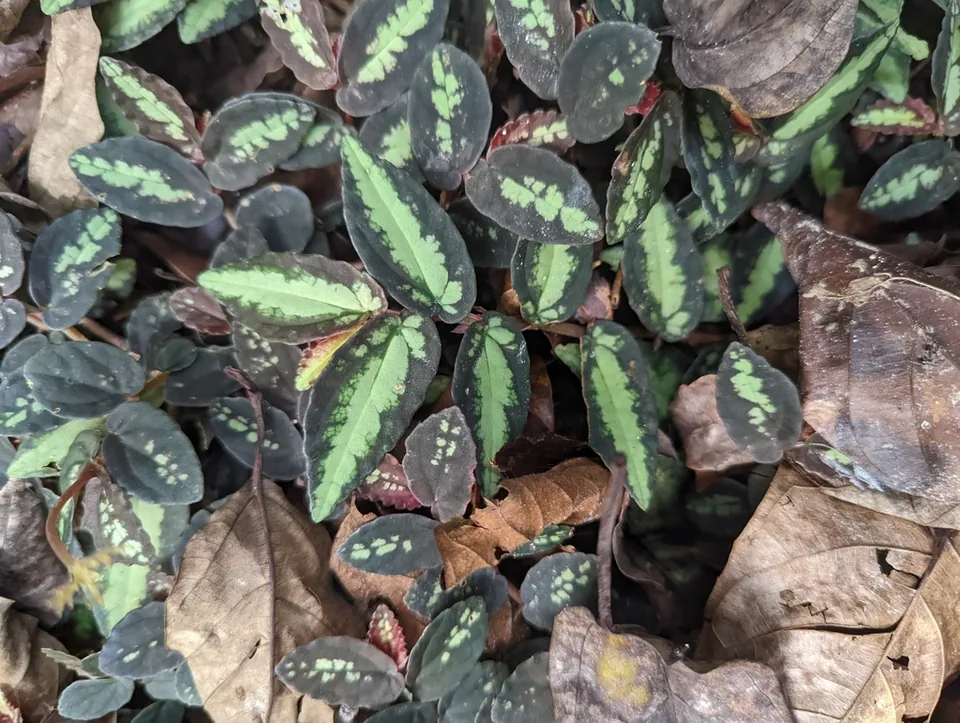
How to Grow and Care for Trailing
Procris repens
Written by Emilio Marruso · last checked
Not toxic to cats and dogs, according to the sources · Sources
At a glance
This tiny perennial stays just 3–6 inches tall and is happy indoors in a pot, in bright indirect light. Keep its soil evenly moist through the growing season, give it very good drainage, and you can make new plants from stem cuttings. Best of all, it is non-toxic for cats, dogs and horses, so it is a worry-free pick for homes with pets.
- Sun
Bright indirect light
What the sources say (1)
Light: Bright indirect light
This is a tropical plant that grows easily in bright indirect light and a humid atmosphere.
— Procris repens (Polynesian Ivy, Rainbow Vine, Satin Creeper, Satin Pellionia, Trailing, Trailing Watermelon Begonia, Wavy Watermelon Begonia) | North Carolina Extension Gardener Plant Toolbox [1] - Water
Keep the soil evenly moist while it grows; water a bit less from fall to late winter
What the sources say (1)
Watering: Keep soil consistently moist during the growing season; reduce watering somewhat from fall to late winter
Keep soil consistently moist during the growing season, but reduce watering somewhat from fall to late winter.
— Procris repens (Polynesian Ivy, Rainbow Vine, Satin Creeper, Satin Pellionia, Trailing, Trailing Watermelon Begonia, Wavy Watermelon Begonia) | North Carolina Extension Gardener Plant Toolbox [1] - Cold
Survives winters down to 30 °F (−1.1 °C)
Half hardy: mild winters or an unheated greenhouse · USDA 10a · RHS H3 · Z10
What the sources say (2)
Hardiness, coldest zone: 10a [winter low −1.1 to 1.7 °C (30 to 35 °F)]
USDA Plant Hardiness Zone: 10a, 10b, 11a, 11b, 12a, 12b
— Procris repens (Polynesian Ivy, Rainbow Vine, Satin Creeper, Satin Pellionia, Trailing, Trailing Watermelon Begonia, Wavy Watermelon Begonia) | North Carolina Extension Gardener Plant Toolbox [1] Hardiness, warmest zone: 12b [winter low 12.8 to 15.6 °C (55 to 60 °F)]
USDA Plant Hardiness Zone: 10a, 10b, 11a, 11b, 12a, 12b
— Procris repens (Polynesian Ivy, Rainbow Vine, Satin Creeper, Satin Pellionia, Trailing, Trailing Watermelon Begonia, Wavy Watermelon Begonia) | North Carolina Extension Gardener Plant Toolbox [1] - Soil
Needs soil that drains very well, or the roots can rot
What the sources say (2)
Watering notes: Needs very good soil drainage; poorly drained soils can result in root rot
This plant needs very good soil drainage. Pinch stems to shape as needed.
— Procris repens (Polynesian Ivy, Rainbow Vine, Satin Creeper, Satin Pellionia, Trailing, Trailing Watermelon Begonia, Wavy Watermelon Begonia) | North Carolina Extension Gardener Plant Toolbox [1] Poorly drained soils can result in roots rot.
— Procris repens (Polynesian Ivy, Rainbow Vine, Satin Creeper, Satin Pellionia, Trailing, Trailing Watermelon Begonia, Wavy Watermelon Begonia) | North Carolina Extension Gardener Plant Toolbox [1] - Pests
Root rot in soggy soil; give it very good drainage
What the sources say (1)
Diseases: root rot
Diseases, Insects, and Other Plant Problems: No serious problems. Leaves drop can occur if houseplants plants are near cold drafts. Poorly drained soils can result in roots rot.
— Procris repens (Polynesian Ivy, Rainbow Vine, Satin Creeper, Satin Pellionia, Trailing, Trailing Watermelon Begonia, Wavy Watermelon Begonia) | North Carolina Extension Gardener Plant Toolbox [1] - Watch out
Keep it away from cold drafts, or it can drop its leaves
- Size
Only 3–6 in tall
What the sources say (1)
Mature height: 7.62-15.24 cm (3-6 in)
Dimensions: Height: 0 ft. 3 in. - 0 ft. 6 in.
— Procris repens (Polynesian Ivy, Rainbow Vine, Satin Creeper, Satin Pellionia, Trailing, Trailing Watermelon Begonia, Wavy Watermelon Begonia) | North Carolina Extension Gardener Plant Toolbox [1] - Propagation
Make new plants from stem cuttings
What the sources say (1)
Propagation: Stem cuttings
Pinch stems to shape as needed. Propagate it easily through stem cuttings.
— Procris repens (Polynesian Ivy, Rainbow Vine, Satin Creeper, Satin Pellionia, Trailing, Trailing Watermelon Begonia, Wavy Watermelon Begonia) | North Carolina Extension Gardener Plant Toolbox [1] - Containers
Grows well in pots and indoors
What the sources say (2)
In containers: Yes
Landscape Location: Container Hanging Baskets Houseplants Naturalized Area Patio
— Procris repens (Polynesian Ivy, Rainbow Vine, Satin Creeper, Satin Pellionia, Trailing, Trailing Watermelon Begonia, Wavy Watermelon Begonia) | North Carolina Extension Gardener Plant Toolbox [1] Indoors: Yes
It is most often used as a houseplant, in terrariums, hanging baskets, or as a ground cover within its growing zones
— Procris repens (Polynesian Ivy, Rainbow Vine, Satin Creeper, Satin Pellionia, Trailing, Trailing Watermelon Begonia, Wavy Watermelon Begonia) | North Carolina Extension Gardener Plant Toolbox [1] - Safety
Non-toxic for cats, dogs and horses
Overview
Procris repens is a small tropical herbaceous perennial grown for its foliage and most often used as a houseplant. [1] It grows in bright indirect light and humid air, with consistently moist soil and very good drainage. [1]
Trailing care
How to water Trailing
Watering
Keep soil consistently moist during the growing season; reduce watering somewhat from fall to late winter
What the sources say (1)
Keep soil consistently moist during the growing season, but reduce watering somewhat from fall to late winter.Watering notes
Needs very good soil drainage; poorly drained soils can result in root rot
What the sources say (2)
This plant needs very good soil drainage. Pinch stems to shape as needed.Poorly drained soils can result in roots rot.How much light Trailing needs
Bright indirect light
What the sources say (1)
This is a tropical plant that grows easily in bright indirect light and a humid atmosphere.How much cold Trailing can take
Hardiness, coldest zone
10a [winter low −1.1 to 1.7 °C (30 to 35 °F)]
What the sources say (1)
USDA Plant Hardiness Zone:
10a, 10b, 11a, 11b, 12a, 12bHardiness, warmest zone
12b [winter low 12.8 to 15.6 °C (55 to 60 °F)]
What the sources say (1)
USDA Plant Hardiness Zone:
10a, 10b, 11a, 11b, 12a, 12bWhere to grow Trailing
Indoors
Yes
What the sources say (1)
It is most often used as a houseplant, in terrariums, hanging baskets, or as a ground cover within its growing zonesIn containers
Yes
What the sources say (1)
Landscape Location:
Container
Hanging Baskets
Houseplants
Naturalized Area
PatioHow to propagate Trailing
Stem cuttings
What the sources say (1)
Pinch stems to shape as needed. Propagate it easily through stem cuttings.How to grow Trailing
The plant
Life cycle
perennial
What the sources say (1)
Trailing watermelon begonia is not a watermelon or a begonia. It is an herbaceous perennial native to Southeast Asia in the Urticaceae family.Family
Urticaceae
What the sources say (1)
Trailing watermelon begonia is not a watermelon or a begonia. It is an herbaceous perennial native to Southeast Asia in the Urticaceae family.Mature height
7.62-15.24 cm (3-6 in)
What the sources say (1)
Dimensions:
Height: 0 ft. 3 in. - 0 ft. 6 in.Pests and diseases
Diseases
root rot
What the sources say (1)
Diseases, Insects, and Other Plant Problems: No serious problems. Leaves drop can occur if houseplants plants are near cold drafts. Poorly drained soils can result in roots rot.Trailing pests and problems
Leaf drop
Symptom: Leaves drop can occur if houseplants plants are near cold drafts.
What to do: Keep away from cold drafts.
What the sources say (1)
Leaves drop can occur if houseplants plants are near cold drafts.
— Procris repens (Polynesian Ivy, Rainbow Vine, Satin Creeper, Satin Pellionia, Trailing, Trailing Watermelon Begonia, Wavy Watermelon Begonia) | North Carolina Extension Gardener Plant Toolbox [1] Root rot
Symptom: Poorly drained soils can result in roots rot.
What to do: Provide very good soil drainage.
What the sources say (2)
This plant needs very good soil drainage. Pinch stems to shape as needed.
— Procris repens (Polynesian Ivy, Rainbow Vine, Satin Creeper, Satin Pellionia, Trailing, Trailing Watermelon Begonia, Wavy Watermelon Begonia) | North Carolina Extension Gardener Plant Toolbox [1] Poorly drained soils can result in roots rot.
— Procris repens (Polynesian Ivy, Rainbow Vine, Satin Creeper, Satin Pellionia, Trailing, Trailing Watermelon Begonia, Wavy Watermelon Begonia) | North Carolina Extension Gardener Plant Toolbox [1]
Remedies
The sources we checked give no remedies for this plant.
Is Trailing poisonous?
Reported by the source, quoted verbatim. This is not medical or veterinary advice: if a person or an animal may have eaten this plant, contact a poison control centre or a veterinarian.
#herbaceous perennial #houseplant #groundcover #hanging baskets #evergreen #non-toxic for cats #non-toxic for horses #non-toxic for dogs
[1]The source flags the risk for this animal but does not explain why.
Indicative values
Values from a secondary source, not checked word for word like the rest of this page. Use them as a starting point.
- Soil pH
- 5.5-6.5Indicative value, adapt it to your climate · Secondary source
- Care level
- MediumIndicative value, adapt it to your climate · Secondary source
- Growth rate
- LowIndicative value, adapt it to your climate · Secondary source
- Pruning
- March, April, June, JulyIndicative value, adapt it to your climate · Secondary source
Similar plants
- Aluminum plant Pilea cadierei
- Artillery Plant Pilea microphylla
- Chinese Money Plant Pilea peperomioides
- Creeping Charlie Pilea nummulariifolia
- Friendship Plant Pilea involucrata
- Mind-Your-Own-Business Soleirolia soleirolii
- Clearweed Pilea pumila
- False Nettle Boehmeria cylindrica
Sources
Every value above is quoted from these documents. Links lead to the original publisher.
- Procris repens (Polynesian Ivy, Rainbow Vine, Satin Creeper, Satin Pellionia, Trailing, Trailing Watermelon Begonia, Wavy Watermelon Begonia) | North Carolina Extension Gardener Plant Toolbox · plants.ces.ncsu.edu, consulted
- Polynesian Ivy - Procris repens | North Carolina Extension Gardener Plant Toolbox · plants.ces.ncsu.edu, consulted
- Wavy Watermelon Begonia - Procris repens | North Carolina Extension Gardener Plant Toolbox · plants.ces.ncsu.edu, consulted
- Satin Creeper - Procris repens | North Carolina Extension Gardener Plant Toolbox · plants.ces.ncsu.edu, consulted
Written by Emilio Marruso · last checked