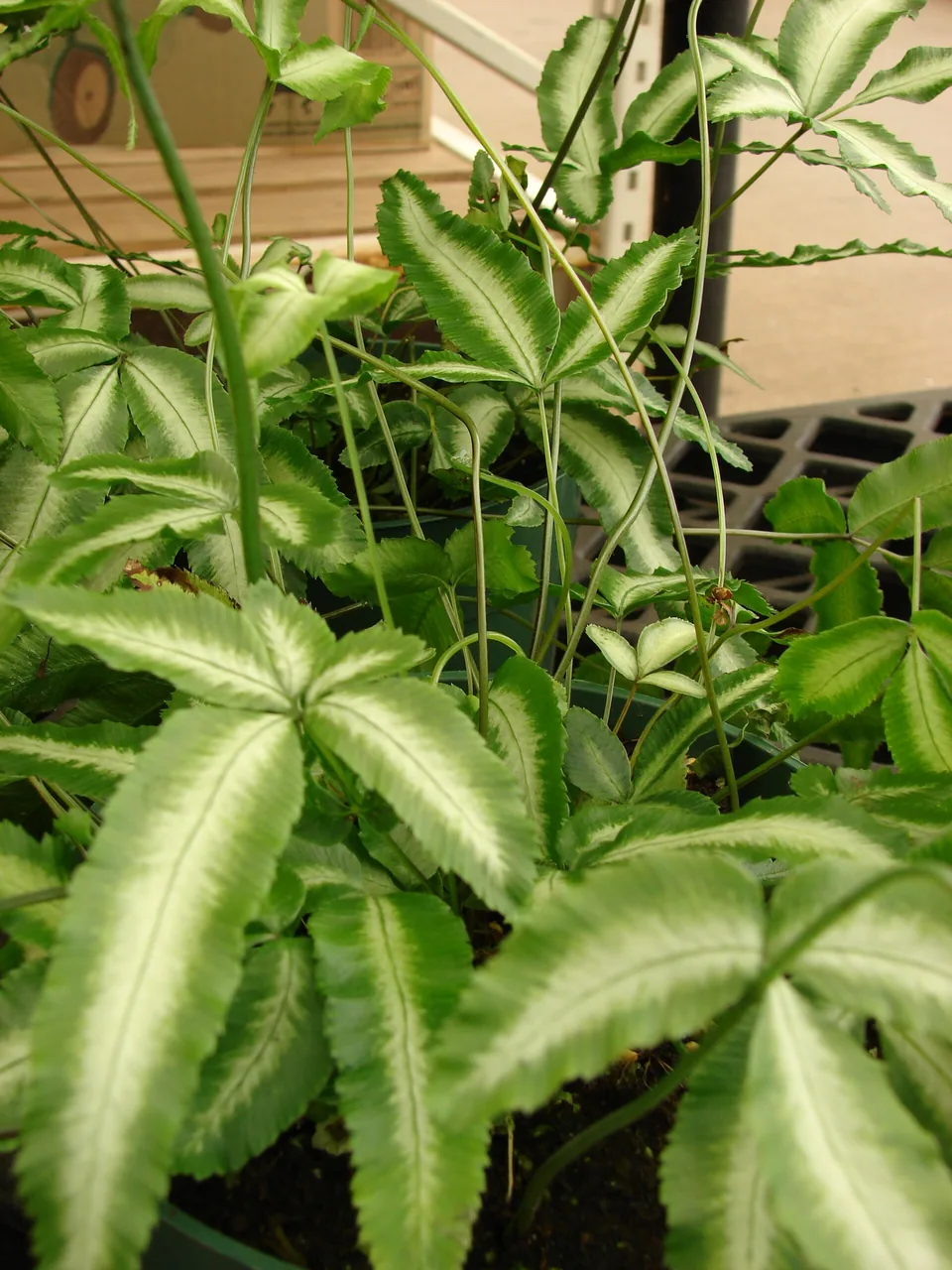

How to Grow and Care for Slender brake
Pteris ensiformis
Written by Emilio Marruso · last checked
At a glance
This fern is happy in bright filtered light and even succeeds in deep shade, so it can brighten the shadiest corners of your home or garden. It grows indoors and in containers, asking only moderate water and acidic soil. As a bonus, its young, uncurling fronds can be steamed and eaten with rice, mixed with other vegetables or added to stews.
- Sun
Semi-shade or bright filtered light; also succeeds in deep shade
What the sources say (3)
Light: Semi-shade to filtered shade; bright filtered light, also succeeds in deep shade
| Light Preference | Semi-Shade | Water Preference | Moderate Water
— NParks | Pteris ensiformis [1] Prefers a position in bright, filtered sunlight, though it also succeeds in quite deep shade
— Pteris ensiformis - Useful Tropical Plants [3] | Exposure: | Part sun/part shade, Filtered shade | Soil or Media: | Humus rich, Well-drained
— Pteris ensiformis - Kwantlen Polytechnic University, School of Horticulture - Plant Database [6] - Water
Moderate water; handles both moist and well-drained soil
What the sources say (2)
Watering: Moderate water
| Water Preference | Moderate Water | Plant Growth Rate | Fast to Moderate
— NParks | Pteris ensiformis [1] Watering notes: Tolerates moist soils and well-drained soils
| Rootzone Tolerance | Moist Soils, Well-Drained Soils | Propagation Method
— NParks | Pteris ensiformis [1] - Cold
Survives winters down to 20 °F (−6.7 °C)
Hardy in average winters · USDA 9 · RHS H4 · Z9
What the sources say (1)
Hardiness, coldest zone: 9 [winter low −6.7 to −1.1 °C (20 to 30 °F)]
| Hardiness Zone: | Zone 9: (-7 to -1 °C) | Plant Type: | Fern, Indoor foliage plant
— Pteris ensiformis - Kwantlen Polytechnic University, School of Horticulture - Plant Database [6] - Soil
Acidic soil, pH 4.5–5.0
- Harvest
Young, uncurling fronds are eaten steamed, with rice, with other vegetables or in stews
- Propagation
By spores or by dividing the plant
What the sources say (3)
Propagation: Spores, division
| Rootzone Tolerance | Moist Soils, Well-Drained Soils | Propagation Method | Spore, Division
— NParks | Pteris ensiformis [1] Spores are a simple method of propagation, with plants reaching maturity within one year
— Pteris ensiformis - Useful Tropical Plants [3] Division. The plants can be slow to settle down afterwards
— Pteris ensiformis - Useful Tropical Plants [3] - Containers
Grows well in pots and indoors
What the sources say (4)
In containers: Yes
Readily cultivated in the ground or a container in a tropical or subtropical garden or fernhouse.
— Pteris ensiformis [2] | Landscape Uses | Indoor Plant, Parks & Gardens, Small Gardens, Container Planting
— NParks | Pteris ensiformis [1] Indoors: Yes
| Landscape Uses | Indoor Plant, Parks & Gardens, Small Gardens, Container Planting
— NParks | Pteris ensiformis [1] | Hardiness Zone: | Zone 9: (-7 to -1 °C) | Plant Type: | Fern, Indoor foliage plant
— Pteris ensiformis - Kwantlen Polytechnic University, School of Horticulture - Plant Database [6]
Overview
Slender brake is an evergreen tropical fern 20-40 cm [8–16 in] tall with dimorphic fronds, the fertile ones taller than the sterile ones. [1] It is grown in tropical or subtropical gardens, in containers and indoors, and needs shelter and warmth. [2][4]
This record is incomplete: the sources we read do not cover every field yet.
Not yet covered by our sources: Hardiness, warmest zone, Pruning
Slender brake care
Measurements in square brackets are our conversion into the other unit system; the quoted text is unchanged.
How to water Slender brake
Watering
Moderate water
What the sources say (1)
| Water Preference
| Moderate Water
| Plant Growth Rate
| Fast to ModerateWatering notes
Tolerates moist soils and well-drained soils
What the sources say (1)
| Rootzone Tolerance
| Moist Soils, Well-Drained Soils
| Propagation MethodHow much light Slender brake needs
Semi-shade to filtered shade; bright filtered light, also succeeds in deep shade
What the sources say (3)
| Light Preference
| Semi-Shade
| Water Preference
| Moderate WaterPrefers a position in bright, filtered sunlight, though it also succeeds in quite deep shade| Exposure:
| Part sun/part shade, Filtered shade
| Soil or Media:
| Humus rich, Well-drainedHow much cold Slender brake can take
Hardiness, coldest zone
9 [winter low −6.7 to −1.1 °C (20 to 30 °F)]
What the sources say (1)
| Hardiness Zone:
| Zone 9: (-7 to -1 °C)
| Plant Type:
| Fern, Indoor foliage plantHardiness, warmest zone
Not stated in the sources we read.
Best soil for Slender brake
Soil pH, minimum
4.5
What the sources say (1)
The plants are indicators of acidic soils, with a pH of 4.5 - 5.0Soil pH, maximum
5.0
What the sources say (1)
The plants are indicators of acidic soils, with a pH of 4.5 - 5.0Where to grow Slender brake
Indoors
Yes
What the sources say (2)
| Landscape Uses
| Indoor Plant, Parks & Gardens, Small Gardens, Container Planting| Hardiness Zone:
| Zone 9: (-7 to -1 °C)
| Plant Type:
| Fern, Indoor foliage plantHow to propagate Slender brake
Spores, division
What the sources say (3)
| Rootzone Tolerance
| Moist Soils, Well-Drained Soils
| Propagation Method
| Spore, DivisionSpores are a simple method of propagation, with plants reaching maturity within one yearDivision. The plants can be slow to settle down afterwardsRemedies
Each remedy shows what official sources say about it; traditional remedies without an official source are marked as such. Harmful ones are listed so you know to avoid them.
Treating the plant
sap-sucking insects
neem oil Not verified
Traditional remedy, not verified by an official source.
How: Treat with neem oil if aphids, mealybugs, scale or whitefly appear.
Calendar
Pruning
Not stated in the sources we read.
Months as given by the sources, which are mostly from the United States (northern hemisphere). In the southern hemisphere they shift by about six months.
Edibility
Reported by the source, quoted verbatim. Do not eat a plant on the basis of this page alone: identification mistakes can be dangerous.
The young, uncurling fronds are steamed and eaten as a side dish with rice, mixed with other vegetables or added to stews
[3]
Indicative values
Values from a secondary source, not checked word for word like the rest of this page. Use them as a starting point.
- Life cycle
- PerennialIndicative value, adapt it to your climate · Secondary source
- Hours of sun
- 4-6 hoursIndicative value, adapt it to your climate · Secondary source
- Drought tolerant
- yesIndicative value, adapt it to your climate · Secondary source
- Care level
- MediumIndicative value, adapt it to your climate · Secondary source
- Growth rate
- ModerateIndicative value, adapt it to your climate · Secondary source
- Pruning
- March, April, May, June, July, MayIndicative value, adapt it to your climate · Secondary source
Similar plants
- Abraham Trachystemon orientalis
- African Marigold Tagetes erecta
- Alabama Croton Croton alabamensis
- Alpine Currant Ribes alpinum
- Alpine violet Viola labradorica
- Alumroot Heuchera americana
- American Arborvitae Thuja occidentalis
- American Cancer-root Conopholis americana
Sources
Every value above is quoted from these documents. Links lead to the original publisher.
- NParks | Pteris ensiformis · nparks.gov.sg, consulted
- Pteris ensiformis · apps.lucidcentral.org, consulted
- Pteris ensiformis - Useful Tropical Plants · tropical.theferns.info, consulted
- HortFlora · hortflora.rbg.vic.gov.au, consulted
- Pteris SilverLace – Port St. Lucie Botanical Gardens · pslbg.org, consulted
- Pteris ensiformis - Kwantlen Polytechnic University, School of Horticulture - Plant Database · plantdatabase.kpu.ca, consulted
Written by Emilio Marruso · last checked