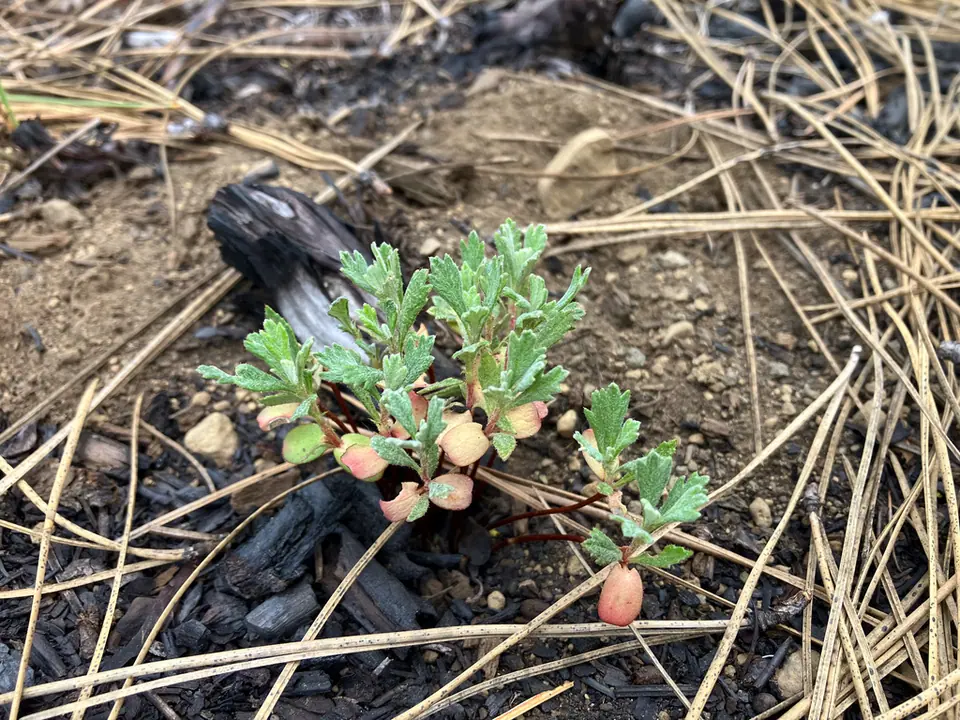
How to Grow and Care for Antelope bitterbrush
Purshia tridentata
Written by Emilio Marruso · last checked
At a glance
Bitterbrush is a tough, easygoing perennial from the rose family that asks for very little. Give it a sunny spot and it shrugs off dry spells thanks to its excellent drought tolerance, so you can spend less time with the hose. Starting it is simple too: sow the seeds in spring or fall and let this plant settle in for years.
- Sun
Loves the sun
What the sources say (1)
Light: Sun
Antelope bitterbrush is shade intolerant.
— Plant Data Sheet [4] - Water
Handles dry spells very well: it needs little watering
What the sources say (1)
Watering: Excellent drought tolerance
It has excellent drought tolerance, is moderately browse tolerant, and is intolerant of shade.
— Bitterbrush | USU [2] - Cold
Survives winters down to −40 °F (−40 °C)
Very hardy · USDA 3 · RHS H7 · Z3
What the sources say (1)
Hardiness, coldest zone: 3 [winter low −40 to −34.4 °C (−40 to −30 °F)]
Hardy to USDA Zone 3
— Purshia tridentata | Landscape Plants | Oregon State University [3] - Propagation
Grow new plants from seed
- Sowing
Sow in spring or fall
What the sources say (1)
Sowing: Spring or fall
Seed should be sown in the spring or fall.
— Plant Data Sheet [4]
Overview
Antelope bitterbrush is a native western North American shrub that is very drought-tolerant. [5] It is a many-branched shrub with a rounded crown, usually 2 to 6 feet [0.6–1.8 m] tall. [2] It is intolerant of shade and does best in well-drained sandy, gravelly or rocky soils. [2][4]
This record is incomplete: the sources we read do not cover every field yet.
Not yet covered by our sources: Hardiness, warmest zone, Pruning
Antelope bitterbrush care
Measurements in square brackets are our conversion into the other unit system; the quoted text is unchanged.
How to water Antelope bitterbrush
Excellent drought tolerance
What the sources say (1)
It has excellent drought tolerance, is moderately browse tolerant, and is intolerant of shade.How much light Antelope bitterbrush needs
Sun
What the sources say (1)
Antelope bitterbrush is shade intolerant.How much cold Antelope bitterbrush can take
Hardiness, coldest zone
3 [winter low −40 to −34.4 °C (−40 to −30 °F)]
What the sources say (1)
Hardy to USDA Zone 3Hardiness, warmest zone
Not stated in the sources we read.
How to propagate Antelope bitterbrush
How to grow Antelope bitterbrush
The plant
Life cycle
perennial
What the sources say (1)
Life Span: Perennial
Origin: Native
Season: Evergreen and deciduousFamily
Rosaceae
What the sources say (1)
Pronunciation:
poor-SHE-ah tri-den-TAH-ta
Family:
Rosaceae
Genus:
Purshia
Type:
Broadleaf
Native to (or naturalized in) Oregon:
YesRemedies
The sources we checked give no remedies for this plant.
Calendar
Sowing
Spring or fall
What the sources say (1)
Seed should be sown in the spring or fall.Pruning
Not stated in the sources we read.
Months as given by the sources, which are mostly from the United States (northern hemisphere). In the southern hemisphere they shift by about six months.
Indicative values
Values from a secondary source, not checked word for word like the rest of this page. Use them as a starting point.
- Hours of sun
- 6-8 hoursIndicative value, adapt it to your climate · Secondary source
- Soil pH
- 6-8Indicative value, adapt it to your climate · Secondary source
- Care level
- MediumIndicative value, adapt it to your climate · Secondary source
- Growth rate
- ModerateIndicative value, adapt it to your climate · Secondary source
- Pruning
- March, April, MayIndicative value, adapt it to your climate · Secondary source
- Pests
- Drought resistantIndicative value, adapt it to your climate · Secondary source
Similar plants
- Afghan Cherry Prunus jacquemontii
- Agrimony Agrimonia eupatoria
- Alabama Snow Wreath Neviusia alabamensis
- Allegheny Serviceberry Amelanchier laevis
- American Ipecac Porteranthus trifoliatus
- American Plum Prunus americana
- Amur chokecherry Prunus maackii
- Apple Rose Rosa villosa
Sources
Every value above is quoted from these documents. Links lead to the original publisher.
- Antelope bitterbrush, Purshia tridentata | OSU Extension Service · extension.oregonstate.edu, consulted
- Bitterbrush | USU · extension.usu.edu, consulted
- Purshia tridentata | Landscape Plants | Oregon State University · landscapeplants.oregonstate.edu, consulted
- Plant Data Sheet · depts.washington.edu, consulted
- Antelope Bitterbrush · csu.org, consulted
- Purshia Tridentata | Utah Valley University · uvu.edu, consulted
- Purshia tridentata - Trees and Shrubs Online · treesandshrubsonline.org, consulted
Written by Emilio Marruso · last checked