

How to Grow and Care for Staghorn Sumac
Rhus typhina
Written by Emilio Marruso · last checked
At a glance
Staghorn sumac is a tough, easygoing shrub or small tree: once it settles in, it shrugs off drought and needs extra water only in severe dry spells. It asks for very little feeding, just soil that drains well. As a bonus, its fruits soaked in water make a tart, lemony drink. Give it room, though, because it spreads by root suckers into colonies.
- Water
1 inch of water a week while it settles in; after that, only in severe drought
What the sources say (5)
Watering: After the establishment period, supplemental irrigation only during periods of severe drought; tolerant of drought
After the establishment period, provide supplemental irrigation during periods of severe drought.
— Bulletin #2579, Native Trees and Shrubs for Maine Landscapes: Staghorn Sumac (Rhus typhina) - Cooperative Extension Publications - University of Maine Cooperative Extension [3] Tolerant of a wide range of soils except for those that are poorly drained. Generally tolerant of urban conditions and drought.
— Rhus typhina (Staghorn Sumac) | North Carolina Extension Gardener Plant Toolbox [1] Watering notes: During establishment (one year after planting for each inch of trunk diameter), water regularly in the growing season, giving the root zone 1 inch [2.5 cm] of water per week; avoid poorly drained soils
Irrigation: During the establishment period, defined as one year after planting for each inch of trunk diameter at planting time, water your trees regularly during the growing season.
— Bulletin #2579, Native Trees and Shrubs for Maine Landscapes: Staghorn Sumac (Rhus typhina) - Cooperative Extension Publications - University of Maine Cooperative Extension [3] Give the root zone of each tree 1 inch of water per week
— Bulletin #2579, Native Trees and Shrubs for Maine Landscapes: Staghorn Sumac (Rhus typhina) - Cooperative Extension Publications - University of Maine Cooperative Extension [3] Tolerant of a wide range of soils except for those that are poorly drained.
— Rhus typhina (Staghorn Sumac) | North Carolina Extension Gardener Plant Toolbox [1] - Cold
Survives winters down to −40 °F (−40 °C)
Very hardy · USDA 3a · RHS H7 · Z3
What the sources say (7)
Hardiness, coldest zone: 3a [winter low −40 to −37.2 °C (−40 to −35 °F)]
According to NC State Extension: USDA Plant Hardiness Zone: 3a, 3b, 4a, 4b, 5a, 5b, 6a, 6b, 7a, 7b, 8a, 8b, 9a, 9b
— Rhus typhina (Staghorn Sumac) | North Carolina Extension Gardener Plant Toolbox [1] According to University of Illinois Extension: Hardiness Zone: | 4 - 8 | Mature
— Staghorn Sumac (Rhus typhina) - Selecting Shrubs for Your Home - University of Illinois Extension [2] Maine: Hardiness: USDA zone 3a Drawing by Margery Read
— Bulletin #2579, Native Trees and Shrubs for Maine Landscapes: Staghorn Sumac (Rhus typhina) - Cooperative Extension Publications - University of Maine Cooperative Extension [3] 3a, 3b, 4a, 4b, 5a, 5b, 6a, 6b, 7a, 7b, 8a, 8b, 9a, 9b
— Rhus typhina (Staghorn Sumac) | North Carolina Extension Gardener Plant Toolbox [1] Hardiness, warmest zone: 9b [winter low −3.9 to −1.1 °C (25 to 30 °F)]
According to NC State Extension: USDA Plant Hardiness Zone: 3a, 3b, 4a, 4b, 5a, 5b, 6a, 6b, 7a, 7b, 8a, 8b, 9a, 9b
— Rhus typhina (Staghorn Sumac) | North Carolina Extension Gardener Plant Toolbox [1] According to University of Illinois Extension: Hardiness Zone: | 4 - 8 | Mature
— Staghorn Sumac (Rhus typhina) - Selecting Shrubs for Your Home - University of Illinois Extension [2] 3a, 3b, 4a, 4b, 5a, 5b, 6a, 6b, 7a, 7b, 8a, 8b, 9a, 9b
— Rhus typhina (Staghorn Sumac) | North Carolina Extension Gardener Plant Toolbox [1] - Soil
Well-drained soil, pH up to 6.0
What the sources say (4)
Soil pH, maximum: 6.0
Soil pH: Acid (<6.0) Soil Drainage: Good Drainage
— Rhus typhina (Staghorn Sumac) | North Carolina Extension Gardener Plant Toolbox [1] Watering notes: During establishment (one year after planting for each inch of trunk diameter), water regularly in the growing season, giving the root zone 1 inch [2.5 cm] of water per week; avoid poorly drained soils
Irrigation: During the establishment period, defined as one year after planting for each inch of trunk diameter at planting time, water your trees regularly during the growing season.
— Bulletin #2579, Native Trees and Shrubs for Maine Landscapes: Staghorn Sumac (Rhus typhina) - Cooperative Extension Publications - University of Maine Cooperative Extension [3] Give the root zone of each tree 1 inch of water per week
— Bulletin #2579, Native Trees and Shrubs for Maine Landscapes: Staghorn Sumac (Rhus typhina) - Cooperative Extension Publications - University of Maine Cooperative Extension [3] Tolerant of a wide range of soils except for those that are poorly drained.
— Rhus typhina (Staghorn Sumac) | North Carolina Extension Gardener Plant Toolbox [1] - Feeding
Feed only if a soil test shows a need; no nitrogen in the first growing season
What the sources say (3)
How often: Only when a soil test indicates a need
Fertilization: Landscape trees and shrubs should not be fertilized unless a soil test indicates a need.
— Bulletin #2579, Native Trees and Shrubs for Maine Landscapes: Staghorn Sumac (Rhus typhina) - Cooperative Extension Publications - University of Maine Cooperative Extension [3] Avoid: Fertilizing without a soil test showing a need; nitrogen fertilizer at planting or during the first growing season
Fertilization: Landscape trees and shrubs should not be fertilized unless a soil test indicates a need.
— Bulletin #2579, Native Trees and Shrubs for Maine Landscapes: Staghorn Sumac (Rhus typhina) - Cooperative Extension Publications - University of Maine Cooperative Extension [3] No nitrogen fertilizer should be added at planting or during the first growing season.
— Bulletin #2579, Native Trees and Shrubs for Maine Landscapes: Staghorn Sumac (Rhus typhina) - Cooperative Extension Publications - University of Maine Cooperative Extension [3] - Harvest
Soak the fruits in water for a tart, lemony drink
- Pests
Can get verticillium wilt and wood rot
What the sources say (1)
Diseases: verticillium wilt, wood rots and decays
Fungal Disease - Verticillium Wilt [Shrubs and Trees] ( Verticillium albo-atrum and V. dahliae ) - Wood Rots and Decays ( Many genus and species involved )
— Staghorn Sumac (Rhus typhina) - Selecting Shrubs for Your Home - University of Illinois Extension [2] - Watch out
Spreads by root suckers into colonies; hard to manage in small gardens
- Propagation
Grow new plants from stem cuttings
What the sources say (1)
Propagation: Stem cutting
Recommended Propagation Strategy: Stem Cutting Country Or Region Of Origin: Eastern North America
— Rhus typhina (Staghorn Sumac) | North Carolina Extension Gardener Plant Toolbox [1] - Safety
Not poisonous to people
Overview
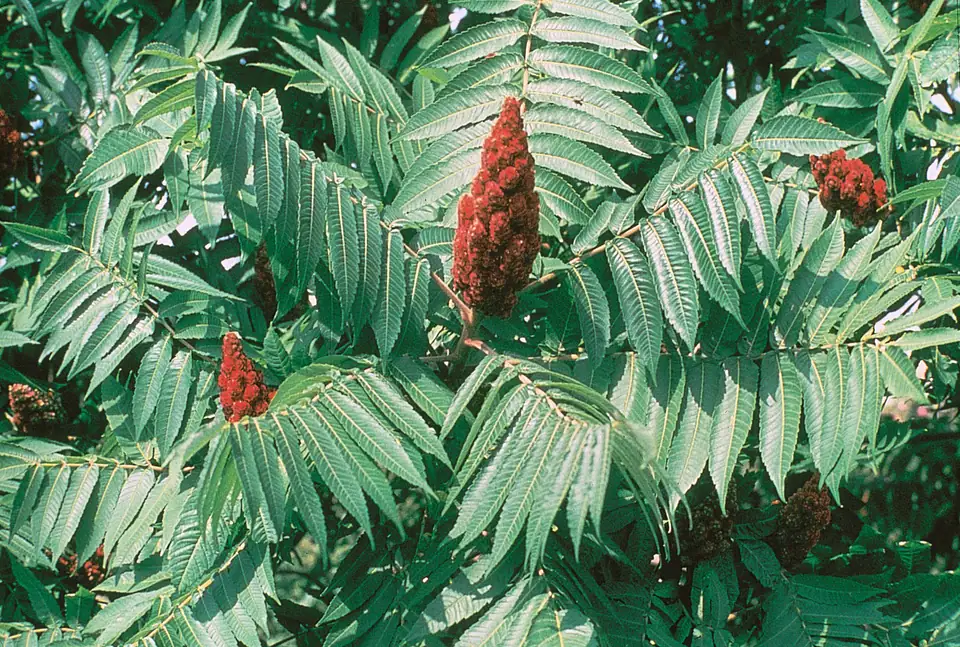
Staghorn sumac is a native deciduous shrub or small tree that forms thickets through self-seeding and root suckering. [1] It has medium green compound leaves that turn scarlet, yellow and orange in fall, and red fruits on female plants. [1][2]
This record is incomplete: the sources we read do not cover every field yet.
Not yet covered by our sources: Pruning
Staghorn Sumac care
Measurements in square brackets are our conversion into the other unit system; the quoted text is unchanged.
How to water Staghorn Sumac
Watering
After the establishment period, supplemental irrigation only during periods of severe drought; tolerant of drought
What the sources say (2)
After the establishment period, provide supplemental irrigation during periods of severe drought.Tolerant of a wide range of soils except for those that are poorly drained. Generally tolerant of urban conditions and drought.Watering notes
During establishment (one year after planting for each inch of trunk diameter), water regularly in the growing season, giving the root zone 1 inch [2.5 cm] of water per week; avoid poorly drained soils
What the sources say (3)
Irrigation: During the establishment period, defined as one year after planting for each inch of trunk diameter at planting time, water your trees regularly during the growing season.Give the root zone of each tree 1 inch of water per weekTolerant of a wide range of soils except for those that are poorly drained.How much light Staghorn Sumac needs
The sources give different values depending on region, zone or growing conditions.
What each source says
According to NC State Extension: Full sun to part shade
According to University of Illinois Extension: Full shade, full sun or partial sun/shade
Maine: Full sun
What the sources say (4)
According to NC State Extension: Easily grown in a wide range of soils as long as they are well-drained, and full sun to part shade.According to University of Illinois Extension: Exposure/ Light Requirements:
Full Shade
Full Sun
Partial Sun/ShadeMaine: Light requirements: full sun
Stress tolerances:
soil compactionEasily grown in a wide range of soils as long as they are well-drained, and full sun to part shade.How much cold Staghorn Sumac can take
Hardiness, coldest zone
3a [winter low −40 to −37.2 °C (−40 to −35 °F)]
What each source says
According to NC State Extension: 3a [winter low −40 to −37.2 °C (−40 to −35 °F)]
According to University of Illinois Extension: 4 [winter low −34.4 to −28.9 °C (−30 to −20 °F)]
Maine: 3a [winter low −40 to −37.2 °C (−40 to −35 °F)]
What the sources say (4)
According to NC State Extension: USDA Plant Hardiness Zone:
3a, 3b, 4a, 4b, 5a, 5b, 6a, 6b, 7a, 7b, 8a, 8b, 9a, 9bAccording to University of Illinois Extension: Hardiness Zone:
|
4 - 8
| MatureMaine: Hardiness: USDA zone 3a
Drawing by Margery Read3a, 3b, 4a, 4b, 5a, 5b, 6a, 6b, 7a, 7b, 8a, 8b, 9a, 9bHardiness, warmest zone
9b [winter low −3.9 to −1.1 °C (25 to 30 °F)]
What each source says
According to NC State Extension: 9b [winter low −3.9 to −1.1 °C (25 to 30 °F)]
According to University of Illinois Extension: 8 [winter low −12.2 to −6.7 °C (10 to 20 °F)]
What the sources say (3)
According to NC State Extension: USDA Plant Hardiness Zone:
3a, 3b, 4a, 4b, 5a, 5b, 6a, 6b, 7a, 7b, 8a, 8b, 9a, 9bAccording to University of Illinois Extension: Hardiness Zone:
|
4 - 8
| Mature3a, 3b, 4a, 4b, 5a, 5b, 6a, 6b, 7a, 7b, 8a, 8b, 9a, 9bBest soil for Staghorn Sumac
6.0
What the sources say (1)
Soil pH:
Acid (<6.0)
Soil Drainage:
Good DrainageHow to propagate Staghorn Sumac
Stem cutting
What the sources say (1)
Recommended Propagation Strategy:
Stem Cutting
Country Or Region Of Origin:
Eastern North AmericaHow to grow Staghorn Sumac
The plant
Life cycle
woody (deciduous shrub or tree)
What the sources say (1)
Life Cycle: Woody Recommended Propagation Strategy: Stem Cutting Country Or Region Of Origin: Eastern North AmericaFamily
Anacardiaceae
What the sources say (1)
Staghorn sumac is a native deciduous shrub or tree in the Anacardiaceae (cashew) family.Mature height
The sources disagree:
What each source says
cultivar 'Tiger Eyes': 182.9-243.8 cm (6-8 ft)
What the sources say (1)
cultivar 'Tiger Eyes': At maturity the plant is only 6-8 feet in height and spread, forming an upright, rounded shrub.Mature width
The sources disagree:
What each source says
cultivar 'Tiger Eyes': 182.9-243.8 cm (6-8 ft)
What the sources say (1)
cultivar 'Tiger Eyes': At maturity the plant is only 6-8 feet in height and spread, forming an upright, rounded shrub.Pests and diseases
Diseases
verticillium wilt, wood rots and decays
What the sources say (1)
Fungal Disease - Verticillium Wilt [Shrubs and Trees] ( Verticillium albo-atrum and V. dahliae ) - Wood Rots and Decays ( Many genus and species involved )Fertilizing
How often
Only when a soil test indicates a need
What the sources say (1)
Fertilization: Landscape trees and shrubs should not be fertilized unless a soil test indicates a need.Avoid
Fertilizing without a soil test showing a need; nitrogen fertilizer at planting or during the first growing season
What the sources say (2)
Fertilization: Landscape trees and shrubs should not be fertilized unless a soil test indicates a need.No nitrogen fertilizer should be added at planting or during the first growing season.Staghorn Sumac pests and problems
Aggressive root suckering
Symptom: Spreads by root suckers to form colonies; difficult to manage in small garden spaces.
What to do: Naturalize along the woodland edge or use where frequent mowing or paving will control its spread.
What the sources say (2)
Insects, Diseases, and Other Plant Problems: May spread aggressively through root suckers.
— Rhus typhina (Staghorn Sumac) | North Carolina Extension Gardener Plant Toolbox [1] Difficult to manage in small garden spaces, this aggressive shrub or small tree is best naturalized along the woodland edge or otherwise used where frequent mowing or paving will control its spread.
— Bulletin #2579, Native Trees and Shrubs for Maine Landscapes: Staghorn Sumac (Rhus typhina) - Cooperative Extension Publications - University of Maine Cooperative Extension [3]
Remedies
Each remedy shows what official sources say about it; traditional remedies without an official source are marked as such. Harmful ones are listed so you know to avoid them.
Treating the plant
leaf spot
removing diseased leaves Works
How: remove diseased leaves, limbs or debris from around the trees as soon as they are spotted
Removing diseased leaves, limbs or debris from around trees as soon as they are spotted helps reduce the infections.
— weekand.com [5] What the evidence says Many insect and disease issues can be solved in the home garden by hand-picking insects or clipping and disposing of diseased plant parts.
— extension.unh.edu [6]
Getting rid of it
root suckers
mowing suckers Works
How: mow root sprouts that break the surface; frequent mowing or paving controls the spread
Difficult to manage in small garden spaces, this aggressive shrub or small tree is best naturalized along the woodland edge or otherwise used where frequent mowing or paving will control its spread.
— Bulletin #2579, Native Trees and Shrubs for Maine Landscapes: Staghorn Sumac (Rhus typhina) - Cooperative Extension Publications - University of Maine Cooperative Extension [3] What the evidence says Difficult to manage in small garden spaces, this aggressive shrub or small tree is best naturalized along the woodland edge or otherwise used where frequent mowing or paving will control its spread.
— Bulletin #2579, Native Trees and Shrubs for Maine Landscapes: Staghorn Sumac (Rhus typhina) - Cooperative Extension Publications - University of Maine Cooperative Extension [3]
Is Staghorn Sumac poisonous?
Reported by the source, quoted verbatim. This is not medical or veterinary advice: if a person or an animal may have eaten this plant, contact a poison control centre or a veterinarian.
It is not poisonous though it can be weedy spreading by suckers to form colonies.
[1]
Calendar
Pruning
Not stated in the sources we read.
Months as given by the sources, which are mostly from the United States (northern hemisphere). In the southern hemisphere they shift by about six months.
Edibility
Reported by the source, quoted verbatim. Do not eat a plant on the basis of this page alone: identification mistakes can be dangerous.
The fruits are soaked in water to make a tart lemony drink
[1]
Indicative values
Values from a secondary source, not checked word for word like the rest of this page. Use them as a starting point.
- Hours of sun
- 6-8 hoursIndicative value, adapt it to your climate · Secondary source
- Drought tolerant
- yesIndicative value, adapt it to your climate · Secondary source
- Soil
- Sandy Loamy RockyIndicative value, adapt it to your climate · Secondary source
- Care level
- MediumIndicative value, adapt it to your climate · Secondary source
- Growth rate
- ModerateIndicative value, adapt it to your climate · Secondary source
- Pruning
- February, March, April, August, May, MayIndicative value, adapt it to your climate · Secondary source
- Pests
- Aphids, adelgids, Dieback, Mites, Wilt, Deer resistant, Rabbit resistant, Drought resistantIndicative value, adapt it to your climate · Secondary source
Similar plants
- Chinese Sumac Rhus chinensis
- Michaux's Sumac Rhus michauxii
- Sicilian sumac Rhus coriaria
- Skunkbush Rhus trilobata
- Smooth Sumac Rhus glabra
- Sumac Rhus aromatica
- Winged Sumac Rhus copallinum
- American pepper Schinus molle
Sources
Every value above is quoted from these documents. Links lead to the original publisher.
- Rhus typhina (Staghorn Sumac) | North Carolina Extension Gardener Plant Toolbox · plants.ces.ncsu.edu, consulted
- Staghorn Sumac (Rhus typhina) - Selecting Shrubs for Your Home - University of Illinois Extension · web.extension.illinois.edu, consulted
- Bulletin #2579, Native Trees and Shrubs for Maine Landscapes: Staghorn Sumac (Rhus typhina) - Cooperative Extension Publications - University of Maine Cooperative Extension · extension.umaine.edu, consulted
- 'Tiger Eyes' Staghorn Sumac, Rhus typhina – Wisconsin Horticulture · hort.extension.wisc.edu, consulted
- weekand.com · weekand.com
- extension.unh.edu · extension.unh.edu
Written by Emilio Marruso · last checked