

How to Grow and Care for Tall Verbena
Verbena bonariensis
Written by Emilio Marruso · last checked
At a glance
Verbena bonariensis is a perennial that happily keeps itself going: left alone, it scatters seeds and new seedlings pop up wherever they like the spot. Start it from seed indoors 8 to 12 weeks before your last frost, give each plant 2 feet of room, and feed it lightly in spring and again after cutting it back in summer.
- Water
Water transplanted seedlings well until they settle in
What the sources say (1)
Watering notes: Keep transplanted volunteers well-watered until re-established
Keep transplanted volunteers well-watered until they are re-established.
— Verbena bonariensis – Wisconsin Horticulture [2] - Cold
Survives winters down to 0 °F (−17.8 °C)
Hardy in very cold winters · USDA 7a · RHS H6 · Z7
What the sources say (2)
Hardiness, coldest zone: 7a [winter low −17.8 to −15 °C (0 to 5 °F)]
This plant is a tender perennial (hardy in zones 7a to 11b) that is commonly grown as an annual in cooler climates.
— Verbena bonariensis – Wisconsin Horticulture [2] Hardiness, warmest zone: 11b [winter low 7.2 to 10 °C (45 to 50 °F)]
This plant is a tender perennial (hardy in zones 7a to 11b) that is commonly grown as an annual in cooler climates.
— Verbena bonariensis – Wisconsin Horticulture [2] - Spacing
2 ft between plants
What the sources say (1)
Spacing: 61.0 cm (2 ft)
Either place transplants or thin volunteers to about 2 feet apart.
— Verbena bonariensis – Wisconsin Horticulture [2] - Feeding
A light all-purpose feed in mid- to late spring, and again after cutting back in summer
What the sources say (3)
When: Mid- to late spring, and again after cutting back in summer
A light application of a complete fertilizer such as 16-4-8 in mid- to late spring and again after trimming back will revitalize plants, but additional fertilization is not generally required.
— Verbena | Home & Garden Information Center [5] Mineral fertilizers: A light application of a complete fertilizer such as 16-4-8
in containers: Fertilize container grown plants either with a controlled-release fertilizer, or with a liquid fertilizer once a month.
— Verbena | Home & Garden Information Center [5] A light application of a complete fertilizer such as 16-4-8 in mid- to late spring and again after trimming back will revitalize plants, but additional fertilization is not generally required.
— Verbena | Home & Garden Information Center [5] - Pests
Powdery mildew can leave white spots on the leaves, but does little harm
What the sources say (2)
Diseases: powdery mildew
This species has few insect or disease problems other than powdery mildew.
— Verbena bonariensis – Wisconsin Horticulture [2] This plant has no serious insect or disease problems although powdery mildew can occur.
— Verbena bonariensis (Argentinian Vervain, Brazilian Verbena, Brazilian Vervain, Clustertop Verbena, Purple Top, Tall Verbena, Tall Vervain, Vervain) | North Carolina Extension Gardener Plant Toolbox [1] - Watch out
Reseeds freely if you leave spent flowers; thin or pull extra seedlings in early spring
- Propagation
From seed, root cuttings, or by moving self-sown seedlings
What the sources say (2)
Propagation: Seed; root cutting; volunteer seedlings
Recommended Propagation Strategy: Root Cutting Seed Country Or Region Of Origin: South America
— Verbena bonariensis (Argentinian Vervain, Brazilian Verbena, Brazilian Vervain, Clustertop Verbena, Purple Top, Tall Verbena, Tall Vervain, Vervain) | North Carolina Extension Gardener Plant Toolbox [1] V. bonariensis is easy to grow from seed indoors or from seedlings (volunteers) in the garden .
— Verbena bonariensis – Wisconsin Horticulture [2] - Sowing
Sow indoors 8–12 weeks before the last frost
What the sources say (1)
Sowing: Indoors, 8 to 12 weeks before the average date of last frost
Start seeds indoors 8 to 12 weeks before the average date of last frost.
— Verbena bonariensis – Wisconsin Horticulture [2] - Containers
In pots, feed with liquid fertilizer once a month or use a slow-release fertilizer
What the sources say (4)
How often: Twice a year in the ground; more often in very sandy, poor soil
in containers: Fertilize container grown plants either with a controlled-release fertilizer, or with a liquid fertilizer once a month.
— Verbena | Home & Garden Information Center [5] A light application of a complete fertilizer such as 16-4-8 in mid- to late spring and again after trimming back will revitalize plants, but additional fertilization is not generally required. Plants growing in very sandy, poor soil may need more frequent fertilization.
— Verbena | Home & Garden Information Center [5] Mineral fertilizers: A light application of a complete fertilizer such as 16-4-8
in containers: Fertilize container grown plants either with a controlled-release fertilizer, or with a liquid fertilizer once a month.
— Verbena | Home & Garden Information Center [5] A light application of a complete fertilizer such as 16-4-8 in mid- to late spring and again after trimming back will revitalize plants, but additional fertilization is not generally required.
— Verbena | Home & Garden Information Center [5]
Overview
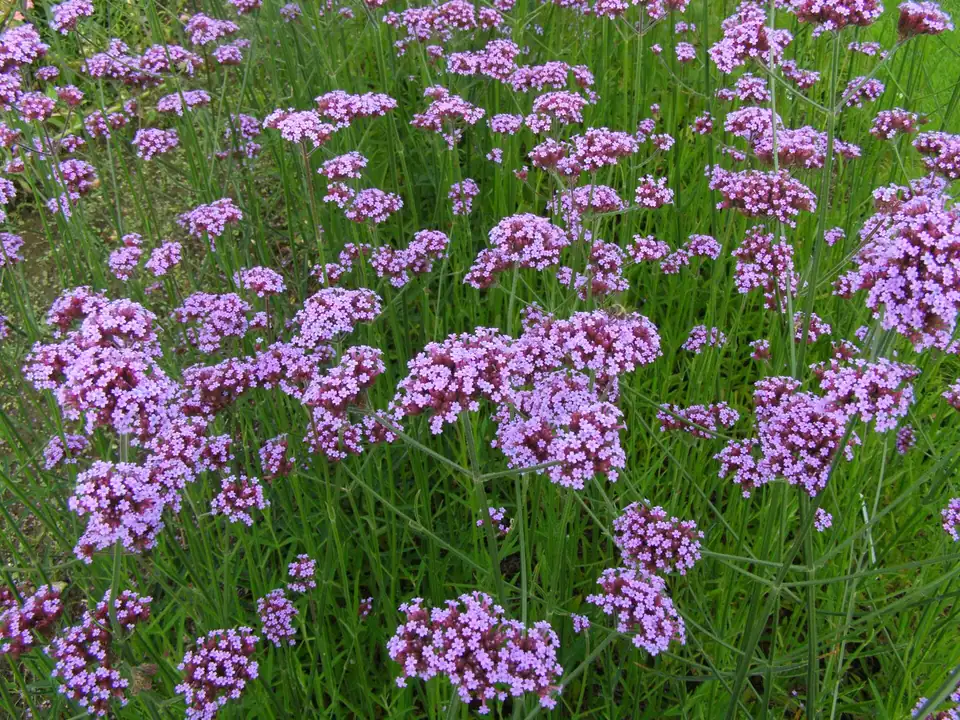
Tall verbena is a tender perennial with rounded clusters of small purple flowers on long wispy stems, grown as an annual in cooler climates. [1] It reseeds prolifically and is considered a weed in many mild climates. [2]
This record is incomplete: the sources we read do not cover every field yet.
Not yet covered by our sources: Watering, Pruning
Tall Verbena care
How to water Tall Verbena
Watering
Not stated in the sources we read.
Watering notes
Keep transplanted volunteers well-watered until re-established
What the sources say (1)
Keep transplanted volunteers well-watered until they are re-established.How much light Tall Verbena needs
The sources give different values depending on region, zone or growing conditions.
What each source says
According to NC State Extension: Full sun to partial shade
According to Clemson HGIC: Full sun throughout the day
What the sources say (3)
According to NC State Extension: Light:
Full sun (6 or more hours of direct sunlight a day)
Partial Shade (Direct sunlight only part of the day, 2-6 hours)According to Clemson HGIC: Verbenas require a location that receives full sun throughout the day.Plant V. bonariensis in full sun and well-drained soil. It is fairly drought tolerant and doesn’t require watering once established (except in periods of drought).How much cold Tall Verbena can take
Hardiness, coldest zone
7a [winter low −17.8 to −15 °C (0 to 5 °F)]
What the sources say (1)
This plant is a tender perennial (hardy in zones 7a to 11b) that is commonly grown as an annual in cooler climates.Hardiness, warmest zone
11b [winter low 7.2 to 10 °C (45 to 50 °F)]
What the sources say (1)
This plant is a tender perennial (hardy in zones 7a to 11b) that is commonly grown as an annual in cooler climates.Where to grow Tall Verbena
61.0 cm (2 ft)
What the sources say (1)
Either place transplants or thin volunteers to about 2 feet apart.How to propagate Tall Verbena
Seed; root cutting; volunteer seedlings
What the sources say (2)
Recommended Propagation Strategy:
Root Cutting
Seed
Country Or Region Of Origin:
South AmericaV. bonariensis is easy to grow from seed indoors or from seedlings (volunteers) in the garden .How to grow Tall Verbena
The plant
Life cycle
perennial
What the sources say (1)
The plant is a tender perennial and is hardy from zones 7 to 11. In cooler climates, it is grown as an annual.Family
Verbenaceae
What the sources say (1)
Genus: Verbena Species: bonariensis Family: Verbenaceae Life Cycle: PerennialMature height
The sources disagree:
What each source says
cultivar 'Lollipop': 51-61 cm (20-24 in):
cultivar 'Flair': 66 cm (26 in):
cultivar 'Vanity': 76 cm (30 in):
What the sources say (3)
cultivar 'Lollipop': 51-61 cm (20-24 in): ‘Lollipop’ is a vegetative selection that grows 20 to 24 inches tall and wide, with a long bloom period.cultivar 'Flair': 66 cm (26 in): ‘Flair’ is very compact and well-branched seed variety, growing 26 inches tall and 16 inches wide.cultivar 'Vanity': 76 cm (30 in): ‘Vanity’ is a seed propagated variety that grows 30 inches tall with improved branching.Mature width
The sources disagree:
What each source says
cultivar 'Lollipop': 51-61 cm (20-24 in):
cultivar 'Flair': 41 cm (16 in):
What the sources say (2)
cultivar 'Lollipop': 51-61 cm (20-24 in): ‘Lollipop’ is a vegetative selection that grows 20 to 24 inches tall and wide, with a long bloom period.cultivar 'Flair': 41 cm (16 in): ‘Flair’ is very compact and well-branched seed variety, growing 26 inches tall and 16 inches wide.Pests and diseases
Diseases
powdery mildew
What the sources say (2)
This species has few insect or disease problems other than powdery mildew.This plant has no serious insect or disease problems although powdery mildew can occur.Fertilizing
When
Mid- to late spring, and again after cutting back in summer
What the sources say (1)
A light application of a complete fertilizer such as 16-4-8 in mid- to late spring and again after trimming back will revitalize plants, but additional fertilization is not generally required.How often
Twice a year in the ground; more often in very sandy, poor soil
What each source says
in containers: Liquid fertilizer once a month, or a controlled-release fertilizer
What the sources say (2)
in containers: Fertilize container grown plants either with a controlled-release fertilizer, or with a liquid fertilizer once a month.A light application of a complete fertilizer such as 16-4-8 in mid- to late spring and again after trimming back will revitalize plants, but additional fertilization is not generally required. Plants growing in very sandy, poor soil may need more frequent fertilization.Mineral fertilizers
A light application of a complete fertilizer such as 16-4-8
What each source says
in containers: Controlled-release fertilizer or a monthly liquid fertilizer
What the sources say (2)
in containers: Fertilize container grown plants either with a controlled-release fertilizer, or with a liquid fertilizer once a month.A light application of a complete fertilizer such as 16-4-8 in mid- to late spring and again after trimming back will revitalize plants, but additional fertilization is not generally required.Tall Verbena pests and problems
Powdery mildew
Symptom: White spots on the leaves, without significant damage to plants.
What to do: Not specified in the source.
What the sources say (1)
Mildew infection causes white spots on the leaves, but does not cause significant damage to plants.
— Verbena bonariensis – Wisconsin Horticulture [2] Prolific reseeding
Symptom: Volunteer seedlings appear in favorable sites when plants are not deadheaded.
What to do: Thin volunteers, transplant them, or pull or hoe them out in early spring.
What the sources say (1)
volunteer seedlings can be thinned to allow some plants to remain, transplanted to new garden locations, or pulled or hoed out in early spring.
— Verbena bonariensis – Wisconsin Horticulture [2]
Remedies
Each remedy shows what official sources say about it; traditional remedies without an official source are marked as such. Harmful ones are listed so you know to avoid them.
Treating the plant
aphids
insecticidal soap Works
How: Use insecticidal soap to control infestations.
Verbena may attract aphids, spider mites, and whiteflies. Use insecticidal soap to control infestations.
— blog.anawaltlumber.com [6] What the evidence says For example, insecticidal soap is a safe, effective organic insecticide with minimal environmental impact.
— extension.psu.edu [7]
powdery mildew
neem oil spray Partly works
be very cautious using these substances because their efficacy, toxicity, and environmental effects have not been university tested.
— extension.unh.edu [9] How: Use neem oil to treat the affected areas.
Apart from chemical remedies, you can use insecticidal soap or neem oil to treat the affected areas.
— diys.com [8] What the evidence says However, neem oil is not effective against every insect and disease, and often must be frequently reapplied to reach the desired outcome.
— extension.unh.edu [9]
pests
diatomaceous earth Not verified
Traditional remedy, not verified by an official source.
How: A natural remedy for getting rid of spider mites, snails, slugs, thrips and aphids.
Getting rid of it
prolific reseeding
pulling or hoeing seedlings Works
How: Volunteer seedlings can be thinned, transplanted to new garden locations, or pulled or hoed out in early spring.
As purpletop often reseeds in favorable sites, when not deadheaded, volunteer seedlings can be thinned to allow some plants to remain, transplanted to new garden locations, or pulled or hoed out in early spring.
— Verbena bonariensis – Wisconsin Horticulture [2] What the evidence says Regularly pulling, hoeing or mowing weeds and encouraging grass to grow and out-compete the weeds is an excellent solution.
— extension.usu.edu [10]
Calendar
Sowing
Indoors, 8 to 12 weeks before the average date of last frost
What the sources say (1)
Start seeds indoors 8 to 12 weeks before the average date of last frost.Planting
The sources give different values depending on region, zone or growing conditions.
What each source says
upstate and piedmont regions of South Carolina: Spring or summer
Coastal region of South Carolina: Fall (also spring or summer)
What the sources say (2)
upstate and piedmont regions of South Carolina: Verbenas are best planted in the spring or summer in the upstate and piedmont regions of South Carolina. They may also be planted in the fall in the Coastal region.Coastal region of South Carolina: Verbenas are best planted in the spring or summer in the upstate and piedmont regions of South Carolina. They may also be planted in the fall in the Coastal region.Pruning
Not stated in the sources we read.
Months as given by the sources, which are mostly from the United States (northern hemisphere). In the southern hemisphere they shift by about six months.
Relative to frost
Less precise estimate: there is no weather station within 300 km.
Find frost dates by ZIP code or city
Sow indoors: 8 to 12 weeks before the last frost
Start seeds indoors 8 to 12 weeks before the average date of last frost.
— Verbena bonariensis – Wisconsin Horticulture [2]
Count from the average frost dates where you live.
Indicative values
Values from a secondary source, not checked word for word like the rest of this page. Use them as a starting point.
- Watering
- AverageIndicative value, adapt it to your climate · Secondary source
- Drought tolerant
- yesIndicative value, adapt it to your climate · Secondary source
- Soil pH
- 6-7.5Indicative value, adapt it to your climate · Secondary source
- Care level
- MediumIndicative value, adapt it to your climate · Secondary source
- Growth rate
- HighIndicative value, adapt it to your climate · Secondary source
- Pruning
- February, March, AprilIndicative value, adapt it to your climate · Secondary source
- Pests
- Rabbit resistantIndicative value, adapt it to your climate · Secondary source
Similar plants
- Blue Vervain Verbena hastata
- Brazilian Verbena Verbena brasiliensis
- Hoary Vervain Verbena stricta
- Moss Verbena Verbena aristigera
- Rigid Verbena Verbena rigida
- Rose Verbena Verbena canadensis
- Vervain Verbena officinalis
- Frogfruit Phyla nodiflora
Sources
Every value above is quoted from these documents. Links lead to the original publisher.
- Verbena bonariensis (Argentinian Vervain, Brazilian Verbena, Brazilian Vervain, Clustertop Verbena, Purple Top, Tall Verbena, Tall Vervain, Vervain) | North Carolina Extension Gardener Plant Toolbox · plants.ces.ncsu.edu, consulted
- Verbena bonariensis – Wisconsin Horticulture · hort.extension.wisc.edu, consulted
- Brazilian Vervain - Verbena bonariensis | North Carolina Extension Gardener Plant Toolbox · plants.ces.ncsu.edu, consulted
- Tall Verbena - Verbena bonariensis | North Carolina Extension Gardener Plant Toolbox · plants.ces.ncsu.edu, consulted
- Verbena | Home & Garden Information Center · hgic.clemson.edu, consulted
- blog.anawaltlumber.com · blog.anawaltlumber.com
- extension.psu.edu · extension.psu.edu
- diys.com · diys.com
- extension.unh.edu · extension.unh.edu
- extension.usu.edu · extension.usu.edu
Written by Emilio Marruso · last checked