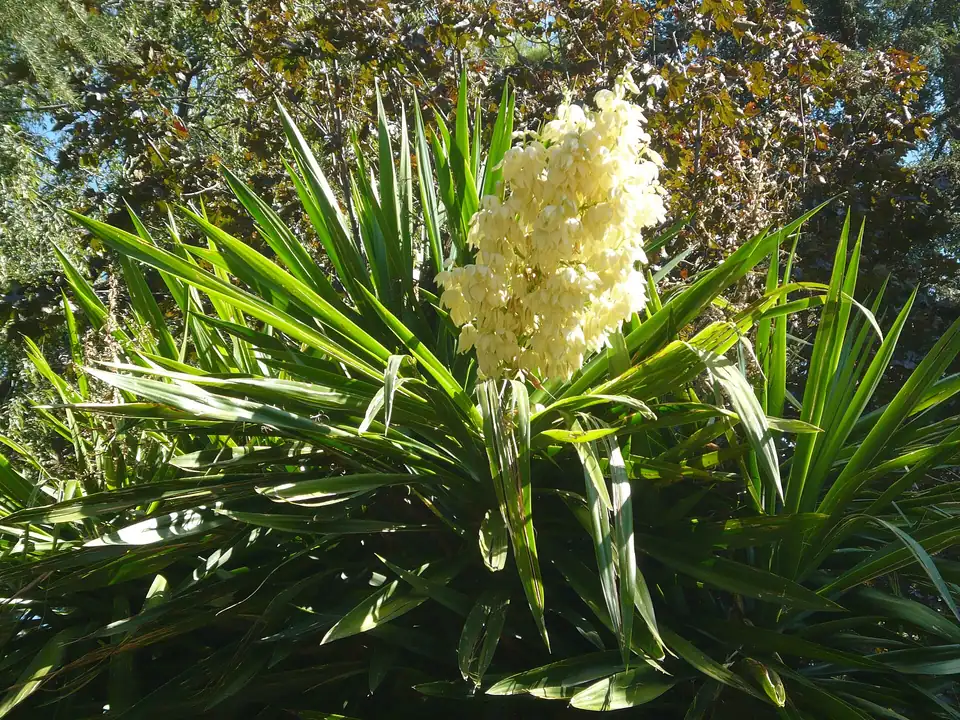


How to Grow and Care for Giant Yucca
Yucca gigantea
Written by Emilio Marruso · last checked
Toxic to: Cats, Dogs, Horses, People · Why
At a glance
Giant yucca is a tough, easygoing perennial that shrugs off drought and grows happily in full sun or partial shade. Outdoors it can reach 15 to 30 feet tall, yet it also grows in containers and even indoors. As a bonus, its flowers are edible and make a pretty addition to salads. Just go easy on the water.
- Sun
Full sun to partial shade: from 2 to 6 or more hours of direct sun a day
What the sources say (2)
Light: Full sun (6 or more hours of direct sunlight a day) to partial shade (direct sunlight only part of the day, 2-6 hours)
Full sun (6 or more hours of direct sunlight a day)
— Yucca gigantea (Giant Yucca, Soft-tip Yucca, Spineless Yucca) | North Carolina Extension Gardener Plant Toolbox [1] Partial Shade (Direct sunlight only part of the day, 2-6 hours)
— Yucca gigantea (Giant Yucca, Soft-tip Yucca, Spineless Yucca) | North Carolina Extension Gardener Plant Toolbox [1] - Water
Handles drought well; too much water causes root rot
What the sources say (3)
Watering: Drought tolerant; overwatering can be problematic
This plant is drought tolerant, and overwatering can be problematic.
— Yucca gigantea (Giant Yucca, Soft-tip Yucca, Spineless Yucca) | North Carolina Extension Gardener Plant Toolbox [1] Watering notes: Overwatering can cause root rot; prefers moist, well-drained soil
Overwatering can cause root rot. Avoid planting near foundations due to its massive base.
— Yucca gigantea (Giant Yucca, Soft-tip Yucca, Spineless Yucca) | North Carolina Extension Gardener Plant Toolbox [1] The giant yucca prefers full sun, and moist, well-drained, loam and sandy soil.
— Yucca gigantea (Giant Yucca, Soft-tip Yucca, Spineless Yucca) | North Carolina Extension Gardener Plant Toolbox [1] - Cold
Survives winters down to 30 °F (−1.1 °C)
Half hardy: mild winters or an unheated greenhouse · USDA 10a · RHS H3 · Z10
What the sources say (2)
Hardiness, coldest zone: 10a [winter low −1.1 to 1.7 °C (30 to 35 °F)]
USDA Plant Hardiness Zone: 10a, 10b, 11a, 11b, 12a, 12b
— Yucca gigantea (Giant Yucca, Soft-tip Yucca, Spineless Yucca) | North Carolina Extension Gardener Plant Toolbox [1] Hardiness, warmest zone: 12b [winter low 12.8 to 15.6 °C (55 to 60 °F)]
USDA Plant Hardiness Zone: 10a, 10b, 11a, 11b, 12a, 12b
— Yucca gigantea (Giant Yucca, Soft-tip Yucca, Spineless Yucca) | North Carolina Extension Gardener Plant Toolbox [1] - Soil
Moist soil that drains well
What the sources say (2)
Watering notes: Overwatering can cause root rot; prefers moist, well-drained soil
Overwatering can cause root rot. Avoid planting near foundations due to its massive base.
— Yucca gigantea (Giant Yucca, Soft-tip Yucca, Spineless Yucca) | North Carolina Extension Gardener Plant Toolbox [1] The giant yucca prefers full sun, and moist, well-drained, loam and sandy soil.
— Yucca gigantea (Giant Yucca, Soft-tip Yucca, Spineless Yucca) | North Carolina Extension Gardener Plant Toolbox [1] - Harvest
The flowers are edible and can go in salads
- Pests
Watch for mealybugs, aphids, scale and weevils; overwatering brings root rot
What the sources say (2)
Pests: mealybugs, aphids, scale, black weevil, yucca moth borers
Monitor for mealybugs, aphids, scale, black weevil, and yucca moth borers.
— Yucca gigantea (Giant Yucca, Soft-tip Yucca, Spineless Yucca) | North Carolina Extension Gardener Plant Toolbox [1] Diseases: root rot
Overwatering can cause root rot. Avoid planting near foundations due to its massive base.
— Yucca gigantea (Giant Yucca, Soft-tip Yucca, Spineless Yucca) | North Carolina Extension Gardener Plant Toolbox [1] - Size
15 to 30 ft tall and 15 to 25 ft wide
What the sources say (2)
Mature height: 457-914 cm (15 to 30 ft)
Dimensions: Height: 15 ft. 0 in. - 30 ft. 0 in. Width: 15 ft. 0 in. - 25 ft. 0 in.
— Yucca gigantea (Giant Yucca, Soft-tip Yucca, Spineless Yucca) | North Carolina Extension Gardener Plant Toolbox [1] Mature width: 457-762 cm (15 to 25 ft)
Dimensions: Height: 15 ft. 0 in. - 30 ft. 0 in. Width: 15 ft. 0 in. - 25 ft. 0 in.
— Yucca gigantea (Giant Yucca, Soft-tip Yucca, Spineless Yucca) | North Carolina Extension Gardener Plant Toolbox [1] - Propagation
From seeds, cuttings or the shoots that grow at its base
What the sources say (1)
Propagation: Seeds, cuttings, and suckers from the base
This plant can be propagated by seeds, cuttings, and from suckers found at the base of the tree or shrub.
— Yucca gigantea (Giant Yucca, Soft-tip Yucca, Spineless Yucca) | North Carolina Extension Gardener Plant Toolbox [1] - Containers
Grows in containers and indoors too
What the sources say (2)
In containers: Yes
It can be used as a container plant on a patio or planted in beds or borders for a coastal or tropical appearance.
— Yucca gigantea (Giant Yucca, Soft-tip Yucca, Spineless Yucca) | North Carolina Extension Gardener Plant Toolbox [1] Indoors: Yes
It is a popular, low-maintenance indoor and outdoor plant that presents as a large, upright succulent shrub or small tree.
— Yucca gigantea (Giant Yucca, Soft-tip Yucca, Spineless Yucca) | North Carolina Extension Gardener Plant Toolbox [1] - Safety
Leaves and roots are toxic to people, cats, dogs and horses
Overview
Giant yucca is a tropical perennial grown for its foliage as a large, upright succulent shrub or small tree. [1] It is grown outdoors or indoors, is drought tolerant, and its leaves and roots are toxic to humans, cats, dogs, and horses. [1]
Giant Yucca care
How to water Giant Yucca
Watering
Drought tolerant; overwatering can be problematic
What the sources say (1)
This plant is drought tolerant, and overwatering can be problematic.Watering notes
Overwatering can cause root rot; prefers moist, well-drained soil
What the sources say (2)
Overwatering can cause root rot. Avoid planting near foundations due to its massive base.The giant yucca prefers full sun, and moist, well-drained, loam and sandy soil.How much light Giant Yucca needs
Full sun (6 or more hours of direct sunlight a day) to partial shade (direct sunlight only part of the day, 2-6 hours)
What the sources say (2)
Full sun (6 or more hours of direct sunlight a day)Partial Shade (Direct sunlight only part of the day, 2-6 hours)How much cold Giant Yucca can take
Hardiness, coldest zone
10a [winter low −1.1 to 1.7 °C (30 to 35 °F)]
What the sources say (1)
USDA Plant Hardiness Zone:
10a, 10b, 11a, 11b, 12a, 12bHardiness, warmest zone
12b [winter low 12.8 to 15.6 °C (55 to 60 °F)]
What the sources say (1)
USDA Plant Hardiness Zone:
10a, 10b, 11a, 11b, 12a, 12bWhere to grow Giant Yucca
Indoors
Yes
What the sources say (1)
It is a popular, low-maintenance indoor and outdoor plant that presents as a large, upright succulent shrub or small tree.In containers
Yes
What the sources say (1)
It can be used as a container plant on a patio or planted in beds or borders for a coastal or tropical appearance.How to propagate Giant Yucca
Seeds, cuttings, and suckers from the base
What the sources say (1)
This plant can be propagated by seeds, cuttings, and from suckers found at the base of the tree or shrub.How to grow Giant Yucca
The plant
Life cycle
perennial
What the sources say (1)
Life Cycle: Perennial Recommended Propagation Strategy: Seed Stem CuttingFamily
Asparagaceae
What the sources say (1)
It is native to Central America and is a member of the asparagus family (Asparagaceae).Mature height
457-914 cm (15 to 30 ft)
What the sources say (1)
Dimensions: Height: 15 ft. 0 in. - 30 ft. 0 in. Width: 15 ft. 0 in. - 25 ft. 0 in.Mature width
457-762 cm (15 to 25 ft)
What the sources say (1)
Dimensions: Height: 15 ft. 0 in. - 30 ft. 0 in. Width: 15 ft. 0 in. - 25 ft. 0 in.Pests and diseases
Pests
mealybugs, aphids, scale, black weevil, yucca moth borers
What the sources say (1)
Monitor for mealybugs, aphids, scale, black weevil, and yucca moth borers.Diseases
root rot
What the sources say (1)
Overwatering can cause root rot. Avoid planting near foundations due to its massive base.Giant Yucca pests and problems
Root rot
Symptom: Overwatering can cause root rot.
What to do: Avoid overwatering; the plant is drought tolerant.
What the sources say (1)
Overwatering can cause root rot. Avoid planting near foundations due to its massive base.
— Yucca gigantea (Giant Yucca, Soft-tip Yucca, Spineless Yucca) | North Carolina Extension Gardener Plant Toolbox [1] Insects
Symptom: Mealybugs, aphids, scale, black weevil, and yucca moth borers may occur.
What to do: Monitor for these pests.
What the sources say (1)
Monitor for mealybugs, aphids, scale, black weevil, and yucca moth borers.
— Yucca gigantea (Giant Yucca, Soft-tip Yucca, Spineless Yucca) | North Carolina Extension Gardener Plant Toolbox [1]
Remedies
Each remedy shows what official sources say about it; traditional remedies without an official source are marked as such. Harmful ones are listed so you know to avoid them.
Treating the plant
mealybugs
water blast from hose Not verified
Traditional remedy, not verified by an official source.
How: Dislodge mealybugs with blasts of water from the garden hose; ant colonies tending the mealybugs need to be baited to prevent reinfestation.
cotton swab dipped in rubbing alcohol Partly works
Make sure to test the soap and alcohol mixtures on a small portion of the plant prior to full application because some plants may be sensitive to soap or alcohol.
— planttalk.colostate.edu [2] How: For small infestations dab the insects with a cotton swab dipped in rubbing alcohol; repeat every week until the bugs are gone.
For smaller infestations, dab the insects with a cotton swab dipped in rubbing alcohol. Repeat this procedure every week until the bugs are gone.
— planttalk.colostate.edu [2] What the evidence says with a cotton swab dipped in alcohol or with an insecticide (including soap-based products) labeled for mealybug control on your specific houseplant. You can also use both methods as neither will kill 100% of mealybugs.
— yardandgarden.extension.iastate.edu [3] insecticidal soap Works
Make sure to test the soap and alcohol mixtures on a small portion of the plant prior to full application because some plants may be sensitive to soap or alcohol.
— planttalk.colostate.edu [2] How: Prune infested branches and apply insecticidal soap.
Control mealy bugs by pruning infested branches and removing and destroying heavily infested plants. These pests may also be controlled with insecticidal soap.
— planttalk.colostate.edu [2] What the evidence says Control mealy bugs by pruning infested branches and removing and destroying heavily infested plants. These pests may also be controlled with insecticidal soap.
— planttalk.colostate.edu [2]
aphids
water spray from hose Not verified
Traditional remedy, not verified by an official source.
How: Spray the aphids with water from a hose; continue spraying daily until the colony is destroyed.
yucca plant bugs
insecticidal soap Not verified
Traditional remedy, not verified by an official source.
How: Several applications of insecticidal soap applied directly to the pest.
scale
neem oil Not verified
Traditional remedy, not verified by an official source.
How: Repeated treatments with neem oil, depending on the size of the colony.
root rot
cut rotten trunk and repot Not verified
Traditional remedy, not verified by an official source.
How: Cut the trunk right above the rotting area (roots should be light in color, not brown), re-pot the rooted end of the trunk and let time pass before watering again.
stop watering and use gritty well-draining soil Not verified
Traditional remedy, not verified by an official source.
How: Stop watering and make sure the plant has gritty soil that drains easily.
Is Giant Yucca toxic to pets?
Reported by the source, quoted verbatim. This is not medical or veterinary advice: if a person or an animal may have eaten this plant, contact a poison control centre or a veterinarian.
The leaves and roots are toxic to humans, cats, dogs, and horses.
[1]
Edibility
Reported by the source, quoted verbatim. Do not eat a plant on the basis of this page alone: identification mistakes can be dangerous.
The flowers are edible and can be used in salad.
[1]
Indicative values
Values from a secondary source, not checked word for word like the rest of this page. Use them as a starting point.
- Hours of sun
- 4-6 hoursIndicative value, adapt it to your climate · Secondary source
- Drought tolerant
- yesIndicative value, adapt it to your climate · Secondary source
- Soil pH
- 6-7.5Indicative value, adapt it to your climate · Secondary source
- Care level
- MediumIndicative value, adapt it to your climate · Secondary source
- Growth rate
- LowIndicative value, adapt it to your climate · Secondary source
- Pruning
- March, April, May, February, AprilIndicative value, adapt it to your climate · Secondary source
Similar plants
- Adam's Needle Yucca flaccida
- Beaked Yucca Yucca rostrata
- Curlyleaf Yucca Yucca filamentosa
- Mound Lily Yucca Yucca gloriosa
- Soapweed Yucca Yucca glauca
- Spanish Bayonet Yucca aloifolia
- Yucca brevifolia Yucca brevifolia
- American Agave Agave virginica
Sources
Every value above is quoted from these documents. Links lead to the original publisher.
- Yucca gigantea (Giant Yucca, Soft-tip Yucca, Spineless Yucca) | North Carolina Extension Gardener Plant Toolbox · plants.ces.ncsu.edu, consulted
- planttalk.colostate.edu · planttalk.colostate.edu
- yardandgarden.extension.iastate.edu · yardandgarden.extension.iastate.edu
Written by Emilio Marruso · last checked