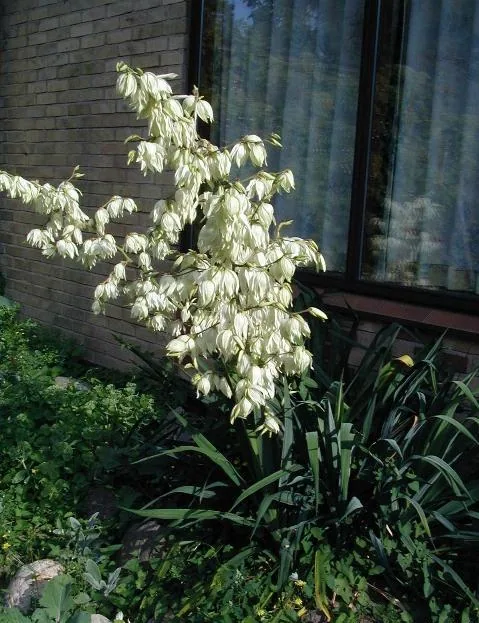
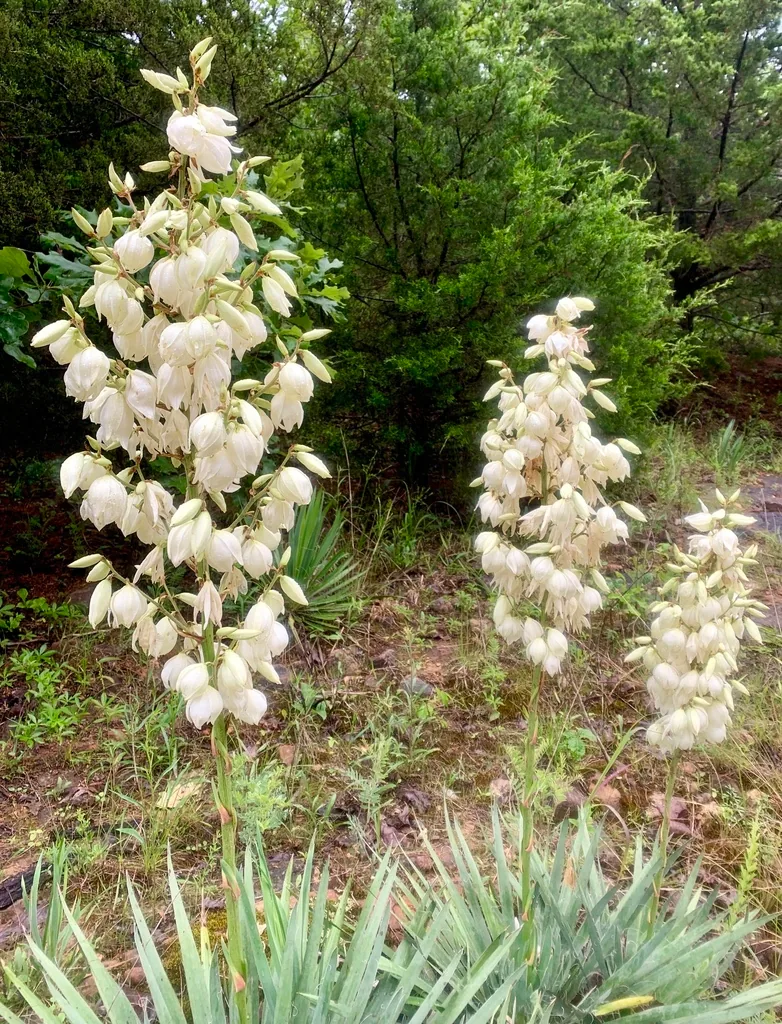

How to Grow and Care for Curlyleaf Yucca
Yucca filamentosa
Written by Emilio Marruso · last checked
Toxic to: Cats, Dogs, Horses · Why
At a glance
This tough yucca asks for very little: once established, it needs little to no watering and rarely any fertilizer. It thrives in full sun to partial shade and grows 3 to 8 feet tall. As a bonus, its flowers are edible, with a taste like bitter artichoke, lovely fresh in salads, cooked in soups or roasted.
- Sun
Full sun to partial shade
What the sources say (1)
Light: Full sun to partial shade
Grow this yucca in full sun or partial shade. It is not particular about soil type but does require the soil to have a neutral pH and good drainage.
— Yucca filamentosa (Adam's Needle Yucca, Curlyleaf Yucca, Spoonleaf Yucca) | North Carolina Extension Gardener Plant Toolbox [1] - Water
Little to no water once established; too much moisture turns leaf edges black
What the sources say (2)
Watering: Little to no irrigation needed once established
As with yuccas in general, the Curyleaf Yucca needs little to no fertilizer, pruning, spraying or irrigation (once established) and can withstand strong winds.
— Yucca Filamentosa (Curlyleaf Yucca) - Brunswick County Center | N.C. Cooperative Extension [3] Watering notes: Needs good drainage; too much moisture may result in black areas on the leaf margins
It is susceptible to leaf spots or blight in areas with poor drainage or in periods of wet weather, and too much moisture may result in black areas on the leaf margins.
— Yucca Filamentosa (Curlyleaf Yucca) - Brunswick County Center | N.C. Cooperative Extension [3] - Cold
Survives winters down to −30 °F (−34.4 °C)
Very hardy · USDA 4a · RHS H7 · Z4
What the sources say (2)
Hardiness, coldest zone: 4a [winter low −34.4 to −31.7 °C (−30 to −25 °F)]
4a, 4b, 5a, 5b, 6a, 6b, 7a, 7b, 8a, 8b, 9a, 9b, 10a, 10b
— Yucca filamentosa (Adam's Needle Yucca, Curlyleaf Yucca, Spoonleaf Yucca) | North Carolina Extension Gardener Plant Toolbox [1] Hardiness, warmest zone: 10b [winter low 1.7 to 4.4 °C (35 to 40 °F)]
4a, 4b, 5a, 5b, 6a, 6b, 7a, 7b, 8a, 8b, 9a, 9b, 10a, 10b
— Yucca filamentosa (Adam's Needle Yucca, Curlyleaf Yucca, Spoonleaf Yucca) | North Carolina Extension Gardener Plant Toolbox [1] - Soil
Well-drained soil, pH 6.0–8.0
What the sources say (3)
Soil pH, minimum: 6.0
Soil pH: Neutral (6.0-8.0) Soil Drainage: Good Drainage
— Yucca filamentosa (Adam's Needle Yucca, Curlyleaf Yucca, Spoonleaf Yucca) | North Carolina Extension Gardener Plant Toolbox [1] Soil pH, maximum: 8.0
Soil pH: Neutral (6.0-8.0) Soil Drainage: Good Drainage
— Yucca filamentosa (Adam's Needle Yucca, Curlyleaf Yucca, Spoonleaf Yucca) | North Carolina Extension Gardener Plant Toolbox [1] Watering notes: Needs good drainage; too much moisture may result in black areas on the leaf margins
It is susceptible to leaf spots or blight in areas with poor drainage or in periods of wet weather, and too much moisture may result in black areas on the leaf margins.
— Yucca Filamentosa (Curlyleaf Yucca) - Brunswick County Center | N.C. Cooperative Extension [3] - Feeding
Rarely: it needs little to no fertilizer
What the sources say (1)
How often: Rarely: needs little to no fertilizer
As with yuccas in general, the Curyleaf Yucca needs little to no fertilizer, pruning, spraying or irrigation (once established) and can withstand strong winds.
— Yucca Filamentosa (Curlyleaf Yucca) - Brunswick County Center | N.C. Cooperative Extension [3] - Harvest
Edible flowers that taste like bitter artichoke: fresh in salads, in soups or roasted
- Pests
Black aphids can ruin the flowers; leaf spots and blight where drainage is poor
What the sources say (3)
Pests: black aphids
It is a hardy, durable plant, but black aphids on flower stalks may ruin the flowers.
— Yucca Filamentosa (Curlyleaf Yucca) - Brunswick County Center | N.C. Cooperative Extension [3] Diseases: leaf spots, blight
In areas of poor drainage, the leaves may be sensitive to leaf spots or blight.
— Yucca filamentosa (Adam's Needle Yucca, Curlyleaf Yucca, Spoonleaf Yucca) | North Carolina Extension Gardener Plant Toolbox [1] It is susceptible to leaf spots or blight in areas with poor drainage or in periods of wet weather, and too much moisture may result in black areas on the leaf margins.
— Yucca Filamentosa (Curlyleaf Yucca) - Brunswick County Center | N.C. Cooperative Extension [3] - Size
3 to 8 ft tall and 3 to 5 ft wide
What the sources say (4)
Mature height: 91-244 cm (3 ft - 8 ft)
It is native to the Southeastern United States. It grows 3 to 8 feet tall and 3 to 5 feet wide.
— Yucca filamentosa (Adam's Needle Yucca, Curlyleaf Yucca, Spoonleaf Yucca) | North Carolina Extension Gardener Plant Toolbox [1] It grows 3- to 8-ft. tall and 3- to 5-ft. wide.
— Yucca Filamentosa (Curlyleaf Yucca) - Brunswick County Center | N.C. Cooperative Extension [3] Mature width: 91-152 cm (3 ft - 5 ft)
It is native to the Southeastern United States. It grows 3 to 8 feet tall and 3 to 5 feet wide.
— Yucca filamentosa (Adam's Needle Yucca, Curlyleaf Yucca, Spoonleaf Yucca) | North Carolina Extension Gardener Plant Toolbox [1] It grows 3- to 8-ft. tall and 3- to 5-ft. wide.
— Yucca Filamentosa (Curlyleaf Yucca) - Brunswick County Center | N.C. Cooperative Extension [3] - Propagation
By division, root cuttings or seed
What the sources say (1)
Propagation: Division, root cutting, seed
It can be propagated by division, root cutting, or seed.
— Yucca filamentosa (Adam's Needle Yucca, Curlyleaf Yucca, Spoonleaf Yucca) | North Carolina Extension Gardener Plant Toolbox [1] - Safety
Harmful to cats, dogs and horses
Overview
Curlyleaf yucca is a perennial, broadleaf evergreen, clumping shrub that grows 3 to 8 feet [0.9–2.4 m] tall and 3 to 5 feet [0.9–1.5 m] wide. [1] It grows in full sun or partial shade and requires good drainage, and is resistant to deer, rabbits, drought and heat. [1]
This record is incomplete: the sources we read do not cover every field yet.
Not yet covered by our sources: Pruning
Curlyleaf Yucca care
Measurements in square brackets are our conversion into the other unit system; the quoted text is unchanged.
How to water Curlyleaf Yucca
Watering
Little to no irrigation needed once established
What the sources say (1)
As with yuccas in general, the Curyleaf Yucca needs little to no fertilizer, pruning, spraying or irrigation (once established) and can withstand strong winds.Watering notes
Needs good drainage; too much moisture may result in black areas on the leaf margins
What the sources say (1)
It is susceptible to leaf spots or blight in areas with poor drainage or in periods of wet weather, and too much moisture may result in black areas on the leaf margins.How much light Curlyleaf Yucca needs
Full sun to partial shade
What the sources say (1)
Grow this yucca in full sun or partial shade. It is not particular about soil type but does require the soil to have a neutral pH and good drainage.How much cold Curlyleaf Yucca can take
Hardiness, coldest zone
4a [winter low −34.4 to −31.7 °C (−30 to −25 °F)]
What the sources say (1)
4a, 4b, 5a, 5b, 6a, 6b, 7a, 7b, 8a, 8b, 9a, 9b, 10a, 10bHardiness, warmest zone
10b [winter low 1.7 to 4.4 °C (35 to 40 °F)]
What the sources say (1)
4a, 4b, 5a, 5b, 6a, 6b, 7a, 7b, 8a, 8b, 9a, 9b, 10a, 10bBest soil for Curlyleaf Yucca
Soil pH, minimum
6.0
What the sources say (1)
Soil pH:
Neutral (6.0-8.0)
Soil Drainage:
Good DrainageSoil pH, maximum
8.0
What the sources say (1)
Soil pH:
Neutral (6.0-8.0)
Soil Drainage:
Good DrainageHow to propagate Curlyleaf Yucca
Division, root cutting, seed
What the sources say (1)
It can be propagated by division, root cutting, or seed.How to grow Curlyleaf Yucca
The plant
Life cycle
perennial
What the sources say (2)
Curlyleaf yucca is a perennial, broadleaf evergreen, clumping shrub in the asparagus family (Asparagaceae).Curlyleaf Yucca is a perennial broadleaf, clumping evergreen shrub native to the Southeastern US.Family
Asparagaceae
What the sources say (1)
Curlyleaf yucca is a perennial, broadleaf evergreen, clumping shrub in the asparagus family (Asparagaceae).Mature height
91-244 cm (3 ft - 8 ft)
What the sources say (2)
It is native to the Southeastern United States. It grows 3 to 8 feet tall and 3 to 5 feet wide.It grows 3- to 8-ft. tall and 3- to 5-ft. wide.Mature width
91-152 cm (3 ft - 5 ft)
What the sources say (2)
It is native to the Southeastern United States. It grows 3 to 8 feet tall and 3 to 5 feet wide.It grows 3- to 8-ft. tall and 3- to 5-ft. wide.Pests and diseases
Pests
black aphids
What the sources say (1)
It is a hardy, durable plant, but black aphids on flower stalks may ruin the flowers.Diseases
leaf spots, blight
What the sources say (2)
In areas of poor drainage, the leaves may be sensitive to leaf spots or blight.It is susceptible to leaf spots or blight in areas with poor drainage or in periods of wet weather, and too much moisture may result in black areas on the leaf margins.Fertilizing
How often
Rarely: needs little to no fertilizer
What the sources say (1)
As with yuccas in general, the Curyleaf Yucca needs little to no fertilizer, pruning, spraying or irrigation (once established) and can withstand strong winds.Curlyleaf Yucca pests and problems
Leaf spots and blight
Symptom: Leaves may be sensitive to leaf spots or blight in areas of poor drainage; too much moisture may cause black areas on leaf margins.
What to do: Provide good drainage.
What the sources say (2)
Insects, Diseases, and Other Plant Problems: In areas of poor drainage, the leaves may be sensitive to leaf spots or blight.
— Yucca filamentosa (Adam's Needle Yucca, Curlyleaf Yucca, Spoonleaf Yucca) | North Carolina Extension Gardener Plant Toolbox [1] It is susceptible to leaf spots or blight in areas with poor drainage or in periods of wet weather, and too much moisture may result in black areas on the leaf margins.
— Yucca Filamentosa (Curlyleaf Yucca) - Brunswick County Center | N.C. Cooperative Extension [3] Black aphids
Symptom: Black aphids on flower stalks may ruin the flowers.
What to do: No management given in the sources.
What the sources say (1)
It is a hardy, durable plant, but black aphids on flower stalks may ruin the flowers.
— Yucca Filamentosa (Curlyleaf Yucca) - Brunswick County Center | N.C. Cooperative Extension [3]
Remedies
Each remedy shows what official sources say about it; traditional remedies without an official source are marked as such. Harmful ones are listed so you know to avoid them.
Treating the plant
aphids
strong spray of water Not verified
Traditional remedy, not verified by an official source.
How: Use a strong spray of water from the garden hose; it may need to be repeated for a few days to completely destroy the colony.
insect pests
curd soap mixture Works
For example, spraying home remedies that contain dish detergent on plants on a sunny day can injure the plant, essentially burning it.
— extension.psu.edu [6] How: Dab the insects with a curd soap mixture.
Spray and pour nettle slurry - dab the insects with curd soap mixture or tobacco stock
— live-native.com [4] What the evidence says For example, insecticidal soap is a safe, effective organic insecticide with minimal environmental impact.
— extension.psu.edu [5]
leaf spots
neem oil Partly works
Despite these being biological pesticides, it is important to read the directions on the label and wear safety equipment.
— extension.illinois.edu [9] How: Neem oil can be used for persistent fungal infections.
A natural fungicide and insecticide like neem oil can be used for persistent fungal infections.
— gardenerspath.com [7] What the evidence says However, neem oil is not effective against every insect and disease, and often must be frequently reapplied to reach the desired outcome.
— extension.unh.edu [8]
Is Curlyleaf Yucca toxic to pets?
Reported by the source, quoted verbatim. This is not medical or veterinary advice: if a person or an animal may have eaten this plant, contact a poison control centre or a veterinarian.
It is described as being a problem for cats, dogs, and horses.
[3]The source flags the risk for this animal but does not explain why.
Calendar
Pruning
Not stated in the sources we read.
Months as given by the sources, which are mostly from the United States (northern hemisphere). In the southern hemisphere they shift by about six months.
Edibility
Reported by the source, quoted verbatim. Do not eat a plant on the basis of this page alone: identification mistakes can be dangerous.
The edible flowers taste somewhat like bitter artichoke and can be used fresh in salads, cooked in soups or stews, or roasted.
[1]
Indicative values
Values from a secondary source, not checked word for word like the rest of this page. Use them as a starting point.
- Hours of sun
- 6-8 hoursIndicative value, adapt it to your climate · Secondary source
- Drought tolerant
- yesIndicative value, adapt it to your climate · Secondary source
- Care level
- LowIndicative value, adapt it to your climate · Secondary source
- Growth rate
- LowIndicative value, adapt it to your climate · Secondary source
- Pruning
- May, June, JulyIndicative value, adapt it to your climate · Secondary source
Similar plants
- Adam's Needle Yucca flaccida
- Beaked Yucca Yucca rostrata
- Giant Yucca Yucca gigantea
- Mound Lily Yucca Yucca gloriosa
- Soapweed Yucca Yucca glauca
- Spanish Bayonet Yucca aloifolia
- Yucca brevifolia Yucca brevifolia
- American Agave Agave virginica
Sources
Every value above is quoted from these documents. Links lead to the original publisher.
- Yucca filamentosa (Adam's Needle Yucca, Curlyleaf Yucca, Spoonleaf Yucca) | North Carolina Extension Gardener Plant Toolbox · plants.ces.ncsu.edu, consulted
- Curlyleaf Yucca - Yucca filamentosa | North Carolina Extension Gardener Plant Toolbox · plants.ces.ncsu.edu, consulted
- Yucca Filamentosa (Curlyleaf Yucca) - Brunswick County Center | N.C. Cooperative Extension · brunswick.ces.ncsu.edu, consulted
- live-native.com · live-native.com
- extension.psu.edu · extension.psu.edu
- extension.psu.edu · extension.psu.edu
- gardenerspath.com · gardenerspath.com
- extension.unh.edu · extension.unh.edu
- extension.illinois.edu · extension.illinois.edu
Written by Emilio Marruso · last checked