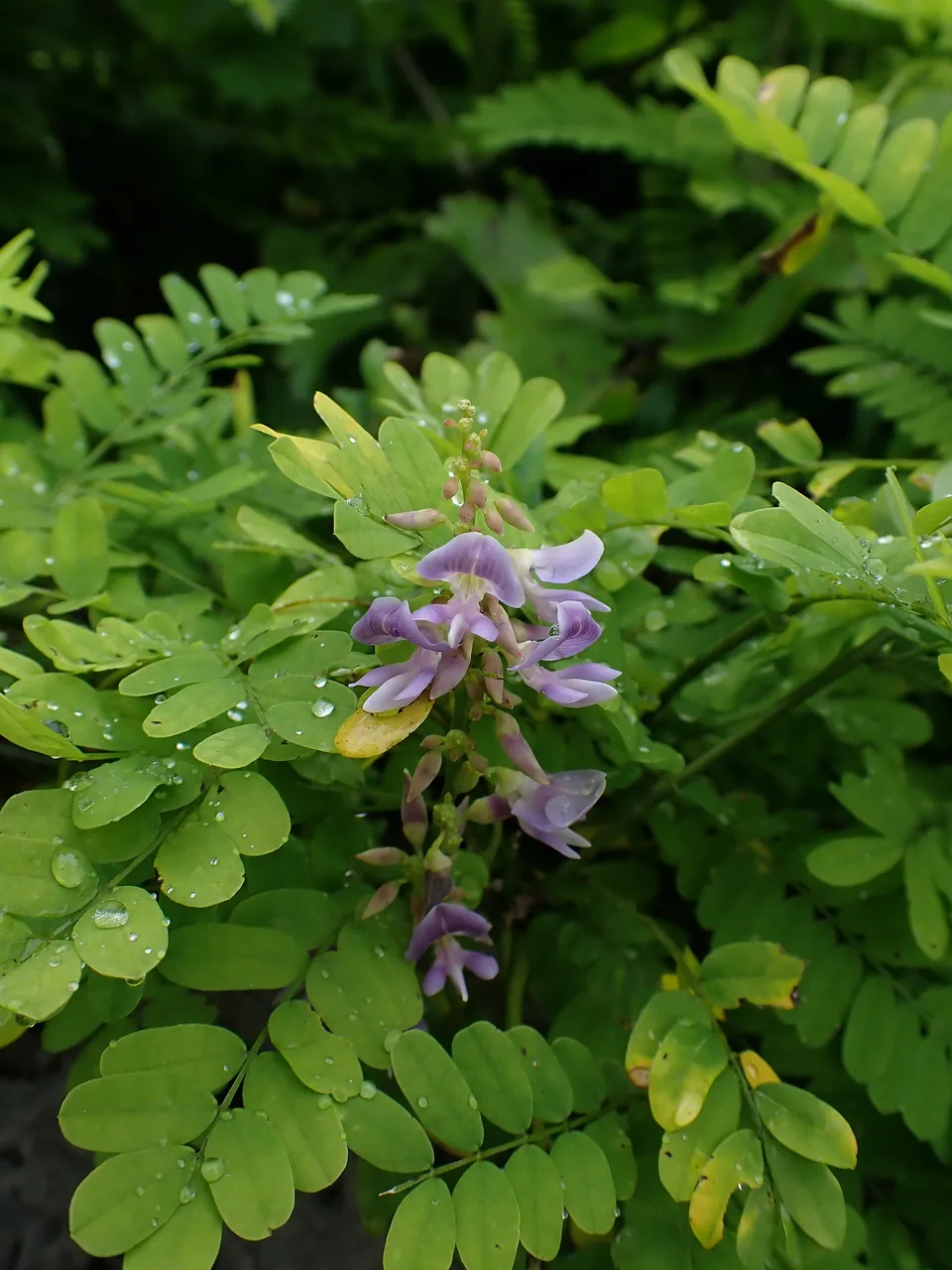


How to Grow and Care for Rosary Pea
Abrus precatorius
Written by Emilio Marruso · last checked
Toxic to: Cats, Dogs, Horses, Birds, Livestock, People · Why
At a glance
Rosary pea is a perennial twining vine from the pea family that loves full sun and well-drained, dry soil. It climbs eagerly over trees and shrubs, and its seeds sprout in 18 days. Treat it with great respect, though: every part is poisonous, a single seed can kill a person, and it spreads easily, so keep it firmly under control.
- Sun
Full sun
What the sources say (1)
Light: Full sun
Full sun (6 or more hours of direct sunlight a day)
— Abrus precatorius (Buddhist Rosary Bead, Crab's Eyes, Indian Bead, Jequirity Bean, Love Bean, Prayer Bean, Precatory Bean, Rosary Pea, Seminole Bead) | North Carolina Extension Gardener Plant Toolbox [1] - Soil
Well-drained soil that stays on the dry side
What the sources say (1)
Watering notes: Prefers well-drained, dry soil conditions
Prefers well-drained, dry soil conditions. Able to grow in almost all Florida soil conditions, except very poorly drained, water-logged areas
— | Center for Aquatic and Invasive Plants | University of Florida, IFAS [2] - Pests
Seed beetles can attack the seeds
What the sources say (1)
Pests: bruchid beetles (Caryopemon)
Bruchid beetles (Caryopemon) have been documented to feed on seeds of this plant
— | Center for Aquatic and Invasive Plants | University of Florida, IFAS [2] - Watch out
Invasive: it climbs over trees, birds spread its seeds and its deep root makes it hard to remove
- Sowing
Seeds sprout in 18 days, but not all of them come up
What the sources say (1)
Days to germination: 18 days (40% of seeds germinated)
Germination of seeds has been documented at 40% in 18 days
— | Center for Aquatic and Invasive Plants | University of Florida, IFAS [2] - Safety
Very poisonous to people, cats, dogs, horses and livestock: one seed can kill a person
Overview
Rosary pea is an evergreen twining vine native to India and tropical Asia whose seeds contain the toxin abrin. [1][2] It is listed as a noxious weed in Florida, where planting it in home landscapes is not advised. [1][2]
This record is incomplete: the sources we read do not cover every field yet.
Not yet covered by our sources: Watering, Hardiness, coldest zone, Hardiness, warmest zone, Pruning, Propagation
Rosary Pea care
How to water Rosary Pea
Watering
Not stated in the sources we read.
Watering notes
Prefers well-drained, dry soil conditions
What the sources say (1)
Prefers well-drained, dry soil conditions. Able to grow in almost all Florida soil conditions, except very poorly drained, water-logged areasHow much light Rosary Pea needs
Full sun
What the sources say (1)
Full sun (6 or more hours of direct sunlight a day)How much cold Rosary Pea can take
Hardiness, coldest zone
Not stated in the sources we read.
Hardiness, warmest zone
Not stated in the sources we read.
How to propagate Rosary Pea
Not stated in the sources we read.
How to grow Rosary Pea
The plant
Life cycle
perennial
What the sources say (1)
Life Cycle:
Perennial
Country Or Region Of Origin:
India and parts of tropical AsiaFamily
Fabaceae
What the sources say (1)
The rosary pea is an evergreen vine in the bean family (Fabaceae) that is native to India and parts of tropical Asia.Sowing and growth
Days to germination
18 days (40% of seeds germinated)
What the sources say (1)
Germination of seeds has been documented at 40% in 18 daysPests and diseases
Pests
bruchid beetles (Caryopemon)
What the sources say (1)
Bruchid beetles (Caryopemon) have been documented to feed on seeds of this plantRosary Pea pests and problems
Invasive spread
Symptom: Twining vine climbs over trees and shrubs, invading undisturbed and disturbed areas; deep taproot makes eradication difficult; abundant seed production and bird dispersal spread it.
What to do: Hand pulling, aggressive tilling and chemical applications; young plants can be hand-pulled; foliar glyphosate or aminopyralid, basal stem or cut-stump triclopyr for mature plants; revisit sites because of the persistent seed bank.
What the sources say (4)
This plant grows as a twining vine and can climb over trees and shrubs, invading both undisturbed and disturbed areas. The deep taproot makes it difficult to eradicate.
— Abrus precatorius (Buddhist Rosary Bead, Crab's Eyes, Indian Bead, Jequirity Bean, Love Bean, Prayer Bean, Precatory Bean, Rosary Pea, Seminole Bead) | North Carolina Extension Gardener Plant Toolbox [1] Control of the plant is by hand pulling, aggressive tilling and chemical applications.
— Abrus precatorius (Buddhist Rosary Bead, Crab's Eyes, Indian Bead, Jequirity Bean, Love Bean, Prayer Bean, Precatory Bean, Rosary Pea, Seminole Bead) | North Carolina Extension Gardener Plant Toolbox [1] Cultural/Physical Young plants can be hand-pulled in small scale contexts [ 23 ]. Seed management by hand removal is effective for reducing propagule pressure locally
— | Center for Aquatic and Invasive Plants | University of Florida, IFAS [2] Revisiting invaded site for follow-up treatment is necessary due to abundant and persistent seed bank
— | Center for Aquatic and Invasive Plants | University of Florida, IFAS [2]
Remedies
Each remedy shows what official sources say about it; traditional remedies without an official source are marked as such. Harmful ones are listed so you know to avoid them.
First aid
First aid: not a substitute for a doctor
seed ingestion
first aid after ingestion Official source, not independently tested
Seek medical attention immediately.
— cdc.gov [8] There is no antidote for abrin toxicity.
— cdc.gov [8] How: Remove the person from the source of exposure, make sure the airway is unobstructed, do not induce vomiting.
INGESTION - Immediately remove the patient/victim from the source of exposure. - Ensure that the patient/victim has an unobstructed airway. - Do not induce vomiting (emesis).
— cdc.gov [8]
eye contact
skin contact
first aid after skin contact Official source, not independently tested
Seek medical attention immediately.
— cdc.gov [8] How: Remove all clothing and wash the contaminated skin thoroughly with soap and water.
Remove all clothing (at least down to their undergarments) and place the clothing in a labeled durable 6-mil polyethylene bag. - Thoroughly wash and rinse (using cold or warm water) the contaminated skin of the patient/victim using a soap and water solution.
— cdc.gov [8]
Getting rid of it
rosary pea vine
hand pulling young plants Partly works
All parts are posoinous but its the seeds that are most often ingested.
— Abrus precatorius (Buddhist Rosary Bead, Crab's Eyes, Indian Bead, Jequirity Bean, Love Bean, Prayer Bean, Precatory Bean, Rosary Pea, Seminole Bead) | North Carolina Extension Gardener Plant Toolbox [1] A single seed contains enough of the toxin abrin to kill a human.
— Abrus precatorius - MREC - UF/IFAS - University of Florida, Institute of Food and Agricultural Sciences - UF/IFAS [7] Deep taproot prevents effective mechanical management techniques for older, established plants.
— | Center for Aquatic and Invasive Plants | University of Florida, IFAS [2] How: Young plants can be hand-pulled in small-scale contexts; removing seeds by hand is effective for reducing the seed load locally.
Young plants can be hand-pulled in small scale contexts
— | Center for Aquatic and Invasive Plants | University of Florida, IFAS [2] What the evidence says Young plants can be hand-pulled in small scale contexts [ 23 ]. Seed management by hand removal is effective for reducing propagule pressure locally [ 20 ].
— | Center for Aquatic and Invasive Plants | University of Florida, IFAS [2] mechanical control of established plants Partly works
All parts are posoinous but its the seeds that are most often ingested.
— Abrus precatorius (Buddhist Rosary Bead, Crab's Eyes, Indian Bead, Jequirity Bean, Love Bean, Prayer Bean, Precatory Bean, Rosary Pea, Seminole Bead) | North Carolina Extension Gardener Plant Toolbox [1] A single seed contains enough of the toxin abrin to kill a human.
— Abrus precatorius - MREC - UF/IFAS - University of Florida, Institute of Food and Agricultural Sciences - UF/IFAS [7] How: Control is by hand pulling and aggressive tilling; the deep taproot makes eradication difficult.
The deep taproot makes it difficult to eradicate.
— Abrus precatorius (Buddhist Rosary Bead, Crab's Eyes, Indian Bead, Jequirity Bean, Love Bean, Prayer Bean, Precatory Bean, Rosary Pea, Seminole Bead) | North Carolina Extension Gardener Plant Toolbox [1] What the evidence says Deep taproot prevents effective mechanical management techniques for older, established plants.
— | Center for Aquatic and Invasive Plants | University of Florida, IFAS [2] burning Partly works
All parts are posoinous but its the seeds that are most often ingested.
— Abrus precatorius (Buddhist Rosary Bead, Crab's Eyes, Indian Bead, Jequirity Bean, Love Bean, Prayer Bean, Precatory Bean, Rosary Pea, Seminole Bead) | North Carolina Extension Gardener Plant Toolbox [1] A single seed contains enough of the toxin abrin to kill a human.
— Abrus precatorius - MREC - UF/IFAS - University of Florida, Institute of Food and Agricultural Sciences - UF/IFAS [7] How: Burning can reset mature growth.
Burning can reset mature growth, but germination of seeds improved by fire.
— | Center for Aquatic and Invasive Plants | University of Florida, IFAS [2] What the evidence says Burning can reset mature growth, but germination of seeds improved by fire. Seeds respond positively to smoke
— | Center for Aquatic and Invasive Plants | University of Florida, IFAS [2] heavy grazing Works
However, caution should be used if livestock have access to forage on this plant and grazing should only be allowed if seeds are not present on plants.
— | Center for Aquatic and Invasive Plants | University of Florida, IFAS [2] All parts are posoinous but its the seeds that are most often ingested.
— Abrus precatorius (Buddhist Rosary Bead, Crab's Eyes, Indian Bead, Jequirity Bean, Love Bean, Prayer Bean, Precatory Bean, Rosary Pea, Seminole Bead) | North Carolina Extension Gardener Plant Toolbox [1] A single seed contains enough of the toxin abrin to kill a human.
— Abrus precatorius - MREC - UF/IFAS - University of Florida, Institute of Food and Agricultural Sciences - UF/IFAS [7] How: Heavy grazing has been shown to control this plant; grazing should only be allowed if seeds are not present on the plants.
Heavy grazing has been shown to control this plant
— | Center for Aquatic and Invasive Plants | University of Florida, IFAS [2] What the evidence says Heavy grazing has been shown to control this plant
— | Center for Aquatic and Invasive Plants | University of Florida, IFAS [2]
Is Rosary Pea toxic to pets?
Reported by the source, quoted verbatim. This is not medical or veterinary advice: if a person or an animal may have eaten this plant, contact a poison control centre or a veterinarian.
Animals
The seeds of rosary pea contain a powerful toxin (abrin) which inhibits protein synthesis and causes cell death in humans and livestock if seeds are crushed and ingested
[2]Problems: Poisonous to Humans Problem for Cats Problem for Dogs Problem for Horses
[1]- Severity
This plant has high severity poison characteristics.
[1]
Birds will eat the fruits, spreading the seeds, and are unaffected by the poison.
[1]The source flags the risk for this animal but does not explain why.
People
All parts are posoinous but its the seeds that are most often ingested. Once eaten there can be a delay of hours or days: nausea, vomiting, severe abdominal pain and diarrhea
[1]- Poisonous parts
Poison Part: Flowers Leaves Roots Seeds
[1]- Toxic principle
Poison Toxic Principle: Abrin, a protein
[1]- Symptoms
nausea, vomiting, severe abdominal pain and diarrhea, tremors, high heart rate, fever, shock, burning in throat; later ulcerative lesions of mouth and esophagus; can be fatal.
[1]- Severity
Poison Severity: High
[1]
A single seed contains enough of the toxin abrin to kill a human.
[7]
Calendar
Pruning
Not stated in the sources we read.
Months as given by the sources, which are mostly from the United States (northern hemisphere). In the southern hemisphere they shift by about six months.
Similar plants
- American hogpeanut Amphicarpaea bracteata
- Bean Phaseolus vulgaris
- Bicolor Lespedeza Lespedeza bicolor
- Black Locust Robinia pseudoacacia
- Black Medick Medicago lupulina
- Blue False Indigo Baptisia australis
- Bur Medick Medicago polymorpha
- Bush Clover Lespedeza thunbergii
Sources
Every value above is quoted from these documents. Links lead to the original publisher.
- Abrus precatorius (Buddhist Rosary Bead, Crab's Eyes, Indian Bead, Jequirity Bean, Love Bean, Prayer Bean, Precatory Bean, Rosary Pea, Seminole Bead) | North Carolina Extension Gardener Plant Toolbox · plants.ces.ncsu.edu, consulted
- | Center for Aquatic and Invasive Plants | University of Florida, IFAS · plant-directory.ifas.ufl.edu, consulted
- Crab's Eyes - Abrus precatorius | North Carolina Extension Gardener Plant Toolbox · plants.ces.ncsu.edu, consulted
- Precatory Bean - Abrus precatorius | North Carolina Extension Gardener Plant Toolbox · plants.ces.ncsu.edu, consulted
- Rosary Pea - Abrus precatorius | North Carolina Extension Gardener Plant Toolbox · plants.ces.ncsu.edu, consulted
- Love Bean - Abrus precatorius | North Carolina Extension Gardener Plant Toolbox · plants.ces.ncsu.edu, consulted
- Abrus precatorius - MREC - UF/IFAS - University of Florida, Institute of Food and Agricultural Sciences - UF/IFAS · mrec.ifas.ufl.edu, consulted
- cdc.gov · cdc.gov
Written by Emilio Marruso · last checked