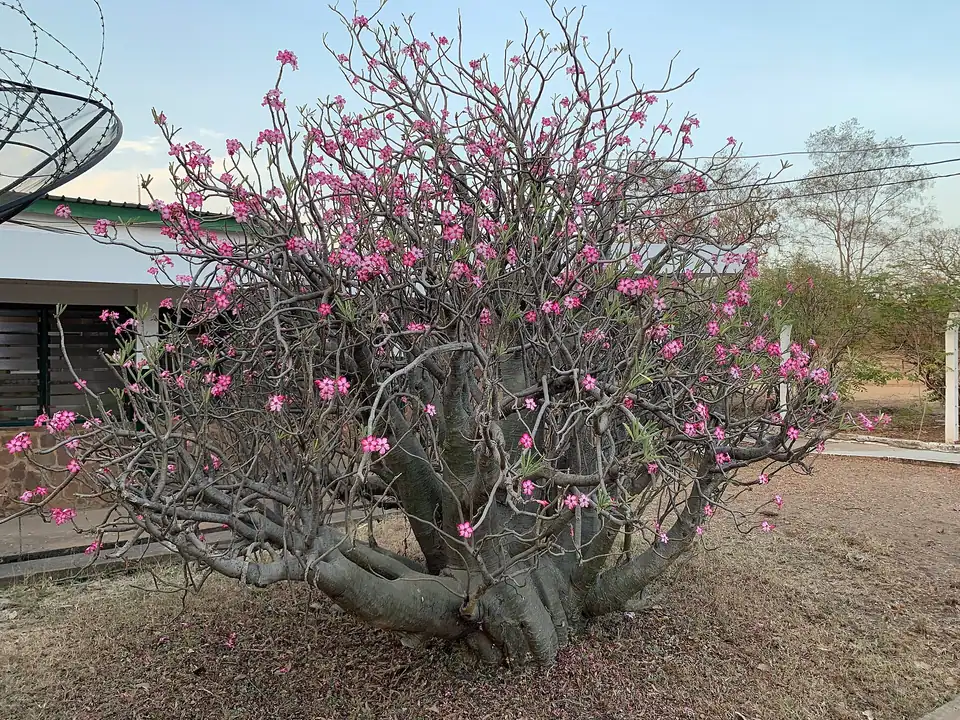


How to Grow and Care for Desert Rose
Adenium obesum
Written by Emilio Marruso · last checked
Toxic to: Cats, Dogs, Horses, People · Why
At a glance
Desert rose is a sun-loving succulent that thrives in a pot, even indoors, and can grow 3 to 9 feet tall. It's quite drought tolerant: let it dry out between waterings, water less when it drops its leaves to rest, and feed it in spring to encourage blooming. Just handle it with care, because its sap and every part are poisonous.
- Sun
Full sun
What the sources say (1)
Light: Full sun
Grow this plant in full sun in potting soil appropriate for cacti and succulents in a pot with several drainage holes.
— Adenium obesum (Desert Azalea, Desert Rose, Impala Lily, Mock Azalea, Sabi Star) | North Carolina Extension Gardener Plant Toolbox [1] - Water
Let it dry between waterings; water little or not at all once it drops its leaves
What the sources say (5)
Watering: Allow the plant to dry between waterings but water during growing periods; quite drought tolerant
Growing periods: Allow the plant to dry between waterings but water during growing periods, though it is quite drought tolerant.
— Adenium obesum (Desert Azalea, Desert Rose, Impala Lily, Mock Azalea, Sabi Star) | North Carolina Extension Gardener Plant Toolbox [1] Dormancy (leaves dropped): If that happens, reduce watering or stop it altogether until the leaves begin to regrow.
— Adenium (Desert Rose, Dwarf Bottle Tree, Elephant's Foot) | North Carolina Extension Gardener Plant Toolbox [2] Allow the plant to dry between waterings but water during growing periods, though it is quite drought tolerant.
— Adenium obesum (Desert Azalea, Desert Rose, Impala Lily, Mock Azalea, Sabi Star) | North Carolina Extension Gardener Plant Toolbox [1] Watering notes: Decrease water while dormant; soils that are too wet will produce rots
Bring this plant indoors when outside temperatures reach 55°F and decrease water while dormant.
— Adenium obesum (Desert Azalea, Desert Rose, Impala Lily, Mock Azalea, Sabi Star) | North Carolina Extension Gardener Plant Toolbox [1] Possible insect pests include aphids, scales, and mealybugs. Fungal leaf spot is an occasional disease problem. Soils that are too wet will produce rots.
— Adenium obesum (Desert Azalea, Desert Rose, Impala Lily, Mock Azalea, Sabi Star) | North Carolina Extension Gardener Plant Toolbox [1] - Feeding
Feed in spring to encourage blooming
What the sources say (1)
When: In spring, to encourage blooming
Allow the plant to dry between waterings but water during growing periods, though it is quite drought tolerant. Provide fertilizer in spring to encourage blooming.
— Adenium obesum (Desert Azalea, Desert Rose, Impala Lily, Mock Azalea, Sabi Star) | North Carolina Extension Gardener Plant Toolbox [1] - Pests
Aphids, scale and mealybugs; sometimes leaf spot
What the sources say (2)
Pests: aphids, scales, mealybugs
Possible insect pests include aphids, scales, and mealybugs.
— Adenium obesum (Desert Azalea, Desert Rose, Impala Lily, Mock Azalea, Sabi Star) | North Carolina Extension Gardener Plant Toolbox [1] Diseases: fungal leaf spot, rots in soils that are too wet
Fungal leaf spot is an occasional disease problem. Soils that are too wet will produce rots.
— Adenium obesum (Desert Azalea, Desert Rose, Impala Lily, Mock Azalea, Sabi Star) | North Carolina Extension Gardener Plant Toolbox [1] - Watch out
Soggy soil makes roots and stems rot: use a pot with several drainage holes
What the sources say (2)
Watering notes: Decrease water while dormant; soils that are too wet will produce rots
Bring this plant indoors when outside temperatures reach 55°F and decrease water while dormant.
— Adenium obesum (Desert Azalea, Desert Rose, Impala Lily, Mock Azalea, Sabi Star) | North Carolina Extension Gardener Plant Toolbox [1] Possible insect pests include aphids, scales, and mealybugs. Fungal leaf spot is an occasional disease problem. Soils that are too wet will produce rots.
— Adenium obesum (Desert Azalea, Desert Rose, Impala Lily, Mock Azalea, Sabi Star) | North Carolina Extension Gardener Plant Toolbox [1] - Size
3 to 9 ft tall and 3 to 5 ft wide
What the sources say (2)
Mature height: 91-274 cm (3-9 ft)
Dimensions: Height: 3 ft. 0 in. - 9 ft. 0 in. Width: 3 ft. 0 in. - 5 ft. 0 in.
— Adenium obesum (Desert Azalea, Desert Rose, Impala Lily, Mock Azalea, Sabi Star) | North Carolina Extension Gardener Plant Toolbox [1] Mature width: 91-152 cm (3-5 ft)
Dimensions: Height: 3 ft. 0 in. - 9 ft. 0 in. Width: 3 ft. 0 in. - 5 ft. 0 in.
— Adenium obesum (Desert Azalea, Desert Rose, Impala Lily, Mock Azalea, Sabi Star) | North Carolina Extension Gardener Plant Toolbox [1] - Propagation
From seed, stem cuttings or grafting
What the sources say (1)
Propagation: Grafting, seed, stem cutting
Life Cycle: Perennial Recommended Propagation Strategy: Grafting Seed Stem Cutting
— Adenium obesum (Desert Azalea, Desert Rose, Impala Lily, Mock Azalea, Sabi Star) | North Carolina Extension Gardener Plant Toolbox [1] - Containers
Grows well in containers, even indoors
What the sources say (2)
In containers: Yes
Grow this plant in full sun in potting soil appropriate for cacti and succulents in a pot with several drainage holes.
— Adenium obesum (Desert Azalea, Desert Rose, Impala Lily, Mock Azalea, Sabi Star) | North Carolina Extension Gardener Plant Toolbox [1] Indoors: Yes
It is often used as a houseplant for its beautiful flowers and charming, small tree-like shape.
— Adenium obesum (Desert Azalea, Desert Rose, Impala Lily, Mock Azalea, Sabi Star) | North Carolina Extension Gardener Plant Toolbox [1] - Safety
All parts are poisonous and the sap irritates skin; harmful to cats, dogs and horses
Overview
Desert rose is a succulent perennial in the dogbane family native to desert regions of Africa and the Arabian Peninsula. [1] It is grown in full sun in cactus and succulent potting soil, in a pot with several drainage holes. [1] The plant is allowed to dry between waterings, and soils that are too wet produce rots. [1]
Desert Rose care
How to water Desert Rose
Watering
Allow the plant to dry between waterings but water during growing periods; quite drought tolerant
What each source says
Growing periods: Allow the plant to dry between waterings; water during growing periods
Dormancy (leaves dropped): Reduce watering or stop it altogether until the leaves begin to regrow
What the sources say (3)
Growing periods: Allow the plant to dry between waterings but water during growing periods, though it is quite drought tolerant.Dormancy (leaves dropped): If that happens, reduce watering or stop it altogether until the leaves begin to regrow.Allow the plant to dry between waterings but water during growing periods, though it is quite drought tolerant.Watering notes
Decrease water while dormant; soils that are too wet will produce rots
What the sources say (2)
Bring this plant indoors when outside temperatures reach 55°F and decrease water while dormant.Possible insect pests include aphids, scales, and mealybugs. Fungal leaf spot is an occasional disease problem. Soils that are too wet will produce rots.How much light Desert Rose needs
Full sun
What the sources say (1)
Grow this plant in full sun in potting soil appropriate for cacti and succulents in a pot with several drainage holes.How much cold Desert Rose can take
Hardiness, coldest zone
The sources give different values depending on region, zone or growing conditions.
What each source says
According to NC State Extension (Adenium obesum): 11a [winter low 4.4 to 7.2 °C (40 to 45 °F)]
According to NC State Extension (genus Adenium): 10a [winter low −1.1 to 1.7 °C (30 to 35 °F)]
What the sources say (3)
According to NC State Extension (Adenium obesum): USDA Plant Hardiness Zone:
11a, 11b, 12a, 12b
-
Fruit:According to NC State Extension (genus Adenium): Coastal
Piedmont
USDA Plant Hardiness Zone:
10a, 10b, 11a, 11bUSDA Plant Hardiness Zone:
11a, 11b, 12a, 12bHardiness, warmest zone
The sources give different values depending on region, zone or growing conditions.
What each source says
According to NC State Extension (Adenium obesum): 12b [winter low 12.8 to 15.6 °C (55 to 60 °F)]
According to NC State Extension (genus Adenium): 11b [winter low 7.2 to 10 °C (45 to 50 °F)]
What the sources say (3)
According to NC State Extension (Adenium obesum): USDA Plant Hardiness Zone:
11a, 11b, 12a, 12b
-
Fruit:According to NC State Extension (genus Adenium): Coastal
Piedmont
USDA Plant Hardiness Zone:
10a, 10b, 11a, 11bUSDA Plant Hardiness Zone:
11a, 11b, 12a, 12bWhere to grow Desert Rose
Indoors
Yes
What the sources say (1)
It is often used as a houseplant for its beautiful flowers and charming, small tree-like shape.In containers
Yes
What the sources say (1)
Grow this plant in full sun in potting soil appropriate for cacti and succulents in a pot with several drainage holes.How to propagate Desert Rose
Grafting, seed, stem cutting
What the sources say (1)
Life Cycle:
Perennial
Recommended Propagation Strategy:
Grafting
Seed
Stem CuttingHow to grow Desert Rose
The plant
Life cycle
perennial (succulent)
What the sources say (1)
Desert rose is a succulent perennial in the dogbane family (Apocynaceae) native to desert regions of Africa and the Arabian Peninsula.Family
Apocynaceae
What the sources say (1)
Desert rose is a succulent perennial in the dogbane family (Apocynaceae) native to desert regions of Africa and the Arabian Peninsula.Mature height
91-274 cm (3-9 ft)
What the sources say (1)
Dimensions: Height: 3 ft. 0 in. - 9 ft. 0 in. Width: 3 ft. 0 in. - 5 ft. 0 in.Mature width
91-152 cm (3-5 ft)
What the sources say (1)
Dimensions: Height: 3 ft. 0 in. - 9 ft. 0 in. Width: 3 ft. 0 in. - 5 ft. 0 in.Pests and diseases
Pests
aphids, scales, mealybugs
What the sources say (1)
Possible insect pests include aphids, scales, and mealybugs.Diseases
fungal leaf spot, rots in soils that are too wet
What the sources say (1)
Fungal leaf spot is an occasional disease problem. Soils that are too wet will produce rots.Fertilizing
When
In spring, to encourage blooming
What the sources say (1)
Allow the plant to dry between waterings but water during growing periods, though it is quite drought tolerant. Provide fertilizer in spring to encourage blooming.Desert Rose pests and problems
Insect pests
Symptom: Aphids, scales and mealybugs.
What to do: Not stated in the sources.
What the sources say (1)
Possible insect pests include aphids, scales, and mealybugs.
— Adenium obesum (Desert Azalea, Desert Rose, Impala Lily, Mock Azalea, Sabi Star) | North Carolina Extension Gardener Plant Toolbox [1] Fungal leaf spot
Symptom: Occasional disease problem.
What to do: Not stated in the sources.
What the sources say (1)
Fungal leaf spot is an occasional disease problem.
— Adenium obesum (Desert Azalea, Desert Rose, Impala Lily, Mock Azalea, Sabi Star) | North Carolina Extension Gardener Plant Toolbox [1] Root and stem rots from wet soil
Symptom: Rots in soils that are too wet.
What to do: Allow the plant to dry between waterings and use a pot with several drainage holes.
What the sources say (2)
Soils that are too wet will produce rots.
— Adenium obesum (Desert Azalea, Desert Rose, Impala Lily, Mock Azalea, Sabi Star) | North Carolina Extension Gardener Plant Toolbox [1] Allow the plant to dry between waterings but water during growing periods, though it is quite drought tolerant.
— Adenium obesum (Desert Azalea, Desert Rose, Impala Lily, Mock Azalea, Sabi Star) | North Carolina Extension Gardener Plant Toolbox [1]
Remedies
Each remedy shows what official sources say about it; traditional remedies without an official source are marked as such. Harmful ones are listed so you know to avoid them.
Treating the plant
spider mites
forceful stream of water Not verified
Traditional remedy, not verified by an official source.
How: Spray a forceful stream of water on the leaves to send the bugs flying. Repeat this every few days.
pests
neem oil Partly works
Neem oil's properties make leaves more vulnerable to sun scorching
— housedigest.com [3] How: Coat the plant in neem oil, applied in the evening so it has time to set in before the next day's light.
You can deter these creatures by coating your desert rose in neem oil
— housedigest.com [3] What the evidence says However, neem oil is not effective against every insect and disease, and often must be frequently reapplied to reach the desired outcome.
— extension.unh.edu [4]
anthracnose
neem cake fertilizer Not verified
Traditional remedy, not verified by an official source.
How: Neem cake fertilizer kills soil-based anthracnose spores.
Is Desert Rose toxic to pets?
Reported by the source, quoted verbatim. This is not medical or veterinary advice: if a person or an animal may have eaten this plant, contact a poison control centre or a veterinarian.
Animals
Problem for Cats Problem for Dogs Problem for Horses
[1]The source flags the risk for this animal but does not explain why.
People
Toxic latex causes contact dermatitis. All parts of the plant are poisonous if ingested. Vomiting, diarrhea, anorexia, depression, irregular heartbeat, and possibly death.
[1]- Poisonous parts
Poison Part: Bark Flowers Fruits Leaves Roots Sap/Juice Seeds Stems
[1]- Toxic principle
Poison Toxic Principle: Cardiac glycosides Causes Contact Dermatitis: Yes
[1]- Symptoms
Vomiting, diarrhea, anorexia, depression, irregular heartbeat, and possibly death.
[1]- Severity
Poison Severity: Low Poison Symptoms: Toxic latex causes contact dermatitis.
[1]
Indicative values
Values from a secondary source, not checked word for word like the rest of this page. Use them as a starting point.
- Drought tolerant
- yesIndicative value, adapt it to your climate · Secondary source
- Soil pH
- 6-6.5Indicative value, adapt it to your climate · Secondary source
- Growth rate
- LowIndicative value, adapt it to your climate · Secondary source
- Pruning
- March, April, May, June, July, August, September, FebruaryIndicative value, adapt it to your climate · Secondary source
Similar plants
- Allamanda Allamanda cathartica
- Bladderflower Araujia sericifera
- Butterfly Weed Asclepias tuberosa
- Clasping Milkweed Asclepias amplexicaulis
- Dogbane Apocynum androsaemifolium
- Few-flower Milkweed Asclepias lanceolata
- Gomphocarpus physocarpus Gomphocarpus physocarpus
- Green Antelopehorn Asclepias viridis
Sources
Every value above is quoted from these documents. Links lead to the original publisher.
- Adenium obesum (Desert Azalea, Desert Rose, Impala Lily, Mock Azalea, Sabi Star) | North Carolina Extension Gardener Plant Toolbox · plants.ces.ncsu.edu, consulted
- Adenium (Desert Rose, Dwarf Bottle Tree, Elephant's Foot) | North Carolina Extension Gardener Plant Toolbox · plants.ces.ncsu.edu, consulted
- housedigest.com · housedigest.com
- extension.unh.edu · extension.unh.edu
Written by Emilio Marruso · last checked