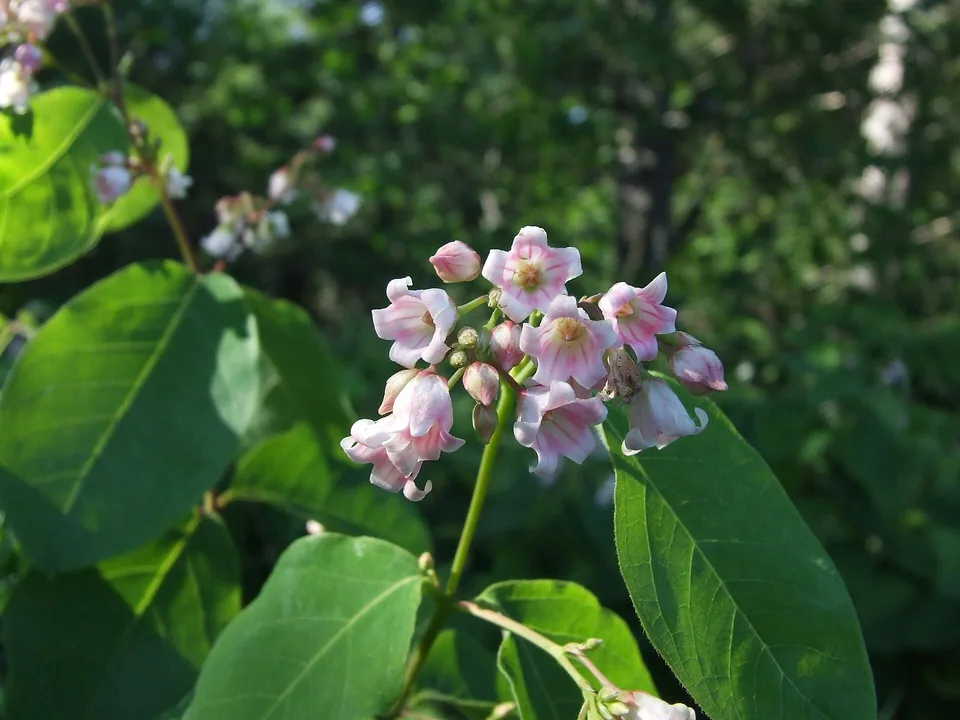


How to Grow and Care for Dogbane
Apocynum androsaemifolium
Written by Emilio Marruso · last checked
Toxic to: Cats, Dogs, Horses, People · Why
At a glance
Spreading dogbane is an easygoing perennial that settles in almost anywhere, from full sun to shade, and it prefers average to dry conditions, so it needs little watering. Each plant grows 3–4 ft wide and spreads quickly underground, making it a lively choice for a large garden rather than a small one. To get more plants, simply divide it.
- Sun
Full sun, partial shade or dappled light
What the sources say (2)
Light: Sunny to shady conditions (full sun, partial shade or dappled sunlight)
This plant prefers average to dry conditions in barren sandy to rocky soils but tolerates loams in sunny to shady conditions.
— Apocynum androsaemifolium (Bitter Root, Dogbane, Dogbane Hemp, Indian Hemp, Spreading Dogbane) | North Carolina Extension Gardener Plant Toolbox [1] Dappled Sunlight (Shade through upper canopy all day) Full sun (6 or more hours of direct sunlight a day)
— Apocynum androsaemifolium (Bitter Root, Dogbane, Dogbane Hemp, Indian Hemp, Spreading Dogbane) | North Carolina Extension Gardener Plant Toolbox [1] - Water
Likes average to dry conditions: little water needed
What the sources say (1)
Watering: Prefers average to dry conditions
This plant prefers average to dry conditions in barren sandy to rocky soils but tolerates loams in sunny to shady conditions.
— Apocynum androsaemifolium (Bitter Root, Dogbane, Dogbane Hemp, Indian Hemp, Spreading Dogbane) | North Carolina Extension Gardener Plant Toolbox [1] - Cold
Survives winters down to −40 °F (−40 °C)
Very hardy · USDA 3a · RHS H7 · Z3
What the sources say (2)
Hardiness, coldest zone: 3a [winter low −40 to −37.2 °C (−40 to −35 °F)]
3a, 3b, 4a, 4b, 5a, 5b, 6a, 6b, 7a, 7b, 8a, 8b, 9a, 9b
— Apocynum androsaemifolium (Bitter Root, Dogbane, Dogbane Hemp, Indian Hemp, Spreading Dogbane) | North Carolina Extension Gardener Plant Toolbox [1] Hardiness, warmest zone: 9b [winter low −3.9 to −1.1 °C (25 to 30 °F)]
3a, 3b, 4a, 4b, 5a, 5b, 6a, 6b, 7a, 7b, 8a, 8b, 9a, 9b
— Apocynum androsaemifolium (Bitter Root, Dogbane, Dogbane Hemp, Indian Hemp, Spreading Dogbane) | North Carolina Extension Gardener Plant Toolbox [1] - Watch out
Spreads quickly through underground stems: not for small gardens
- Size
3–4 ft wide
What the sources say (1)
Mature width: 91-122 cm (3 ft - 4 ft)
Height: 2 ft. 0 in. - 3 ft. 0 in. Width: 3 ft. 0 in. - 4 ft. 0 in.
— Apocynum androsaemifolium (Bitter Root, Dogbane, Dogbane Hemp, Indian Hemp, Spreading Dogbane) | North Carolina Extension Gardener Plant Toolbox [1] - Propagation
Divide the plant to get new ones
What the sources say (1)
Propagation: Division
Recommended Propagation Strategy: Division Country Or Region Of Origin: North America
— Apocynum androsaemifolium (Bitter Root, Dogbane, Dogbane Hemp, Indian Hemp, Spreading Dogbane) | North Carolina Extension Gardener Plant Toolbox [1] - Safety
Toxic to people, children, cats, dogs and horses; the milky sap can blister skin
Overview
Spreading dogbane is an herbaceous perennial wildflower with fragrant pink bell-shaped flowers that is suited to woodland, pollinator or naturalized plantings. [1] It spreads quickly from underground rhizomes, which makes it inappropriate for small gardens. [1] The plant is rated as high severity poison, with cardiac glycosides and a milky sap that can blister skin. [1]
This record is incomplete: the sources we read do not cover every field yet.
Not yet covered by our sources: Pruning
Dogbane care
How to water Dogbane
Prefers average to dry conditions
What the sources say (1)
This plant prefers average to dry conditions in barren sandy to rocky soils but tolerates loams in sunny to shady conditions.How much light Dogbane needs
Sunny to shady conditions (full sun, partial shade or dappled sunlight)
What the sources say (2)
This plant prefers average to dry conditions in barren sandy to rocky soils but tolerates loams in sunny to shady conditions.Dappled Sunlight (Shade through upper canopy all day)
Full sun (6 or more hours of direct sunlight a day)How much cold Dogbane can take
Hardiness, coldest zone
3a [winter low −40 to −37.2 °C (−40 to −35 °F)]
What the sources say (1)
3a, 3b, 4a, 4b, 5a, 5b, 6a, 6b, 7a, 7b, 8a, 8b, 9a, 9bHardiness, warmest zone
9b [winter low −3.9 to −1.1 °C (25 to 30 °F)]
What the sources say (1)
3a, 3b, 4a, 4b, 5a, 5b, 6a, 6b, 7a, 7b, 8a, 8b, 9a, 9bHow to propagate Dogbane
Division
What the sources say (1)
Recommended Propagation Strategy:
Division
Country Or Region Of Origin:
North AmericaHow to grow Dogbane
The plant
Life cycle
perennial
What the sources say (1)
Spreading Dogbane is an herbaceous perennial wildflower that is widespread across North AmericaFamily
Apocynaceae
What the sources say (1)
Family:
Apocynaceae
Uses (Ethnobotany):
Fiber from the plant was used by Native Americans as threadMature height
Mature width
91-122 cm (3 ft - 4 ft)
What the sources say (1)
Height: 2 ft. 0 in. - 3 ft. 0 in.
Width: 3 ft. 0 in. - 4 ft. 0 in.Dogbane pests and problems
Aggressive rhizomatous spread
Symptom: Spreads quickly from underground rhizomes
What to do: Source advises against planting in small gardens
What the sources say (1)
spreads quickly from underground rhizomes making it inappropriate for small gardens.
— Apocynum androsaemifolium (Bitter Root, Dogbane, Dogbane Hemp, Indian Hemp, Spreading Dogbane) | North Carolina Extension Gardener Plant Toolbox [1]
Remedies
Each remedy shows what official sources say about it; traditional remedies without an official source are marked as such. Harmful ones are listed so you know to avoid them.
First aid
First aid: not a substitute for a doctor
contact dermatitis from sap
cool wet cloth on the skin Official source, not independently tested
See your health care provider if: - The rash is so itchy that you can't sleep or go about your day - The rash is severe or widespread
— mayoclinic.org [4] How: Soothe the skin with a cool, wet cloth and other self-care steps.
You can try soothing your skin with a cool, wet cloth and other self-care steps.
— mayoclinic.org [4]
Is Dogbane toxic to pets?
Reported by the source, quoted verbatim. This is not medical or veterinary advice: if a person or an animal may have eaten this plant, contact a poison control centre or a veterinarian.
Animals
Problems: Poisonous to Humans Problem for Cats Problem for Children Problem for Dogs Problem for Horses
[1]The source flags the risk for this animal but does not explain why.
People
Poison Symptoms: Cardiac Arrest, nausea, vomiting, weakness, diarrhea. The milky sap from stems can cause blisters on skin.
[1]- Poisonous parts
Causes Contact Dermatitis: Yes Poison Part: Flowers Fruits Leaves Sap/Juice Seeds
[1]- Toxic principle
Poison Toxic Principle: Cardiac glycosides and others Causes Contact Dermatitis:
[1]- Symptoms
Poison Symptoms: Cardiac Arrest, nausea, vomiting, weakness, diarrhea. The milky sap from stems can cause blisters on skin.
[1]- Severity
This plant has high severity poison characteristics. See below
[1]
contains a milky white sap that is toxic to humans
[2]- Toxic principle
its tough fibers were used to make threads and cords by Native Americans -the root contains cymarin, a cardiac stimulant
[2]
Calendar
Pruning
Not stated in the sources we read.
Months as given by the sources, which are mostly from the United States (northern hemisphere). In the southern hemisphere they shift by about six months.
Indicative values
Values from a secondary source, not checked word for word like the rest of this page. Use them as a starting point.
- Drought tolerant
- yesIndicative value, adapt it to your climate · Secondary source
- Soil
- SandIndicative value, adapt it to your climate · Secondary source
- Soil pH
- 6-7.5Indicative value, adapt it to your climate · Secondary source
- Care level
- MediumIndicative value, adapt it to your climate · Secondary source
- Growth rate
- LowIndicative value, adapt it to your climate · Secondary source
- Pruning
- June, July, August, December, January, February, June, July, August, December, January, FebruaryIndicative value, adapt it to your climate · Secondary source
Similar plants
- Dogbane Apocynum cannabinum
- Allamanda Allamanda cathartica
- Asiatic Jasmine Trachelospermum asiaticum
- Bladderflower Araujia sericifera
- Blue Star Amsonia ciliata
- Blue Star Amsonia hubrichtii
- Bush allamanda Allamanda schottii
- Butterfly Weed Asclepias tuberosa
Sources
Every value above is quoted from these documents. Links lead to the original publisher.
- Apocynum androsaemifolium (Bitter Root, Dogbane, Dogbane Hemp, Indian Hemp, Spreading Dogbane) | North Carolina Extension Gardener Plant Toolbox · plants.ces.ncsu.edu, consulted
- Spreading dogbane - Cooperative Extension: Maine Wild Blueberries - University of Maine Cooperative Extension · extension.umaine.edu, consulted
- Indian Hemp - Apocynum androsaemifolium | North Carolina Extension Gardener Plant Toolbox · plants.ces.ncsu.edu, consulted
- mayoclinic.org · mayoclinic.org
Written by Emilio Marruso · last checked