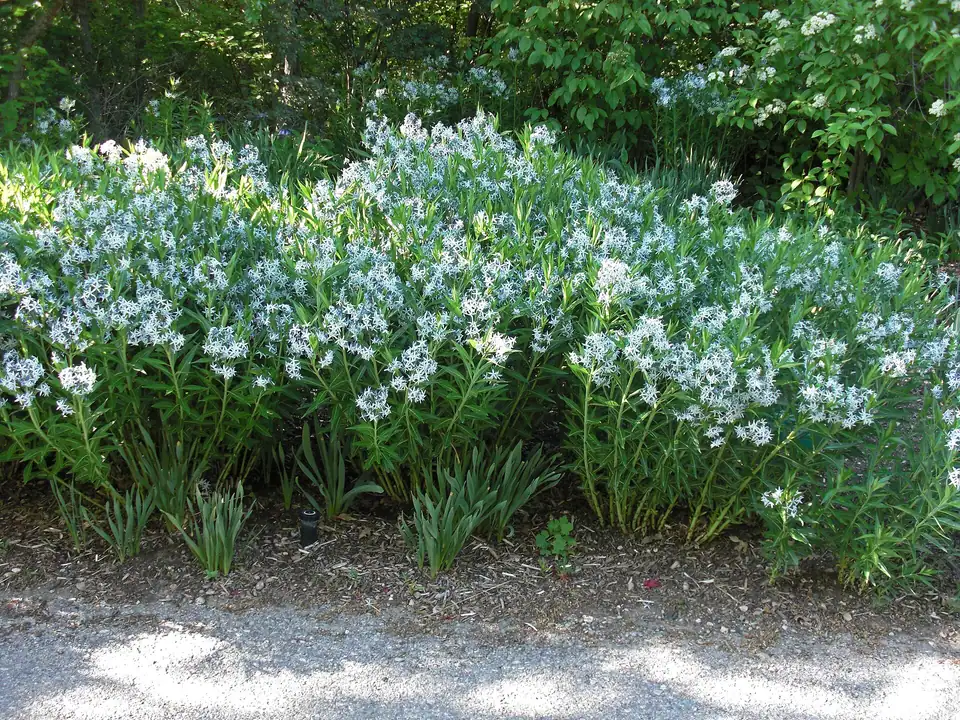


How to Grow and Care for Blue Star
Amsonia ciliata
Written by Emilio Marruso · last checked
At a glance
This amsonia is an easygoing perennial that comes back year after year and is happy in drier soil. Give it full sun, or at most light shade, and it rewards you with sturdy flower stems and better fall color. Trim it after flowering, and grow even more plants from seed or root cuttings.
- Sun
Full sun to light shade; full sun is best
What the sources say (2)
Light: Full sun to light shade
Blue Star prefers sandy very well-drained soils in full sun but tolerates light shade.
— Amsonia ciliata (Blue Milkweed, Bluestar, Blue Star, Creeping Bluestar, Downy Amsonia, Downy Blue Star, Fringe Blue Star, Sandhills Bluestar) | North Carolina Extension Gardener Plant Toolbox [1] Light: Full sun (6 or more hours of direct sunlight a day) Partial Shade (Direct sunlight only part of the day, 2-6 hours)
— Amsonia ciliata (Blue Milkweed, Bluestar, Blue Star, Creeping Bluestar, Downy Amsonia, Downy Blue Star, Fringe Blue Star, Sandhills Bluestar) | North Carolina Extension Gardener Plant Toolbox [1] - Water
Likes drier soil
What the sources say (1)
Watering notes: Prefers drier soils
with Amsonia tabernaemontana preferring moist soils and A. ciliata and A. hubrichtii preferring drier soils.
— Bonkers for Bluestars | Yard and Garden [7] - Cold
Survives winters down to −20 °F (−28.9 °C)
Very hardy · USDA 5a · RHS H7 · Z5
What the sources say (2)
Hardiness, coldest zone: 5a [winter low −28.9 to −26.1 °C (−20 to −15 °F)]
USDA Plant Hardiness Zone: 5a, 5b, 6a, 6b, 7a, 7b, 8a, 8b, 9a, 9b
— Amsonia ciliata (Blue Milkweed, Bluestar, Blue Star, Creeping Bluestar, Downy Amsonia, Downy Blue Star, Fringe Blue Star, Sandhills Bluestar) | North Carolina Extension Gardener Plant Toolbox [1] Hardiness, warmest zone: 9b [winter low −3.9 to −1.1 °C (25 to 30 °F)]
USDA Plant Hardiness Zone: 5a, 5b, 6a, 6b, 7a, 7b, 8a, 8b, 9a, 9b
— Amsonia ciliata (Blue Milkweed, Bluestar, Blue Star, Creeping Bluestar, Downy Amsonia, Downy Blue Star, Fringe Blue Star, Sandhills Bluestar) | North Carolina Extension Gardener Plant Toolbox [1] - Pruning
Prune after flowering
What the sources say (1)
Pruning: After flowering
but can be pruned back to 8"-10" above the ground after it flowers to help give it a more compact rounded shape.
— Amsonia ciliata (Blue Milkweed, Bluestar, Blue Star, Creeping Bluestar, Downy Amsonia, Downy Blue Star, Fringe Blue Star, Sandhills Bluestar) | North Carolina Extension Gardener Plant Toolbox [1] - Watch out
Too much shade makes the flower stems flop and dulls the fall color
- Propagation
Grow new plants from seed or root cuttings
What the sources say (2)
Propagation: Root cuttings, seed
Propagate by root cuttins and seed. In addition to its lovely star-shaped blue spring flowers
— Amsonia ciliata (Blue Milkweed, Bluestar, Blue Star, Creeping Bluestar, Downy Amsonia, Downy Blue Star, Fringe Blue Star, Sandhills Bluestar) | North Carolina Extension Gardener Plant Toolbox [1] Recommended Propagation Strategy: Root Cutting Seed Distribution: AL, AR
— Amsonia ciliata (Blue Milkweed, Bluestar, Blue Star, Creeping Bluestar, Downy Amsonia, Downy Blue Star, Fringe Blue Star, Sandhills Bluestar) | North Carolina Extension Gardener Plant Toolbox [1]
Overview
Amsonia ciliata is a clump-forming herbaceous perennial of the dogbane family, native to the southeast United States and west to Texas, usually found in sandy soils. [1] It has star-shaped blue spring flowers and needle-like leaves that turn yellow in fall. [1] It is used in groups or borders in pollinator, cottage or rock gardens. [1]
This record is incomplete: the sources we read do not cover every field yet.
Not yet covered by our sources: Watering
Blue Star care
How to water Blue Star
Watering
Not stated in the sources we read.
Watering notes
Prefers drier soils
What the sources say (1)
with Amsonia tabernaemontana preferring moist soils and A. ciliata and A. hubrichtii preferring drier soils.How much light Blue Star needs
Full sun to light shade
What the sources say (2)
Blue Star prefers sandy very well-drained soils in full sun but tolerates light shade.Light:
Full sun (6 or more hours of direct sunlight a day)
Partial Shade (Direct sunlight only part of the day, 2-6 hours) How much cold Blue Star can take
Hardiness, coldest zone
5a [winter low −28.9 to −26.1 °C (−20 to −15 °F)]
What the sources say (1)
USDA Plant Hardiness Zone:
5a, 5b, 6a, 6b, 7a, 7b, 8a, 8b, 9a, 9bHardiness, warmest zone
9b [winter low −3.9 to −1.1 °C (25 to 30 °F)]
What the sources say (1)
USDA Plant Hardiness Zone:
5a, 5b, 6a, 6b, 7a, 7b, 8a, 8b, 9a, 9bHow to propagate Blue Star
Root cuttings, seed
What the sources say (2)
Propagate by root cuttins and seed.
In addition to its lovely star-shaped blue spring flowersRecommended Propagation Strategy:
Root Cutting
Seed
Distribution:
AL, ARHow to grow Blue Star
The plant
Life cycle
perennial
What the sources say (1)
Blue Star is a clump-forming herbaceous perennial in the dogbane family (Apocynaceae) native to the southeast and west to Texas.Family
Apocynaceae
What the sources say (1)
Blue Star is a clump-forming herbaceous perennial in the dogbane family (Apocynaceae) native to the southeast and west to Texas.Blue Star pests and problems
Flopping stems and poor fall color in shade
Symptom: Too much shade will cause flopping of the flower stem and poor fall color.
What to do: Grow in full sun; the plant tolerates only light shade.
What the sources say (2)
Too much shade will cause flopping of the flower stem and poor fall color.
— Amsonia ciliata (Blue Milkweed, Bluestar, Blue Star, Creeping Bluestar, Downy Amsonia, Downy Blue Star, Fringe Blue Star, Sandhills Bluestar) | North Carolina Extension Gardener Plant Toolbox [1] Blue Star prefers sandy very well-drained soils in full sun but tolerates light shade.
— Amsonia ciliata (Blue Milkweed, Bluestar, Blue Star, Creeping Bluestar, Downy Amsonia, Downy Blue Star, Fringe Blue Star, Sandhills Bluestar) | North Carolina Extension Gardener Plant Toolbox [1]
Remedies
Each remedy shows what official sources say about it; traditional remedies without an official source are marked as such. Harmful ones are listed so you know to avoid them.
Treating the plant
rust
cutting down and removing infected plants Official source, not independently tested
Wear gloves when pruning because stems and leaves have a white latex-like sap, which irritates sensitive skin.
— Native Amsonia for the Home Garden [6] How: Cut down and remove all infected plants so that the rust does not overwinter in the garden.
You need to cut down and remove all infected plants so that it does not overwinter in your garden.
— ask.extension.org [8]
Calendar
Pruning
After flowering
What the sources say (1)
but can be pruned back to 8"-10" above the ground after it flowers to help give it a more compact rounded shape.Months as given by the sources, which are mostly from the United States (northern hemisphere). In the southern hemisphere they shift by about six months.
Indicative values
Values from a secondary source, not checked word for word like the rest of this page. Use them as a starting point.
- Hours of sun
- 8-10 hoursIndicative value, adapt it to your climate · Secondary source
- Watering
- AverageIndicative value, adapt it to your climate · Secondary source
- Drought tolerant
- yesIndicative value, adapt it to your climate · Secondary source
- Soil pH
- 6-7Indicative value, adapt it to your climate · Secondary source
- Care level
- MediumIndicative value, adapt it to your climate · Secondary source
- Growth rate
- LowIndicative value, adapt it to your climate · Secondary source
Similar plants
- Blue Star Amsonia hubrichtii
- Eastern Bluestar Amsonia tabernaemontana
- Allamanda Allamanda cathartica
- Asiatic Jasmine Trachelospermum asiaticum
- Bladderflower Araujia sericifera
- Butterfly Weed Asclepias tuberosa
- Clasping Milkweed Asclepias amplexicaulis
- Dogbane Apocynum androsaemifolium
Sources
Every value above is quoted from these documents. Links lead to the original publisher.
- Amsonia ciliata (Blue Milkweed, Bluestar, Blue Star, Creeping Bluestar, Downy Amsonia, Downy Blue Star, Fringe Blue Star, Sandhills Bluestar) | North Carolina Extension Gardener Plant Toolbox · plants.ces.ncsu.edu, consulted
- Fringe Blue Star - Amsonia ciliata | North Carolina Extension Gardener Plant Toolbox · plants.ces.ncsu.edu, consulted
- Sandhills Bluestar - Amsonia ciliata | North Carolina Extension Gardener Plant Toolbox · plants.ces.ncsu.edu, consulted
- Creeping Bluestar - Amsonia ciliata | North Carolina Extension Gardener Plant Toolbox · plants.ces.ncsu.edu, consulted
- Blue Star - Amsonia ciliata | North Carolina Extension Gardener Plant Toolbox · plants.ces.ncsu.edu, consulted
- Native Amsonia for the Home Garden · extension.psu.edu, consulted
- Bonkers for Bluestars | Yard and Garden · yardandgarden.extension.iastate.edu, consulted
- ask.extension.org · ask.extension.org
Written by Emilio Marruso · last checked