
How to Grow and Care for Cape aloe
Aloe ferox
Written by Emilio Marruso · last checked
At a glance
Aloe ferox is a tough, sun-loving plant that tolerates long periods of drought, yet thrives and flowers better with some summer water. Plant it in spring, water it right after planting and keep it out of soggy soil. It grows happily in containers too, and once it is 18 months old its leaves can be harvested in winter for their juice and gel.
- Sun
Full sun to partial shade; in hot deserts, shade it from the afternoon sun
- Water
Water right after planting, then only now and then in summer; it handles long dry spells
What the sources say (4)
Watering: Infrequent irrigation in summer; tolerates long periods of drought but thrives and flowers better with adequate summer water
Soil: Tolerant, but well drained is best. Watering: Infrequent irrigations during the summer.
— [2] Aloe ferox can indeed tolerate long periods of drought but they will thrive and fl ower better if adequate water is provided in summer.
— Aloe feroxAloe ferox [7] Watering notes: Irrigate immediately after planting; waterlogged soils are unsuitable
The land should be ir-rigated immediately after planting.
— Aloe feroxAloe ferox [7] This hardy species can grow in sandy soil, loamy sand or silty loam, provided it is moderately fertile and well drained. Waterlogged, saline and alkaline soils are unsuitable.
— Tips on how to grow aloe [8] - Cold
Survives winters down to 20 °F (−6.7 °C)
Hardy in average winters · USDA 9 · RHS H4 · Z9
- Soil
Never in soggy, waterlogged soil
What the sources say (2)
Watering notes: Irrigate immediately after planting; waterlogged soils are unsuitable
The land should be ir-rigated immediately after planting.
— Aloe feroxAloe ferox [7] This hardy species can grow in sandy soil, loamy sand or silty loam, provided it is moderately fertile and well drained. Waterlogged, saline and alkaline soils are unsuitable.
— Tips on how to grow aloe [8] - Planting
Plant in spring
What the sources say (1)
Planting: Spring
Aloe ferox can be planted in spring, 1, 5 to 2 m from each other in the nurs-ery.
— Aloe feroxAloe ferox [7] - Harvest
Harvest leaves in winter once the plant is 18 months old; the juice and gel are used in drinks
What the sources say (1)
Harvest: Leaves are harvested in winter, once the crop is 18 months old
The crop is ready for harvesting after 18 months of cultivation. Harvesting is done in winter
— Aloe feroxAloe ferox [7] - Pests
Aloe snout beetle larvae tunnel into stems; white scale insects line the leaf undersides
- Propagation
From seed, offsets, stem cuttings or by dividing clumps
- Containers
Grows in containers too
What the sources say (1)
In containers: Yes
Landscape Use: Cape aloe is a great accent plant for xeric gardens, container plant.
— [2]
Overview
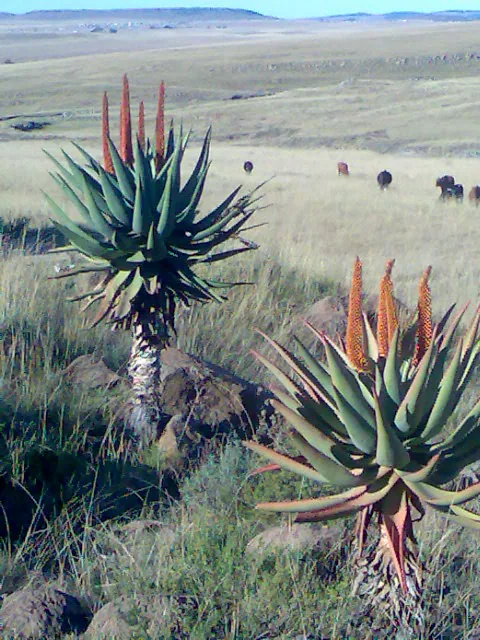
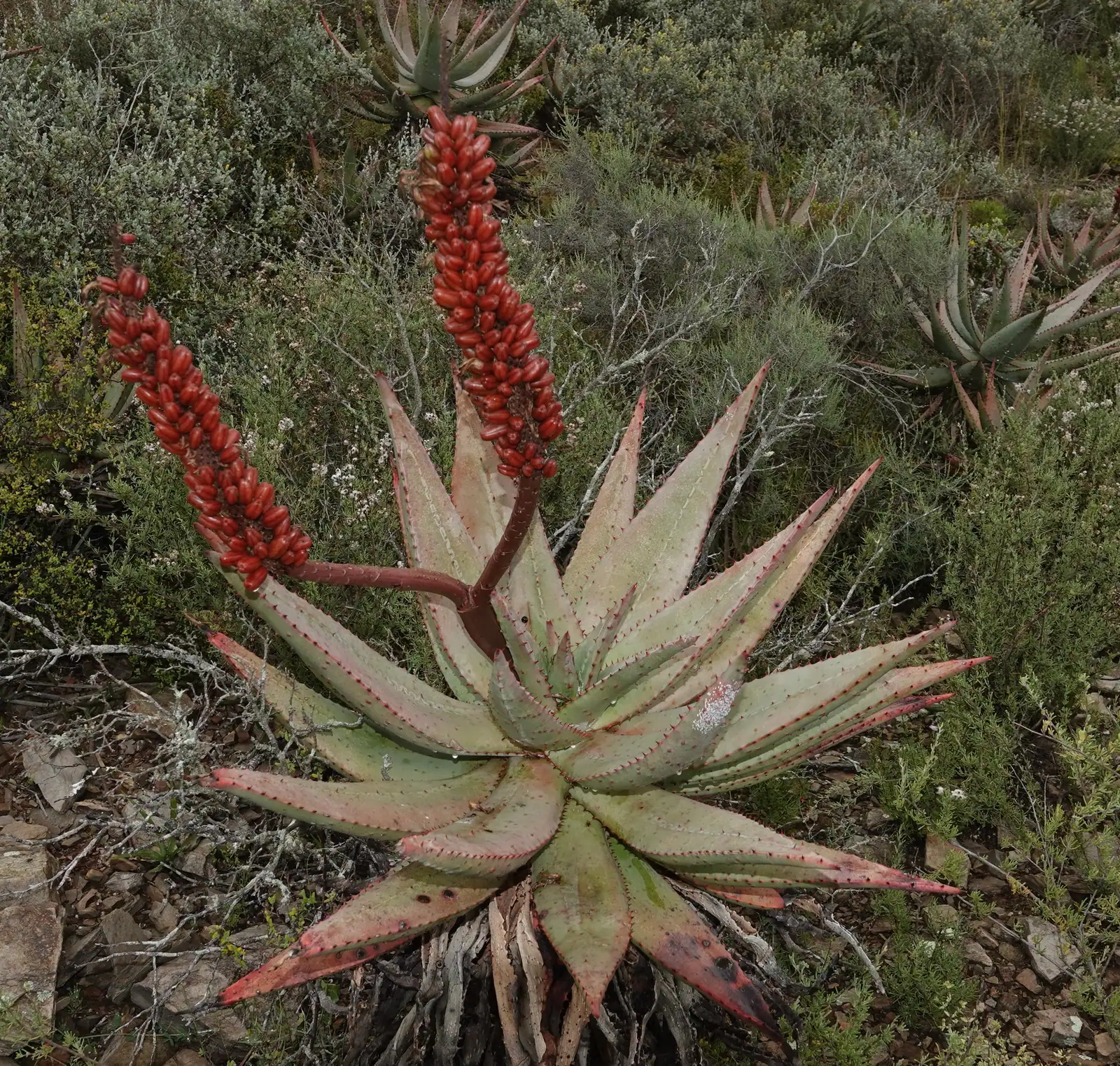
Aloe ferox is a tall, single-stemmed South African aloe used as an accent and container plant and, commercially, for its leaf juice and gel. [6][2][7] It tolerates drought but not winter freezing or waterlogged soil. [2][7] It is mainly a winter-flowering species, with candelabra-like heads of orange to red flowers. [5]
This record is incomplete: the sources we read do not cover every field yet.
Not yet covered by our sources: Pruning
Cape aloe care
Measurements in square brackets are our conversion into the other unit system; the quoted text is unchanged.
How to water Cape aloe
Watering
Infrequent irrigation in summer; tolerates long periods of drought but thrives and flowers better with adequate summer water
Watering notes
Irrigate immediately after planting; waterlogged soils are unsuitable
What the sources say (2)
The land should be ir-rigated immediately after planting.This hardy species can grow in sandy soil, loamy sand or silty loam, provided it is moderately fertile and well drained. Waterlogged, saline and alkaline soils are unsuitable.How much light Cape aloe needs
Full sun to semi-shade
What each source says
central Arizona deserts: Light shade or protection from western afternoon sun
How much cold Cape aloe can take
Hardiness, coldest zone
9 [winter low −6.7 to −1.1 °C (20 to 30 °F)]
What the sources say (1)
Sunset 12 and 13 with protection, 16-24
USDA 9-11Hardiness, warmest zone
11 [winter low 4.4 to 10 °C (40 to 50 °F)]
What the sources say (1)
Sunset 12 and 13 with protection, 16-24
USDA 9-11Where to grow Cape aloe
In containers
Yes
What the sources say (1)
Landscape Use: Cape aloe is a great accent plant for xeric gardens, container plant.Spacing
The sources give different values depending on region, zone or growing conditions.
What each source says
commercial field production (bed layout): 50 cm [20 in] between plants (60 cm [24 in] between rows)
nursery: 150-200 cm (1.5-2 m)
How to propagate Cape aloe
Cape aloe pests and problems
Aloe snout beetle
Symptom: The larvae tunnel into the stems, so that the plant starts to rot and ultimately collapses
What to do: Plants can be treated by injecting recommended insecticide into small holes drilled into the stem
Scale insects
Symptom: White scale insects become visible as neat white rows on the leaves, especially on the lower surfaces
What to do: Scale insects can be killed off with recommended insecticides
What the sources say (2)
One of the most unsightly aloe infestations is caused by white scale insects that become visible as neat white rows on the leaves, espe-cially on the lower surfaces.
— Aloe feroxAloe ferox [7] These and other scale insects can easily be killed off by the use of recommended insecticides.
— Aloe feroxAloe ferox [7]
Remedies
The sources we checked give no remedies for this plant.
Calendar
Planting
Spring
What the sources say (1)
Aloe ferox can be planted in spring, 1, 5 to 2 m from each other in the nurs-ery.Harvest
Leaves are harvested in winter, once the crop is 18 months old
What the sources say (1)
The crop is ready for harvesting after 18 months of cultivation. Harvesting is done in winterPruning
Not stated in the sources we read.
Months as given by the sources, which are mostly from the United States (northern hemisphere). In the southern hemisphere they shift by about six months.
Edibility
Reported by the source, quoted verbatim. Do not eat a plant on the basis of this page alone: identification mistakes can be dangerous.
Aloe ferox is used in beverages and for medicinal purposes.
[7]
Indicative values
Values from a secondary source, not checked word for word like the rest of this page. Use them as a starting point.
- Life cycle
- Herbaceous PerennialIndicative value, adapt it to your climate · Secondary source
- Mature height
- 198.1-365.8 cm (6.5-12 ft)Indicative value, adapt it to your climate · Secondary source
- Soil pH
- 6-7Indicative value, adapt it to your climate · Secondary source
- Growth rate
- LowIndicative value, adapt it to your climate · Secondary source
- Pruning
- May, June, July, AugustIndicative value, adapt it to your climate · Secondary source
Similar plants
- Aloe striata Aloe striata
- Soap aloe Aloe maculata
- Aloe aristata Aloe aristata
- Aloe vera Aloe vera
- Krantz aloe Aloe arborescens
- Abies grandis Abies grandis
- Abraham Trachystemon orientalis
- Abyssinian banana Ensete ventricosum
Sources
Every value above is quoted from these documents. Links lead to the original publisher.
- Aloe ferox – „Wilde Schwester“ der Aloe vera · botanischergarten.univie.ac.at, consulted
- · asu.edu, consulted
- NParks | Aloe ferox · nparks.gov.sg, consulted
- Aloe | Eden Project · edenproject.com, consulted
- Aloe ferox - The Ruth Bancroft Garden & Nursery · ruthbancroftgarden.org, consulted
- Aloe ferox · plantzafrica.com, consulted
- Aloe feroxAloe ferox · old.dalrrd.gov.za, consulted
- Tips on how to grow aloe · farmersweekly.co.za, consulted
Written by Emilio Marruso · last checked