
How to Grow and Care for Aloe striata
Aloe striata
Written by Emilio Marruso · last checked
Toxic to: Cats, Dogs, People · Why
At a glance
Aloe striata is an easygoing succulent that thrives in full sun to light shade and shrugs off drought. Give it a very well-drained spot, water it without overdoing it, and simply cut off the spent flower stalks in spring. It grows happily in containers too, and you can share it with friends by dividing the clumps.
- Sun
Full sun to light shade; shield it from hot afternoon sun in summer
What the sources say (6)
Light: Full sun to light shade
According to SANBI PlantZAfrica: provided it is planted in a well-drained situation in full sun and given adequate water but not over-watered. It can withstand extreme frost and prolonged drought.
— Aloe striata [1] According to LLIFLE: Grows it full sun and but protect in summer from afternoon sun, and avoid reflected heat.
— Aloe striata [2] Phoenix: Light: Light shade including protection from western afternoon sun is best in Phoenix.
— [3] provided it is planted in a well-drained situation in full sun and given adequate water but not over-watered. It can withstand extreme frost and prolonged drought.
— Aloe striata [1] It is easy to cultivate under a wide variety of climatic conditions, thriving in full sun or light shade.
— The Coral Aloe is perfect to plant in gardens small or large [4] Grows it full sun and but protect in summer from afternoon sun, and avoid reflected heat.
— Aloe striata [2] - Water
Drought tolerant: water enough but never too much; keep it dry in winter in very cold areas
What the sources say (7)
Watering: Adequate water but not over-watered; drought tolerant
Phoenix: Watering: In Phoenix, give coral aloe infrequent supplemental water especially during the hot summer months for best performance.
— [3] According to Gardening in South Africa: It is most important to provide very well-drained soil, and although it can survive prolonged drought, in the garden it will look at its best if it can be watered moderately during long, hot and dry spells.
— The Coral Aloe is perfect to plant in gardens small or large [4] provided it is planted in a well-drained situation in full sun and given adequate water but not over-watered. It can withstand extreme frost and prolonged drought.
— Aloe striata [1] It is most important to provide very well-drained soil, and although it can survive prolonged drought, in the garden it will look at its best if it can be watered moderately during long, hot and dry spells.
— The Coral Aloe is perfect to plant in gardens small or large [4] Watering notes: Plant in a very well-drained position; in very cold regions keep it on the dry side in winter
provided it is planted in a well-drained situation in full sun and given adequate water but not over-watered. It can withstand extreme frost and prolonged drought.
— Aloe striata [1] It is most important to provide very well-drained soil, and although it can survive prolonged drought, in the garden it will look at its best if it can be watered moderately during long, hot and dry spells.
— The Coral Aloe is perfect to plant in gardens small or large [4] but the flowers may be damaged by severe frost. In very cold regions, keep it on the dry side in winter.
— The Coral Aloe is perfect to plant in gardens small or large [4] - Soil
Needs a spot with very good drainage
What the sources say (3)
Watering notes: Plant in a very well-drained position; in very cold regions keep it on the dry side in winter
provided it is planted in a well-drained situation in full sun and given adequate water but not over-watered. It can withstand extreme frost and prolonged drought.
— Aloe striata [1] It is most important to provide very well-drained soil, and although it can survive prolonged drought, in the garden it will look at its best if it can be watered moderately during long, hot and dry spells.
— The Coral Aloe is perfect to plant in gardens small or large [4] but the flowers may be damaged by severe frost. In very cold regions, keep it on the dry side in winter.
— The Coral Aloe is perfect to plant in gardens small or large [4] - Pruning
In spring, after flowering, just cut off the dry flower stalks
What the sources say (3)
Pruning: Spring, after bloom (removal of flower stalks only)
Phoenix: Pruning: None except to remove flower stalks in spring after bloom. Otherwise, divide and separate vegetative clumps every 3 to 5 years in maintain vigor and control spread.
— [3] According to Gardening in South Africa: It also requires no pruning besides the removal of the spent flower stalks as required.
— The Coral Aloe is perfect to plant in gardens small or large [4] Pruning: None except to remove flower stalks in spring after bloom. Otherwise, divide and separate vegetative clumps every 3 to 5 years in maintain vigor and control spread.
— [3] - Pests
Weevils, scale, mealybugs and aloe rust, mostly on stressed plants
- Propagation
From seed or by dividing the clumps
What the sources say (2)
Propagation: Seed; division of clumps
Propagation is from seed which germinates easily if sown in well drained soil and covered lightly with fine sand.
— Aloe striata [1] Propagation: Easy to propagate from seed which germinate easily if sown in well drained soil and are covered lightly with fine sand. Division of clumps every few years
— [3] - Containers
Grows in containers too
What the sources say (3)
In containers: Yes
Aloe striata is a popular and most rewarding garden and pot plant. Mostly a winter grower,
— Aloe striata [2] small scale ground cover or edging plant for succulent or rock gardens, great patio container plant or walkway plant
— [3] but is just as lovely as a solitary specimen plant, and because it also thrives in large pots, this aloe is perfect for gardens large and small.
— The Coral Aloe is perfect to plant in gardens small or large [4] - Safety
Leaves make cats and dogs sick (vomiting, diarrhea); never swallow the sap
Overview
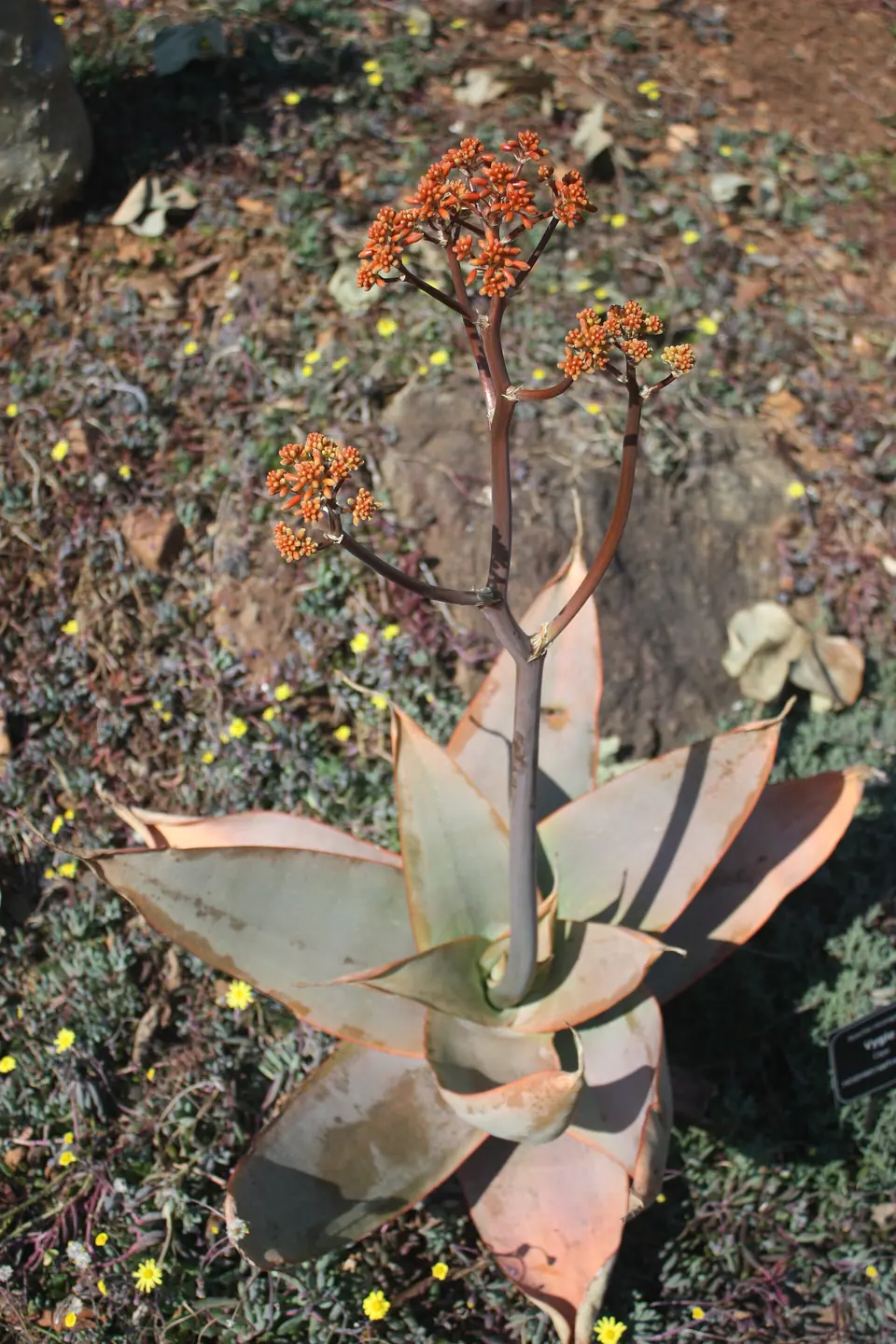
Coral aloe is a stemless aloe with blue-green leaves whose margins are smooth and pinkish rather than toothed. [1] It is easy to grow in a well-drained position in full sun, with adequate water but without over-watering. [1] It is propagated from seed, which germinates easily when sown in well-drained soil and lightly covered with fine sand. [1]
This record is incomplete: the sources we read do not cover every field yet.
Not yet covered by our sources: Hardiness, coldest zone
Aloe striata care
How to water Aloe striata
Watering
Adequate water but not over-watered; drought tolerant
What each source says
Phoenix: Infrequent supplemental water, especially in the hot summer months
According to Gardening in South Africa: Moderate watering during long, hot and dry spells
What the sources say (4)
Phoenix: Watering: In Phoenix, give coral aloe infrequent supplemental water especially during the hot summer months for best performance.According to Gardening in South Africa: It is most important to provide very well-drained soil, and although it can survive prolonged drought, in the garden it will look at its best if it can be watered moderately during long, hot and dry spells.provided it is planted in a well-drained
situation in full sun and given adequate water but not over-watered.
It can withstand extreme frost and prolonged drought.It is most important to provide very well-drained soil, and although it can survive prolonged drought, in the garden it will look at its best if it can be watered moderately during long, hot and dry spells.Watering notes
Plant in a very well-drained position; in very cold regions keep it on the dry side in winter
What the sources say (3)
provided it is planted in a well-drained
situation in full sun and given adequate water but not over-watered.
It can withstand extreme frost and prolonged drought.It is most important to provide very well-drained soil, and although it can survive prolonged drought, in the garden it will look at its best if it can be watered moderately during long, hot and dry spells.but the flowers may be damaged by severe frost. In very cold regions, keep it on the dry side in winter.How much light Aloe striata needs
Full sun to light shade
What each source says
According to SANBI PlantZAfrica: Full sun
According to LLIFLE: Full sun, protected from afternoon sun in summer
Phoenix: Light shade with protection from western afternoon sun
What the sources say (6)
According to SANBI PlantZAfrica: provided it is planted in a well-drained
situation in full sun and given adequate water but not over-watered.
It can withstand extreme frost and prolonged drought.According to LLIFLE: Grows it full sun and but protect in summer from afternoon sun, and avoid reflected heat.Phoenix: Light: Light shade including protection from western afternoon sun is best in Phoenix.provided it is planted in a well-drained
situation in full sun and given adequate water but not over-watered.
It can withstand extreme frost and prolonged drought.It is easy to cultivate under a wide variety of climatic conditions, thriving in full sun or light shade.Grows it full sun and but protect in summer from afternoon sun, and avoid reflected heat.How much cold Aloe striata can take
Hardiness, coldest zone
Not stated in the sources we read.
Hardiness, warmest zone
11 [winter low 4.4 to 10 °C (40 to 50 °F)]
What the sources say (1)
Hardiness zones
Sunset 12 and 13 (with protection), 16-24
USDA 9 (with protection)-11Where to grow Aloe striata
Yes
What the sources say (3)
Aloe striata is a popular and most rewarding garden and pot plant. Mostly a winter grower,small scale ground cover or edging plant for succulent or rock gardens, great patio container plant or walkway plantbut is just as lovely as a solitary specimen plant, and because it also thrives in large pots, this aloe is perfect for gardens large and small.How to propagate Aloe striata
Seed; division of clumps
What the sources say (2)
Propagation is from seed which germinates easily
if sown in well drained soil and covered lightly with fine sand.Propagation: Easy to propagate from seed which germinate easily if sown in well drained soil and are covered lightly with fine sand. Division of clumps every few yearsAloe striata pests and problems
Snout weevil, white scale and aloe rust
Symptom: Attack by snout weevil, white scale and aloe rust, mainly on stressed plants
What to do: Treat symptomatically when they occur
What the sources say (2)
This species, as with most Aloe species , is subject to attack by snout weevil, white scale and aloe rust, although healthy specimens don't fall prey to pests and disease as easily as stressed plants do.
— Aloe striata [1] These maladies are best treated symptomatically when they occur
— Aloe striata [1] Mealybugs
Symptom: Mealybug infestation in sheltered gardens
What the sources say (1)
this species can succumb to white scale and aloe rust, and in sheltered gardens watch out for mealybugs.
— The Coral Aloe is perfect to plant in gardens small or large [4]
Remedies
Each remedy shows what official sources say about it; traditional remedies without an official source are marked as such. Harmful ones are listed so you know to avoid them.
First aid
First aid: not a substitute for a doctor
ingestion
removing plant pieces from the mouth and rinsing Official source, not independently tested
Call the NSW Poisons Information Centre on 13 11 26 for immediate support. They will give you information about any first aid you need to do and tell you which emergency department to go to.
— schn.health.nsw.gov.au [5] Seek medical help right way. Do not make the person throw up unless poison control or a health care provider tells you to.
— medlineplus.gov [6] Get medical help if a rash, throat tightness, difficulty breathing, or chest pain develop.
— medlineplus.gov [6] How: Remove plant pieces from the mouth, then rinse with water.
flushing the eyes with clean, running water for 10-15 minutes - removing plant pieces from your child's mouth, then rinsing with water.
— schn.health.nsw.gov.au [5]
Is Aloe striata toxic to pets?
Reported by the source, quoted verbatim. This is not medical or veterinary advice: if a person or an animal may have eaten this plant, contact a poison control centre or a veterinarian.
Animals
Its level of toxicity is mild to moderate for cats and dogs, and if they chew on the leaves, vomiting, diarrhoea, lethargy, depression, anorexia, tremors, and a change in urine colour may occur.
[4]- Poisonous parts
Its level of toxicity is mild to moderate for cats and dogs, and if they chew on the leaves, vomiting, diarrhoea, lethargy, depression, anorexia, tremors, and a change in urine colour may occur.
[4]- Symptoms
Its level of toxicity is mild to moderate for cats and dogs, and if they chew on the leaves, vomiting, diarrhoea, lethargy, depression, anorexia, tremors, and a change in urine colour may occur.
[4]- Severity
Its level of toxicity is mild to moderate for cats and dogs, and if they chew on the leaves, vomiting, diarrhoea, lethargy, depression, anorexia, tremors, and a change in urine colour may occur.
[4]
People
Avoid using aloe latex orally, as if you swallow it, you will likely have diarrhoea.
[4]- Poisonous parts
Avoid using aloe latex orally, as if you swallow it, you will likely have diarrhoea.
[4]- Symptoms
Avoid using aloe latex orally, as if you swallow it, you will likely have diarrhoea.
[4]- Symptoms
Although aloe gel is generally safe and can be effective in treating skin conditions such as burns and psoriasis, a small number of people have an allergic reaction to aloe, which can be dangerous.
[4]
Calendar
Pruning
Spring, after bloom (removal of flower stalks only)
What each source says
Phoenix: Spring, after bloom
According to Gardening in South Africa: Spent flower stalks removed as required
What the sources say (3)
Phoenix: Pruning: None except to remove flower stalks in spring after bloom. Otherwise, divide and separate vegetative clumps every 3 to 5 years in maintain vigor and control spread.According to Gardening in South Africa: It also requires no pruning besides the removal of the spent flower stalks as required.Pruning: None except to remove flower stalks in spring after bloom. Otherwise, divide and separate vegetative clumps every 3 to 5 years in maintain vigor and control spread.Months as given by the sources, which are mostly from the United States (northern hemisphere). In the southern hemisphere they shift by about six months.
Indicative values
Values from a secondary source, not checked word for word like the rest of this page. Use them as a starting point.
- Life cycle
- Herbaceous PerennialIndicative value, adapt it to your climate · Secondary source
- Mature height
- 30.5-61 cm (1-2 ft)Indicative value, adapt it to your climate · Secondary source
- Hours of sun
- 6-8 hoursIndicative value, adapt it to your climate · Secondary source
- Drought tolerant
- yesIndicative value, adapt it to your climate · Secondary source
- Soil pH
- 6-7Indicative value, adapt it to your climate · Secondary source
- Care level
- MediumIndicative value, adapt it to your climate · Secondary source
- Growth rate
- LowIndicative value, adapt it to your climate · Secondary source
Similar plants
- Cape aloe Aloe ferox
- Soap aloe Aloe maculata
- Aloe aristata Aloe aristata
- Aloe vera Aloe vera
- Krantz aloe Aloe arborescens
- Abies grandis Abies grandis
- Abraham Trachystemon orientalis
- Abyssinian banana Ensete ventricosum
Sources
Every value above is quoted from these documents. Links lead to the original publisher.
- Aloe striata · plantzafrica.com, consulted
- Aloe striata · llifle.com, consulted
- · asu.edu, consulted
- The Coral Aloe is perfect to plant in gardens small or large · gardeninginsouthafrica.co.za, consulted
- schn.health.nsw.gov.au · schn.health.nsw.gov.au
- medlineplus.gov · medlineplus.gov
Written by Emilio Marruso · last checked