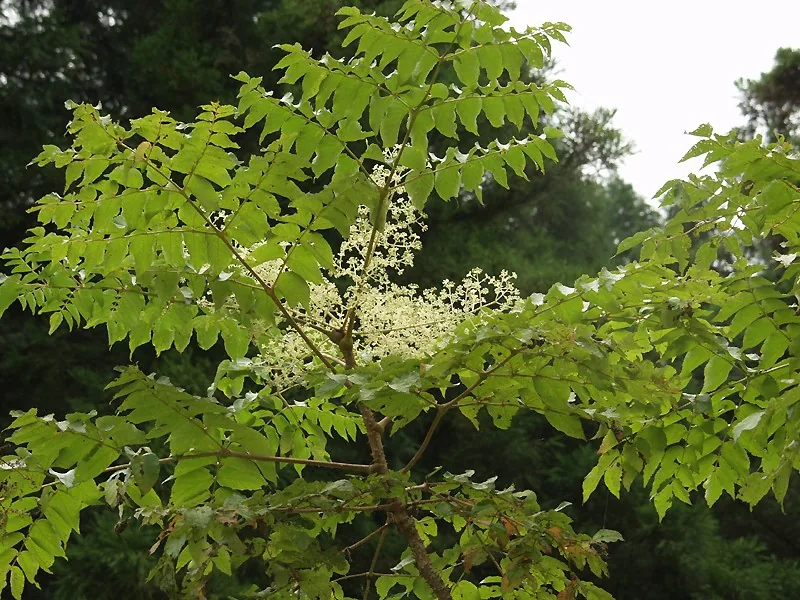


How to Grow and Care for Angelica Tree
Aralia elata
Written by Emilio Marruso · last checked
At a glance
This plant is easygoing about light, happy anywhere from full sun to partial shade, and it spreads 6–10 ft wide. Birds love its abundant black fruits. To keep it in its place, cut the flowers in late summer as soon as they fade, and pull up young plants and suckers before they form thickets.
- Sun
Full sun to partial shade
What the sources say (2)
Light: Full sun to partial shade
Full sun (6 or more hours of direct sunlight a day)
— Aralia elata (Angelica Tree, Japanese Angelica Tree) | North Carolina Extension Gardener Plant Toolbox [1] Partial Shade (Direct sunlight only part of the day, 2-6 hours)
— Aralia elata (Angelica Tree, Japanese Angelica Tree) | North Carolina Extension Gardener Plant Toolbox [1] - Cold
Survives winters down to −30 °F (−34.4 °C)
Very hardy · USDA 4a · RHS H7 · Z4
What the sources say (2)
Hardiness, coldest zone: 4a [winter low −34.4 to −31.7 °C (−30 to −25 °F)]
4a, 4b, 5a, 5b, 6a, 6b, 7a, 7b, 8a, 8b, 9a, 9b
— Aralia elata (Angelica Tree, Japanese Angelica Tree) | North Carolina Extension Gardener Plant Toolbox [1] Hardiness, warmest zone: 9b [winter low −3.9 to −1.1 °C (25 to 30 °F)]
4a, 4b, 5a, 5b, 6a, 6b, 7a, 7b, 8a, 8b, 9a, 9b
— Aralia elata (Angelica Tree, Japanese Angelica Tree) | North Carolina Extension Gardener Plant Toolbox [1] - Pruning
Cut the flowers in late summer as soon as they fade
What the sources say (1)
Pruning: Cut the flowers in late summer as soon as they fade
The flowers should be cut in late summer as soon as they fade then bagged and trashed to avoid seed spread.
— Aralia elata (Angelica Tree, Japanese Angelica Tree) | North Carolina Extension Gardener Plant Toolbox [1] - Pests
Aphids, mealybugs and leaf spots
What the sources say (2)
Pests: aphids, mealybugs
Insects, Diseases and Other Plant Problems : Susceptible to leaf spots, aphids and mealybugs.
— Aralia elata (Angelica Tree, Japanese Angelica Tree) | North Carolina Extension Gardener Plant Toolbox [1] Diseases: leaf spots
Insects, Diseases and Other Plant Problems : Susceptible to leaf spots, aphids and mealybugs.
— Aralia elata (Angelica Tree, Japanese Angelica Tree) | North Carolina Extension Gardener Plant Toolbox [1] - Watch out
Spreads by suckers and bird-carried seed: pull young plants, dig each sucker out to the main stem
- Size
6–10 ft wide
What the sources say (1)
Mature width: 183-305 cm (6-10 ft)
Japanese angelica grows 8 to 20 feet tall and 6 to 10 feet wide and is difficult to control.
— Aralia elata (Angelica Tree, Japanese Angelica Tree) | North Carolina Extension Gardener Plant Toolbox [1] - Propagation
By division or by seed
What the sources say (1)
Propagation: Division, seed
Recommended Propagation Strategy: Division Seed Country Or Region Of Origin:
— Aralia elata (Angelica Tree, Japanese Angelica Tree) | North Carolina Extension Gardener Plant Toolbox [1]
Overview
Japanese angelica tree is a fast-growing deciduous multistemmed large shrub or small tree with spines on trunk and branches. [1] It is an invasive species in North Carolina, introduced to the United States in 1830 from eastern Asia. [1] It grows in full sun to partial shade. [1]
Angelica Tree care
How much light Angelica Tree needs
Full sun to partial shade
What the sources say (2)
Full sun (6 or more hours of direct sunlight a day)Partial Shade (Direct sunlight only part of the day, 2-6 hours)How much cold Angelica Tree can take
Hardiness, coldest zone
4a [winter low −34.4 to −31.7 °C (−30 to −25 °F)]
What the sources say (1)
4a, 4b, 5a, 5b, 6a, 6b, 7a, 7b, 8a, 8b, 9a, 9bHardiness, warmest zone
9b [winter low −3.9 to −1.1 °C (25 to 30 °F)]
What the sources say (1)
4a, 4b, 5a, 5b, 6a, 6b, 7a, 7b, 8a, 8b, 9a, 9bHow to propagate Angelica Tree
Division, seed
What the sources say (1)
Recommended Propagation Strategy:
Division
Seed
Country Or Region Of Origin:How to grow Angelica Tree
The plant
Family
Araliaceae
What the sources say (1)
Japanese angelica tree is a rapidly growing, woody deciduous, multistemmed large shrub or small tree in the ginseng family (Araliaceae).Mature height
Mature width
183-305 cm (6-10 ft)
What the sources say (1)
Japanese angelica grows 8 to 20 feet tall and 6 to 10 feet wide and is difficult to control.Pests and diseases
Pests
aphids, mealybugs
What the sources say (1)
Insects, Diseases and Other Plant Problems : Susceptible to leaf spots, aphids and mealybugs.Diseases
leaf spots
What the sources say (1)
Insects, Diseases and Other Plant Problems : Susceptible to leaf spots, aphids and mealybugs.Angelica Tree pests and problems
Leaf spots, aphids and mealybugs
Symptom: Susceptible to leaf spots, aphids and mealybugs.
What to do: Not given in the sources.
What the sources say (1)
Insects, Diseases and Other Plant Problems : Susceptible to leaf spots, aphids and mealybugs.
— Aralia elata (Angelica Tree, Japanese Angelica Tree) | North Carolina Extension Gardener Plant Toolbox [1] Invasive spread by suckers and seed
Symptom: Root suckers and resprouting from cut or injured stems form dense thickets; birds disperse the seeds.
What to do: Hand-pull young plants; cut flowers before they fruit; each sucker must be dug out to the point where it meets the main stem.
What the sources say (2)
root suckers and resprouting from cut or injured stems allow it to form dense thickets
— Invasives in Your Woodland: Japanese Angelica Tree | University of Maryland Extension [2] Each sucker must be dug out to the point where it meets the main stem.
— Aralia elata (Angelica Tree, Japanese Angelica Tree) | North Carolina Extension Gardener Plant Toolbox [1]
Remedies
Each remedy shows what official sources say about it; traditional remedies without an official source are marked as such. Harmful ones are listed so you know to avoid them.
Getting rid of it
invasive spread
digging up young saplings Partly works
Angelica tree can be identified in the winter even as a young sapling by its stems and bark that are covered in sharp spines and large leaf scars
— envirostewards.rutgers.edu [3] How: Young saplings can be dug up, removing the entire root or the plant will re-sprout.
Young saplings can be dug up, being careful to remove the entire root or the plant will re-sprout.
— envirostewards.rutgers.edu [3] What the evidence says Hand-pull young plants, and treat larger individuals with foliar sprays, basal bark, or cut-stump treatments
— Invasives in Your Woodland: Japanese Angelica Tree | University of Maryland Extension [2] removing flower heads before seed Partly works
Angelica tree can be identified in the winter even as a young sapling by its stems and bark that are covered in sharp spines and large leaf scars
— envirostewards.rutgers.edu [3] How: Remove the flower head in summer so it does not go to seed.
Remove the inflorescence (flower head) in the summer so it does not go to seed.
— envirostewards.rutgers.edu [3] What the evidence says Monitor for new seedlings and prevent reinvasion by cutting flowers before they fruit.
— Invasives in Your Woodland: Japanese Angelica Tree | University of Maryland Extension [2]
Calendar
Pruning
Cut the flowers in late summer as soon as they fade
What the sources say (1)
The flowers should be cut in late summer as soon as they fade then bagged and trashed to avoid seed spread.Months as given by the sources, which are mostly from the United States (northern hemisphere). In the southern hemisphere they shift by about six months.
Edibility
Reported by the source, quoted verbatim. Do not eat a plant on the basis of this page alone: identification mistakes can be dangerous.
Birds eat its abundant black fruits and disperse the seeds over long distances
[2]
Indicative values
Values from a secondary source, not checked word for word like the rest of this page. Use them as a starting point.
- Life cycle
- PerennialIndicative value, adapt it to your climate · Secondary source · Data for the variety Aralia elata 'Variegata'
- Hours of sun
- 4-6 hoursIndicative value, adapt it to your climate · Secondary source · Data for the variety Aralia elata 'Variegata'
- Watering
- AverageIndicative value, adapt it to your climate · Secondary source · Data for the variety Aralia elata 'Variegata'
- Soil
- Humus richIndicative value, adapt it to your climate · Secondary source · Data for the variety Aralia elata 'Variegata'
- Soil pH
- 5.5-6.5Indicative value, adapt it to your climate · Secondary source · Data for the variety Aralia elata 'Variegata'
- Care level
- MediumIndicative value, adapt it to your climate · Secondary source · Data for the variety Aralia elata 'Variegata'
- Growth rate
- ModerateIndicative value, adapt it to your climate · Secondary source · Data for the variety Aralia elata 'Variegata'
Similar plants
- Devil's Walking Stick Aralia spinosa
- Wild sarsaparilla Aralia nudicaulis
- Udo Aralia cordata
- American spikenard Aralia racemosa
- American ginseng Panax quinquefolius
- American Water-Pennywort Hydrocotyle americana
- Balfour Aralia Polyscias balfouriana
- Castor aralia Kalopanax pictus
Sources
Every value above is quoted from these documents. Links lead to the original publisher.
- Aralia elata (Angelica Tree, Japanese Angelica Tree) | North Carolina Extension Gardener Plant Toolbox · plants.ces.ncsu.edu, consulted
- Invasives in Your Woodland: Japanese Angelica Tree | University of Maryland Extension · extension.umd.edu, consulted
- envirostewards.rutgers.edu · envirostewards.rutgers.edu
Written by Emilio Marruso · last checked