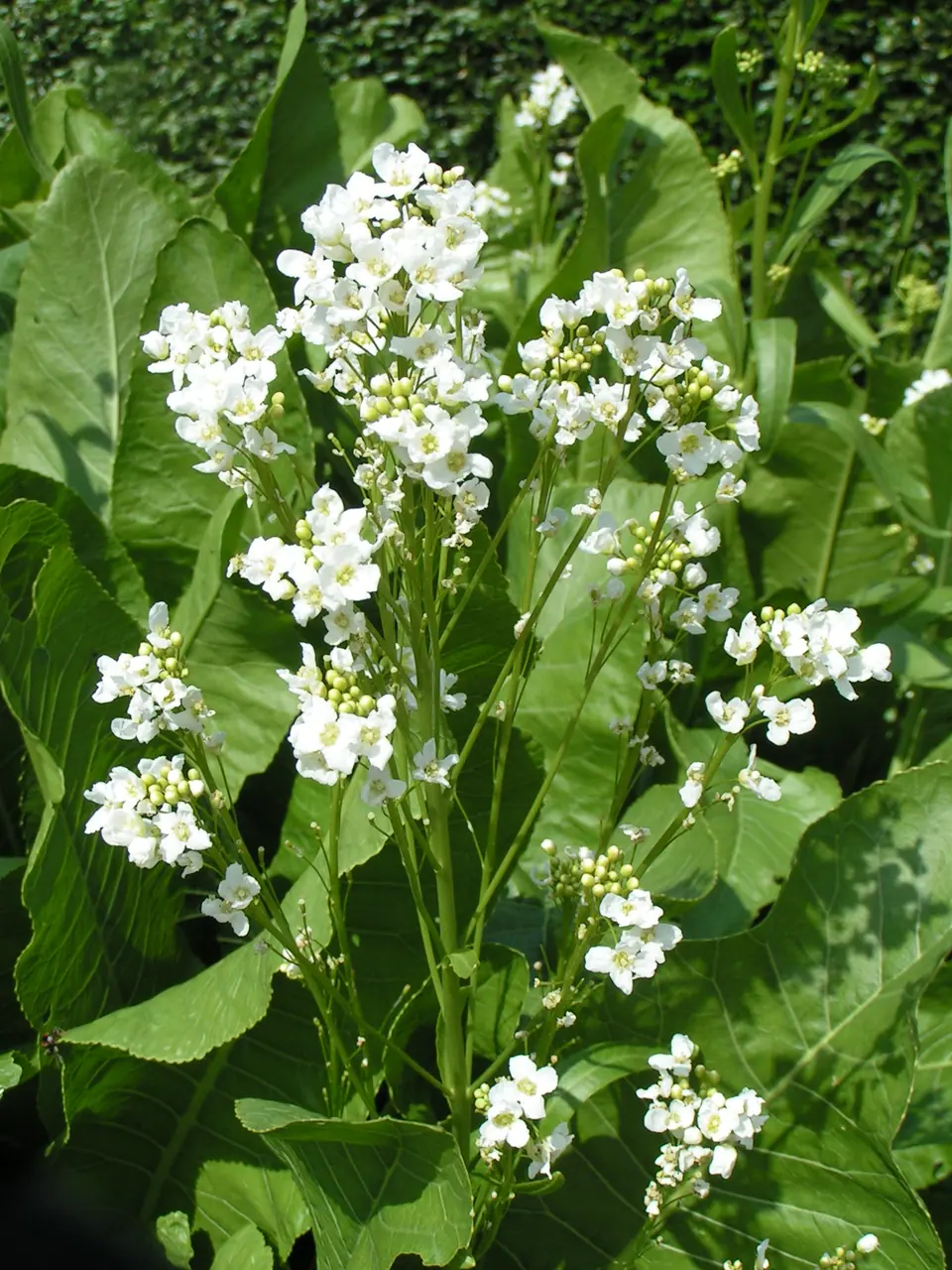


How to Grow and Care for Horseradish
Armoracia rusticana
Written by Emilio Marruso · last checked
Toxic to: Livestock, People · Why
At a glance
Horseradish is a hardy perennial that asks for little: full sun or partial shade, a deep watering once a week, and soil with a pH between 6.0 and 7.5. Plant root cuttings in fall or spring, then dig the roots in the fall after frost has killed the leaves. Use them in small amounts as a condiment, and store extras for up to 3 months.
- Sun
Full sun; also handles partial shade
What the sources say (2)
Light: Full sun; tolerates partial shade
Armoracia does best in full sun but will tolerate partial shade.
— Horseradish, Armoracia rusticana – Wisconsin Horticulture [2] This plant can grow 2-5 feet tall and 2-4 feet wide in full sun in amended well-drained moist garden soil.
— Armoracia rusticana (Horseradish, Red Cole) | North Carolina Extension Gardener Plant Toolbox [1] - Water
1–2 inches once a week, soaking 18–24 in deep; too much water rots the roots
What the sources say (5)
Watering: Once a week (1-2 inches [2.5–5.1 cm] of water) so it penetrates to a depth of 18-24 inches [46–61 cm]; quite drought tolerant
Water horseradish once a week (1-2 inches of water) so it penetrates to a depth of 18-24 inches.
— How to Grow Horseradish in Your Garden | USU [3] Horseradish is quite drought tolerant, but the roots become woody and has a weak flavor if stressed too much.
— How to Grow Horseradish in Your Garden | USU [3] Watering notes: Over-watering makes the roots very soft and strong in flavor and causes root rot; mulching with compost or leaves helps retain moisture
The roots become very soft and have a strong flavor if over watered.
— How to Grow Horseradish in Your Garden | USU [3] Root rot is common if plants are over watered.
— How to Grow Horseradish in Your Garden | USU [3] Mulching with compost or leaves during the year will help retain moisture and suppress weeds.
— How to Grow Horseradish in Your Garden | USU [3] - Cold
Survives winters down to −30 °F (−34.4 °C)
Very hardy · USDA 4a · RHS H7 · Z4
What the sources say (2)
Hardiness, coldest zone: 4a [winter low −34.4 to −31.7 °C (−30 to −25 °F)]
USDA Plant Hardiness Zone: 4a, 4b, 5a, 5b, 6a, 6b, 7a, 7b, 8a, 8b, 9a, 9b
— Armoracia rusticana (Horseradish, Red Cole) | North Carolina Extension Gardener Plant Toolbox [1] Hardiness, warmest zone: 9b [winter low −3.9 to −1.1 °C (25 to 30 °F)]
USDA Plant Hardiness Zone: 4a, 4b, 5a, 5b, 6a, 6b, 7a, 7b, 8a, 8b, 9a, 9b
— Armoracia rusticana (Horseradish, Red Cole) | North Carolina Extension Gardener Plant Toolbox [1] - Soil
Soil pH 6.0–7.5
What the sources say (2)
Soil pH, minimum: 6.0
Horseradish will grow in all soil types provided they are well drained, high in organic matter, and fertile. The recommended pH is 6.0 to 7.5.
— How to Grow Horseradish in Your Garden | USU [3] Soil pH, maximum: 7.5
Horseradish will grow in all soil types provided they are well drained, high in organic matter, and fertile. The recommended pH is 6.0 to 7.5.
— How to Grow Horseradish in Your Garden | USU [3] - Spacing
1 ft between root cuttings, planted 2–3 in deep
What the sources say (1)
Spacing: 30.5 cm (1 ft) between root cuttings, planted 2-3 inches deep
Plant these root pieces 2-3 inches deep and one foot apart.
— How to Grow Horseradish in Your Garden | USU [3] - Planting
Plant in fall or spring
What the sources say (6)
Planting: Fall or spring; early spring (late March or early April in Utah, late winter or early spring in Texas)
According to University of Wisconsin Extension: They can be planted in fall or spring, from divisions or root cuttings purchased from a nursery or garden center
— Horseradish, Armoracia rusticana – Wisconsin Horticulture [2] According to Utah State University Extension: Plant in late March or early April, for the average garden, four to six plants are sufficient
— How to Grow Horseradish in Your Garden | USU [3] According to Texas A&M AgriLife Extension: Plant the roots in late winter or early spring.
— Horseradish - Vegetable Resources Vegetable Resources [6] They can be planted in fall or spring, from divisions or root cuttings purchased from a nursery or garden center
— Horseradish, Armoracia rusticana – Wisconsin Horticulture [2] Plant in late March or early April, for the average garden, four to six plants are sufficient
— How to Grow Horseradish in Your Garden | USU [3] Plant the roots in late winter or early spring.
— Horseradish - Vegetable Resources Vegetable Resources [6] - Feeding
Feed at planting, then nitrogen 4 and 8 weeks later; too much gives big tops and forked roots
What the sources say (3)
How often: At planting, then two nitrogen applications, 4 and 8 weeks after planting
In addition to the fertilizer and at planting, apply 1 teaspoon per plant of nitrogen (21-0-0) 4 and 8 weeks after planting.
— How to Grow Horseradish in Your Garden | USU [3] Avoid: Too much nitrogen
Too much nitrogen will cause excessive top growth and root branching.
— How to Grow Horseradish in Your Garden | USU [3] Signs of excess: Excessive top growth and branching of the roots
Too much nitrogen will cause excessive top growth and root branching.
— How to Grow Horseradish in Your Garden | USU [3] - Harvest
Dig the roots in fall after frost kills the leaves, or in early spring; use in small amounts
What the sources say (4)
Harvest: In the fall after frost has killed the leaves, or in early spring before growth resumes
According to University of Wisconsin Extension: Horseradish is best when harvested in the fall after frost has killed the leaves or in early spring before growth resumes.
— Horseradish, Armoracia rusticana – Wisconsin Horticulture [2] regions with long growing seasons (150 days): In regions with long growing seasons (150 days), horseradish can be harvested at the end of first year.
— How to Grow Horseradish in Your Garden | USU [3] East Texas: Horseradish is harvested in late fall in most areas of East Texas.
— Horseradish - Vegetable Resources Vegetable Resources [6] Horseradish is best when harvested in the fall after frost has killed the leaves or in early spring before growth resumes.
— Horseradish, Armoracia rusticana – Wisconsin Horticulture [2] - Pests
Cabbageworms, flea beetles and mustard leaf beetles; too much water causes root rot
What the sources say (3)
Pests: cabbageworm larvae, mustard leaf beetles, flea beetles
The leaves are occasionally eaten by cabbageworm larvae, mustard leaf beetles and flea beetles.
— Armoracia rusticana (Horseradish, Red Cole) | North Carolina Extension Gardener Plant Toolbox [1] It has few pests, although imported cabbageworm larvae and flea beetles will chew holes in the leaves.
— Horseradish, Armoracia rusticana – Wisconsin Horticulture [2] Diseases: root rot (when over watered)
Few pests or diseases affect horseradish. Root rot is common if plants are over watered.
— How to Grow Horseradish in Your Garden | USU [3] - Watch out
It spreads: any root piece left in the soil grows a new plant, so dig them all up
What the sources say (2)
How to harvest: After several frosts, loosen the soil with a spade or fork, lift the roots, trim off tops and side roots and scrub the root clean; dig all the roots, since small pieces left behind can become weeds.
To harvest, loosen the soil with a spade or fork and then lift the roots by hand. Remove the tops and side shoots.
— Preserving horseradish | OSU Extension Service [4] Harvest begins after several frosts which helps improve flavor. Dig up the plant, trim off the tops and side roots and scrub root clean.
— How to Grow Horseradish in Your Garden | USU [3] - Size
2–5 ft tall and 2–4 ft wide
What the sources say (3)
Mature height: 61-152 cm (2-5 ft)
This plant can grow 2-5 feet tall and 2-4 feet wide in full sun in amended well-drained moist garden soil.
— Armoracia rusticana (Horseradish, Red Cole) | North Carolina Extension Gardener Plant Toolbox [1] Horseradish plants grow as a rosette about 2 feet tall with a spread of 18 inches or more.
— Horseradish, Armoracia rusticana – Wisconsin Horticulture [2] Mature width: 61-122 cm (2-4 ft)
This plant can grow 2-5 feet tall and 2-4 feet wide in full sun in amended well-drained moist garden soil.
— Armoracia rusticana (Horseradish, Red Cole) | North Carolina Extension Gardener Plant Toolbox [1] - Propagation
From crown division or root cuttings
What the sources say (2)
Propagation: Division (crown), root cuttings
Horseradish is propagated from crown or root cuttings.
— How to Grow Horseradish in Your Garden | USU [3] Roots and leaves were used medicinally in the middle ages Life Cycle: Perennial Recommended Propagation Strategy: Division Root Cutting
— Armoracia rusticana (Horseradish, Red Cole) | North Carolina Extension Gardener Plant Toolbox [1] - Containers
Grows in a large, deep container, which also keeps it from spreading
What the sources say (1)
In containers: Yes
It can also be grown in a large, deep container if potential escape is an issue.
— Horseradish, Armoracia rusticana – Wisconsin Horticulture [2] - Safety
Never feed it to animals; the leaves are slightly poisonous to people
Overview
Horseradish is a herbaceous perennial grown for its pungent, fleshy roots that are grated for relish and sauces. [1] It grows in full sun in well-drained, moist soil and can become weedy if roots are left in the ground. [1][2] Roots are harvested after frost in fall or in early spring. [2]
Horseradish care
Measurements in square brackets are our conversion into the other unit system; the quoted text is unchanged.
How to water Horseradish
Watering
Once a week (1-2 inches [2.5–5.1 cm] of water) so it penetrates to a depth of 18-24 inches [46–61 cm]; quite drought tolerant
What the sources say (2)
Water horseradish once a week (1-2 inches of water) so it penetrates to a depth of 18-24 inches.Horseradish is quite drought tolerant, but the roots become woody and has a weak flavor if stressed too much.Watering notes
Over-watering makes the roots very soft and strong in flavor and causes root rot; mulching with compost or leaves helps retain moisture
What the sources say (3)
The roots become very soft and have a strong flavor if over watered.Root rot is common if plants are over watered.Mulching with compost or leaves during the year will help retain moisture and suppress weeds.How much light Horseradish needs
Full sun; tolerates partial shade
What the sources say (2)
Armoracia does best in full sun but will tolerate partial shade.This plant can grow 2-5 feet tall and 2-4 feet wide in full sun in amended well-drained moist garden soil.How much cold Horseradish can take
Hardiness, coldest zone
4a [winter low −34.4 to −31.7 °C (−30 to −25 °F)]
What the sources say (1)
USDA Plant Hardiness Zone:
4a, 4b, 5a, 5b, 6a, 6b, 7a, 7b, 8a, 8b, 9a, 9bHardiness, warmest zone
9b [winter low −3.9 to −1.1 °C (25 to 30 °F)]
What the sources say (1)
USDA Plant Hardiness Zone:
4a, 4b, 5a, 5b, 6a, 6b, 7a, 7b, 8a, 8b, 9a, 9bBest soil for Horseradish
Soil pH, minimum
6.0
What the sources say (1)
Horseradish will grow in all soil types provided they are well drained, high in organic matter, and fertile. The recommended pH is 6.0 to 7.5.Soil pH, maximum
7.5
What the sources say (1)
Horseradish will grow in all soil types provided they are well drained, high in organic matter, and fertile. The recommended pH is 6.0 to 7.5.Where to grow Horseradish
In containers
Yes
What the sources say (1)
It can also be grown in a large, deep container if potential escape is an issue.Spacing
30.5 cm (1 ft) between root cuttings, planted 2-3 inches deep
What the sources say (1)
Plant these root pieces 2-3 inches deep and one foot apart.How to propagate Horseradish
Division (crown), root cuttings
What the sources say (2)
Horseradish is propagated from crown or root cuttings.Roots and leaves were used medicinally in the middle ages
Life Cycle:
Perennial
Recommended Propagation Strategy:
Division
Root CuttingHow to grow Horseradish
The plant
Life cycle
perennial
What each source says
commercial production in Illinois:
What the sources say (3)
commercial production in Illinois: one of the most favorable locations for horseradish cultivation is in Illinois where this perennial is grown as an annual row crop.Horseradish is a herbaceous perennial in the mustard family (Brassicaceae) brought to the US by colonists and is native to Eastern Europe and Western Asia.Horseradish is a hardy perennial vegetable that is grown for its thick yellowish to white taproot.Family
Brassicaceae
What the sources say (2)
Horseradish is a herbaceous perennial in the mustard family (Brassicaceae) brought to the US by colonists and is native to Eastern Europe and Western Asia.This perennial plant in the cabbage family (Brassicaceae) is now grown for its root that is used to create a condimentMature height
61-152 cm (2-5 ft)
What the sources say (2)
This plant can grow 2-5 feet tall and 2-4 feet wide in full sun in amended well-drained moist garden soil.Horseradish plants grow as a rosette about 2 feet tall with a spread of 18 inches or more.Mature width
61-122 cm (2-4 ft)
What the sources say (1)
This plant can grow 2-5 feet tall and 2-4 feet wide in full sun in amended well-drained moist garden soil.Sowing and growth
Days to maturity
150 days growing season; harvest at the end of the first year
What each source says
spring-planted roots in cooler regions:
What the sources say (2)
spring-planted roots in cooler regions: Spring-planted roots probably won’t be ready to harvest by the first fall; most gardeners dig those plants the following spring or fall.In regions with long growing seasons (150 days), horseradish can be harvested at the end of first year.Harvest and storage
How to harvest
After several frosts, loosen the soil with a spade or fork, lift the roots, trim off tops and side roots and scrub the root clean; dig all the roots, since small pieces left behind can become weeds.
What the sources say (2)
To harvest, loosen the soil with a spade or fork and then lift the roots by hand. Remove the tops and side shoots.Harvest begins after several frosts which helps improve flavor. Dig up the plant, trim off the tops and side roots and scrub root clean.Storage
Store intact roots in moist sand or sawdust in a dark root cellar, or in a plastic bag with moist sand in the refrigerator; they keep their flavor for up to 3 months.
What the sources say (2)
Intact roots will retain their flavor for up to 3 months if stored properly. Horseradish roots should be stored in moist sand or sawdust in a dark root cellar, or they can be put in a plastic bag with moist sand and stored in the refrigerator.Intact horseradish roots can be stored under cool, dark conditions with high humidity (eg. in a plastic bag in the refrigerator) for a few months.Pests and diseases
Pests
cabbageworm larvae, mustard leaf beetles, flea beetles
What the sources say (2)
The leaves are occasionally eaten by cabbageworm larvae, mustard leaf beetles and flea beetles.It has few pests, although imported cabbageworm larvae and flea beetles will chew holes in the leaves.Diseases
root rot (when over watered)
What the sources say (1)
Few pests or diseases affect horseradish. Root rot is common if plants are over watered.Fertilizing
When
Before planting, as a soil test indicates; then nitrogen 4 and 8 weeks after planting
What the sources say (2)
Before planting, determine fertilizer needs with a soil test and then follow the recommendations given with the test report.In addition to the fertilizer and at planting, apply 1 teaspoon per plant of nitrogen (21-0-0) 4 and 8 weeks after planting.How often
At planting, then two nitrogen applications, 4 and 8 weeks after planting
What the sources say (1)
In addition to the fertilizer and at planting, apply 1 teaspoon per plant of nitrogen (21-0-0) 4 and 8 weeks after planting.Natural fertilizers
Well-composted organic matter, no more than a 2.54 cm [1 in] layer over the garden area
What the sources say (1)
If you fertilize with compost, apply no more than 1 inch of well-composted organic matter per 100 square feet of garden area.Mineral fertilizers
Nitrogen fertilizer 21-0-0, 4.9 mL per plant at 4 and 8 weeks after planting; other fertilizer according to a soil test, worked into the top 15.2 cm [6 in] of soil
What the sources say (3)
In addition to the fertilizer and at planting, apply 1 teaspoon per plant of nitrogen (21-0-0) 4 and 8 weeks after planting.Before planting, determine fertilizer needs with a soil test and then follow the recommendations given with the test report.If fertilizer applications are warranted, work the fertilizer into the top 6 inches of soil.Avoid
Too much nitrogen
What the sources say (1)
Too much nitrogen will cause excessive top growth and root branching.Signs of excess
Excessive top growth and branching of the roots
What the sources say (1)
Too much nitrogen will cause excessive top growth and root branching.Horseradish pests and problems
Weediness
Symptom: The plant spreads by underground shoots and any root piece left in the soil can grow a new plant
What to do: Dig all the roots at harvest; contain the plant with a buried tub or pots, or grow it in a large deep container
What the sources say (2)
The smallest piece left in the soil can take root and grow into another plant.
— Armoracia rusticana (Horseradish, Red Cole) | North Carolina Extension Gardener Plant Toolbox [1] Burying a large plastic tub with the bottom cut out around the plant may help contain it.
— Horseradish, Armoracia rusticana – Wisconsin Horticulture [2] Leaf-chewing insects
Symptom: Holes chewed in the leaves by imported cabbageworm larvae and flea beetles
What the sources say (1)
It has few pests, although imported cabbageworm larvae and flea beetles will chew holes in the leaves.
— Horseradish, Armoracia rusticana – Wisconsin Horticulture [2] Root rot
Symptom: Root rot when plants are over watered
What to do: Avoid overwatering
What the sources say (1)
Root rot is common if plants are over watered.
— How to Grow Horseradish in Your Garden | USU [3]
Remedies
Each remedy shows what official sources say about it; traditional remedies without an official source are marked as such. Harmful ones are listed so you know to avoid them.
Treating the plant
weediness
burying a plastic tub around the plant Partly works
How: Bury a large plastic tub with the bottom cut out around the plant to contain it.
Burying a large plastic tub with the bottom cut out around the plant may help contain it.
— Horseradish, Armoracia rusticana – Wisconsin Horticulture [2] What the evidence says Burying a large plastic tub with the bottom cut out around the plant may help contain it.
— Horseradish, Armoracia rusticana – Wisconsin Horticulture [2]
aphids
water spray Not verified
Traditional remedy, not verified by an official source.
How: Knock the aphids off with a water spray.
insecticidal soap Works
How: Apply insecticidal soap to aphids.
Knock off with water spray; apply insecticidal soap; inspect new plants carefully; use slow- release fertilizers; avoid excess nitrogen
— almanac.com [7] What the evidence says For example, insecticidal soap is a safe, effective organic insecticide with minimal environmental impact.
— extension.psu.edu [8] neem oil Partly works
Despite these being biological pesticides, it is important to read the directions on the label and wear safety equipment.
— extension.illinois.edu [11] How: Applied against aphids.
One natural remedy is the application of organic insecticides like neem oil , which works effectively against a range of pests, including aphids .
— discover.texasrealfood.com [9] What the evidence says However, neem oil is not effective against every insect and disease, and often must be frequently reapplied to reach the desired outcome.
— extension.unh.edu [10]
flea beetles
row covers and heavy mulch Not verified
Traditional remedy, not verified by an official source.
How: Cover the plants with row covers and mulch heavily.
Getting rid of it
weediness
digging up the whole root every year Partly works
One thing you should absolutely not do is rototill over the plants. Tilling breaks the roots into small pieces that will proliferate in new horseradish plants that can spread far and wide.
— gardeningknowhow.com [12] How: Dig a large hole around the plant, lift the root with a garden fork and check for remaining white pieces of root; repeat until the plant stops coming up.
The most effective way of controlling horseradish is to dig up the plant every year, and try to remove as much of the root as possible.
— gardeningknowhow.com [12] What the evidence says This plant is hardy in zones 2-9 and may be difficult to eradicate once established because the smallest piece of root can grow a new plant.
— Horseradish, Armoracia rusticana – Wisconsin Horticulture [2] mowing and seeding over with grass Not verified
Traditional remedy, not verified by an official source.
How: Mow the horseradish regularly and seed the area with grass seed to stop it spreading.
cabbageworms
handpicking Not verified
Traditional remedy, not verified by an official source.
How: Pick the cabbageworms off by hand; row covers and companion plants such as thyme also help.
Is Horseradish toxic to pets?
Reported by the source, quoted verbatim. This is not medical or veterinary advice: if a person or an animal may have eaten this plant, contact a poison control centre or a veterinarian.
Animals
Do not feed animals horseradish, the volatile oils in the plant cause acute inflammation of the stomach and can be fatal.
[3]- Poisonous parts
Can horseradish leaves and roots be fed to livestock?
[3]- Toxic principle
Do not feed animals horseradish, the volatile oils in the plant cause acute inflammation
[3]- Symptoms
the volatile oils in the plant cause acute inflammation of the stomach and can be fatal.
[3]- Severity
cause acute inflammation of the stomach and can be fatal.
[3]
People
Calendar
Planting
Fall or spring; early spring (late March or early April in Utah, late winter or early spring in Texas)
What each source says
According to University of Wisconsin Extension: Fall or spring
According to Utah State University Extension: Late March or early April
According to Texas A&M AgriLife Extension: Late winter or early spring
What the sources say (6)
According to University of Wisconsin Extension: They can be planted in fall or spring, from divisions or root cuttings purchased from a nursery or garden centerAccording to Utah State University Extension: Plant in late March or early April, for the average garden, four to six plants are sufficientAccording to Texas A&M AgriLife Extension: Plant the roots in late winter or early spring.They can be planted in fall or spring, from divisions or root cuttings purchased from a nursery or garden centerPlant in late March or early April, for the average garden, four to six plants are sufficientPlant the roots in late winter or early spring.Harvest
In the fall after frost has killed the leaves, or in early spring before growth resumes
What each source says
According to University of Wisconsin Extension: Fall after frost has killed the leaves, or early spring before growth resumes
regions with long growing seasons (150 days): End of the first year
East Texas: Late fall
What the sources say (4)
According to University of Wisconsin Extension: Horseradish is best when harvested in the fall after frost has killed the leaves or in early spring before growth resumes.regions with long growing seasons (150 days): In regions with long growing seasons (150 days), horseradish can be harvested at the end of first year.East Texas: Horseradish is harvested in late fall in most areas of East Texas.Horseradish is best when harvested in the fall after frost has killed the leaves or in early spring before growth resumes.Months as given by the sources, which are mostly from the United States (northern hemisphere). In the southern hemisphere they shift by about six months.
Relative to frost
Less precise estimate: there is no weather station within 300 km.
Find frost dates by ZIP code or city
Harvest: around the first frost
Horseradish is best when harvested in the fall after frost has killed the leaves or in early spring before growth resumes.
— Horseradish, Armoracia rusticana – Wisconsin Horticulture [2]
Count from the average frost dates where you live.
Edibility
Reported by the source, quoted verbatim. Do not eat a plant on the basis of this page alone: identification mistakes can be dangerous.
Indicative values
Values from a secondary source, not checked word for word like the rest of this page. Use them as a starting point.
- Hours of sun
- 6-8 hoursIndicative value, adapt it to your climate · Secondary source
- Drought tolerant
- yesIndicative value, adapt it to your climate · Secondary source
- Care level
- MediumIndicative value, adapt it to your climate · Secondary source
- Growth rate
- HighIndicative value, adapt it to your climate · Secondary source
- Pruning
- March, AprilIndicative value, adapt it to your climate · Secondary source
Similar plants
- American Yellow Rocket Barbarea orthoceras
- Black Mustard Brassica nigra
- Broadleaved pepperweed Lepidium latifolium
- Brown Mustard Brassica juncea
- Cabbage Brassica oleracea
- Crested wartycabbage Bunias erucago
- Cultivated radish Raphanus sativus
- Dame's Rocket Hesperis matronalis
Sources
Every value above is quoted from these documents. Links lead to the original publisher.
- Armoracia rusticana (Horseradish, Red Cole) | North Carolina Extension Gardener Plant Toolbox · plants.ces.ncsu.edu, consulted
- Horseradish, Armoracia rusticana – Wisconsin Horticulture · hort.extension.wisc.edu, consulted
- How to Grow Horseradish in Your Garden | USU · extension.usu.edu, consulted
- Preserving horseradish | OSU Extension Service · extension.oregonstate.edu, consulted
- How to Grow and harvest Horseradish | Prairies to Perennials | Illinois Extension | Illinois · extension.illinois.edu, consulted
- Horseradish - Vegetable Resources Vegetable Resources · aggie-horticulture.tamu.edu, consulted
- almanac.com · almanac.com
- extension.psu.edu · extension.psu.edu
- discover.texasrealfood.com · discover.texasrealfood.com
- extension.unh.edu · extension.unh.edu
- extension.illinois.edu · extension.illinois.edu
- gardeningknowhow.com · gardeningknowhow.com
Written by Emilio Marruso · last checked