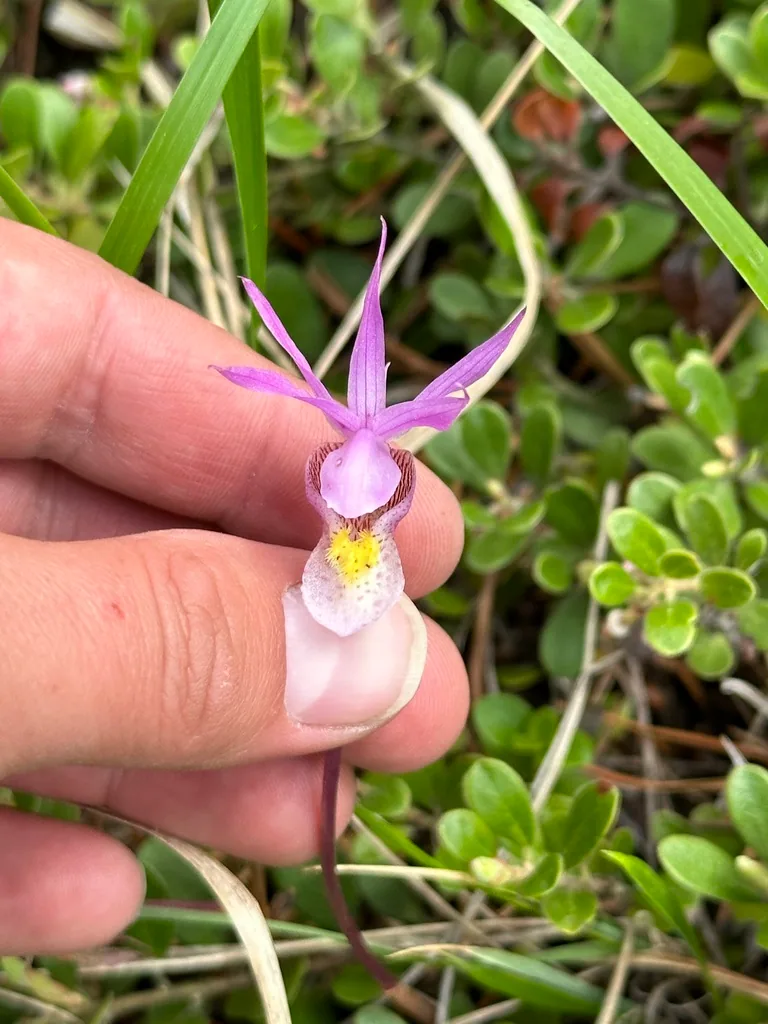
How to Grow and Care for Calypso orchid
Calypso bulbosa
Written by Emilio Marruso · last checked
At a glance
Calypso is a plant for the shady corners of your garden: it is happy in partial shade to shade. Give it regular water without overdoing it, and leave 2 to 3 feet between plants so each one has room. Its corms can be divided with care to make new plants, and Native Americans once used them as food.
- Sun
Partial shade to shade
What the sources say (2)
Light: Partial shade to shade
Enjoys rich, moist soil enriched with leaf mold or bark chips in a neutral to acid soil in partial shade.
— Plant Data Sheet http://depts.washington.edu/propplnt/Plants/calypso.htm [4] part shade, shade; rich woods, coniferous forest
— Calypso bulbosa var. americana (Fairy Slipper): Minnesota Wildflowers [2] - Water
Average needs: water regularly, but do not overwater
What the sources say (1)
Watering: Average water needs; water regularly, do not overwater
Average Water Needs; Water regularly; do not overwater.
— Plant Data Sheet http://depts.washington.edu/propplnt/Plants/calypso.htm [4] - Spacing
2–3 ft between plants
What the sources say (1)
Spacing: 60-90 cm (24-36 in)
Recommended planting density 24-36 in. (60-90 cm)
— Plant Data Sheet http://depts.washington.edu/propplnt/Plants/calypso.htm [4] - Harvest
Native Americans used its corms as food
- Propagation
Divide the corms carefully
What the sources say (1)
Propagation: Careful division of corms
Divide corms very carefully to propigate.
— Plant Data Sheet http://depts.washington.edu/propplnt/Plants/calypso.htm [4]
Overview
Calypso bulbosa inhabits moist forests with cool, rich soils and decaying leaves and wood. [1] Transplanting or cultivating it is rarely successful because it needs specific soil fungi. [3]
This record is incomplete: the sources we read do not cover every field yet.
Not yet covered by our sources: Hardiness, coldest zone, Hardiness, warmest zone, Pruning
Calypso orchid care
How to water Calypso orchid
Average water needs; water regularly, do not overwater
What the sources say (1)
Average Water Needs; Water regularly; do not overwater.How much light Calypso orchid needs
Partial shade to shade
What the sources say (2)
Enjoys rich, moist soil enriched with leaf mold or bark chips in a neutral to acid soil in partial shade.part shade, shade; rich woods, coniferous forestHow much cold Calypso orchid can take
Hardiness, coldest zone
Not stated in the sources we read.
Hardiness, warmest zone
Not stated in the sources we read.
Where to grow Calypso orchid
60-90 cm (24-36 in)
What the sources say (1)
Recommended planting density 24-36 in. (60-90 cm)How to propagate Calypso orchid
Careful division of corms
What the sources say (1)
Divide corms very carefully to propigate.Remedies
The sources we checked give no remedies for this plant.
Calendar
Pruning
Not stated in the sources we read.
Months as given by the sources, which are mostly from the United States (northern hemisphere). In the southern hemisphere they shift by about six months.
Edibility
Reported by the source, quoted verbatim. Do not eat a plant on the basis of this page alone: identification mistakes can be dangerous.
Native Americans used the corms as a food source
[1]
Indicative values
Values from a secondary source, not checked word for word like the rest of this page. Use them as a starting point.
- Mature height
- 7-20 cm [2.8–7.9 in]Indicative value, adapt it to your climate · Secondary source
- Soil pH
- 5-6.5Indicative value, adapt it to your climate · Secondary source
- Care level
- MediumIndicative value, adapt it to your climate · Secondary source
- Growth rate
- LowIndicative value, adapt it to your climate · Secondary source
- Pruning
- June, JulyIndicative value, adapt it to your climate · Secondary source
Similar plants
- Abies grandis Abies grandis
- Acanthus hungaricus Acanthus hungaricus
- Achlys triphylla Achlys triphylla
- Aconite Aconitum napellus
- Afghan Redbud Cercis griffithii
- African Blood Lily Scadoxus multiflorus
- African lily Dietes bicolor
- African Living Rock Pleiospilos bolusii
Sources
Every value above is quoted from these documents. Links lead to the original publisher.
- Calypso Orchid (U.S. National Park Service) · nps.gov, consulted
- Calypso bulbosa var. americana (Fairy Slipper): Minnesota Wildflowers · minnesotawildflowers.info, consulted
- Calypso bulbosa - Useful Temperate Plants · temperate.theferns.info, consulted
- Plant Data Sheet http://depts.washington.edu/propplnt/Plants/calypso.htm · courses.washington.edu, consulted
Written by Emilio Marruso · last checked