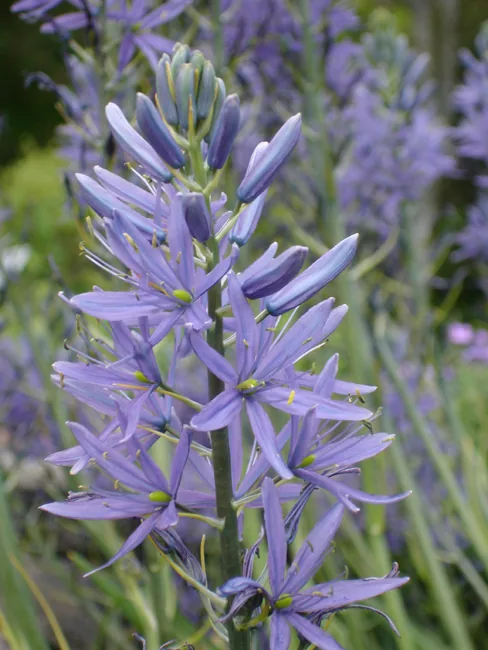

How to Grow and Care for Large camas
Camassia leichtlinii
Written by Emilio Marruso · last checked
At a glance
Camassia is a bulb worth getting to know: plant it in early autumn in full sun, or in part shade if that's what you have. Give it plenty of water in spring, but make sure the spot doesn't stay wet over winter. You can even grow it from seed, and its bulb is edible, with a mild, starchy flavor.
- Sun
Full sun; it also handles part shade
What the sources say (1)
Light: Full sun, tolerating part shade
Prefers a moist, fertile, acidic, humus-rich soil in full sun, tolerating part shade
— Camassia leichtlinii - Useful Temperate Plants [1] - Water
Plenty of water in spring, but the soil must not stay wet over winter
What the sources say (1)
Watering notes: Plenty of moisture in spring but does not remain wet over the winter
that has plenty of moisture in spring but does not remain wet over the winter
— Camassia leichtlinii - Useful Temperate Plants [1] - Planting
Plant the bulbs in early autumn
What the sources say (1)
Planting: Early autumn
Plant the bulbs 7 - 10cm deep in early autumn and then leave undisturbed
— Camassia leichtlinii - Useful Temperate Plants [1] - Harvest
The bulb can be eaten raw: mild and starchy, but a bit gummy
- Propagation
New plants come from seed sown in a cold frame
What the sources say (1)
Propagation: Seed sown in a cold frame
Seed - best sown as soon as it is ripe in a cold frame
— Camassia leichtlinii - Useful Temperate Plants [1] - Sowing
Sow in a cold frame as soon as the seeds are ripe, or in spring
Overview
Camassia leichtlinii is a bulbous perennial often grown as an ornamental in the garden. [1] It prefers a moist, fertile, humus-rich soil in full sun, tolerating part shade, and bulbs are planted in early autumn. [1]
This record is incomplete: the sources we read do not cover every field yet.
Not yet covered by our sources: Watering, Hardiness, coldest zone, Hardiness, warmest zone, Pruning
Large camas care
How to water Large camas
Watering
Not stated in the sources we read.
Watering notes
Plenty of moisture in spring but does not remain wet over the winter
What the sources say (1)
that has plenty of moisture in spring but does not remain wet over the winterHow much light Large camas needs
Full sun, tolerating part shade
What the sources say (1)
Prefers a moist, fertile, acidic, humus-rich soil in full sun, tolerating part shadeHow much cold Large camas can take
Hardiness, coldest zone
Not stated in the sources we read.
Hardiness, warmest zone
Not stated in the sources we read.
How to propagate Large camas
Seed sown in a cold frame
What the sources say (1)
Seed - best sown as soon as it is ripe in a cold frameRemedies
The sources we checked give no remedies for this plant.
Calendar
Planting
Early autumn
What the sources say (1)
Plant the bulbs 7 - 10cm deep in early autumn and then leave undisturbedPruning
Not stated in the sources we read.
Months as given by the sources, which are mostly from the United States (northern hemisphere). In the southern hemisphere they shift by about six months.
Edibility
Reported by the source, quoted verbatim. Do not eat a plant on the basis of this page alone: identification mistakes can be dangerous.
eaten raw it has a mild, starchy flavour, but a gummy texture that reduces the enjoyment of it somewhat
[1]
Indicative values
Values from a secondary source, not checked word for word like the rest of this page. Use them as a starting point.
- Life cycle
- PerennialIndicative value, adapt it to your climate · Secondary source
- Mature height
- 91.4-121.9 cm (3-4 ft)Indicative value, adapt it to your climate · Secondary source
- Watering
- AverageIndicative value, adapt it to your climate · Secondary source
- Drought tolerant
- yesIndicative value, adapt it to your climate · Secondary source
- Soil pH
- 6-7Indicative value, adapt it to your climate · Secondary source
- USDA hardiness zones
- 5-9 [winter low −28.9 to −1.1 °C (−20 to 30 °F)]Indicative value, adapt it to your climate · Secondary source
- Care level
- MediumIndicative value, adapt it to your climate · Secondary source
- Growth rate
- LowIndicative value, adapt it to your climate · Secondary source
- Pruning
- February, MayIndicative value, adapt it to your climate · Secondary source
Similar plants
- Camas Camassia quamash
- Cusick's camass Camassia cusickii
- Wild Hyacinth Camassia scilloides
- Abies grandis Abies grandis
- Abraham Trachystemon orientalis
- Abyssinian banana Ensete ventricosum
- Acacia longifolia Acacia longifolia
- Acanthus hungaricus Acanthus hungaricus
Sources
Every value above is quoted from these documents. Links lead to the original publisher.
- Camassia leichtlinii - Useful Temperate Plants · temperate.theferns.info, consulted
- Camassia leichtlinii Page -licale.htm · people.wou.edu, consulted
- Camassia leichtlinii ssp.suksdorfii 'Blue Danube' - Fine Gardening · finegardening.com, consulted
- How to Plant and Grow Camassia - Camas · harvesttotable.com, consulted
Written by Emilio Marruso · last checked