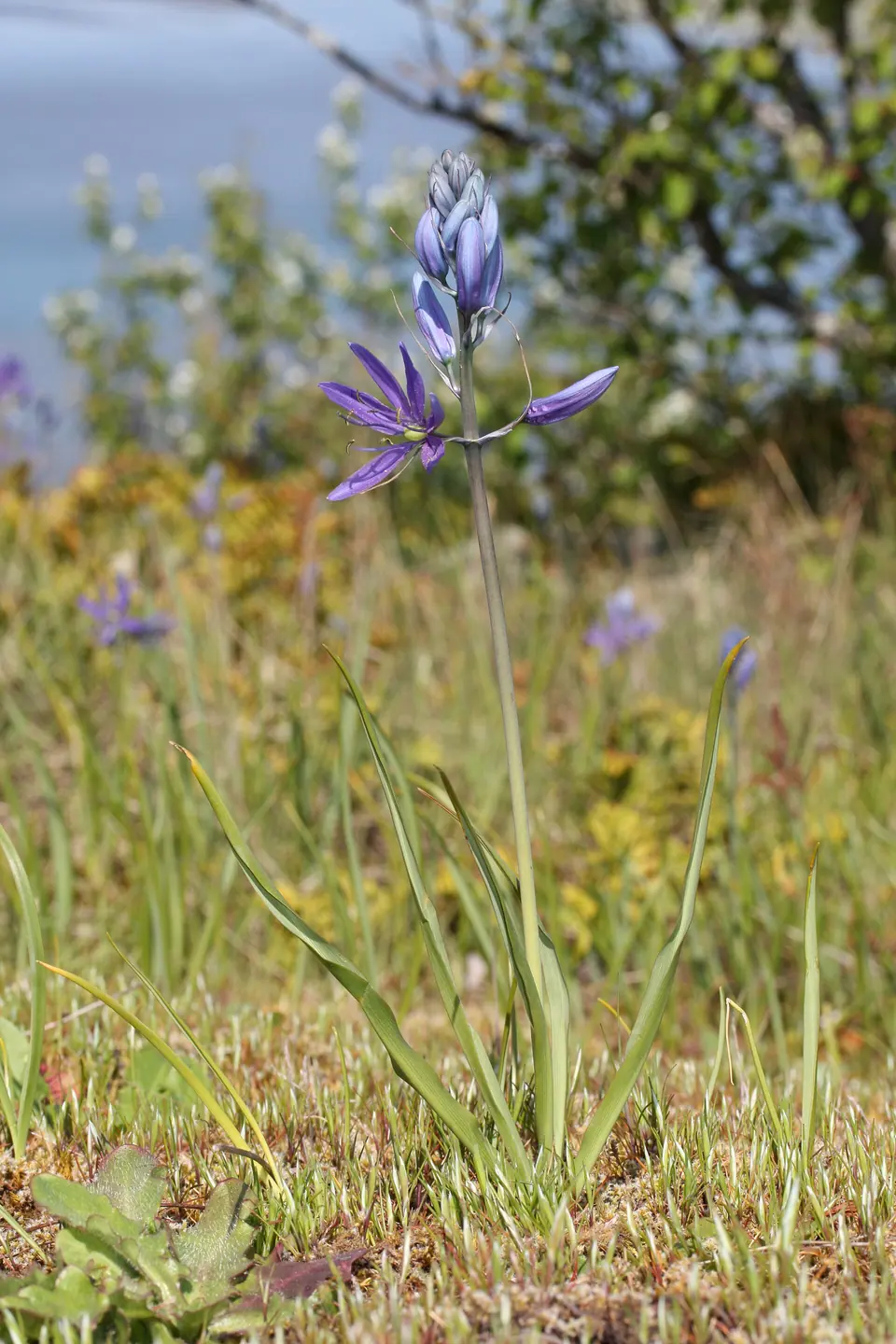

How to Grow and Care for Camas
Camassia quamash
Written by Emilio Marruso · last checked
At a glance
Camas is a tough perennial with a story: its bulb was a staple food for Native North Americans, who dried it for storing and even used it for trade. Give it full sun, or part shade if that is what you have, and once settled it copes with hot, dry spots. Sow the seeds in fall and watch it grow up to 3 feet tall.
- Sun
Best in full sun, but it also adapts to part shade
What the sources say (1)
Light: Best in full sun, adapts to part shade
It is best in full sun but adapts readily to part shade.
— Camass [2] - Water
Likes moisture in winter and early spring; once established it handles hot, dry summers
What the sources say (3)
Watering: Tough on exposed, hot dry sites once established
Very tough plant for exposed, hot dry sites once established (S. Bastin, personal communication).
— Camassia Quamash [6] Watering notes: Natural habitat is moist to wet in winter and early spring, but very dry by late spring and summer
Camas grows occurs on sites that are moist to wet in winter and early spring, but very dry by late spring and summer.
— Plant Data Sheet [5] Grows in moist areas that are often dry by late spring, particularly grassy slopes and meadows at low to middle elevations.
— Camassia quamash (common or small camas) | OSU Extension Service [1] - Cold
Survives winters down to −40 °F (−40 °C)
Very hardy · USDA 3 · RHS H7 · Z3
- Soil
Grows in soil with pH 5.1–7.8
- Harvest
The bulbs were a traditional food, dug in early autumn
What the sources say (1)
Harvest: Early autumn (traditional bulb harvest)
The tribes would move to the Quamash fields in the early autumn and, whilst some people harvested the bulbs
— Camassia quamash - Useful Temperate Plants [4] - Size
Up to 3 ft tall
What the sources say (1)
Mature height: up to 91 cm (3 feet)
Bulb-forming perennial plant that produces erect flowering stems up to 3 feet tall.
— Camassia quamash (common or small camas) | OSU Extension Service [1] - Propagation
From seed, small offset bulbs, division or potted seedlings
What the sources say (2)
Propagation: Seed, bulb offsets, division, container-grown seedlings
Seeds, container grown seedlings, transplanting salvaged or commercially grown bulbs, bulb offsets.
— Plant Data Sheet [5] Individual bulbs produce offsets at the base and in a few years can form dense clumps. If division is necessary, divide as the foliage is dying down in early summer.
— Camass [2]
Overview
Common camas is a bulb-forming perennial with blue-violet star-shaped flowers that blooms from April to June. [1] It is easy to grow in reasonably well-drained garden soil, best in full sun but adaptable to part shade. [2] In the wild it grows in moist areas that are often dry by late spring. [1]
This record is incomplete: the sources we read do not cover every field yet.
Not yet covered by our sources: Pruning
Camas care
How to water Camas
Watering
Tough on exposed, hot dry sites once established
What the sources say (1)
Very tough plant for exposed, hot dry sites once established (S. Bastin, personal communication).Watering notes
Natural habitat is moist to wet in winter and early spring, but very dry by late spring and summer
What the sources say (2)
Camas grows occurs on
sites that are moist to wet in winter and early spring, but very dry by late
spring and summer.Grows in moist areas that are often dry by late spring, particularly grassy slopes and meadows at low to middle elevations.How much light Camas needs
Best in full sun, adapts to part shade
What the sources say (1)
It is best in full sun but adapts readily to part
shade.How much cold Camas can take
Hardiness, coldest zone
3 [winter low −40 to −34.4 °C (−40 to −30 °F)]
What the sources say (1)
Bulbs can be grown in zones 3 to 7.Hardiness, warmest zone
7 [winter low −17.8 to −12.2 °C (0 to 10 °F)]
What the sources say (1)
Bulbs can be grown in zones 3 to 7.Best soil for Camas
Soil pH, minimum
5.1
What the sources say (1)
pH 5.1 to 7.8 (Dave’s Garden, 2006).Soil pH, maximum
7.8
What the sources say (1)
pH 5.1 to 7.8 (Dave’s Garden, 2006).How to propagate Camas
Seed, bulb offsets, division, container-grown seedlings
What the sources say (2)
Seeds,
container grown seedlings, transplanting salvaged or commercially grown bulbs,
bulb offsets.Individual bulbs produce offsets at the base and in a few years can form dense
clumps. If division is necessary, divide as the foliage is dying down in early summer.How to grow Camas
The plant
Life cycle
perennial
What the sources say (1)
Bulb-forming perennial plant that produces erect flowering stems up to 3 feet tall.Mature height
up to 91 cm (3 feet)
What the sources say (1)
Bulb-forming perennial plant that produces erect flowering stems up to 3 feet tall.Remedies
The sources we checked give no remedies for this plant.
Calendar
Harvest
Early autumn (traditional bulb harvest)
What the sources say (1)
The tribes would move to the Quamash fields in the early autumn and, whilst some people harvested the bulbsPruning
Not stated in the sources we read.
Months as given by the sources, which are mostly from the United States (northern hemisphere). In the southern hemisphere they shift by about six months.
Edibility
Reported by the source, quoted verbatim. Do not eat a plant on the basis of this page alone: identification mistakes can be dangerous.
The bulb was a staple food of the native N. Americans who harvested it in quantity for immediate use, dried it for storing and also used it as an item of trade.
[4]
Indicative values
Values from a secondary source, not checked word for word like the rest of this page. Use them as a starting point.
- Hours of sun
- 6-8 hoursIndicative value, adapt it to your climate · Secondary source
- Drought tolerant
- yesIndicative value, adapt it to your climate · Secondary source
- Care level
- MediumIndicative value, adapt it to your climate · Secondary source
- Growth rate
- LowIndicative value, adapt it to your climate · Secondary source
- Pruning
- March, AprilIndicative value, adapt it to your climate · Secondary source
Similar plants
- Cusick's camass Camassia cusickii
- Large camas Camassia leichtlinii
- Wild Hyacinth Camassia scilloides
- Abies grandis Abies grandis
- Abraham Trachystemon orientalis
- Abyssinian banana Ensete ventricosum
- Acacia longifolia Acacia longifolia
- Acanthus hungaricus Acanthus hungaricus
Sources
Every value above is quoted from these documents. Links lead to the original publisher.
- Camassia quamash (common or small camas) | OSU Extension Service · extension.oregonstate.edu, consulted
- Camass · uaex.uada.edu, consulted
- Camassia (quamash) trial | RHS Plant Trial / RHS · rhs.org.uk, consulted
- Camassia quamash - Useful Temperate Plants · temperate.theferns.info, consulted
- Plant Data Sheet · depts.washington.edu, consulted
- Camassia Quamash · goert.ca, consulted
Written by Emilio Marruso · last checked