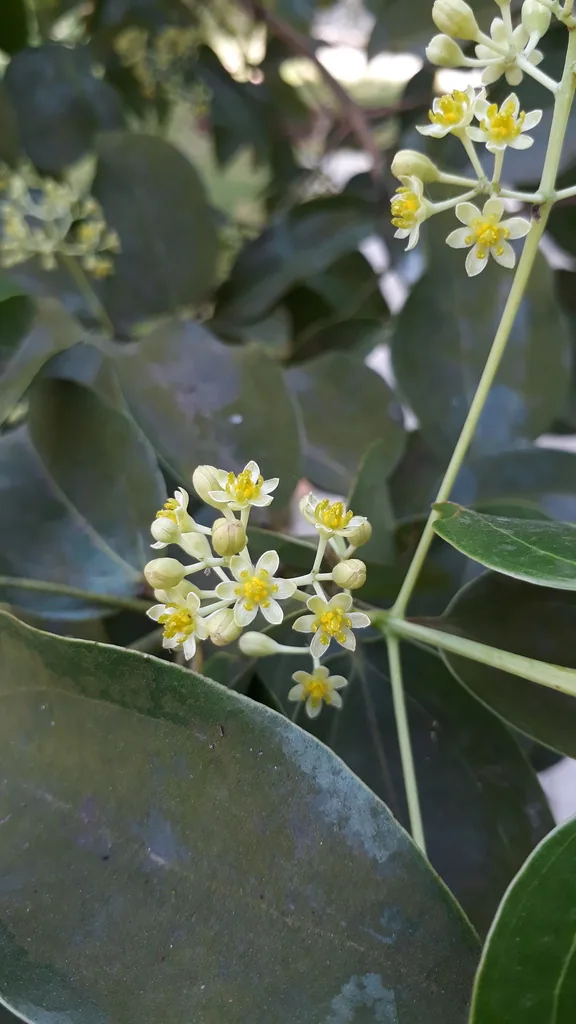
How to Grow and Care for Cinnamon
Cinnamomum verum
Written by Emilio Marruso · last checked
At a glance
This is the plant that gives us cinnamon: its inner bark, dried and ground, flavors both sweet and savory dishes, and oils from the plant are used as flavoring too. It loves a warm, wet climate and can grow 30–50 ft tall. Grown as a houseplant, it is happy with warmth above 60 °F and humid air.
- Water
Likes warm, wet conditions; indoors keep it above 60 °F with 50% humidity or more
What the sources say (3)
Watering notes: Optimum conditions for growing include a warm and wet climate
According to NC State Extension: Optimum conditions for growing include warm and wet climate.
— Cinnamomum verum (Ceylon cinnamon, Ceylon cinnamon tree, Cinnamon, Cinnamon bark tree, Kayu Manis, True cinnamon) | North Carolina Extension Gardener Plant Toolbox [1] Illinois (Illinois Extension): houseplant: Since they are tropical, plants should be given warm (above 60°F), humid (ideally 50% or higher, but they can tolerate lower) conditions.
— From bark to baking: Cinnamon’s journey to your table | Good Growing | Illinois Extension | Illinois [3] Optimum conditions for growing include warm and wet climate.
— Cinnamomum verum (Ceylon cinnamon, Ceylon cinnamon tree, Cinnamon, Cinnamon bark tree, Kayu Manis, True cinnamon) | North Carolina Extension Gardener Plant Toolbox [1] - Cold
Survives winters down to 30 °F (−1.1 °C)
Half hardy: mild winters or an unheated greenhouse · USDA 10a · RHS H3 · Z10
What the sources say (3)
Hardiness, coldest zone: 10a [winter low −1.1 to 1.7 °C (30 to 35 °F)]
According to NC State Extension: USDA Plant Hardiness Zone: 10a, 10b, 11a, 11b, 12a, 12b
— Cinnamomum verum (Ceylon cinnamon, Ceylon cinnamon tree, Cinnamon, Cinnamon bark tree, Kayu Manis, True cinnamon) | North Carolina Extension Gardener Plant Toolbox [1] USDA Plant Hardiness Zone: 10a, 10b, 11a, 11b, 12a, 12b
— Cinnamomum verum (Ceylon cinnamon, Ceylon cinnamon tree, Cinnamon, Cinnamon bark tree, Kayu Manis, True cinnamon) | North Carolina Extension Gardener Plant Toolbox [1] Hardiness, warmest zone: 12b [winter low 12.8 to 15.6 °C (55 to 60 °F)]
USDA Plant Hardiness Zone: 10a, 10b, 11a, 11b, 12a, 12b
— Cinnamomum verum (Ceylon cinnamon, Ceylon cinnamon tree, Cinnamon, Cinnamon bark tree, Kayu Manis, True cinnamon) | North Carolina Extension Gardener Plant Toolbox [1] - Harvest
The dried, ground inner bark is the spice; stems are cut every 2–3 years
What the sources say (3)
How to harvest: In commercial production the stems are cut, the outer bark is scraped off and the inner bark is peeled away, then dried into quills; plants are usually harvested every two to three years
Workers cut branches, scrape off the outer bark, and peel away the delicate inner bark (what we use).
— From bark to baking: Cinnamon’s journey to your table | Good Growing | Illinois Extension | Illinois [3] These strips are then dried, during which they curl into quills or cinnamon sticks.
— From bark to baking: Cinnamon’s journey to your table | Good Growing | Illinois Extension | Illinois [3] Plants are usually harvested every two to three years.
— From bark to baking: Cinnamon’s journey to your table | Good Growing | Illinois Extension | Illinois [3] - Pests
Cinnamon butterfly can strip young plants; also aphids, whiteflies, scale and leaf spot
What the sources say (2)
Pests: cinnamon butterfly, beetles, leaf miners, aphids, whiteflies, scale
A host plant for the cinnamon butterfly, who can defoliate young plants. Beetles and leaf miners feed on the plant. Issues with aphids, whiteflies and scale are possible.
— Cinnamomum verum (Ceylon cinnamon, Ceylon cinnamon tree, Cinnamon, Cinnamon bark tree, Kayu Manis, True cinnamon) | North Carolina Extension Gardener Plant Toolbox [1] Diseases: stripe canker, anthracnose, leaf spot
Stripe canker, anthracnose, and leaf spot are also issues for this plant.
— Cinnamomum verum (Ceylon cinnamon, Ceylon cinnamon tree, Cinnamon, Cinnamon bark tree, Kayu Manis, True cinnamon) | North Carolina Extension Gardener Plant Toolbox [1] - Size
30–50 ft tall and 20–40 ft wide
What the sources say (3)
Mature height: 914-1524 cm (30-50 ft)
commercial production, coppiced: Because they are coppiced, cultivated cinnamon is a shrub-like plant that grows to be about 6–8 feet tall.
— From bark to baking: Cinnamon’s journey to your table | Good Growing | Illinois Extension | Illinois [3] Dimensions: Height: 30 ft. 0 in. - 50 ft. 0 in. Width: 20 ft. 0 in. - 40 ft. 0 in.
— Cinnamomum verum (Ceylon cinnamon, Ceylon cinnamon tree, Cinnamon, Cinnamon bark tree, Kayu Manis, True cinnamon) | North Carolina Extension Gardener Plant Toolbox [1] Mature width: 610-1219 cm (20-40 ft)
Dimensions: Height: 30 ft. 0 in. - 50 ft. 0 in. Width: 20 ft. 0 in. - 40 ft. 0 in.
— Cinnamomum verum (Ceylon cinnamon, Ceylon cinnamon tree, Cinnamon, Cinnamon bark tree, Kayu Manis, True cinnamon) | North Carolina Extension Gardener Plant Toolbox [1]
Overview
Ceylon cinnamon is a small evergreen tropical tree native to Sri Lanka, grown for its fragrant bark and foliage. [1] It is listed for USDA zones 10a to 12b and does best in warm, wet conditions. [1] The dried inner bark is used as a spice. [1]
This record is incomplete: the sources we read do not cover every field yet.
Not yet covered by our sources: Watering, Sowing / Planting, Harvest, Propagation
Cinnamon care
Measurements in square brackets are our conversion into the other unit system; the quoted text is unchanged.
How to water Cinnamon
Watering
Not stated in the sources we read.
Watering notes
Optimum conditions for growing include a warm and wet climate
What each source says
According to NC State Extension: Warm and wet climate
Illinois (Illinois Extension): houseplant: Warm (above 60°F [16 °C]), humid conditions (ideally 50% or higher, tolerates lower)
What the sources say (3)
According to NC State Extension: Optimum conditions for growing include warm and wet climate.Illinois (Illinois Extension): houseplant: Since they are tropical, plants should be given warm (above 60°F), humid (ideally 50% or higher, but they can tolerate lower) conditions.Optimum conditions for growing include warm and wet climate.How much light Cinnamon needs
The sources give different values depending on region, zone or growing conditions.
What each source says
According to NC State Extension: young trees: Shade from the afternoon sun
According to NC State Extension: mature trees: Can withstand more sunlight
Illinois (Illinois Extension): houseplant: Full sun to partial shade
What the sources say (5)
According to NC State Extension: young trees: Young trees will perform at their best when shade from the afternoon sun is provided.According to NC State Extension: mature trees: As the tree matures, it can withstand more sunlight.Illinois (Illinois Extension): houseplant: Plants should be grown in a well-drained, slightly acidic potting mix and placed in full sun to partial shade.Young trees will perform at their best when shade from the afternoon sun is provided.As the tree matures, it can withstand more sunlight.How much cold Cinnamon can take
Hardiness, coldest zone
10a [winter low −1.1 to 1.7 °C (30 to 35 °F)]
What each source says
According to NC State Extension: 10a [winter low −1.1 to 1.7 °C (30 to 35 °F)]
What the sources say (2)
According to NC State Extension: USDA Plant Hardiness Zone:
10a, 10b, 11a, 11b, 12a, 12bUSDA Plant Hardiness Zone:
10a, 10b, 11a, 11b, 12a, 12bHardiness, warmest zone
12b [winter low 12.8 to 15.6 °C (55 to 60 °F)]
What the sources say (1)
USDA Plant Hardiness Zone:
10a, 10b, 11a, 11b, 12a, 12bHow to propagate Cinnamon
Not stated in the sources we read.
How to grow Cinnamon
The plant
Life cycle
perennial
What the sources say (1)
Plant Type: Edible Perennial Tree Woody Plant Leaf Characteristics: Broadleaf EvergreenFamily
Lauraceae
What the sources say (1)
Genus: Cinnamomum Species: verum Family: Lauraceae Uses (Ethnobotany): It is used to treat a wide varietyMature height
914-1524 cm (30-50 ft)
What each source says
commercial production, coppiced:
What the sources say (2)
commercial production, coppiced: Because they are coppiced, cultivated cinnamon is a shrub-like plant that grows to be about 6–8 feet tall.Dimensions: Height: 30 ft. 0 in. - 50 ft. 0 in. Width: 20 ft. 0 in. - 40 ft. 0 in.Mature width
610-1219 cm (20-40 ft)
What the sources say (1)
Dimensions: Height: 30 ft. 0 in. - 50 ft. 0 in. Width: 20 ft. 0 in. - 40 ft. 0 in.Harvest and storage
How to harvest
In commercial production the stems are cut, the outer bark is scraped off and the inner bark is peeled away, then dried into quills; plants are usually harvested every two to three years
What the sources say (3)
Workers cut branches, scrape off the outer bark, and peel away the delicate inner bark (what we use).These strips are then dried, during which they curl into quills or cinnamon sticks.Plants are usually harvested every two to three years.Pests and diseases
Pests
cinnamon butterfly, beetles, leaf miners, aphids, whiteflies, scale
What the sources say (1)
A host plant for the cinnamon butterfly, who can defoliate young plants. Beetles and leaf miners feed on the plant. Issues with aphids, whiteflies and scale are possible.Diseases
stripe canker, anthracnose, leaf spot
What the sources say (1)
Stripe canker, anthracnose, and leaf spot are also issues for this plant.Cinnamon pests and problems
Cinnamon butterfly, beetles and leaf miners
Symptom: The cinnamon butterfly can defoliate young plants; beetles and leaf miners feed on the plant.
What to do: No management given.
What the sources say (1)
A host plant for the cinnamon butterfly, who can defoliate young plants. Beetles and leaf miners feed on the plant.
— Cinnamomum verum (Ceylon cinnamon, Ceylon cinnamon tree, Cinnamon, Cinnamon bark tree, Kayu Manis, True cinnamon) | North Carolina Extension Gardener Plant Toolbox [1] Aphids, whiteflies and scale
Symptom: Issues are possible.
What to do: No management given.
What the sources say (1)
Issues with aphids, whiteflies and scale are possible.
— Cinnamomum verum (Ceylon cinnamon, Ceylon cinnamon tree, Cinnamon, Cinnamon bark tree, Kayu Manis, True cinnamon) | North Carolina Extension Gardener Plant Toolbox [1] Stripe canker, anthracnose and leaf spot
Symptom: Listed as issues for this plant.
What to do: No management given.
What the sources say (1)
Stripe canker, anthracnose, and leaf spot are also issues for this plant.
— Cinnamomum verum (Ceylon cinnamon, Ceylon cinnamon tree, Cinnamon, Cinnamon bark tree, Kayu Manis, True cinnamon) | North Carolina Extension Gardener Plant Toolbox [1]
Remedies
The sources we checked give no remedies for this plant.
Calendar
Sowing
Not stated in the sources we read.
Planting
Not stated in the sources we read.
Harvest
Not stated in the sources we read.
Months as given by the sources, which are mostly from the United States (northern hemisphere). In the southern hemisphere they shift by about six months.
Edibility
Reported by the source, quoted verbatim. Do not eat a plant on the basis of this page alone: identification mistakes can be dangerous.
Indicative values
Values from a secondary source, not checked word for word like the rest of this page. Use them as a starting point.
- Watering
- AverageIndicative value, adapt it to your climate · Secondary source
- Soil pH
- 4.5-5.5Indicative value, adapt it to your climate · Secondary source
- Care level
- MediumIndicative value, adapt it to your climate · Secondary source
- Growth rate
- LowIndicative value, adapt it to your climate · Secondary source
- Pruning
- March, April, November, March, April, November, May, March, April, May, June, July, August, September, March, April, May, June, July, August, SeptemberIndicative value, adapt it to your climate · Secondary source
- Propagation
- Air Layering Propagation, Cutting, Grafting Propagation, Division, Seed PropagationIndicative value, adapt it to your climate · Secondary source
Similar plants
- Camphor Tree Cinnamomum camphora
- Chinese Cassia Cinnamomum cassia
- Avocado Persea americana
- Spicebush Lindera benzoin
- Sweet bay Laurus nobilis
- California bay Umbellularia californica
- Japanese Spicebush Lindera obtusiloba
- Pondberry Lindera melissifolia
Sources
Every value above is quoted from these documents. Links lead to the original publisher.
- Cinnamomum verum (Ceylon cinnamon, Ceylon cinnamon tree, Cinnamon, Cinnamon bark tree, Kayu Manis, True cinnamon) | North Carolina Extension Gardener Plant Toolbox · plants.ces.ncsu.edu, consulted
- Ceylon cinnamon - Cinnamomum verum | North Carolina Extension Gardener Plant Toolbox · plants.ces.ncsu.edu, consulted
- From bark to baking: Cinnamon’s journey to your table | Good Growing | Illinois Extension | Illinois · extension.illinois.edu, consulted
- Cinnamon bark tree - Cinnamomum verum | North Carolina Extension Gardener Plant Toolbox · plants.ces.ncsu.edu, consulted
Written by Emilio Marruso · last checked