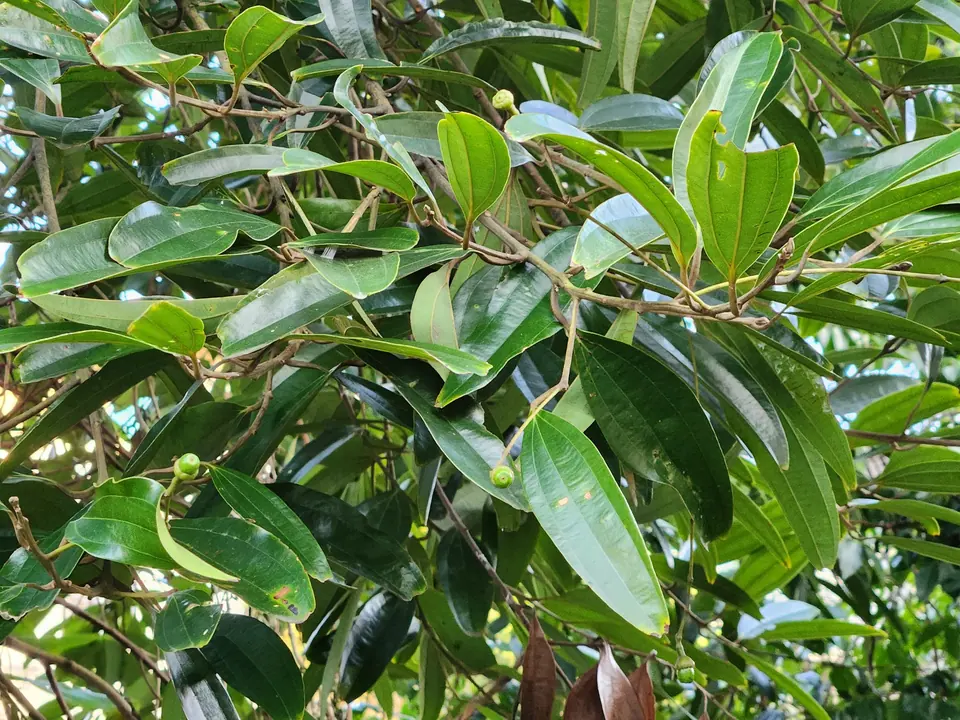
How to Grow and Care for Chinese Cassia
Cinnamomum cassia
Written by Emilio Marruso · last checked
At a glance
Grow your own cinnamon! This tree from the laurel family gives a bark that flavors curries, sweets and baked goods, and its young fruits, called cassia buds, are a prized spice too. It enjoys full sun to partial shade, grows happily in a container, and once it is 5–7 years old, you can start cutting its buds.
- Sun
Full sun to partial shade
What the sources say (2)
- Cold
Survives winters down to 20 °F (−6.7 °C)
Hardy in average winters · USDA 9 · RHS H4 · Z9
What the sources say (2)
Hardiness, coldest zone: 9 [winter low −6.7 to −1.1 °C (20 to 30 °F)]
Hardiness: Zones 9-11
— Plant Profile: Cassia (Cinnamomum cassia) – KarensGardenTips.com [4] Hardiness, warmest zone: 11 [winter low 4.4 to 10 °C (40 to 50 °F)]
Hardiness: Zones 9-11
— Plant Profile: Cassia (Cinnamomum cassia) – KarensGardenTips.com [4] - Soil
Rich, sandy soil that holds moisture but drains freely; pH 4.5–7
What the sources say (4)
Watering notes: Fertile, sandy, moisture-retentive but freely draining soil
Prefers a fertile, sandy, moisture-retentive but freely draining soil in full sun or partial shade
— Cinnamomum cassia - Useful Tropical Plants [3] Soil : Fertile, moist, well-drained, acid but tolerates neutral pH.
— Plant Profile: Cassia (Cinnamomum cassia) – KarensGardenTips.com [4] Soil pH, minimum: 4.5
Prefers a pH in the range 5 - 5.5, tolerating 4.5 - 7
— Cinnamomum cassia - Useful Tropical Plants [3] Soil pH, maximum: 7
Prefers a pH in the range 5 - 5.5, tolerating 4.5 - 7
— Cinnamomum cassia - Useful Tropical Plants [3] - Harvest
Cut the buds once the tree is 5–7 years old; the bark flavors curries, sweets and baked goods
What the sources say (1)
Harvest: Buds can be cut when the tree is 5-7 years old
The buds can be cut when the tree is 5 - 7 years old
— Cinnamomum cassia - Useful Tropical Plants [3] - Pests
Many insects and diseases are reported, but most are rare outside the tropics
- Size
30 to 40 ft tall
What the sources say (1)
Mature height: 914.4-1219.2 cm (30-40 ft)
The trees grown for cinnamon bark extraction are evergreen trees growing 30 to 40 feet tall with a rounded crown.
— Cinnamomum cassia; Cinnamon [2] - Propagation
Sow seeds fresh, since they don't last long, or root cuttings of semi-ripe side shoots
What the sources say (3)
Propagation: Seed (short viability, sown fresh); cuttings of semi-ripe side shoots
Seed - the seed has a short viability and is best sown as soon in containers as it is ripe
— Cinnamomum cassia - Useful Tropical Plants [3] Cuttings of semi-ripe side shoots, 7cm with a heel, in a frame with bottom heat
— Cinnamomum cassia - Useful Tropical Plants [3] Propagation : Seed (low viability), cuttings of semi-soft side shoots
— Plant Profile: Cassia (Cinnamomum cassia) – KarensGardenTips.com [4] - Containers
Grows in containers too
What the sources say (1)
In containers: Yes
the plants can be grown in containers and purned to maintain size
— Plant Profile: Cassia (Cinnamomum cassia) – KarensGardenTips.com [4]
Overview
Cassia cinnamon is an evergreen tree grown for its bark, which is the source of the spice cassia. [4][3] It prefers a fertile, moisture-retentive but freely draining soil in full sun or partial shade. [3] It can be grown from fresh seed or from cuttings of semi-ripe side shoots. [3]
This record is incomplete: the sources we read do not cover every field yet.
Not yet covered by our sources: Watering, Sowing / Planting
Chinese Cassia care
How to water Chinese Cassia
Watering
Not stated in the sources we read.
Watering notes
Fertile, sandy, moisture-retentive but freely draining soil
What the sources say (2)
Prefers a fertile, sandy, moisture-retentive but freely draining soil in full sun or partial shadeSoil : Fertile, moist, well-drained, acid but tolerates neutral pH.How much light Chinese Cassia needs
How much cold Chinese Cassia can take
Hardiness, coldest zone
9 [winter low −6.7 to −1.1 °C (20 to 30 °F)]
What the sources say (1)
Hardiness: Zones 9-11Hardiness, warmest zone
11 [winter low 4.4 to 10 °C (40 to 50 °F)]
What the sources say (1)
Hardiness: Zones 9-11Best soil for Chinese Cassia
Soil pH, minimum
4.5
What the sources say (1)
Prefers a pH in the range 5 - 5.5, tolerating 4.5 - 7Soil pH, maximum
7
What the sources say (1)
Prefers a pH in the range 5 - 5.5, tolerating 4.5 - 7Where to grow Chinese Cassia
Yes
What the sources say (1)
the plants can be grown in containers and purned to maintain sizeHow to propagate Chinese Cassia
Seed (short viability, sown fresh); cuttings of semi-ripe side shoots
What the sources say (3)
Seed - the seed has a short viability and is best sown as soon in containers as it is ripeCuttings of semi-ripe side shoots, 7cm with a heel, in a frame with bottom heatPropagation : Seed (low viability), cuttings of semi-soft side shootsHow to grow Chinese Cassia
The plant
Family
Lauraceae (laurel family)
What the sources say (1)
There are about 250 species of cinnamon scattered in the tropics around the world
and all have some cinnamon-like characteristics. They are members of the Laurel family.Mature height
914.4-1219.2 cm (30-40 ft)
What the sources say (1)
The trees grown for cinnamon bark extraction are evergreen trees growing 30 to 40
feet tall with a rounded crown.Chinese Cassia pests and problems
Insects and diseases
Symptom: Numerous insects and diseases are reported, most not common outside of the tropics and semi tropics
What the sources say (1)
Pests and Diseases : Numerous insects and diseases but most are not common outside of the tropics and semi tropics.
— Plant Profile: Cassia (Cinnamomum cassia) – KarensGardenTips.com [4]
Remedies
The sources we checked give no remedies for this plant.
Calendar
Sowing
Not stated in the sources we read.
Planting
Not stated in the sources we read.
Harvest
Buds can be cut when the tree is 5-7 years old
What the sources say (1)
The buds can be cut when the tree is 5 - 7 years oldMonths as given by the sources, which are mostly from the United States (northern hemisphere). In the southern hemisphere they shift by about six months.
Edibility
Reported by the source, quoted verbatim. Do not eat a plant on the basis of this page alone: identification mistakes can be dangerous.
Indicative values
Values from a secondary source, not checked word for word like the rest of this page. Use them as a starting point.
- Life cycle
- PerennialIndicative value, adapt it to your climate · Secondary source
- Hours of sun
- 6-8 hoursIndicative value, adapt it to your climate · Secondary source
- Watering
- AverageIndicative value, adapt it to your climate · Secondary source
- Drought tolerant
- yesIndicative value, adapt it to your climate · Secondary source
- Care level
- MediumIndicative value, adapt it to your climate · Secondary source
- Growth rate
- LowIndicative value, adapt it to your climate · Secondary source
- Pruning
- May, June, July, March, April, May, June, July, August, SeptemberIndicative value, adapt it to your climate · Secondary source
Similar plants
- Cinnamon Cinnamomum verum
- Camphor Tree Cinnamomum camphora
- Alexanders Smyrnium olusatrum
- American pepper Schinus molle
- Angelica Angelica archangelica
- Anise burnet saxifrage Pimpinella anisum
- Bayrumtree Pimenta racemosa
- Bitter orange Citrus × aurantium
Sources
Every value above is quoted from these documents. Links lead to the original publisher.
- Ethnobotanical Plant Cinnamomum cassia | Dr. Duke's Phytochemical and Ethnobotanical Databases · phytochem.nal.usda.gov, consulted
- Cinnamomum cassia; Cinnamon · uaex.uada.edu, consulted
- Cinnamomum cassia - Useful Tropical Plants · tropical.theferns.info, consulted
- Plant Profile: Cassia (Cinnamomum cassia) – KarensGardenTips.com · karensgardentips.com, consulted
- Canela de China - EcuRed · ecured.cu, consulted
- Spice Pages: Cassia (Cinnamomum cassia, Chinese Cinnamon) · gernot-katzers-spice-pages.com, consulted
Written by Emilio Marruso · last checked