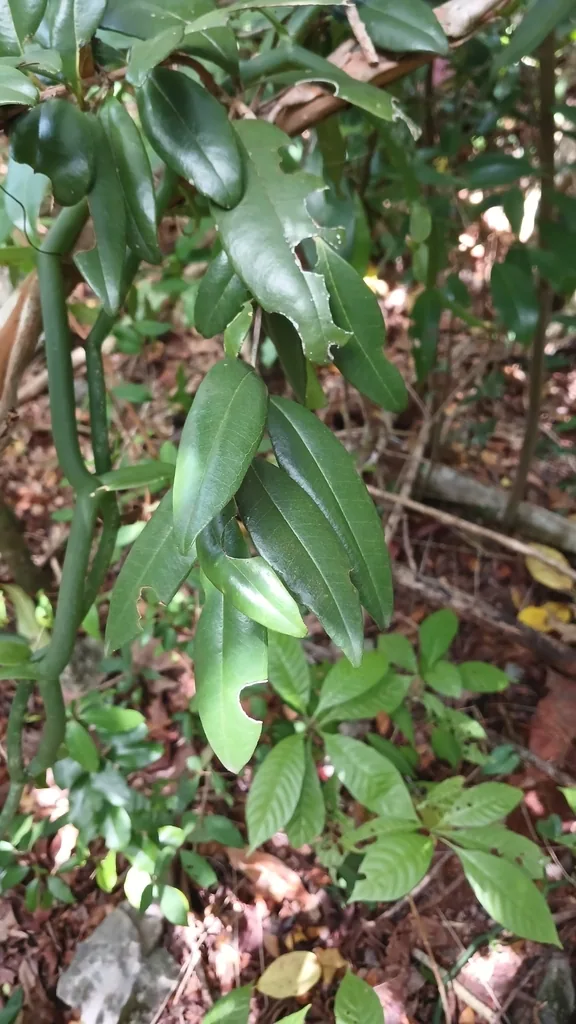
How to Grow and Care for Bayrumtree
Pimenta racemosa
Written by Emilio Marruso · last checked
Toxic to: People · Why
At a glance
The bay rum tree gives you leaves you can pick all year round, and its dried green berries taste of cinnamon, clove and nutmeg, a spice for your kitchen. Give it full sun, acidic soil and steady moisture, since it handles drought poorly. Start your own tree from seed, sown as soon as the fruit is ripe.
- Sun
Full sun
What the sources say (1)
Light: Full sun
Light needs: Full sun
— Bay Rum – Port St. Lucie Botanical Gardens [1] - Water
Keep the soil moist all the time; it handles drought poorly
- Soil
Acidic soil, pH 5–6
- Spacing
In plantations: 7–16 ft between trees, 16–33 ft between rows
What the sources say (1)
Spacing: 200-500 cm [79–197 in] x 500-1000 cm (2-5 m x 5-10 m [16.4–32.8 ft]), plantation spacing on flat land
on flat land 2—5 m x 5—10 m is common
— PROSEA - Plant Resources of South East Asia [3] - Harvest
Pick leaves all year; dried green berries are a spice with a cinnamon, clove and nutmeg taste
What the sources say (1)
Harvest: Leaves can be harvested year-round
Harvesting can be done year-round.
— PROSEA - Plant Resources of South East Asia [3] - Propagation
Grow it from seed, sown as soon as it is ripe
What the sources say (2)
Propagation: Mostly by seed, planted as soon as ripe; vegetative propagation is rarely practised
Propagation: Mainly done by seeds as soon as they become ripe.
— Bay Rum – Port St. Lucie Botanical Gardens [1] Propagation of Pimenta racemosa is mostly by seed.
— PROSEA - Plant Resources of South East Asia [3] - Safety
Bay rum used in hair products and aftershaves may irritate the skin
Overview
Pimenta racemosa is a tropical evergreen tree whose leaves yield bay leaf oil, used in perfumery and to make bay rum. [3] It needs full sun, consistently moist well-drained soil and does not tolerate frost. [1][3]
This record is incomplete: the sources we read do not cover every field yet.
Not yet covered by our sources: Hardiness, coldest zone, Hardiness, warmest zone, Pruning
Bayrumtree care
Measurements in square brackets are our conversion into the other unit system; the quoted text is unchanged.
How to water Bayrumtree
How much light Bayrumtree needs
Full sun
What the sources say (1)
Light needs: Full sunHow much cold Bayrumtree can take
Hardiness, coldest zone
Not stated in the sources we read.
Hardiness, warmest zone
Not stated in the sources we read.
Best soil for Bayrumtree
Soil pH, minimum
5
What the sources say (1)
Prefers moist, well-drained loamy soils with a pH of 5-6Soil pH, maximum
6
What the sources say (1)
Prefers moist, well-drained loamy soils with a pH of 5-6Where to grow Bayrumtree
200-500 cm [79–197 in] x 500-1000 cm (2-5 m x 5-10 m [16.4–32.8 ft]), plantation spacing on flat land
What the sources say (1)
on flat land 2—5 m x 5—10 m is commonHow to propagate Bayrumtree
Mostly by seed, planted as soon as ripe; vegetative propagation is rarely practised
Remedies
Each remedy shows what official sources say about it; traditional remedies without an official source are marked as such. Harmful ones are listed so you know to avoid them.
Treating the plant
scale insects
oil application Works
How: Watch for newly settled scales in late June or early July; an oil application is often sufficient for control.
Watch for newly settled scales in late June or early July; an oil application is often sufficient for control.
— ipm.ucanr.edu [7] What the evidence says Watch for newly settled scales in late June or early July; an oil application is often sufficient for control.
— ipm.ucanr.edu [7]
Is Bayrumtree poisonous?
Reported by the source, quoted verbatim. This is not medical or veterinary advice: if a person or an animal may have eaten this plant, contact a poison control centre or a veterinarian.
Calendar
Harvest
Leaves can be harvested year-round
What the sources say (1)
Harvesting can be done year-round.Pruning
Not stated in the sources we read.
Months as given by the sources, which are mostly from the United States (northern hemisphere). In the southern hemisphere they shift by about six months.
Edibility
Reported by the source, quoted verbatim. Do not eat a plant on the basis of this page alone: identification mistakes can be dangerous.
Indicative values
Values from a secondary source, not checked word for word like the rest of this page. Use them as a starting point.
- Life cycle
- PerennialIndicative value, adapt it to your climate · Secondary source
- Mature height
- 762-1219.2 cm (25-40 ft)Indicative value, adapt it to your climate · Secondary source
- Hours of sun
- 6-8 hoursIndicative value, adapt it to your climate · Secondary source
- USDA hardiness zones
- 10-12 [winter low −1.1 to 15.6 °C (30 to 60 °F)]Indicative value, adapt it to your climate · Secondary source
- Care level
- MediumIndicative value, adapt it to your climate · Secondary source
- Growth rate
- LowIndicative value, adapt it to your climate · Secondary source
- Pruning
- December, January, February, March, April, March, April, May, June, July, August, MayIndicative value, adapt it to your climate · Secondary source
Similar plants
- Abies grandis Abies grandis
- Abraham Trachystemon orientalis
- Abyssinian banana Ensete ventricosum
- Acacia longifolia Acacia longifolia
- Acanthus hungaricus Acanthus hungaricus
- Aconite Aconitum napellus
- Adam's Needle Yucca flaccida
- Adriatic lizard orchid Himantoglossum adriaticum
Sources
Every value above is quoted from these documents. Links lead to the original publisher.
- Bay Rum – Port St. Lucie Botanical Gardens · pslbg.org, consulted
- Data sheet · ecocrop.apps.fao.org, consulted
- PROSEA - Plant Resources of South East Asia · prosea.prota4u.org, consulted
- Bay Rum Tree – Aromatic Caribbean Plant at Valombreuse · jardindebalata.fr, consulted
- Ethnobotanical Plant Pimenta racemosa | Dr. Duke's Phytochemical and Ethnobotanical Databases · phytochem.nal.usda.gov, consulted
- Bay-rum - Tree selection - Landscape plants - Edward F. Gilman - UF/IFAS · hort.ifas.ufl.edu, consulted
- ipm.ucanr.edu · ipm.ucanr.edu
Written by Emilio Marruso · last checked