
How to Grow and Care for Asian ponysfoot
Dichondra micrantha
Written by Emilio Marruso · last checked
At a glance
Dichondra is a charming little plant that can even become a lawn, happy in full sun or light shade and able to tolerate some heat. It is easy to multiply: divide it or simply let it self-seed. Feed it nitrogen from April to October, and water deeply but not too often, because it doesn't like drought.
- Sun
Full sun to light shade; tolerates some heat
What the sources say (3)
Light: Full sun to light shade
USDA: 9-11 Sun Exposure: Light shade to full sun
— Dichondra, Kidney Weed (Dichondra micrantha) [5] Light full sun Shade tolerance light shade Water moderate
— Dichondra micrantha — Practical Plants [3] Heat: Tolerates some heat
It has a low tolerance for salinity, drought, and very cold temperatures but tolerates some heat.
— [8] - Water
Doesn't like drought: water deeply but not too often
What the sources say (3)
Watering notes: Drought intolerant
Water moderate Soil textures sandy, loamy, clay Soil pH acid, neutral, alkaline Tolerates Nutritionally Poor Soil No Drought intolerant
— Dichondra micrantha — Practical Plants [3] Drought: Low drought tolerance
It has a low tolerance for salinity, drought, and very cold temperatures but tolerates some heat.
— [8] Root system: Deep root system in dichondra lawns, kept by deep, infrequent watering
Water deep and infrequently to maintain dichondra's deep root system.
— [7] - Cold
Survives winters down to 20 °F (−6.7 °C)
Hardy in average winters · USDA 9 · RHS H4 · Z9
What the sources say (2)
Hardiness, coldest zone: 9 [winter low −6.7 to −1.1 °C (20 to 30 °F)]
USDA: 9-11 Sun Exposure: Light shade to full sun
— Dichondra, Kidney Weed (Dichondra micrantha) [5] Hardiness, warmest zone: 11 [winter low 4.4 to 10 °C (40 to 50 °F)]
USDA: 9-11 Sun Exposure: Light shade to full sun
— Dichondra, Kidney Weed (Dichondra micrantha) [5] - Feeding
Feed with nitrogen from April to October; go light in the hottest summer months
What the sources say (4)
When: During active growth, from April to October, with less fertilizer in the hottest summer months
Fertilize using 4 lbs. nitrogen/1000 sq. ft. per year during the period of active growth (April - October).
— [7] Mineral fertilizers: Nitrogen fertilizer, 19.5 g of nitrogen per m² per year; dichondra has a high nitrogen requirement
Fertilize using 4 lbs. nitrogen/1000 sq. ft. per year during the period of active growth (April - October).
— [7] High maintenance for water and fertilizer. Dichondra requires well-drained soil and has a high nitrogen requirement.
— [8] Avoid: Heavy feeding during the hot summer months
Fertilize using 4 lbs. nitrogen/1000 sq. ft. per year during the period of active growth (April - October). - Limit fertilization during high temperature summer months.
— [7] - Propagation
Divide the plants, or let it self-seed
What the sources say (2)
Propagation: Division; self-seeds
Growth Habits: Perennial ground cover, 2 to 4 inches tall (5-10 cm) Watering Needs: Regular to abundant water Propagation: division
— Dichondra, Kidney Weed (Dichondra micrantha) [5] Culture: Dichondras like humus rich, well cultivated soil. In Phoenix, they self-seed readily.
— Dichondra, Kidney Weed (Dichondra micrantha) [5]
Overview
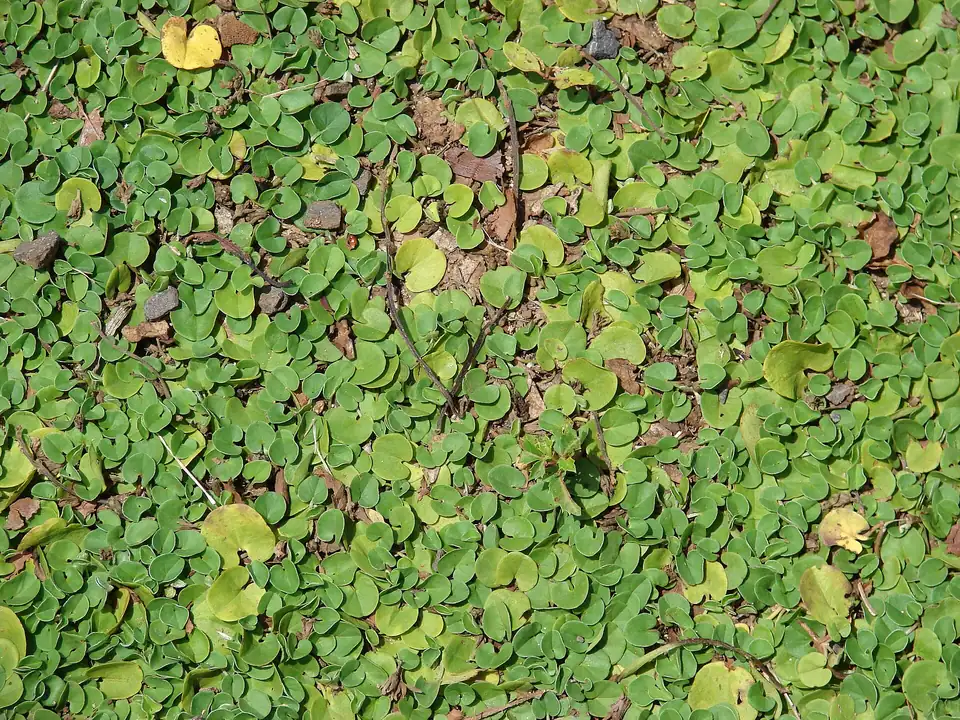
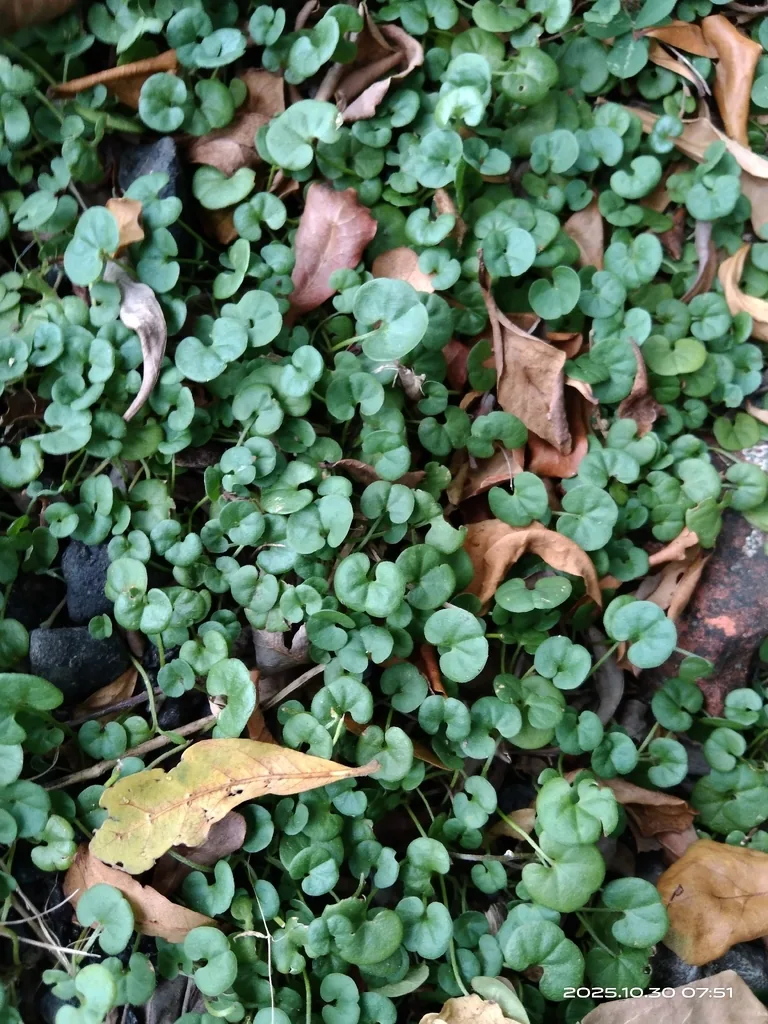
Dichondra micrantha is a low perennial herb with stoloniferous stems forming extensive mats or low cushions. [6] It is planted as a lawn or lawn substitute and decorative creeper. [6][4] In Florida it is not considered a problem species in natural areas. [1]
This record is incomplete: the sources we read do not cover every field yet.
Not yet covered by our sources: Pruning
Asian ponysfoot care
How to water Asian ponysfoot
Watering
The sources give different values depending on region, zone or growing conditions.
What each source says
According to Desert-Tropicals: Regular to abundant water
According to Practical Plants: Moderate
What the sources say (2)
According to Desert-Tropicals: Growth Habits: Perennial ground cover, 2 to 4 inches tall (5-10 cm)
Watering Needs: Regular to abundant water
Propagation: divisionAccording to Practical Plants: Light
full sun
Shade tolerance
light shade
Water
moderateWatering notes
Drought intolerant
What the sources say (1)
Water
moderate
Soil textures
sandy, loamy, clay
Soil pH
acid, neutral, alkaline
Tolerates Nutritionally Poor Soil
No
Drought
intolerantHow much light Asian ponysfoot needs
How much cold Asian ponysfoot can take
Hardiness, coldest zone
9 [winter low −6.7 to −1.1 °C (20 to 30 °F)]
What the sources say (1)
USDA: 9-11
Sun Exposure: Light shade to full sunHardiness, warmest zone
11 [winter low 4.4 to 10 °C (40 to 50 °F)]
What the sources say (1)
USDA: 9-11
Sun Exposure: Light shade to full sunHow to propagate Asian ponysfoot
Division; self-seeds
What the sources say (2)
Growth Habits: Perennial ground cover, 2 to 4 inches tall (5-10 cm)
Watering Needs: Regular to abundant water
Propagation: divisionCulture:
Dichondras like humus rich, well cultivated soil. In Phoenix, they self-seed readily.How to grow Asian ponysfoot
The plant
Family
Convolvulaceae
What the sources say (1)
Dichondra repens var. micrantha
- Family
Convolvulaceae
- Conclusions by ZoneFertilizing
When
During active growth, from April to October, with less fertilizer in the hottest summer months
What the sources say (1)
Fertilize using 4 lbs. nitrogen/1000 sq. ft. per year during the period of active growth (April - October).Mineral fertilizers
Nitrogen fertilizer, 19.5 g of nitrogen per m² per year; dichondra has a high nitrogen requirement
Avoid
Heavy feeding during the hot summer months
What the sources say (1)
Fertilize using 4 lbs. nitrogen/1000 sq. ft. per year during the period of active growth (April - October). - Limit fertilization during high temperature summer months.Roots
Root system
Deep root system in dichondra lawns, kept by deep, infrequent watering
What the sources say (1)
Water deep and infrequently to maintain dichondra's deep root system.Heat and drought
Heat
Tolerates some heat
What the sources say (1)
It has a low tolerance for salinity, drought, and very cold temperatures but tolerates some heat.Drought
Low drought tolerance
What the sources say (1)
It has a low tolerance for salinity, drought, and very cold temperatures but tolerates some heat.Remedies
The sources we checked give no remedies for this plant.
Calendar
Pruning
Not stated in the sources we read.
Months as given by the sources, which are mostly from the United States (northern hemisphere). In the southern hemisphere they shift by about six months.
Similar plants
- Beach Morning-glory Ipomoea imperati
- Common Morning Glory Ipomoea purpurea
- Cypress Vine Ipomoea quamoclit
- Dwarf Morning Glory Convolvulus tricolor
- Giant Bindweed Calystegia silvatica
- Moonflower Ipomoea alba
- Morning Glory Ipomoea sagittata
- Morning Glory Ipomoea tricolor
Sources
Every value above is quoted from these documents. Links lead to the original publisher.
- Dichondra micrantha - UF/IFAS Assessment - University of Florida, Institute of Food and Agricultural Sciences · assessment.ifas.ufl.edu, consulted
- Dichondra micrantha - Useful Temperate Plants · temperate.theferns.info, consulted
- Dichondra micrantha — Practical Plants · practicalplants.org, consulted
- VicFlora: Dichondra micrantha · vicflora.rbg.vic.gov.au, consulted
- Dichondra, Kidney Weed (Dichondra micrantha) · desert-tropicals.com, consulted
- Dichondra micrantha • New Zealand Plant Conservation Network · nzpcn.org.nz, consulted
- ipm.ucanr.edu · ipm.ucanr.edu
- ipm.ucanr.edu · ipm.ucanr.edu
Written by Emilio Marruso · last checked