
How to Grow and Care for Finger millet
Eleusine coracana
Written by Emilio Marruso · last checked
At a glance
Finger millet is a tough, sun-loving grain that bounces back strongly after dry spells. Sow the seeds 1 inch deep and watch them sprout in 5–7 days; in 3–6 months you can harvest a grain to cook whole or grind into flour. It even stores well, because storage pests leave the grain alone.
- Sun
Sun; grows best with warm days of 86–93 °F (30–34 °C)
What the sources say (2)
Light: Sun
it succeeds in ordinary garden soil in a sunny position
— Eleusine coracana - Useful Tropical Plants [4] Heat: Grows best with day temperatures of 30-34 °C [86–93 °F] and night temperatures of 22-25 °C [72–77 °F]
Finger millet is a short day plant and grows best in an environment with day temperatures of 30 to 34oc and 22 to 25oc night temperatures
—  [3] - Water
Every 6–8 days in light soil, every 12–15 in heavy soil; never let it get waterlogged
What the sources say (4)
Watering: Light soils: once in 6-8 days; heavy soils: once in 12-15 days (8-14 irrigations in all)
Light soils: Irrigate the crop once in 6-8 days Heavy soils: once in 12-15 days.
— Recommended package of practices [5] 8-14 irrigations are necessary
— Recommended package of practices [5] Watering notes: Avoid excess irrigation and waterlogging; seedlings are sensitive to drought, mature plants go dormant in short droughts
Excess irrigation and waterlogging should be avoided
— How to grow Finger Millet - A Comprehensive Guide | Wikifarmer [6] Seedlings are sensitive to drought, but mature plants go dormant during short periods of drought
— Eleusine coracana - Useful Tropical Plants [4] - Spacing
3–4 in between plants, 9–12 in between rows
What the sources say (3)
Between plants: 7.5-10 cm [3–3.9 in] between plants in the row
transplanted seedlings: Seedlings of 21-25 days old are ideal for transplanting in rows of 22.5- 25 cm with 2 seedlings /hill with 10 cm between hills.
— Recommended package of practices [5] this is attained by line sowing using seed drill giving a spacing of 22.5-30 cm between rows and 7.5-10 cm between plants
— Recommended package of practices [5] Between rows: 22.5-30 cm [9–12 in] between rows
this is attained by line sowing using seed drill giving a spacing of 22.5-30 cm between rows and 7.5-10 cm between plants
— Recommended package of practices [5] - Feeding
Mix in compost or manure before sowing; give nitrogen in two or three doses over the following weeks
What the sources say (10)
Natural fertilizers: Farmyard manure or compost, worked into the soil before sowing or transplanting
field production, irrigated (Tamil Nadu): Spread 12.5 t/ha of FYM or compost or composted coir pith evenly on the unploughed field and then plough and incorporate in the soil.
— [7] field production (Assam): Apply Farmyard Manure (FYM) or Compost at a rate of 5 tons per hectare or 6 quintals per bigha.
— [8] seed treatment (Tamil Nadu): Treating seeds with Azospirillum brasilense (N fixing bacterium) and Aspergillus awamori (P solubilizing fungus) @ 25 g/kg seed is beneficial.
— [7] Spread 12.5 t/ha of FYM or compost or composted coir pith evenly on the unploughed field and then plough and incorporate in the soil.
— [7] Apply Farmyard Manure (FYM) or Compost at a rate of 5 tons per hectare or 6 quintals per bigha.
— [8] When: At sowing or transplanting for all the phosphorus and potassium and part of the nitrogen; the rest of the nitrogen as top-dressing in the following weeks
rainfed crop, good rainfall (Tamil Nadu): In areas of good rainfall and moisture availability, 50% of recommended nitrogen is to be applied at sowing and the remaining 50% in two equal splits at 25-30 and 40-45 days after sowing.
— [7] transplanted crop (Assam): Apply 50% of the full doses of FYM, P 2 O 5 , and K 2 O as basal fertilizer, and apply the remaining 50% of nitrogen (N) as a top dressing 30 days after transplanting.
— [8] Entire P2O5 and K2O are to be applied at sowing, whereas nitrogen is to be applied in two or three split doses depending upon moisture availability.
— [7] Apply 50% of the full doses of FYM, P 2 O 5 , and K 2 O as basal fertilizer, and apply the remaining 50% of nitrogen (N) as a top dressing 30 days after transplanting.
— [8] How often: Nitrogen split into two or three applications; phosphorus and potassium once, at sowing
Entire P2O5 and K2O are to be applied at sowing, whereas nitrogen is to be applied in two or three split doses depending upon moisture availability.
— [7] - Harvest
Ready in 3–6 months; cook the grain whole or grind it into flour
What the sources say (1)
Harvest: Complete crop cycle 3-6 months
Time from planting to flowering is 50 - 120 days; the complete crop cycle is 3 - 6 months
— Eleusine coracana - Useful Tropical Plants [4] - Pests
Blast causes gray spots with brown edges; choose resistant varieties
- Propagation
From seed, sown in place or in a seedbed for transplanting
- Sowing
Sow 1 inch deep; sprouts in 5–7 days; transplant seedlings at 21–25 days old
What the sources say (3)
Germination: Sow 2-3 cm [0.8–1.2 in] deep; the seeds take 5-7 days to germinate
nursery for transplanting: Seedlings of 21-25 days old are ideal for transplanting in rows of 22.5- 25 cm with 2 seedlings /hill with 10 cm between hills.
— Recommended package of practices [5] The seed should be planted 2-3 cm in depth.
—  [3] Seeds are very small and take 5-7 days to germinate.
— Recommended package of practices [5]
Overview
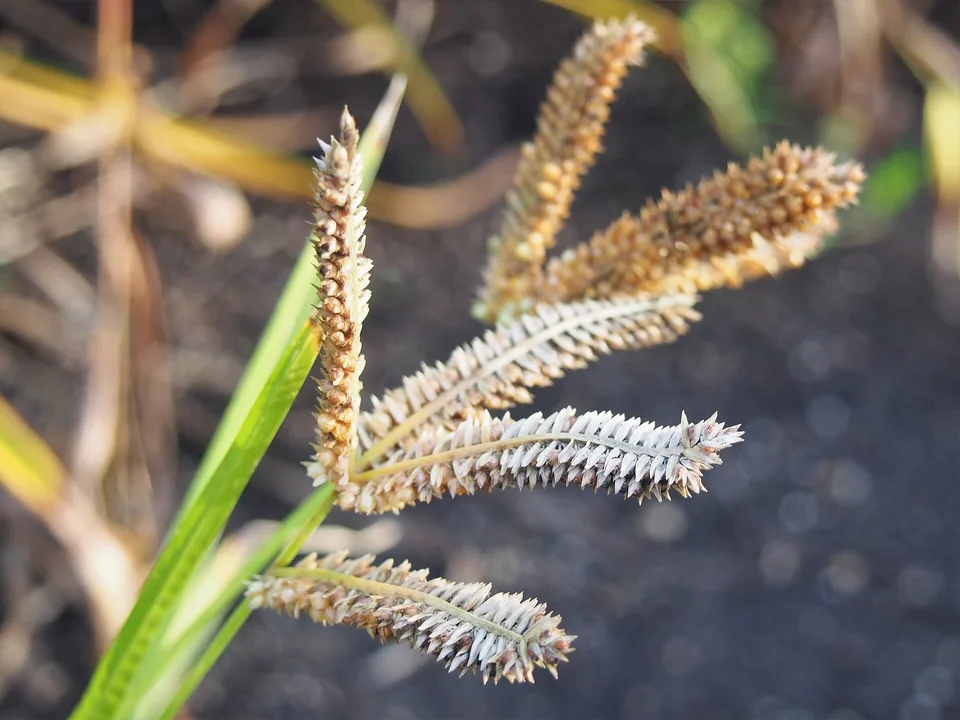
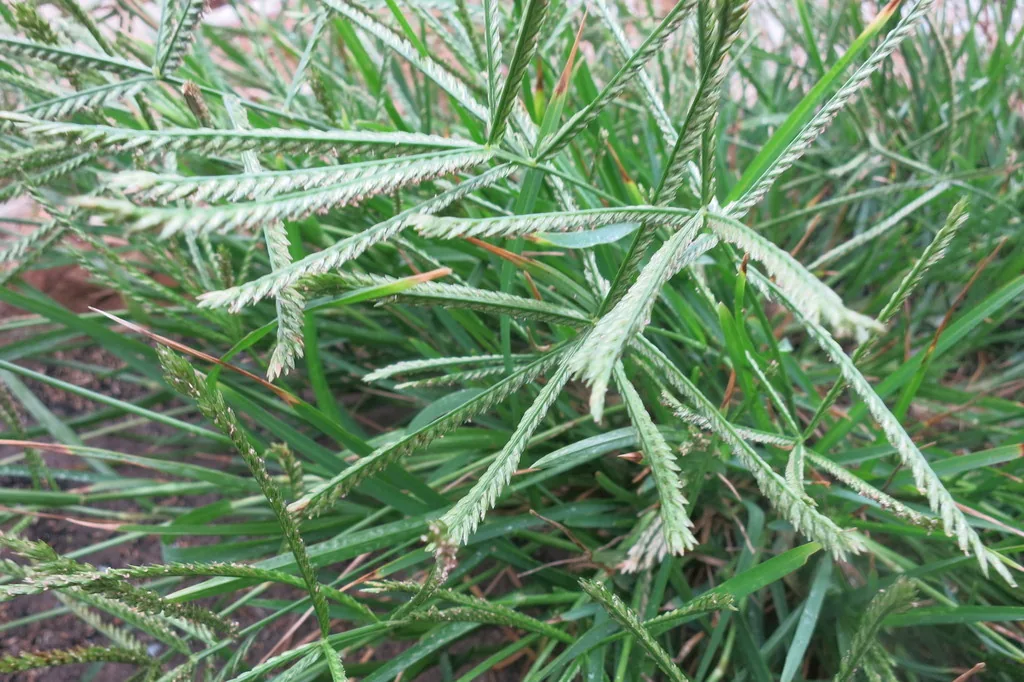
Finger millet is an annual tufted grass grown for its seed as a cereal. [4][2] It is grown from the temperate zone to the tropics, in sunny positions and ordinary soil. [4]
This record is incomplete: the sources we read do not cover every field yet.
Not yet covered by our sources: Sowing / Planting
Finger millet care
Measurements in square brackets are our conversion into the other unit system; the quoted text is unchanged.
How to water Finger millet
Watering
Light soils: once in 6-8 days; heavy soils: once in 12-15 days (8-14 irrigations in all)
Watering notes
Avoid excess irrigation and waterlogging; seedlings are sensitive to drought, mature plants go dormant in short droughts
How much light Finger millet needs
Sun
What the sources say (1)
it succeeds in ordinary garden soil in a sunny positionWhere to grow Finger millet
22.5-30 cm [9–12 in] between rows and 7.5-10 cm [3–3.9 in] between plants
What each source says
Transplanting, early-maturing varieties: 20 x 10 cm [3.9 in]
Transplanting, medium-duration varieties: 30 x 15 cm [5.9 in]
What the sources say (3)
Transplanting, early-maturing varieties: use close spacing: 20 x 10 cm for early-maturing varieties and 30 x 15 cm for medium-duration varietiesTransplanting, medium-duration varieties: use close spacing: 20 x 10 cm for early-maturing varieties and 30 x 15 cm for medium-duration varietiesgiving a spacing of 22.5-30 cm between rows and 7.5-10 cm between plantsHow to propagate Finger millet
How to grow Finger millet
Fertilizing
When
At sowing or transplanting for all the phosphorus and potassium and part of the nitrogen; the rest of the nitrogen as top-dressing in the following weeks
What each source says
rainfed crop, good rainfall (Tamil Nadu): Half the nitrogen at sowing, the rest in two equal splits at 25-30 and 40-45 days after sowing
transplanted crop (Assam): Half the nitrogen as top-dressing 30 days after transplanting
What the sources say (4)
rainfed crop, good rainfall (Tamil Nadu): In areas of good rainfall and moisture availability, 50% of recommended nitrogen is to be applied at sowing and the remaining 50% in two equal splits at 25-30 and 40-45 days after sowing.transplanted crop (Assam): Apply 50% of the full doses of FYM, P 2 O 5 , and K 2 O as basal fertilizer, and apply the remaining 50% of nitrogen (N) as a top dressing 30 days after transplanting.Entire P2O5 and K2O are to be applied at sowing, whereas nitrogen is to be applied in two or three split doses depending upon moisture availability.Apply 50% of the full doses of FYM, P 2 O 5 , and K 2 O as basal fertilizer, and apply the remaining 50% of nitrogen (N) as a top dressing 30 days after transplanting.How often
Nitrogen split into two or three applications; phosphorus and potassium once, at sowing
What the sources say (1)
Entire P2O5 and K2O are to be applied at sowing, whereas nitrogen is to be applied in two or three split doses depending upon moisture availability.Natural fertilizers
Farmyard manure or compost, worked into the soil before sowing or transplanting
What each source says
field production, irrigated (Tamil Nadu): 12.5 t/ha of farmyard manure or compost
field production (Assam): 5 t/ha of farmyard manure or compost
seed treatment (Tamil Nadu): Nitrogen-fixing and phosphorus-solubilising biofertilizers, 25 g per kg of seed
What the sources say (5)
field production, irrigated (Tamil Nadu): Spread 12.5 t/ha of FYM or compost or composted coir pith evenly on the unploughed field and then plough and incorporate in the soil.field production (Assam): Apply Farmyard Manure (FYM) or Compost at a rate of 5 tons per hectare or 6 quintals per bigha.seed treatment (Tamil Nadu): Treating seeds with Azospirillum brasilense (N fixing bacterium) and Aspergillus awamori (P solubilizing fungus) @ 25 g/kg seed is beneficial.Spread 12.5 t/ha of FYM or compost or composted coir pith evenly on the unploughed field and then plough and incorporate in the soil.Apply Farmyard Manure (FYM) or Compost at a rate of 5 tons per hectare or 6 quintals per bigha.Mineral fertilizers
Complete nitrogen-phosphorus-potassium fertilizer, based on a soil test where possible; the crop responds especially to nitrogen and phosphorus
What each source says
field production, irrigated, without a soil test (Tamil Nadu): 60 kg [132.3 lb] N, 30 kg [66.1 lb] P₂O₅ and 30 kg [66.1 lb] K₂O per hectare
field production, rainfed (Tamil Nadu): N:P:K 40:20:20 kg [44.1 lb] per hectare
What the sources say (4)
field production, irrigated, without a soil test (Tamil Nadu): If soil test recommendation is not available, adopt a blanket recommendation of 60 kg N, 30 kg PO5 and 30 kg K2O per ha.field production, rainfed (Tamil Nadu): The recommended doses of fertilizers vary from state to state for rainfed crop. Apply recommended dose of 40:20:20 N:P:K kg/ha was applied.Apply NPK fertilizers as per soil test recommendation as far as possible.Finger millet responds well to fertilizer application especially to N and P.Micronutrients
The sources give different values depending on region, zone or growing conditions.
What each source says
field production, irrigated (Tamil Nadu): 12.5 kg [27.6 lb]/ha of micronutrient mixture, mixed with sand to 50 kg [110.2 lb] and spread on the beds without incorporating it
What the sources say (1)
field production, irrigated (Tamil Nadu): Mix 12.5 kg of micronutrient mixture formulated by the Department of Agriculture, Tamil Nadu with enough sand to make a total quantity of 50 kg/ha.Avoid
Leaving spread manure uncovered on the field, which loses nutrients
What each source says
field production, soils high in available potassium (Tamil Nadu): Potassium is not needed
What the sources say (2)
field production, soils high in available potassium (Tamil Nadu): In soils having high intensive cropping system viz., Ragi-Maize-Cowpea, having high soil available K potassium need not be applied.NOTE: Do not spread and leave the manure uncovered in the field as nutrients will be lost.Spacing
Between plants
7.5-10 cm [3–3.9 in] between plants in the row
What each source says
transplanted seedlings: 2 seedlings per hill, 10 cm [3.9 in] between hills, rows 22.5-25 cm [8.9–9.8 in] apart
What the sources say (2)
transplanted seedlings: Seedlings of 21-25 days old are ideal for transplanting in rows of 22.5- 25 cm with 2 seedlings /hill with 10 cm between hills.this is attained by line sowing using seed drill giving a spacing of 22.5-30 cm between rows and 7.5-10 cm between plantsBetween rows
22.5-30 cm [9–12 in] between rows
What the sources say (1)
this is attained by line sowing using seed drill giving a spacing of 22.5-30 cm between rows and 7.5-10 cm between plantsPropagation
Germination
Sow 2-3 cm [0.8–1.2 in] deep; the seeds take 5-7 days to germinate
What each source says
nursery for transplanting: Seedlings 21-25 days old are transplanted
What the sources say (3)
nursery for transplanting: Seedlings of 21-25 days old are ideal for transplanting in rows of 22.5- 25 cm with 2 seedlings /hill with 10 cm between hills.The seed should be planted 2-3 cm in depth.Seeds are very small and take 5-7 days to germinate.After harvest
Storage
The grain stores well: it is free from storage seed pests
What the sources say (1)
Free from storage seed pests, this cereal becomes an invaluable risk management strategy for farmers in drought-prone regions of Eastern Africa and South Asia.Heat and drought
Heat
Grows best with day temperatures of 30-34 °C [86–93 °F] and night temperatures of 22-25 °C [72–77 °F]
What the sources say (1)
Finger millet is a short day plant and grows best in an environment with day temperatures of 30 to 34oc and 22 to 25oc night temperaturesDrought
Recovers strongly after stress, which makes it suited to dryland farming
What the sources say (1)
The high rejuvenation capacity after alleviated stress conditions makes this crop ideal for dry land farming.Finger millet pests and problems
Blast
Symptom: Circular lesions pointed towards either end, grayish centre with brownish borders
What to do: Grow resistant varieties
Remedies
Each remedy shows what official sources say about it; traditional remedies without an official source are marked as such. Harmful ones are listed so you know to avoid them.
Treating the plant
blast
plant leaf extract spray Not verified
Traditional remedy, not verified by an official source.
How: Spray Prosopis juliflora leaf extract (10%) and Ipomoea carnea leaf extract (10%), after treating the seed with Pseudomonas fluorescens at 6 g/kg seed.
early sowing and proper spacing Not verified
Traditional remedy, not verified by an official source.
How: Proper plant spacing and transplanting are advisable; early sowing (July) reduces blast severity.
disease-free seed and resistant varieties Not verified
Traditional remedy, not verified by an official source.
How: Use disease-free seeds and grow resistant varieties such as CO RA (14), Paiyur (RA)-2, GPU-28, GPU-45, GPU-48, L-5.
Calendar
Sowing
The sources give different values depending on region, zone or growing conditions.
What each source says
Bihar: Kharif (June-September)
Himachal Pradesh: Kharif (April-September)
Planting
Not stated in the sources we read.
Harvest
Complete crop cycle 3-6 months
What the sources say (1)
Time from planting to flowering is 50 - 120 days; the complete crop cycle is 3 - 6 monthsMonths as given by the sources, which are mostly from the United States (northern hemisphere). In the southern hemisphere they shift by about six months.
Edibility
Reported by the source, quoted verbatim. Do not eat a plant on the basis of this page alone: identification mistakes can be dangerous.
Similar plants
- Goosegrass Eleusine indica
- Abyssinian banana Ensete ventricosum
- Agretti Soda inermis
- Aji Capsicum chinense
- Alexanders Smyrnium olusatrum
- Allium senescens Allium senescens
- Allium triquetrum Allium triquetrum
- Alpine dock Rumex alpinus
Sources
Every value above is quoted from these documents. Links lead to the original publisher.
- Eleusine coracana - Finger Millet | ECHOcommunity.org · echocommunity.org, consulted
- Crops Overview · icrisat.org, consulted
-  · millets.res.in, consulted
- Eleusine coracana - Useful Tropical Plants · tropical.theferns.info, consulted
- Recommended package of practices · millets.res.in, consulted
- How to grow Finger Millet - A Comprehensive Guide | Wikifarmer · wikifarmer.com, consulted
- agritech.tnau.ac.in · agritech.tnau.ac.in
- rkbassam.aau.ac.in · rkbassam.aau.ac.in
Written by Emilio Marruso · last checked