
How to Grow and Care for Yellow Bird-of-Paradise
Erythrostemon gilliesii
Written by Emilio Marruso · last checked
Toxic to: Cats, Dogs, People · Why
At a glance
This sun-loving shrub grows into a generous 6–8 ft tall and 4–6 ft wide, perfect for the sunniest spot in your yard. It asks for very little: deep, occasional watering, soil that dries slightly between drinks, and just a light trim after flowering. Start the seeds in early spring and plant it out once the last frosts are over.
- Sun
Full sun: 6 or more hours a day
What the sources say (2)
Light: Full sun (6 or more hours of direct sunlight a day)
Light: Full sun (6 or more hours of direct sunlight a day)
— Erythrostemon gilliesii (Bird-of Paradise Bush, Bird-of-Paradise shrub, Brazilwood, Desert Bird, Desert Bird of Paradise, Peacock Flower, Yellow Barbados Pride, Yellow Bird-of-Paradise, Yellow Pride of Barbados) | North Carolina Extension Gardener Plant Toolbox [1] Light: Full sun
— [4] - Water
Water deeply but not often; let the soil dry slightly. Give some summer water in hot, dry climates
What the sources say (2)
Watering: Allow the soil to dry slightly between waterings; deep, less frequent watering rather than frequent shallow watering
Allowing the soil to dry slightly between watering will stimulate the plant to develop a deep root system. Less often deep watering will help the development of the plant, rather than frequent, less volume watering.
— Erythrostemon gilliesii (Bird-of Paradise Bush, Bird-of-Paradise shrub, Brazilwood, Desert Bird, Desert Bird of Paradise, Peacock Flower, Yellow Barbados Pride, Yellow Bird-of-Paradise, Yellow Pride of Barbados) | North Carolina Extension Gardener Plant Toolbox [1] Watering notes: Needs some summer water in Phoenix
Definitely needs some summer water in Phoenix.
— [4] - Soil
Slightly acidic to slightly alkaline soil, pH 6.0–8.0
What the sources say (2)
Soil pH, minimum: 6.0
Soil pH: Neutral (6.0-8.0)
— Erythrostemon gilliesii (Bird-of Paradise Bush, Bird-of-Paradise shrub, Brazilwood, Desert Bird, Desert Bird of Paradise, Peacock Flower, Yellow Barbados Pride, Yellow Bird-of-Paradise, Yellow Pride of Barbados) | North Carolina Extension Gardener Plant Toolbox [1] Soil pH, maximum: 8.0
Soil pH: Neutral (6.0-8.0)
— Erythrostemon gilliesii (Bird-of Paradise Bush, Bird-of-Paradise shrub, Brazilwood, Desert Bird, Desert Bird of Paradise, Peacock Flower, Yellow Barbados Pride, Yellow Bird-of-Paradise, Yellow Pride of Barbados) | North Carolina Extension Gardener Plant Toolbox [1] - Planting
Plant in late spring or early summer, after the last frosts
What the sources say (1)
Planting: Late spring or early summer, after the last expected frosts
planting them out into their permanent positions in late spring or early summer, after the last expected frosts.
— Erythrostemon gilliesii - Useful Temperate Plants [3] - Pruning
Prune lightly after flowering, only as needed
What the sources say (1)
Pruning: After flowering, lightly and only as needed
Head back lightly after bloom, but only as needed to promote a more excellent shape, never shear.
— [4] - Size
6–8 ft tall and 4–6 ft wide
What the sources say (2)
Mature height: 182.88-243.84 cm (6-8 ft)
Dimensions: Height: 6 ft. 0 in. - 8 ft. 0 in. Width: 4 ft. 0 in. - 6 ft. 0 in.
— Erythrostemon gilliesii (Bird-of Paradise Bush, Bird-of-Paradise shrub, Brazilwood, Desert Bird, Desert Bird of Paradise, Peacock Flower, Yellow Barbados Pride, Yellow Bird-of-Paradise, Yellow Pride of Barbados) | North Carolina Extension Gardener Plant Toolbox [1] Mature width: 121.92-182.88 cm (4-6 ft)
Dimensions: Height: 6 ft. 0 in. - 8 ft. 0 in. Width: 4 ft. 0 in. - 6 ft. 0 in.
— Erythrostemon gilliesii (Bird-of Paradise Bush, Bird-of-Paradise shrub, Brazilwood, Desert Bird, Desert Bird of Paradise, Peacock Flower, Yellow Barbados Pride, Yellow Bird-of-Paradise, Yellow Pride of Barbados) | North Carolina Extension Gardener Plant Toolbox [1] - Propagation
Grow new plants from seed or from soft young stem cuttings
What the sources say (2)
Propagation: Seed; softwood cuttings
Recommended Propagation Strategy: Seed
— Erythrostemon gilliesii (Bird-of Paradise Bush, Bird-of-Paradise shrub, Brazilwood, Desert Bird, Desert Bird of Paradise, Peacock Flower, Yellow Barbados Pride, Yellow Bird-of-Paradise, Yellow Pride of Barbados) | North Carolina Extension Gardener Plant Toolbox [1] Softwood cuttings in sand in a frame
— Erythrostemon gilliesii - Useful Temperate Plants [3] - Sowing
Sow in early spring in a greenhouse
What the sources say (1)
Sowing: Early spring (in a greenhouse)
sow in a greenhouse in early spring
— Erythrostemon gilliesii - Useful Temperate Plants [3] - Safety
Seeds and green pods are toxic and cause severe vomiting; harmful to cats and dogs
Overview
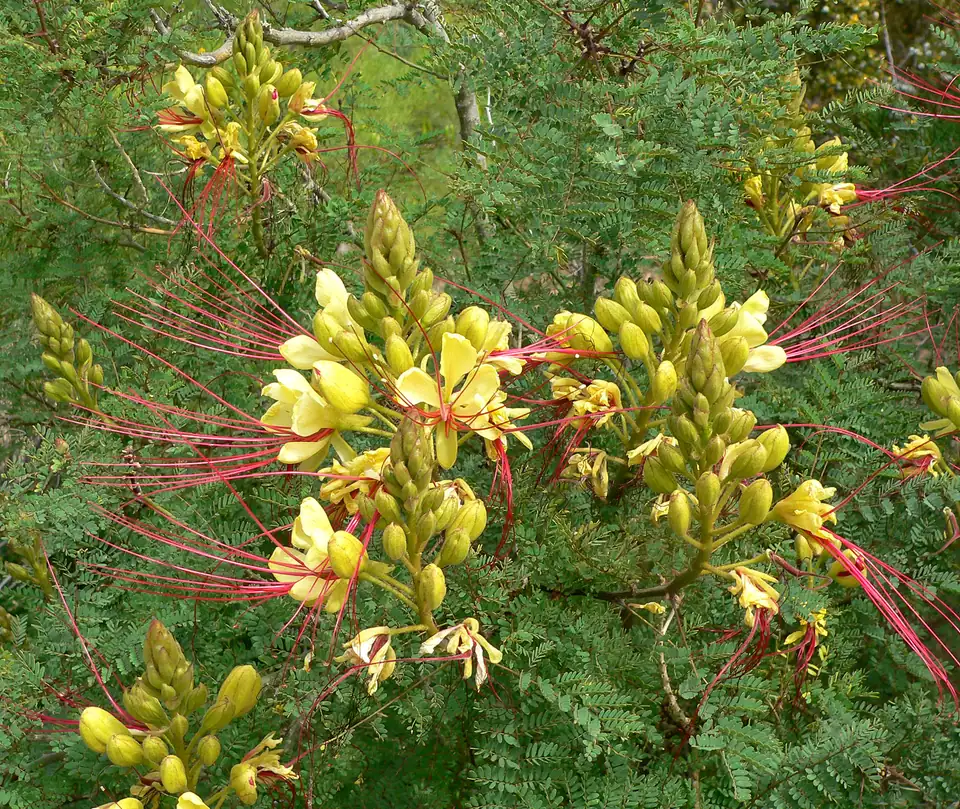
Yellow bird-of-paradise is a shrub or small tree native to South America, with showy yellow flowers and long red stamens. [1] It needs full sun and well-drained soil, and is drought and deer resistant. [1][4] Ingesting the fruits or seeds can cause gastrointestinal upset. [1]
This record is incomplete: the sources we read do not cover every field yet.
Not yet covered by our sources: Hardiness, coldest zone, Hardiness, warmest zone
Yellow Bird-of-Paradise care
How to water Yellow Bird-of-Paradise
Watering
Allow the soil to dry slightly between waterings; deep, less frequent watering rather than frequent shallow watering
What the sources say (1)
Allowing the soil to dry slightly between watering will stimulate the plant to develop a deep root system. Less often deep watering will help the development of the plant, rather than frequent, less volume watering.Watering notes
Needs some summer water in Phoenix
What the sources say (1)
Definitely needs some summer water in Phoenix.How much light Yellow Bird-of-Paradise needs
Full sun (6 or more hours of direct sunlight a day)
What the sources say (2)
Light:
Full sun (6 or more hours of direct sunlight a day)Light: Full sunHow much cold Yellow Bird-of-Paradise can take
Hardiness, coldest zone
Not stated in the sources we read.
Hardiness, warmest zone
Not stated in the sources we read.
Best soil for Yellow Bird-of-Paradise
Soil pH, minimum
6.0
What the sources say (1)
Soil pH:
Neutral (6.0-8.0)Soil pH, maximum
8.0
What the sources say (1)
Soil pH:
Neutral (6.0-8.0)How to propagate Yellow Bird-of-Paradise
Seed; softwood cuttings
What the sources say (2)
Recommended Propagation Strategy:
SeedSoftwood cuttings in sand in a frameHow to grow Yellow Bird-of-Paradise
The plant
Life cycle
perennial
What the sources say (1)
Uses (Ethnobotany):
Used as an accent.
Life Cycle:
Perennial
Woody
Recommended Propagation Strategy:
SeedFamily
Fabaceae
What the sources say (1)
Genus:
Erythrostemon
Species:
gilliesii
Family:
Fabaceae
Uses (Ethnobotany):
Used as an accent.Mature height
182.88-243.84 cm (6-8 ft)
What the sources say (1)
Dimensions:
Height: 6 ft. 0 in. - 8 ft. 0 in.
Width: 4 ft. 0 in. - 6 ft. 0 in.Mature width
121.92-182.88 cm (4-6 ft)
What the sources say (1)
Dimensions:
Height: 6 ft. 0 in. - 8 ft. 0 in.
Width: 4 ft. 0 in. - 6 ft. 0 in.Remedies
The sources we checked give no remedies for this plant.
Is Yellow Bird-of-Paradise toxic to pets?
Reported by the source, quoted verbatim. This is not medical or veterinary advice: if a person or an animal may have eaten this plant, contact a poison control centre or a veterinarian.
Animals
Problem for Cats
[1]The source flags the risk for this animal but does not explain why.
Problem for Dogs
[1]The source flags the risk for this animal but does not explain why.
People
This plant has low severity poison characteristics.
[1]- Poisonous parts
Poison Part: Leaves
[1]- Toxic principle
Poison Toxic Principle: possibly hydrocyanic acid
[1]- Symptoms
Poison Symptoms: Oral irritation, intense burning and irritation of mouth, tongue and lips, excessive drooling, vomiting, diarrhea, difficulty swallowing and incoordination is possible. Deaths in rabbits have been reported.
[1]- Severity
Poison Severity: Low
[1]
The seeds and the green seed pods are toxic, provoking severe vomiting and other abdominal symptoms
[3]
Calendar
Sowing
Early spring (in a greenhouse)
What the sources say (1)
sow in a greenhouse in early springPlanting
Late spring or early summer, after the last expected frosts
What the sources say (1)
planting them out into their permanent positions in late spring or early summer, after the last expected frosts.Pruning
After flowering, lightly and only as needed
What the sources say (1)
Head back lightly after bloom, but only as needed to promote a more excellent shape, never shear.Months as given by the sources, which are mostly from the United States (northern hemisphere). In the southern hemisphere they shift by about six months.
Similar plants
- Afghan Redbud Cercis griffithii
- Amur Maackia Maackia amurensis
- Bauhinia Bauhinia blakeana
- Bean Phaseolus vulgaris
- Bicolor Lespedeza Lespedeza bicolor
- Black Locust Robinia pseudoacacia
- Blue False Indigo Baptisia australis
- Blue Ridge Golden-banner Thermopsis villosa
Sources
Every value above is quoted from these documents. Links lead to the original publisher.
- Erythrostemon gilliesii (Bird-of Paradise Bush, Bird-of-Paradise shrub, Brazilwood, Desert Bird, Desert Bird of Paradise, Peacock Flower, Yellow Barbados Pride, Yellow Bird-of-Paradise, Yellow Pride of Barbados) | North Carolina Extension Gardener Plant Toolbox · plants.ces.ncsu.edu, consulted
- Erythrostemon gilliesii | Desert Legume Program · cales.arizona.edu, consulted
- Erythrostemon gilliesii - Useful Temperate Plants · temperate.theferns.info, consulted
- · asu.edu, consulted
Written by Emilio Marruso · last checked