
How to Grow and Care for Indonesian gum
Eucalyptus deglupta
Written by Emilio Marruso · last checked
Toxic to: Cats, Dogs, Horses · Why
At a glance
This eucalyptus is easy to keep happy: water it regularly whenever rain falls short, and it grows most lush with plenty of moisture. It likes soil from slightly acidic to slightly alkaline, pH 6.0–7.5, and you can start it from seed. Just keep it out of soggy ground, since it can't stand long flooding, and keep pets away from its bark and oil.
- Water
Water regularly when rain is not enough; it loves moisture but hates long flooding
What the sources say (3)
Watering: Regular watering when rainfall is insufficient
Once established, the tree grows 3 feet (91 cm.) per season without supplemental fertilizer, although it needs regular watering when rainfall is insufficient.
— Rainbow Eucalyptus Tree - Rainbow Eucalyptus Growing Conditions | Gardening Know How [2] Watering notes: Mature trees can grow in drier areas but are most luxuriant with abundant moisture; it does not withstand prolonged flooding
mature trees can survive and grow in drier areas, but they become their most luxuriant when they have access to abundant moisture
— Rainbow Eucalyptus – Port St. Lucie Botanical Gardens [3] E. deglupta does not withstand prolonged flooding, is highly sensitive to fires and, although it may grow in cool environments, it does not tolerate frost.
— Eucalyptus deglupta [5] - Cold
Survives winters down to 30 °F (−1.1 °C)
Half hardy: mild winters or an unheated greenhouse · USDA 10 · RHS H3 · Z10
What the sources say (3)
Hardiness, coldest zone: 10 [winter low −1.1 to 4.4 °C (30 to 40 °F)]
Winter hardy to USDA Zones 10-11 where this tree will grow well in rich, medium to wet soils in full sun
— Rainbow Eucalyptus – Port St. Lucie Botanical Gardens [3] It is suitable for U.S. Department of Agriculture plant hardiness zones 10 and higher.
— Rainbow Eucalyptus Tree - Rainbow Eucalyptus Growing Conditions | Gardening Know How [2] Hardiness, warmest zone: 11 [winter low 4.4 to 10 °C (40 to 50 °F)]
Winter hardy to USDA Zones 10-11 where this tree will grow well in rich, medium to wet soils in full sun
— Rainbow Eucalyptus – Port St. Lucie Botanical Gardens [3] - Soil
Slightly acidic to slightly alkaline soil, pH 6.0–7.5
What the sources say (2)
Soil pH, minimum: 6.0
It can grow successfully on coarse-textured sands and loamy soils, volcanic ash and limestone-derived soils (pH 6-7.5).
— Eucalyptus deglupta [5] Soil pH, maximum: 7.5
It can grow successfully on coarse-textured sands and loamy soils, volcanic ash and limestone-derived soils (pH 6-7.5).
— Eucalyptus deglupta [5] - Pests
Termites attack the wood; young seedlings can rot and collapse, a regular fungicide helps
- Propagation
Grows from seed
What the sources say (1)
Propagation: Seed
Prefers a humid, cooler tropical climate. Propagation by seeds.
— NParks | Eucalyptus deglupta [4] - Safety
Bark and oil are poisonous to dogs, cats and horses
Overview
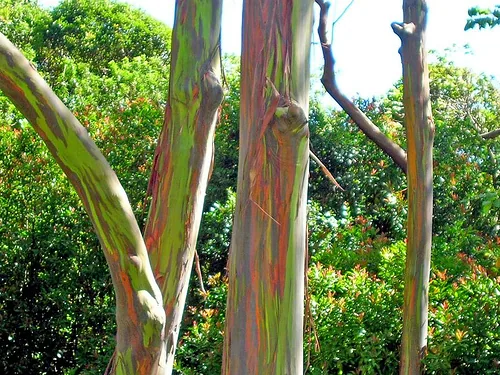
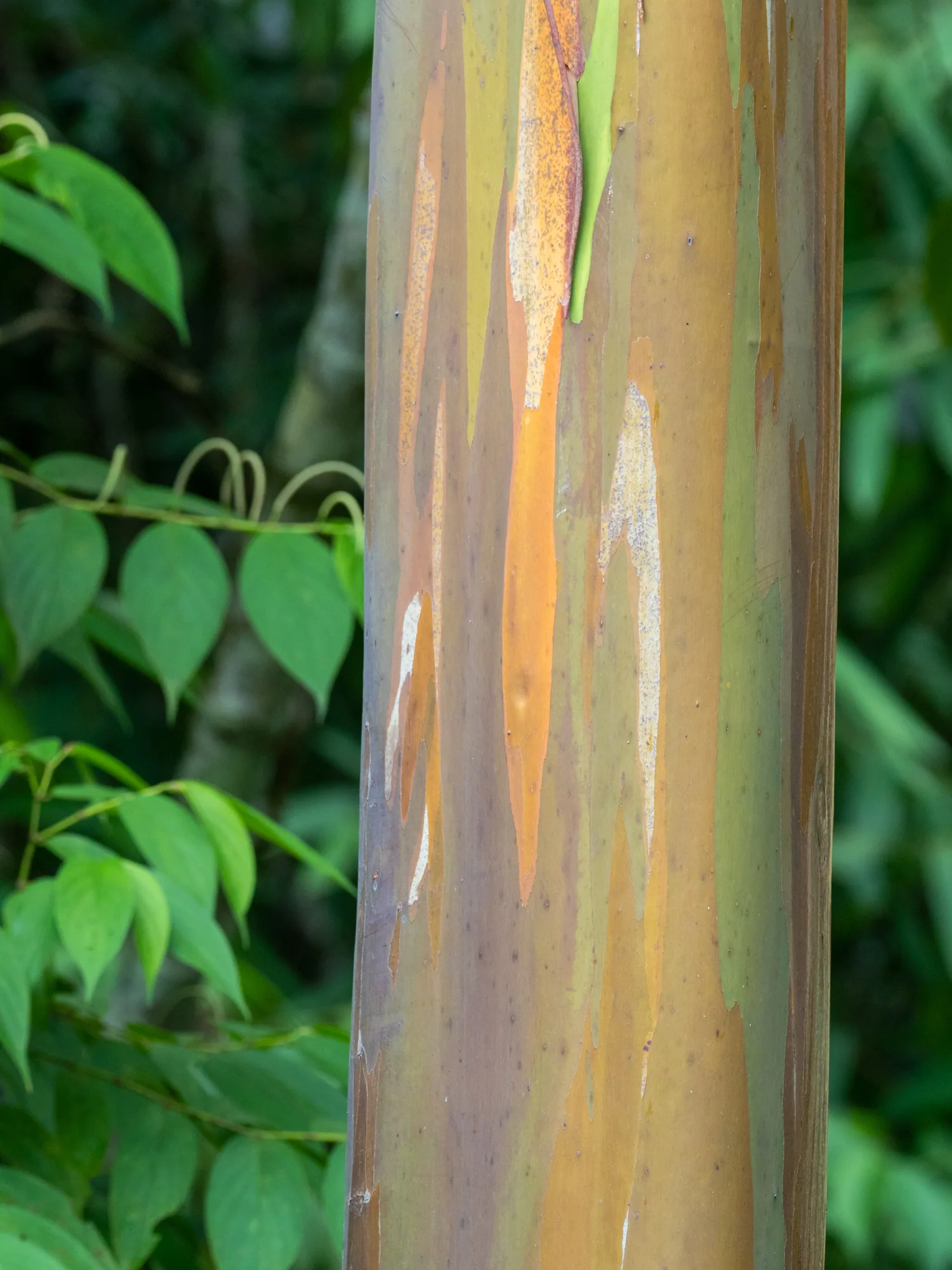
Rainbow eucalyptus is a large evergreen tree grown as an ornamental for its colourful peeling bark. [4] Its raised roots can damage sidewalks and foundations, so it suits open areas. [2]
This record is incomplete: the sources we read do not cover every field yet.
Not yet covered by our sources: Light, Pruning
Indonesian gum care
Measurements in square brackets are our conversion into the other unit system; the quoted text is unchanged.
How to water Indonesian gum
Watering
Regular watering when rainfall is insufficient
What the sources say (1)
Once established, the tree grows 3 feet (91 cm.) per season without supplemental fertilizer, although it needs regular watering when rainfall is insufficient.Watering notes
Mature trees can grow in drier areas but are most luxuriant with abundant moisture; it does not withstand prolonged flooding
What the sources say (2)
mature trees can survive and grow in drier areas, but they become their most luxuriant when they have access to abundant moistureE. deglupta does not withstand prolonged flooding, is highly sensitive to fires and, although it may grow in cool environments, it does not tolerate frost.How much light Indonesian gum needs
Not stated in the sources we read.
How much cold Indonesian gum can take
Hardiness, coldest zone
10 [winter low −1.1 to 4.4 °C (30 to 40 °F)]
What the sources say (2)
Winter hardy to USDA Zones 10-11 where this tree will grow well in rich, medium to wet soils in full sunIt is suitable for U.S. Department of Agriculture plant hardiness zones 10 and higher.Hardiness, warmest zone
11 [winter low 4.4 to 10 °C (40 to 50 °F)]
What the sources say (1)
Winter hardy to USDA Zones 10-11 where this tree will grow well in rich, medium to wet soils in full sunBest soil for Indonesian gum
Soil pH, minimum
6.0
What the sources say (1)
It can grow successfully on coarse-textured sands and loamy soils, volcanic ash and limestone-derived soils (pH 6-7.5).Soil pH, maximum
7.5
What the sources say (1)
It can grow successfully on coarse-textured sands and loamy soils, volcanic ash and limestone-derived soils (pH 6-7.5).Where to grow Indonesian gum
The sources give different values depending on region, zone or growing conditions.
What each source says
Philippines (plantation): 400 x 400 cm (4 x 4 m [13.1 ft])
Papua New Guinea (plantation): 300 x 300 cm [118 in] to 400 x 400 cm (3 x 3 m [9.8 ft] to 4 x 4 m [13.1 ft])
What the sources say (2)
Philippines (plantation): in the Philippines the spacing most commonly used is 4 x 4 m and the rotation 12 years with no thinningPapua New Guinea (plantation): in Papua New Guinea the spacing varies from 3 x 3 m to 4 x 4 m, for a rotation of 7-10 yearsHow to propagate Indonesian gum
Seed
What the sources say (1)
Prefers a humid, cooler tropical climate. Propagation by seeds.How to grow Indonesian gum
Fertilizing
When
The sources give different values depending on region, zone or growing conditions.
What each source says
Eucalyptus in general: Only after a hard pruning, if the tree isn't growing strongly; established trees in the ground need no feeding
Eucalyptus in general, in containers: Throughout the growing season (April to September)
What the sources say (2)
Eucalyptus in general: Most established trees growing in the ground don't need feeding.
However, it can be beneficial to feed eucalyptus that have just been hard prunedEucalyptus in general, in containers: Feed monthly with a general-purpose liquid fertiliser throughout the growing season (April to September)How often
The sources give different values depending on region, zone or growing conditions.
What each source says
Eucalyptus in general, in containers: Monthly during the growing season
What the sources say (1)
Eucalyptus in general, in containers: Feed monthly with a general-purpose liquid fertiliser throughout the growing season (April to September)Mineral fertilizers
The sources give different values depending on region, zone or growing conditions.
What each source says
Eucalyptus in general, in containers: General-purpose liquid fertiliser
What the sources say (1)
Eucalyptus in general, in containers: Feed monthly with a general-purpose liquid fertiliser throughout the growing season (April to September)Avoid
The sources give different values depending on region, zone or growing conditions.
What each source says
Eucalyptus in general: Enriching the planting soil with manure or garden compost
What the sources say (1)
Eucalyptus in general: Don't enrich the soil with manure or garden compostIndonesian gum pests and problems
Termites
Symptom: Termites are the most serious pest in natural stands and plantations; the wood is liable to termite attack
What the sources say (1)
Termites are the most serious pests in both natural stands and plantations.
— Eucalyptus deglupta [5] Damping-off in nursery
Symptom: Seedlings are susceptible to damping-off
What to do: Regular application of a fungicide can control this problem
What the sources say (1)
In the nursery, E. deglupta seedlings are susceptible to damping-off. Regular application of a fungicide can control this problem.
— Eucalyptus deglupta [5]
Remedies
The sources we checked give no remedies for this plant.
Is Indonesian gum toxic to pets?
Reported by the source, quoted verbatim. This is not medical or veterinary advice: if a person or an animal may have eaten this plant, contact a poison control centre or a veterinarian.
Calendar
Pruning
Not stated in the sources we read.
Months as given by the sources, which are mostly from the United States (northern hemisphere). In the southern hemisphere they shift by about six months.
Indicative values
Values from a secondary source, not checked word for word like the rest of this page. Use them as a starting point.
- Life cycle
- PerennialIndicative value, adapt it to your climate · Secondary source
- Mature height
- 3048-7620 cm (100-250 ft)Indicative value, adapt it to your climate · Secondary source
- Light
- Full sunIndicative value, adapt it to your climate · Secondary source
- Hours of sun
- 5-6 hoursIndicative value, adapt it to your climate · Secondary source
- Growth rate
- HighIndicative value, adapt it to your climate · Secondary source
- Pruning
- February, March, AprilIndicative value, adapt it to your climate · Secondary source
Similar plants
- River redgum Eucalyptus camaldulensis
- Silver Dollar Tree Eucalyptus cinerea
- Tasmanian blue gum Eucalyptus globulus
- Aaron's Beard Hypericum calycinum
- Abies grandis Abies grandis
- Abraham Trachystemon orientalis
- Abyssinian banana Ensete ventricosum
- Acacia longifolia Acacia longifolia
Sources
Every value above is quoted from these documents. Links lead to the original publisher.
- Eucalyptus deglupta Blume — Reforestation, Nurseries and Genetics Resources · rngr.net, consulted
- Rainbow Eucalyptus Tree - Rainbow Eucalyptus Growing Conditions | Gardening Know How · gardeningknowhow.com, consulted
- Rainbow Eucalyptus – Port St. Lucie Botanical Gardens · pslbg.org, consulted
- NParks | Eucalyptus deglupta · nparks.gov.sg, consulted
- Eucalyptus deglupta · apps.worldagroforestry.org, consulted
- Rainbow Gum: Eucalyptus deglupta | University of Pretoria · up.ac.za, consulted
- Completed: July 2012 · assessment.ifas.ufl.edu, consulted
- rhs.org.uk · rhs.org.uk
Written by Emilio Marruso · last checked