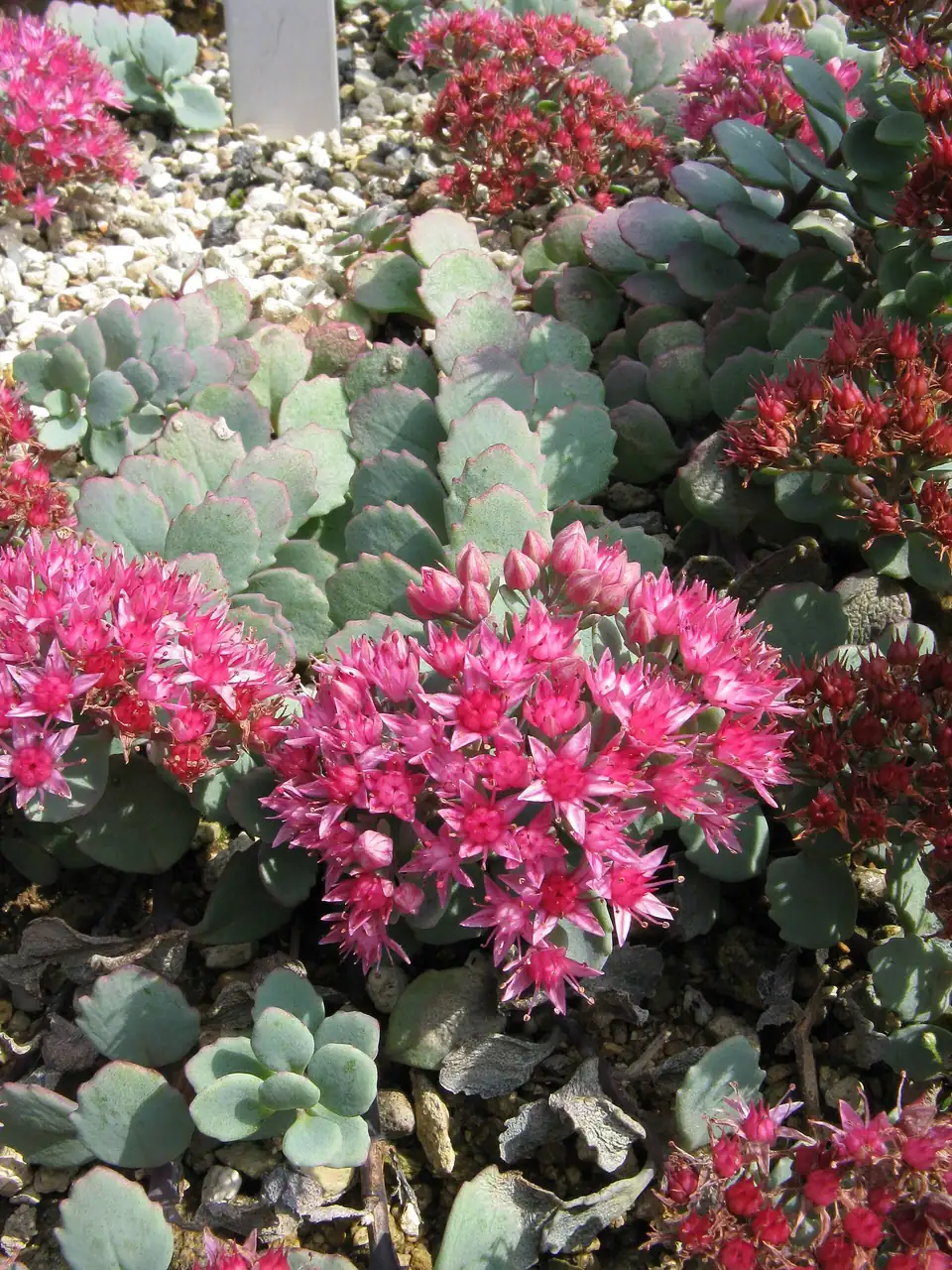


How to Grow and Care for Stonecrop
Hylotelephium cauticola
Written by Emilio Marruso · last checked
Toxic to: People · Why
At a glance
This little perennial stays just 2–4 inches tall and spreads 8 inches to 1 foot, happy in full sun or partial shade. It asks for very little: let the soil dry out completely between waterings, trim it after flowering, and it comes back year after year. It even thrives in a clay pot, and you can share it by division, cuttings or seed.
- Sun
Full sun to partial shade
What the sources say (1)
Light: Full sun to partial shade
It should be grown in full sun to partial shade and in sandy or loamy soil with neutral to alkaline pH.
— Hylotelephium cauticola (Cliff-dwelling stonecrop, Stonecrop) | North Carolina Extension Gardener Plant Toolbox [1] - Water
Let the soil dry out completely between waterings
What the sources say (1)
Watering: Allow the soil to dry out completely between watering
The soil should have good drainage and be allowed to dry out completely between watering.
— Hylotelephium cauticola (Cliff-dwelling stonecrop, Stonecrop) | North Carolina Extension Gardener Plant Toolbox [1] - Cold
Survives winters down to −30 °F (−34.4 °C)
Very hardy · USDA 4a · RHS H7 · Z4
What the sources say (2)
Hardiness, coldest zone: 4a [winter low −34.4 to −31.7 °C (−30 to −25 °F)]
USDA Plant Hardiness Zone: 4a, 4b, 5a, 5b, 6a, 6b, 7a, 7b, 8a, 8b, 9a, 9b
— Hylotelephium cauticola (Cliff-dwelling stonecrop, Stonecrop) | North Carolina Extension Gardener Plant Toolbox [1] Hardiness, warmest zone: 9b [winter low −3.9 to −1.1 °C (25 to 30 °F)]
USDA Plant Hardiness Zone: 4a, 4b, 5a, 5b, 6a, 6b, 7a, 7b, 8a, 8b, 9a, 9b
— Hylotelephium cauticola (Cliff-dwelling stonecrop, Stonecrop) | North Carolina Extension Gardener Plant Toolbox [1] - Soil
Well-drained soil, so the roots never sit in water
- Pruning
Trim it after flowering
What the sources say (1)
Pruning: After flowering
The plant may be trimmed after flowering to maintain its shape.
— Hylotelephium cauticola (Cliff-dwelling stonecrop, Stonecrop) | North Carolina Extension Gardener Plant Toolbox [1] - Pests
Slugs, snails, mealybugs and vine weevils; too much water causes root rot
What the sources say (2)
Pests: slugs, snails, mealybugs, vine weevil
Slugs, snails, mealybugs, vine weevil, and root rot can be found.
— Hylotelephium cauticola (Cliff-dwelling stonecrop, Stonecrop) | North Carolina Extension Gardener Plant Toolbox [1] Diseases: root rot
Slugs, snails, mealybugs, vine weevil, and root rot can be found.
— Hylotelephium cauticola (Cliff-dwelling stonecrop, Stonecrop) | North Carolina Extension Gardener Plant Toolbox [1] - Size
2–4 in tall and 8 in to 1 ft wide
What the sources say (2)
Mature height: 5.1-10.2 cm (2-4 in)
Height: 0 ft. 2 in. - 0 ft. 4 in. Width: 0 ft. 8 in. - 1 ft. 0 in.
— Hylotelephium cauticola (Cliff-dwelling stonecrop, Stonecrop) | North Carolina Extension Gardener Plant Toolbox [1] Mature width: 20.3-30.5 cm (8 in - 1 ft)
Height: 0 ft. 2 in. - 0 ft. 4 in. Width: 0 ft. 8 in. - 1 ft. 0 in.
— Hylotelephium cauticola (Cliff-dwelling stonecrop, Stonecrop) | North Carolina Extension Gardener Plant Toolbox [1] - Propagation
Divide it, take stem cuttings or sow seed
What the sources say (1)
Propagation: Division, stem cutting, seed
Propagate it by division, stem cutting, or seed.
— Hylotelephium cauticola (Cliff-dwelling stonecrop, Stonecrop) | North Carolina Extension Gardener Plant Toolbox [1] - Containers
Grows in containers: use an unglazed clay or terracotta pot
What the sources say (2)
In containers: Yes
If you choose to grow it in a container, choose a pot that is unglazed clay or terracotta
— Hylotelephium cauticola (Cliff-dwelling stonecrop, Stonecrop) | North Carolina Extension Gardener Plant Toolbox [1] Watering notes: In containers, use an unglazed clay or terracotta pot to avoid water retention that could cause root rot
choose a pot that is unglazed clay or terracotta to avoid water retention, which could cause root rot
— Hylotelephium cauticola (Cliff-dwelling stonecrop, Stonecrop) | North Carolina Extension Gardener Plant Toolbox [1] - Safety
Mildly toxic to people
Overview
Cliff-dwelling stonecrop is a low, creeping herbaceous perennial ground cover native to Japan. [1] It grows in full sun to partial shade in well-drained soil that is allowed to dry out completely between waterings. [1] It is listed as a low-severity poisonous plant for humans. [1]
Stonecrop care
How to water Stonecrop
Watering
Allow the soil to dry out completely between watering
What the sources say (1)
The soil should have good drainage and be allowed to dry out completely between watering.Watering notes
In containers, use an unglazed clay or terracotta pot to avoid water retention that could cause root rot
What the sources say (1)
choose a pot that is unglazed clay or terracotta to avoid water retention, which could cause root rotHow much light Stonecrop needs
Full sun to partial shade
What the sources say (1)
It should be grown in full sun to partial shade and in sandy or loamy soil with neutral to alkaline pH.How much cold Stonecrop can take
Hardiness, coldest zone
4a [winter low −34.4 to −31.7 °C (−30 to −25 °F)]
What the sources say (1)
USDA Plant Hardiness Zone:
4a, 4b, 5a, 5b, 6a, 6b, 7a, 7b, 8a, 8b, 9a, 9bHardiness, warmest zone
9b [winter low −3.9 to −1.1 °C (25 to 30 °F)]
What the sources say (1)
USDA Plant Hardiness Zone:
4a, 4b, 5a, 5b, 6a, 6b, 7a, 7b, 8a, 8b, 9a, 9bWhere to grow Stonecrop
Yes
What the sources say (1)
If you choose to grow it in a container, choose a pot that is unglazed clay or terracottaHow to propagate Stonecrop
Division, stem cutting, seed
What the sources say (1)
Propagate it by division, stem cutting, or seed.How to grow Stonecrop
The plant
Life cycle
perennial
What the sources say (1)
Family:
Crassulaceae
Uses (Ethnobotany):
Container plant
Life Cycle:
PerennialFamily
Crassulaceae
What the sources say (1)
Family:
Crassulaceae
Uses (Ethnobotany):
Container plant
Life Cycle:
PerennialMature height
5.1-10.2 cm (2-4 in)
What the sources say (1)
Height: 0 ft. 2 in. - 0 ft. 4 in.
Width: 0 ft. 8 in. - 1 ft. 0 in.Mature width
20.3-30.5 cm (8 in - 1 ft)
What the sources say (1)
Height: 0 ft. 2 in. - 0 ft. 4 in.
Width: 0 ft. 8 in. - 1 ft. 0 in.Pests and diseases
Pests
slugs, snails, mealybugs, vine weevil
What the sources say (1)
Slugs, snails, mealybugs, vine weevil, and root rot can be found.Diseases
root rot
What the sources say (1)
Slugs, snails, mealybugs, vine weevil, and root rot can be found.Fertilizing
How often
The sources give different values depending on region, zone or growing conditions.
What each source says
Hylotelephium in general: Little or no feeding needed in most garden soils
What the sources say (1)
Hylotelephium in general: Your hylotelephiums will need little or no feeding in most garden soils.Avoid
The sources give different values depending on region, zone or growing conditions.
What each source says
Hylotelephium in general: Too much plant food, especially nitrogen
What the sources say (1)
Hylotelephium in general: Your hylotelephiums will need little or no feeding in most garden soils. Too much plant food, particularly nitrogen (which is in most plant fertilisers), will lead to lush floppy growth that can be disease prone and flower poorly.Signs of excess
The sources give different values depending on region, zone or growing conditions.
What each source says
Hylotelephium in general: Lush, floppy growth that is disease prone and flowers poorly
What the sources say (1)
Hylotelephium in general: Your hylotelephiums will need little or no feeding in most garden soils. Too much plant food, particularly nitrogen (which is in most plant fertilisers), will lead to lush floppy growth that can be disease prone and flower poorly.Stonecrop pests and problems
Pests and root rot
Symptom: Slugs, snails, mealybugs, vine weevil, and root rot can be found.
What to do: Grow in well-drained soil and let it dry out completely between watering; in containers use an unglazed clay or terracotta pot.
What the sources say (2)
Slugs, snails, mealybugs, vine weevil, and root rot can be found.
— Hylotelephium cauticola (Cliff-dwelling stonecrop, Stonecrop) | North Carolina Extension Gardener Plant Toolbox [1] The soil should have good drainage and be allowed to dry out completely between watering.
— Hylotelephium cauticola (Cliff-dwelling stonecrop, Stonecrop) | North Carolina Extension Gardener Plant Toolbox [1]
Remedies
Each remedy shows what official sources say about it; traditional remedies without an official source are marked as such. Harmful ones are listed so you know to avoid them.
First aid
First aid: not a substitute for a doctor
contact with sap
wash with soap and running water Official source, not independently tested
Swallowed a possibly poisonous plant? Use the web POISON CONTROL online tool to get help, or call your poison center at 1-800-222-1222
— poison.org [5] How: Wash the area thoroughly with plenty of running water and soap.
Wash the area thoroughly with plenty of running water and soap.
— poison.org [5]
Treating the plant
slugs
hand-picking Works
How: Handpick from plants at night.
Handpick from plants at night or from fence ledges, undersides of decks, and meter boxes.
— ipm.ucanr.edu [6] What the evidence says Hand-picking can be very effective if done thoroughly on a regular basis.
— ipm.ucanr.edu [6] beer trap Partly works
How: Bury beer traps at ground level in the garden and check traps daily.
Bury beer traps at ground level in your garden to catch snails and slugs. Check traps daily.
— ipm.ucanr.edu [6] What the evidence says Bury beer traps at ground level in your garden to catch snails and slugs. Check traps daily.
— ipm.ucanr.edu [6] copper barrier Works
How: Use a 4- to 6- inch-wide band of copper, buried an inch below the soil or attached around the edge of a raised bed.
Install a copper barrier around gardens. Use a 4- to 6- inch-wide band of copper, buried an inch below the soil or attached around the edge of a raised bed.
— ipm.ucanr.edu [6] What the evidence says Install a copper barrier around gardens. Use a 4- to 6- inch-wide band of copper, buried an inch below the soil or attached around the edge of a raised bed.
— ipm.ucanr.edu [6] salt Harmful
Do not use salt to destroy snails and slugs, as it will increase soil salinity.
— ipm.ucanr.edu [6] How: Not to be used on slugs and snails.
Do not use salt to destroy snails and slugs, as it will increase soil salinity.
— ipm.ucanr.edu [6] What the evidence says Do not use salt to destroy snails and slugs, as it will increase soil salinity.
— ipm.ucanr.edu [6]
vine weevil
removing beetles by hand Official source, not independently tested
How: On mild spring or summer evenings inspect plants and walls by torchlight and pick off the adult weevils.
Remove beetles by hand where practical. On mild spring or summer evenings inspect plants and walls by torchlight and pick off the adult weevils.
— rhs.org.uk [7] nematodes Official source, not independently tested
Nematodes have the potential to infect other animals. They should therefore be used with care and only when there is a specific problem to treat
— rhs.org.uk [7] How: Apply microscopic insect pathogenic nematodes against the larvae, in August or early September, in containers or in the open ground.
Biological control for the larvae is available as microscopic insect pathogenic nematodes. Several species and combinations are available ( Steinernema kraussei, Heterorhabditis megidis, H. bacteriophora and S. feltiae ).They are available from suppliers of biological controls and as sachet formulations available from some retail outlets. They are suitable for use in containers and in the open ground.
— rhs.org.uk [7]
Is Stonecrop poisonous?
Reported by the source, quoted verbatim. This is not medical or veterinary advice: if a person or an animal may have eaten this plant, contact a poison control centre or a veterinarian.
This plant has low severity poison characteristics. See below
[1]- Poisonous parts
Poison Part: Flowers Fruits Leaves Roots Sap/Juice Seeds Stems
[1]- Toxic principle
Poison Toxic Principle: Alkaloids sedine, sedamine and others
[1]- Symptoms
Poison Symptoms: Unknown, but possibly gastrointestinal symptoms Poison Toxic Principle:
[1]- Severity
Poison Severity: Low Poison Symptoms: Unknown, but possibly gastrointestinal symptoms Poison Toxic Principle: Alkaloids sedine, sedamine and others Causes Contact Dermatitis:
[1]
Calendar
Pruning
After flowering
What the sources say (1)
The plant may be trimmed after flowering to maintain its shape.Months as given by the sources, which are mostly from the United States (northern hemisphere). In the southern hemisphere they shift by about six months.
Similar plants
- Allegheny Stonecrop Hylotelephium telephioides
- Evergreen Orpine Hylotelephium anacampseros
- Stonecrop Hylotelephium sieboldii
- Stonecrop Hylotelephium spectabile
- Stonecrop Hylotelephium telephium
- Carpet Sedum Sedum lineare
- Chandelier Plant Kalanchoe delagoensis
- Copper Rose Echeveria multicaulis
Sources
Every value above is quoted from these documents. Links lead to the original publisher.
- Hylotelephium cauticola (Cliff-dwelling stonecrop, Stonecrop) | North Carolina Extension Gardener Plant Toolbox · plants.ces.ncsu.edu, consulted
- Stonecrop - Hylotelephium | North Carolina Extension Gardener Plant Toolbox · plants.ces.ncsu.edu, consulted
- Hylotelephium (Live-forever, Orpine, Sedum, Stonecrop) | North Carolina Extension Gardener Plant Toolbox · plants.ces.ncsu.edu, consulted
- rhs.org.uk · rhs.org.uk
- poison.org · poison.org
- ipm.ucanr.edu · ipm.ucanr.edu
- rhs.org.uk · rhs.org.uk
Written by Emilio Marruso · last checked