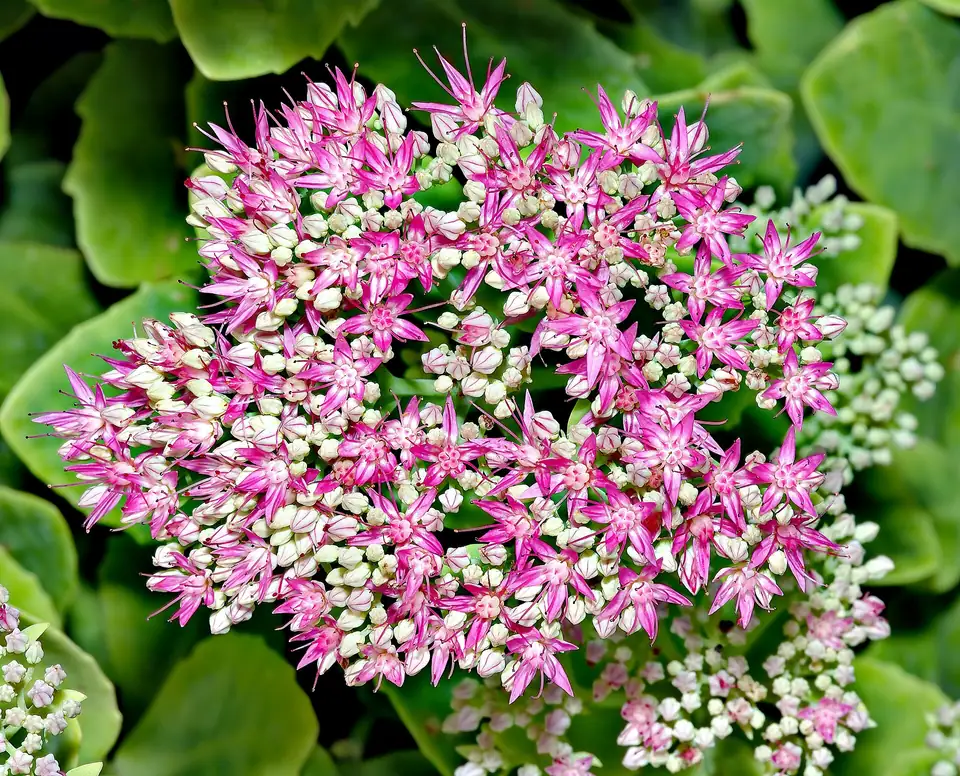


How to Grow and Care for Stonecrop
Hylotelephium spectabile
Written by Emilio Marruso · last checked
Toxic to: People · Why
At a glance
This tough perennial thrives anywhere from full sun to partial shade and shrugs off dry spells, so it's a forgiving choice for beginners. It needs little or no feeding, grows happily in containers, and new plants start easily from stem cuttings. Just give it well-drained soil, because soggy ground makes it rot, and it will reward you year after year.
- Sun
Full sun to partial shade
What the sources say (1)
Light: Full sun to partial shade
Stonecrop requires full sun or partial shade and well-drained or gravelly soil
— Hylotelephium spectabile (Ice Plant, Showy Stonecrop, Stonecrop) | North Carolina Extension Gardener Plant Toolbox [1] - Water
Handles dry spells well; too much water makes it rot
What the sources say (4)
Watering: Drought tolerant; can suffer in overly moist soils
It is drought- and salt-tolerant, resistant to browsing by rabbits
— Hylotelephium spectabile (Ice Plant, Showy Stonecrop, Stonecrop) | North Carolina Extension Gardener Plant Toolbox [1] It can suffer in overly moist or fertile soils.
— Hylotelephium spectabile (Ice Plant, Showy Stonecrop, Stonecrop) | North Carolina Extension Gardener Plant Toolbox [1] Watering notes: Wet soils cause rot; needs well-drained or gravelly soil
Aphids, mealybugs, nematodes, scale, slugs and weevils can be problematic. Wet soils cause rot.
— Hylotelephium spectabile (Ice Plant, Showy Stonecrop, Stonecrop) | North Carolina Extension Gardener Plant Toolbox [1] requires full sun or partial shade and well-drained or gravelly soil with average to low fertility.
— Hylotelephium spectabile (Ice Plant, Showy Stonecrop, Stonecrop) | North Carolina Extension Gardener Plant Toolbox [1] - Cold
Survives winters down to −30 °F (−34.4 °C)
Very hardy · USDA 4a · RHS H7 · Z4
What the sources say (2)
Hardiness, coldest zone: 4a [winter low −34.4 to −31.7 °C (−30 to −25 °F)]
4a, 4b, 5a, 5b, 6a, 6b, 7a, 7b, 8a, 8b, 9a, 9b
— Hylotelephium spectabile (Ice Plant, Showy Stonecrop, Stonecrop) | North Carolina Extension Gardener Plant Toolbox [1] Hardiness, warmest zone: 9b [winter low −3.9 to −1.1 °C (25 to 30 °F)]
4a, 4b, 5a, 5b, 6a, 6b, 7a, 7b, 8a, 8b, 9a, 9b
— Hylotelephium spectabile (Ice Plant, Showy Stonecrop, Stonecrop) | North Carolina Extension Gardener Plant Toolbox [1] - Soil
Well-drained or gravelly soil, not too rich
What the sources say (2)
Watering notes: Wet soils cause rot; needs well-drained or gravelly soil
Aphids, mealybugs, nematodes, scale, slugs and weevils can be problematic. Wet soils cause rot.
— Hylotelephium spectabile (Ice Plant, Showy Stonecrop, Stonecrop) | North Carolina Extension Gardener Plant Toolbox [1] requires full sun or partial shade and well-drained or gravelly soil with average to low fertility.
— Hylotelephium spectabile (Ice Plant, Showy Stonecrop, Stonecrop) | North Carolina Extension Gardener Plant Toolbox [1] - Feeding
Little or no feeding; too much nitrogen makes floppy stems and few flowers
What the sources say (3)
How often: Little or no feeding needed in most garden soils
Your hylotelephiums will need little or no feeding in most garden soils.
— [3] Avoid: Too much plant food, especially nitrogen
Your hylotelephiums will need little or no feeding in most garden soils. Too much plant food, particularly nitrogen (which is in most plant fertilisers), will lead to lush floppy growth that can be disease prone and flower poorly.
— [3] Signs of excess: Lush, floppy growth that is disease prone and flowers poorly
Your hylotelephiums will need little or no feeding in most garden soils. Too much plant food, particularly nitrogen (which is in most plant fertilisers), will lead to lush floppy growth that can be disease prone and flower poorly.
— [3] - Pruning
Cut or pinch back stems in early spring; pruning in summer may delay blooms
What the sources say (1)
Pruning: Early spring (cut or pinch back stems); pruning in summer may delay blooms
cut or pinch back the stems in early spring. If pruned in summer, the showy blooms may be delayed.
— Hylotelephium spectabile (Ice Plant, Showy Stonecrop, Stonecrop) | North Carolina Extension Gardener Plant Toolbox [1] - Harvest
Very young stems and leaves can be eaten raw; later, until it flowers, briefly cooked
- Pests
Aphids, mealybugs, scale, slugs and weevils; rot in wet soil
What the sources say (2)
Pests: aphids, mealybugs, nematodes, scale, slugs, weevils
Aphids, mealybugs, nematodes, scale, slugs and weevils can be problematic. Wet soils cause rot.
— Hylotelephium spectabile (Ice Plant, Showy Stonecrop, Stonecrop) | North Carolina Extension Gardener Plant Toolbox [1] Diseases: rot (in wet soils)
Aphids, mealybugs, nematodes, scale, slugs and weevils can be problematic. Wet soils cause rot.
— Hylotelephium spectabile (Ice Plant, Showy Stonecrop, Stonecrop) | North Carolina Extension Gardener Plant Toolbox [1] - Size
1–2 ft tall and 1–2 ft wide
What the sources say (2)
Mature height: 30-61 cm (1 ft - 2 ft)
It forms a mound 1 to 2 feet high and wide.
— Hylotelephium spectabile (Ice Plant, Showy Stonecrop, Stonecrop) | North Carolina Extension Gardener Plant Toolbox [1] Mature width: 30-61 cm (1 ft - 2 ft)
It forms a mound 1 to 2 feet high and wide.
— Hylotelephium spectabile (Ice Plant, Showy Stonecrop, Stonecrop) | North Carolina Extension Gardener Plant Toolbox [1] - Propagation
Easy to start from stem cuttings
What the sources say (1)
Propagation: Stem cuttings
requires little attention. It is easily rooted from stem cuttings.
— Hylotelephium spectabile (Ice Plant, Showy Stonecrop, Stonecrop) | North Carolina Extension Gardener Plant Toolbox [1] - Containers
Grows in containers too
What the sources say (1)
In containers: Yes
It also works well in containers (outside), in borders, along a foundation
— Hylotelephium spectabile (Ice Plant, Showy Stonecrop, Stonecrop) | North Carolina Extension Gardener Plant Toolbox [1] - Safety
Low toxicity for people; eating it may upset the stomach
Overview
Showy stonecrop is a clumping perennial succulent forming a mound 1 to 2 feet [30–61 cm] high and wide. [1] It needs full sun or partial shade and well-drained or gravelly soil, and is drought- and salt-tolerant. [1] It roots easily from stem cuttings and suits rock gardens, borders and containers. [1]
Stonecrop care
Measurements in square brackets are our conversion into the other unit system; the quoted text is unchanged.
How to water Stonecrop
Watering
Drought tolerant; can suffer in overly moist soils
What the sources say (2)
It is drought- and salt-tolerant, resistant to browsing by rabbitsIt can suffer in overly moist or fertile soils.Watering notes
Wet soils cause rot; needs well-drained or gravelly soil
What the sources say (2)
Aphids, mealybugs, nematodes, scale, slugs and weevils can be problematic. Wet soils cause rot.requires full sun or partial shade and well-drained or gravelly soil with average to low fertility.How much light Stonecrop needs
Full sun to partial shade
What the sources say (1)
Stonecrop requires full sun or partial shade and well-drained or gravelly soilHow much cold Stonecrop can take
Hardiness, coldest zone
4a [winter low −34.4 to −31.7 °C (−30 to −25 °F)]
What the sources say (1)
4a, 4b, 5a, 5b, 6a, 6b, 7a, 7b, 8a, 8b, 9a, 9bHardiness, warmest zone
9b [winter low −3.9 to −1.1 °C (25 to 30 °F)]
What the sources say (1)
4a, 4b, 5a, 5b, 6a, 6b, 7a, 7b, 8a, 8b, 9a, 9bWhere to grow Stonecrop
Yes
What the sources say (1)
It also works well in containers (outside), in borders, along a foundationHow to propagate Stonecrop
Stem cuttings
What the sources say (1)
requires little attention. It is easily rooted from stem cuttings.How to grow Stonecrop
The plant
Life cycle
perennial
What the sources say (1)
Stonecrop is a clumping, perennial succulent in the stonecrop family (Crassulaceae) and is native to China and Korea.Family
Crassulaceae
What the sources say (1)
Stonecrop is a clumping, perennial succulent in the stonecrop family (Crassulaceae) and is native to China and Korea.Mature height
30-61 cm (1 ft - 2 ft)
What the sources say (1)
It forms a mound 1 to 2 feet high and wide.Mature width
30-61 cm (1 ft - 2 ft)
What the sources say (1)
It forms a mound 1 to 2 feet high and wide.Pests and diseases
Pests
aphids, mealybugs, nematodes, scale, slugs, weevils
What the sources say (1)
Aphids, mealybugs, nematodes, scale, slugs and weevils can be problematic. Wet soils cause rot.Diseases
rot (in wet soils)
What the sources say (1)
Aphids, mealybugs, nematodes, scale, slugs and weevils can be problematic. Wet soils cause rot.Fertilizing
How often
Little or no feeding needed in most garden soils
What the sources say (1)
Your hylotelephiums will need little or no feeding in most garden soils.Avoid
Too much plant food, especially nitrogen
What the sources say (1)
Your hylotelephiums will need little or no feeding in most garden soils. Too much plant food, particularly nitrogen (which is in most plant fertilisers), will lead to lush floppy growth that can be disease prone and flower poorly.Signs of excess
Lush, floppy growth that is disease prone and flowers poorly
What the sources say (1)
Your hylotelephiums will need little or no feeding in most garden soils. Too much plant food, particularly nitrogen (which is in most plant fertilisers), will lead to lush floppy growth that can be disease prone and flower poorly.Stonecrop pests and problems
Pests
Symptom: Aphids, mealybugs, nematodes, scale, slugs and weevils can be problematic.
What to do: Not specified in the source.
What the sources say (1)
Aphids, mealybugs, nematodes, scale, slugs and weevils can be problematic. Wet soils cause rot.
— Hylotelephium spectabile (Ice Plant, Showy Stonecrop, Stonecrop) | North Carolina Extension Gardener Plant Toolbox [1] Rot in wet soils
Symptom: Wet soils cause rot.
What to do: Grow in well-drained or gravelly soil with average to low fertility.
What the sources say (2)
Aphids, mealybugs, nematodes, scale, slugs and weevils can be problematic. Wet soils cause rot.
— Hylotelephium spectabile (Ice Plant, Showy Stonecrop, Stonecrop) | North Carolina Extension Gardener Plant Toolbox [1] It can suffer in overly moist or fertile soils.
— Hylotelephium spectabile (Ice Plant, Showy Stonecrop, Stonecrop) | North Carolina Extension Gardener Plant Toolbox [1]
Remedies
The sources we checked give no remedies for this plant.
Is Stonecrop poisonous?
Reported by the source, quoted verbatim. This is not medical or veterinary advice: if a person or an animal may have eaten this plant, contact a poison control centre or a veterinarian.
Poison Severity: Low Poison Symptoms: Unknown, but possibly gastrointestinal symptoms.
[1]
Calendar
Pruning
Early spring (cut or pinch back stems); pruning in summer may delay blooms
What the sources say (1)
cut or pinch back the stems in early spring. If pruned in summer, the showy blooms may be delayed.Months as given by the sources, which are mostly from the United States (northern hemisphere). In the southern hemisphere they shift by about six months.
Edibility
Reported by the source, quoted verbatim. Do not eat a plant on the basis of this page alone: identification mistakes can be dangerous.
Stems and leaves, when very young and tender, may be eaten raw. Later, until they flower, they may be briefly cooked.
[1]
Indicative values
Values from a secondary source, not checked word for word like the rest of this page. Use them as a starting point.
- Hours of sun
- 6-8 hoursIndicative value, adapt it to your climate · Secondary source
- Drought tolerant
- yesIndicative value, adapt it to your climate · Secondary source
- Soil pH
- 6-7.5Indicative value, adapt it to your climate · Secondary source
- Care level
- MediumIndicative value, adapt it to your climate · Secondary source
- Growth rate
- LowIndicative value, adapt it to your climate · Secondary source
Similar plants
- Allegheny Stonecrop Hylotelephium telephioides
- Evergreen Orpine Hylotelephium anacampseros
- Stonecrop Hylotelephium cauticola
- Stonecrop Hylotelephium sieboldii
- Stonecrop Hylotelephium telephium
- Carpet Sedum Sedum lineare
- Chandelier Plant Kalanchoe delagoensis
- Copper Rose Echeveria multicaulis
Sources
Every value above is quoted from these documents. Links lead to the original publisher.
- Hylotelephium spectabile (Ice Plant, Showy Stonecrop, Stonecrop) | North Carolina Extension Gardener Plant Toolbox · plants.ces.ncsu.edu, consulted
- Hylotelephium (Live-forever, Orpine, Sedum, Stonecrop) | North Carolina Extension Gardener Plant Toolbox · plants.ces.ncsu.edu, consulted
- rhs.org.uk · rhs.org.uk
Written by Emilio Marruso · last checked