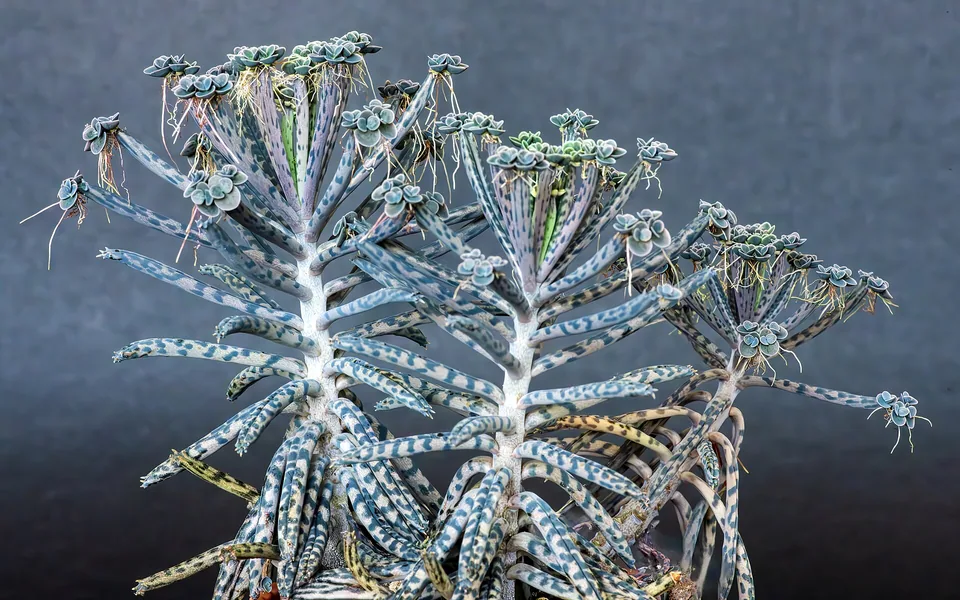


How to Grow and Care for Chandelier Plant
Kalanchoe delagoensis
Written by Emilio Marruso · last checked
Toxic to: Cats, Dogs, Horses, People · Why
At a glance
This kalanchoe is a perennial that grows happily indoors or in containers, reaching 1 to 4 ft tall. Give it full to partial sun, shaded from the hot afternoon sun, and let the soil dry out between waterings. Best of all, it makes its own little plantlets, so you can start new plants from them, from leaves or from stem cuttings.
- Sun
Full to partial sun, shaded from the hot afternoon sun
What the sources say (1)
Light: Full to partial sun, with protection from the hot afternoon sun
This plant grows best in hot, arid climates and prefers full to partial sun, but it needs protection from the hot afternoon sun.
— Kalanchoe delagoensis (Chandelier Plant, Devil's Backbone, Lizard Plant, Mother-In-Law-Plant, Mother of Millons) | North Carolina Extension Gardener Plant Toolbox [1] - Water
Let the soil dry between waterings; every 2 weeks in summer. Too much water rots the roots
What the sources say (2)
Watering: Allow the soil to dry out between waterings; during the summer dormant period, reduce watering to every 2 weeks
Allow the soil to dry out between waterings. During its dormant period in summer, reduce watering to every 2 weeks.
— Kalanchoe delagoensis (Chandelier Plant, Devil's Backbone, Lizard Plant, Mother-In-Law-Plant, Mother of Millons) | North Carolina Extension Gardener Plant Toolbox [1] Watering notes: Overwatering can result in root rot; leaf drop can come from excessive watering and dry, brown, curling leaves from too little water
Overwatering can result in root rot. Other possible diseases or problems include powdery mildew from poor air circulation and high humidity, leaf drop from excessive watering or too little light
— Kalanchoe delagoensis (Chandelier Plant, Devil's Backbone, Lizard Plant, Mother-In-Law-Plant, Mother of Millons) | North Carolina Extension Gardener Plant Toolbox [1] - Cold
Survives winters down to 30 °F (−1.1 °C)
Half hardy: mild winters or an unheated greenhouse · USDA 10a · RHS H3 · Z10
What the sources say (2)
Hardiness, coldest zone: 10a [winter low −1.1 to 1.7 °C (30 to 35 °F)]
USDA Plant Hardiness Zone: 10a, 10b, 11a, 11b
— Kalanchoe delagoensis (Chandelier Plant, Devil's Backbone, Lizard Plant, Mother-In-Law-Plant, Mother of Millons) | North Carolina Extension Gardener Plant Toolbox [1] Hardiness, warmest zone: 11b [winter low 7.2 to 10 °C (45 to 50 °F)]
USDA Plant Hardiness Zone: 10a, 10b, 11a, 11b
— Kalanchoe delagoensis (Chandelier Plant, Devil's Backbone, Lizard Plant, Mother-In-Law-Plant, Mother of Millons) | North Carolina Extension Gardener Plant Toolbox [1] - Pests
Mealybugs and aphids; root rot and powdery mildew
What the sources say (2)
Pests: mealybugs, aphids
Insects, Diseases, and Other Plant Problems: Watch for mealybugs and aphids.
— Kalanchoe delagoensis (Chandelier Plant, Devil's Backbone, Lizard Plant, Mother-In-Law-Plant, Mother of Millons) | North Carolina Extension Gardener Plant Toolbox [1] Diseases: root rot, powdery mildew
Overwatering can result in root rot. Other possible diseases or problems include powdery mildew from poor air circulation and high humidity
— Kalanchoe delagoensis (Chandelier Plant, Devil's Backbone, Lizard Plant, Mother-In-Law-Plant, Mother of Millons) | North Carolina Extension Gardener Plant Toolbox [1] - Size
1 to 4 ft tall and 1 to 2 ft wide
What the sources say (2)
Mature height: 30.5-121.9 cm (1-4 ft)
Dimensions: Height: 1 ft. 0 in. - 4 ft. 0 in.
— Kalanchoe delagoensis (Chandelier Plant, Devil's Backbone, Lizard Plant, Mother-In-Law-Plant, Mother of Millons) | North Carolina Extension Gardener Plant Toolbox [1] Mature width: 30.5-61 cm (1-2 ft)
Width: 1 ft. 0 in. - 2 ft. 0 in.
— Kalanchoe delagoensis (Chandelier Plant, Devil's Backbone, Lizard Plant, Mother-In-Law-Plant, Mother of Millons) | North Carolina Extension Gardener Plant Toolbox [1] - Propagation
From its little plantlets, leaf cuttings or stem cuttings
What the sources say (2)
Propagation: Plantlets, leaf cuttings and stem cuttings
This plant can be propagated by plantlets and cuttings.
— Kalanchoe delagoensis (Chandelier Plant, Devil's Backbone, Lizard Plant, Mother-In-Law-Plant, Mother of Millons) | North Carolina Extension Gardener Plant Toolbox [1] Recommended Propagation Strategy: Leaf Cutting Stem Cutting Country Or Region Of Origin:
— Kalanchoe delagoensis (Chandelier Plant, Devil's Backbone, Lizard Plant, Mother-In-Law-Plant, Mother of Millons) | North Carolina Extension Gardener Plant Toolbox [1] - Containers
Grows in containers and indoors too
What the sources say (2)
In containers: Yes
Suggested planting locations are a patio, container planting, or use as a houseplant.
— Kalanchoe delagoensis (Chandelier Plant, Devil's Backbone, Lizard Plant, Mother-In-Law-Plant, Mother of Millons) | North Carolina Extension Gardener Plant Toolbox [1] Indoors: Yes
It is easily grown indoors in a cactus and succulent potting mix.
— Kalanchoe delagoensis (Chandelier Plant, Devil's Backbone, Lizard Plant, Mother-In-Law-Plant, Mother of Millons) | North Carolina Extension Gardener Plant Toolbox [1] - Safety
Toxic if eaten, for people, cats, dogs and horses; wear gloves, it can irritate skin
Overview
Kalanchoe delagoensis is a perennial succulent from Madagascar, often grown as a houseplant. [1] It prefers full to partial sun, needs the soil to dry out between waterings, and reproduces by plantlets at the leaf margins. [1] It has become invasive in some parts of the world and is toxic to humans and pets if ingested. [1]
Chandelier Plant care
How to water Chandelier Plant
Watering
Allow the soil to dry out between waterings; during the summer dormant period, reduce watering to every 2 weeks
What the sources say (1)
Allow the soil to dry out between waterings. During its dormant period in summer, reduce watering to every 2 weeks.Watering notes
Overwatering can result in root rot; leaf drop can come from excessive watering and dry, brown, curling leaves from too little water
What the sources say (1)
Overwatering can result in root rot. Other possible diseases or problems include powdery mildew from poor air circulation and high humidity, leaf drop from excessive watering or too little lightHow much light Chandelier Plant needs
Full to partial sun, with protection from the hot afternoon sun
What the sources say (1)
This plant grows best in hot, arid climates and prefers full to partial sun, but it needs protection from the hot afternoon sun.How much cold Chandelier Plant can take
Hardiness, coldest zone
10a [winter low −1.1 to 1.7 °C (30 to 35 °F)]
What the sources say (1)
USDA Plant Hardiness Zone:
10a, 10b, 11a, 11bHardiness, warmest zone
11b [winter low 7.2 to 10 °C (45 to 50 °F)]
What the sources say (1)
USDA Plant Hardiness Zone:
10a, 10b, 11a, 11bWhere to grow Chandelier Plant
Indoors
Yes
What the sources say (1)
It is easily grown indoors in a cactus and succulent potting mix.In containers
Yes
What the sources say (1)
Suggested planting locations are a patio, container planting, or use as a houseplant.How to propagate Chandelier Plant
Plantlets, leaf cuttings and stem cuttings
What the sources say (2)
This plant can be propagated by plantlets and cuttings.Recommended Propagation Strategy:
Leaf Cutting
Stem Cutting
Country Or Region Of Origin:How to grow Chandelier Plant
The plant
Life cycle
perennial
What the sources say (1)
Genus:
Kalanchoe
Species:
delagoensis
Family:
Crassulaceae
Life Cycle:
PerennialFamily
Crassulaceae
What the sources say (1)
Mother of millions is a member of the stonecrop or orpine family (Crassulaceae).Mature height
30.5-121.9 cm (1-4 ft)
What the sources say (1)
Dimensions:
Height: 1 ft. 0 in. - 4 ft. 0 in.Mature width
30.5-61 cm (1-2 ft)
What the sources say (1)
Width: 1 ft. 0 in. - 2 ft. 0 in.Pests and diseases
Pests
mealybugs, aphids
What the sources say (1)
Insects, Diseases, and Other Plant Problems: Watch for mealybugs and aphids.Diseases
root rot, powdery mildew
What the sources say (1)
Overwatering can result in root rot. Other possible diseases or problems include powdery mildew from poor air circulation and high humidityChandelier Plant pests and problems
Mealybugs and aphids
Symptom: Insect pests to watch for
What to do: Watch for them
What the sources say (1)
Insects, Diseases, and Other Plant Problems: Watch for mealybugs and aphids. Overwatering can result in root rot.
— Kalanchoe delagoensis (Chandelier Plant, Devil's Backbone, Lizard Plant, Mother-In-Law-Plant, Mother of Millons) | North Carolina Extension Gardener Plant Toolbox [1] Root rot
Symptom: Root rot
What to do: Avoid overwatering; allow the soil to dry out between waterings
What the sources say (2)
Watch for mealybugs and aphids. Overwatering can result in root rot.
— Kalanchoe delagoensis (Chandelier Plant, Devil's Backbone, Lizard Plant, Mother-In-Law-Plant, Mother of Millons) | North Carolina Extension Gardener Plant Toolbox [1] Allow the soil to dry out between waterings. During its dormant period in summer, reduce watering to every 2 weeks.
— Kalanchoe delagoensis (Chandelier Plant, Devil's Backbone, Lizard Plant, Mother-In-Law-Plant, Mother of Millons) | North Carolina Extension Gardener Plant Toolbox [1] Powdery mildew
Symptom: Powdery mildew
What to do: Avoid poor air circulation and high humidity
What the sources say (1)
Other possible diseases or problems include powdery mildew from poor air circulation and high humidity, leaf drop from excessive watering or too little light
— Kalanchoe delagoensis (Chandelier Plant, Devil's Backbone, Lizard Plant, Mother-In-Law-Plant, Mother of Millons) | North Carolina Extension Gardener Plant Toolbox [1] Leggy growth
Symptom: Leggy growth
What to do: Provide enough sunlight
What the sources say (1)
and leggy growth due to inadequate sunlight. Too much sun or providing to little water can cause dry, brown, and curling leaves.
— Kalanchoe delagoensis (Chandelier Plant, Devil's Backbone, Lizard Plant, Mother-In-Law-Plant, Mother of Millons) | North Carolina Extension Gardener Plant Toolbox [1]
Remedies
Each remedy shows what official sources say about it; traditional remedies without an official source are marked as such. Harmful ones are listed so you know to avoid them.
Treating the plant
mealybugs
rubbing alcohol on a cotton swab Partly works
How: clean the bugs off with a cotton swab dipped in rubbing alcohol
To speed things up and kill any obvious bugs you see on contact, clean them off using a cotton swab dipped in rubbing alcohol .
— getbusygardening.com [9] What the evidence says Mealybugs can be managed by noticing them quickly and killing them by hand with a cotton swab dipped in alcohol or with an insecticide (including soap-based products) labeled for mealybug control on your specific houseplant.
— yardandgarden.extension.iastate.edu [10] mild liquid soap spray Partly works
How: mix your own by combining 1 teaspoon of mild liquid soap with 1 liter of water
You can even mix your own by combining 1 teaspoon of mild liquid soap with 1 liter of water.
— getbusygardening.com [9] What the evidence says Mealybugs can be managed by noticing them quickly and killing them by hand with a cotton swab dipped in alcohol or with an insecticide (including soap-based products) labeled for mealybug control on your specific houseplant.
— yardandgarden.extension.iastate.edu [10]
Getting rid of it
invasive spread
pulling by hand Official source, not independently tested
Wear gloves, long sleeves, and pants during plant removal.
— blogs.ifas.ufl.edu [11] Do not place the Kalanchoe into your compost piles or yard waste.
— blogs.ifas.ufl.edu [12] How: pull the plants by hand, removing the full plant and any leaves and plantlets in the area, and dispose of them in a plastic bag
Because mother of millions has a weak root system, they are fairly easy to remove mechanically, and the best way to remove them is pulling by hand.
— blogs.ifas.ufl.edu [11]
Is Chandelier Plant toxic to pets?
Reported by the source, quoted verbatim. This is not medical or veterinary advice: if a person or an animal may have eaten this plant, contact a poison control centre or a veterinarian.
Animals
#problem for cats #problem for dogs #problem for horses
[1]The source flags the risk for this animal but does not explain why.
People
This plant is toxic to humans and pets, if ingested. Keep it out of the reach of children and pets.
[1]Skin irritation can result from handling this plant. Protective gloves are recommended.
[1]- Symptoms
Causes Contact Dermatitis: Yes
[1]
Poison Symptoms: Vomiting, diarrhea, abnormal heart rhythm (rare).
[1]
Similar plants
- Kalanchoe Kalanchoe beharensis
- Mother of Thousands Kalanchoe daigremontiana
- Kalanchoe Kalanchoe blossfeldiana
- Panda Plant Kalanchoe tomentosa
- Silver Teaspoons Kalanchoe bracteata
- Blue Echeveria Echeveria secunda
- Copper Rose Echeveria multicaulis
- Ghost Plant Graptopetalum paraguayense
Sources
Every value above is quoted from these documents. Links lead to the original publisher.
- Kalanchoe delagoensis (Chandelier Plant, Devil's Backbone, Lizard Plant, Mother-In-Law-Plant, Mother of Millons) | North Carolina Extension Gardener Plant Toolbox · plants.ces.ncsu.edu, consulted
- Mother of Millons - Kalanchoe delagoensis | North Carolina Extension Gardener Plant Toolbox · plants.ces.ncsu.edu, consulted
- Kalanchoe - Kalanchoe | North Carolina Extension Gardener Plant Toolbox · plants.ces.ncsu.edu, consulted
- Devil's Backbone - Kalanchoe delagoensis | North Carolina Extension Gardener Plant Toolbox · plants.ces.ncsu.edu, consulted
- Kalanchoe (Chandelier Plant, Devils Backbone, Kalanchoe, Mother-In-Law-Plant, Mother of Millions, Mother of Thousands) | North Carolina Extension Gardener Plant Toolbox · plants.ces.ncsu.edu, consulted
- Mother of Thousands - Kalanchoe | North Carolina Extension Gardener Plant Toolbox · plants.ces.ncsu.edu, consulted
- Mother-In-Law-Plant - Kalanchoe | North Carolina Extension Gardener Plant Toolbox · plants.ces.ncsu.edu, consulted
- | Center for Aquatic and Invasive Plants | University of Florida, IFAS · plant-directory.ifas.ufl.edu, consulted
- getbusygardening.com · getbusygardening.com
- yardandgarden.extension.iastate.edu · yardandgarden.extension.iastate.edu
- blogs.ifas.ufl.edu · blogs.ifas.ufl.edu
- blogs.ifas.ufl.edu · blogs.ifas.ufl.edu
Written by Emilio Marruso · last checked