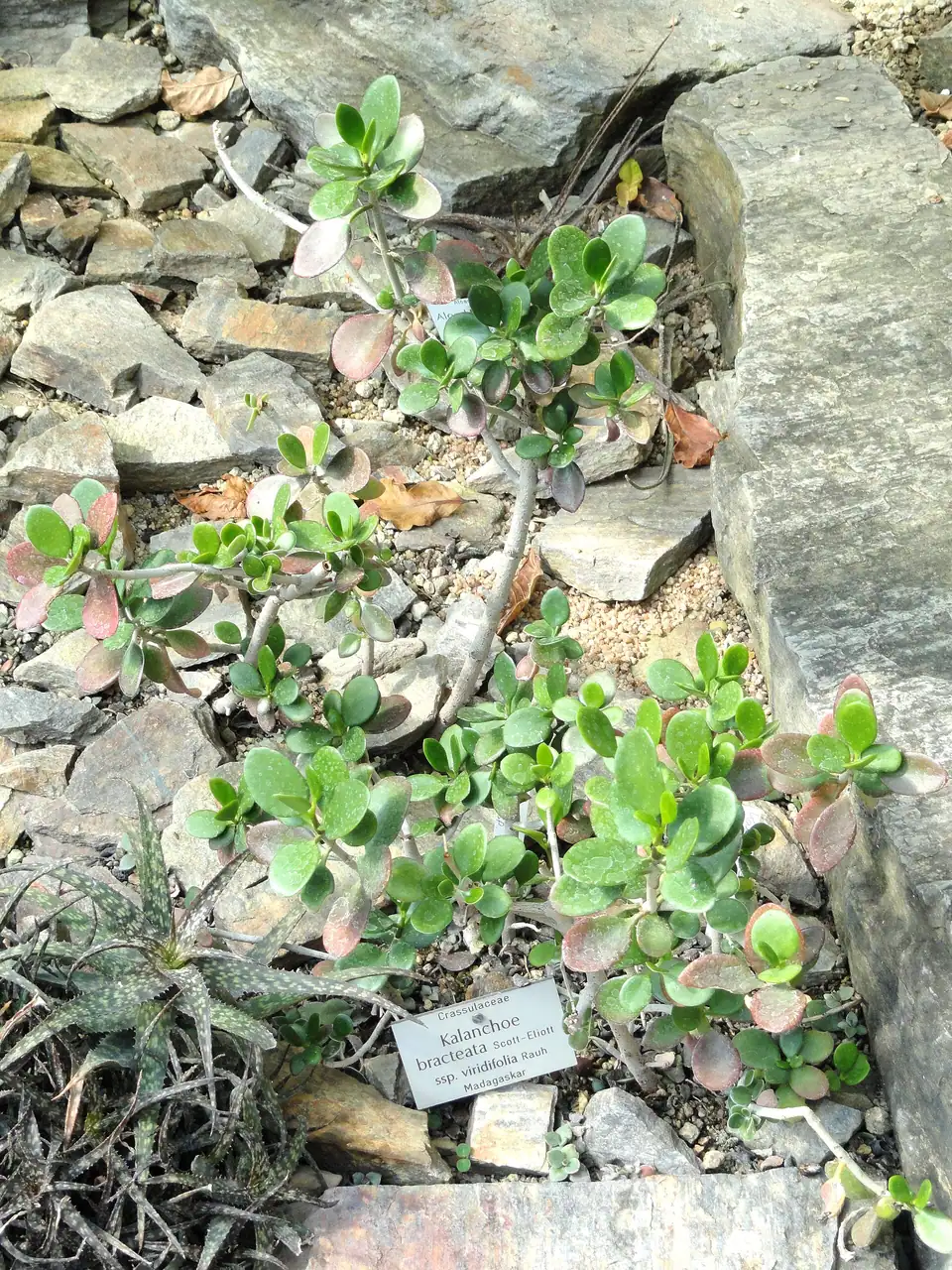


How to Grow and Care for Silver Teaspoons
Kalanchoe bracteata
Written by Emilio Marruso · last checked
Toxic to: Cats, Dogs, People · Why
At a glance
Kalanchoe bracteata is an easygoing perennial that grows happily indoors or in a container. Give it bright, indirect light, keep it out of the hot afternoon sun, and let the soil dry out between waterings. In return it becomes a generous plant 2 to 4 feet tall and wide, and new plants start easily from stem or leaf cuttings.
- Sun
Bright, indirect light; some direct sun is fine, but hot afternoon sun burns the leaves
What the sources say (1)
Light: Bright, indirect light; tolerates some direct sun but avoid hot afternoon sun
This plant prefers bright, indirect light and well-drained soil. It can tolerate some direct sun, but it is best to avoid the hot afternoon sun.
— Kalanchoe bracteata (Silver Spoons, Silver Teaspoons) | North Carolina Extension Gardener Plant Toolbox [1] - Water
Let the soil dry out between waterings; water even less in winter
What the sources say (3)
Watering: Avoid overwatering; let the soil dry out between waterings
Avoid overwatering. It is best to let the soil to dry out between waterings. The plant is dormant during the winter
— Kalanchoe bracteata (Silver Spoons, Silver Teaspoons) | North Carolina Extension Gardener Plant Toolbox [1] Watering notes: Dormant in winter, when watering should be further reduced; overwatering can result in root rot
The plant is dormant during the winter and watering should be further reduced during that time.
— Kalanchoe bracteata (Silver Spoons, Silver Teaspoons) | North Carolina Extension Gardener Plant Toolbox [1] Overwatering can result in root rot. Prolonged and intense sunlight can cause leaf burn.
— Kalanchoe bracteata (Silver Spoons, Silver Teaspoons) | North Carolina Extension Gardener Plant Toolbox [1] - Cold
Survives winters down to 25 °F (−3.9 °C)
Half hardy: mild winters or an unheated greenhouse · USDA 9b · RHS H3 · Z9
What the sources say (2)
Hardiness, coldest zone: 9b [winter low −3.9 to −1.1 °C (25 to 30 °F)]
USDA Plant Hardiness Zone: 9b, 10a, 10b, 11a, 11b
— Kalanchoe bracteata (Silver Spoons, Silver Teaspoons) | North Carolina Extension Gardener Plant Toolbox [1] Hardiness, warmest zone: 11b [winter low 7.2 to 10 °C (45 to 50 °F)]
USDA Plant Hardiness Zone: 9b, 10a, 10b, 11a, 11b
— Kalanchoe bracteata (Silver Spoons, Silver Teaspoons) | North Carolina Extension Gardener Plant Toolbox [1] - Pests
Watch for mealybugs, scale, aphids and spider mites; too much water causes root rot
What the sources say (2)
Pests: mealybugs, scale, aphids, spider mites
Insects, Diseases and Other Plant Problems: Monitor for mealybugs,scale, aphids and spider mites. Overwatering can result in root rot.
— Kalanchoe bracteata (Silver Spoons, Silver Teaspoons) | North Carolina Extension Gardener Plant Toolbox [1] Diseases: root rot
Insects, Diseases and Other Plant Problems: Monitor for mealybugs,scale, aphids and spider mites. Overwatering can result in root rot.
— Kalanchoe bracteata (Silver Spoons, Silver Teaspoons) | North Carolina Extension Gardener Plant Toolbox [1] - Size
2 to 4 feet tall and wide
What the sources say (2)
Mature height: 61 to 122 cm (2 to 4 feet)
Silver teaspoons have an erect and mounding habit and may grow up to 2 to 4 feet tall and equally as wide.
— Kalanchoe bracteata (Silver Spoons, Silver Teaspoons) | North Carolina Extension Gardener Plant Toolbox [1] Mature width: 61 to 122 cm (2 to 4 feet)
Silver teaspoons have an erect and mounding habit and may grow up to 2 to 4 feet tall and equally as wide.
— Kalanchoe bracteata (Silver Spoons, Silver Teaspoons) | North Carolina Extension Gardener Plant Toolbox [1] - Propagation
Easy to grow new plants from stem or leaf cuttings
What the sources say (2)
Propagation: Stem cuttings; leaf cuttings
Propagation can be completed through stem cuttings.
— Kalanchoe bracteata (Silver Spoons, Silver Teaspoons) | North Carolina Extension Gardener Plant Toolbox [1] Recommended Propagation Strategy: Leaf Cutting Stem Cutting Country Or Region Of Origin: Madagascar
— Kalanchoe bracteata (Silver Spoons, Silver Teaspoons) | North Carolina Extension Gardener Plant Toolbox [1] - Containers
Grows well in containers and indoors
What the sources say (2)
In containers: Yes
Landscape Location: Container Houseplants Landscape Theme: Rock Garden
— Kalanchoe bracteata (Silver Spoons, Silver Teaspoons) | North Carolina Extension Gardener Plant Toolbox [1] Indoors: Yes
In colder climates, it can be used as a houseplant. The soil should be high in organic matter.
— Kalanchoe bracteata (Silver Spoons, Silver Teaspoons) | North Carolina Extension Gardener Plant Toolbox [1] - Safety
Poisonous: keep it away from children, cats and dogs
Overview
Silver teaspoons is a slow-growing, compact shrubby succulent native to Madagascar, in the stonecrop family. [1] It prefers bright, indirect light and well-drained soil, should be allowed to dry out between waterings, and can be grown as a houseplant in colder climates. [1] The plant is toxic if ingested by humans or pets. [1]
Silver Teaspoons care
How to water Silver Teaspoons
Watering
Avoid overwatering; let the soil dry out between waterings
What the sources say (1)
Avoid overwatering. It is best to let the soil to dry out between waterings. The plant is dormant during the winterWatering notes
Dormant in winter, when watering should be further reduced; overwatering can result in root rot
What the sources say (2)
The plant is dormant during the winter and watering should be further reduced during that time.Overwatering can result in root rot. Prolonged and intense sunlight can cause leaf burn.How much light Silver Teaspoons needs
Bright, indirect light; tolerates some direct sun but avoid hot afternoon sun
What the sources say (1)
This plant prefers bright, indirect light and well-drained soil. It can tolerate some direct sun, but it is best to avoid the hot afternoon sun.How much cold Silver Teaspoons can take
Hardiness, coldest zone
9b [winter low −3.9 to −1.1 °C (25 to 30 °F)]
What the sources say (1)
USDA Plant Hardiness Zone:
9b, 10a, 10b, 11a, 11bHardiness, warmest zone
11b [winter low 7.2 to 10 °C (45 to 50 °F)]
What the sources say (1)
USDA Plant Hardiness Zone:
9b, 10a, 10b, 11a, 11bWhere to grow Silver Teaspoons
Indoors
Yes
What the sources say (1)
In colder climates, it can be used as a houseplant. The soil should be high in organic matter.In containers
Yes
What the sources say (1)
Landscape Location:
Container
Houseplants
Landscape Theme:
Rock GardenHow to propagate Silver Teaspoons
Stem cuttings; leaf cuttings
What the sources say (2)
Propagation can be completed through stem cuttings.Recommended Propagation Strategy:
Leaf Cutting
Stem Cutting
Country Or Region Of Origin:
MadagascarHow to grow Silver Teaspoons
The plant
Life cycle
perennial
What the sources say (1)
Genus: Kalanchoe Species: bracteata Family: Crassulaceae Life Cycle: Perennial Recommended Propagation Strategy: Leaf Cutting Stem CuttingFamily
Crassulaceae
What the sources say (1)
Genus: Kalanchoe Species: bracteata Family: Crassulaceae Life Cycle: Perennial Recommended Propagation Strategy: Leaf Cutting Stem CuttingMature height
61 to 122 cm (2 to 4 feet)
What the sources say (1)
Silver teaspoons have an erect and mounding habit and may grow up to 2 to 4 feet tall and equally as wide.Mature width
61 to 122 cm (2 to 4 feet)
What the sources say (1)
Silver teaspoons have an erect and mounding habit and may grow up to 2 to 4 feet tall and equally as wide.Pests and diseases
Pests
mealybugs, scale, aphids, spider mites
What the sources say (1)
Insects, Diseases and Other Plant Problems: Monitor for mealybugs,scale, aphids and spider mites. Overwatering can result in root rot.Diseases
root rot
What the sources say (1)
Insects, Diseases and Other Plant Problems: Monitor for mealybugs,scale, aphids and spider mites. Overwatering can result in root rot.Fertilizing
How often
The sources give different values depending on region, zone or growing conditions.
What each source says
Kalanchoe in general: Every few months
What the sources say (1)
Kalanchoe in general: Fertilize kalanchoes every few months with a half-strength solution of an all-purpose, water-soluble fertilizer.Mineral fertilizers
The sources give different values depending on region, zone or growing conditions.
What each source says
Kalanchoe in general: All-purpose water-soluble fertilizer at half strength
What the sources say (1)
Kalanchoe in general: Fertilize kalanchoes every few months with a half-strength solution of an all-purpose, water-soluble fertilizer.Silver Teaspoons pests and problems
Pests
Symptom: Mealybugs, scale, aphids and spider mites
What to do: Monitor for them
What the sources say (1)
Monitor for mealybugs,scale, aphids and spider mites.
— Kalanchoe bracteata (Silver Spoons, Silver Teaspoons) | North Carolina Extension Gardener Plant Toolbox [1] Root rot
Symptom: Results from overwatering
What to do: Avoid overwatering
What the sources say (1)
Overwatering can result in root rot. Prolonged and intense sunlight can cause leaf burn.
— Kalanchoe bracteata (Silver Spoons, Silver Teaspoons) | North Carolina Extension Gardener Plant Toolbox [1] Leaf burn
Symptom: Caused by prolonged and intense sunlight
What to do: Avoid the hot afternoon sun
What the sources say (1)
Overwatering can result in root rot. Prolonged and intense sunlight can cause leaf burn.
— Kalanchoe bracteata (Silver Spoons, Silver Teaspoons) | North Carolina Extension Gardener Plant Toolbox [1]
Remedies
Each remedy shows what official sources say about it; traditional remedies without an official source are marked as such. Harmful ones are listed so you know to avoid them.
First aid
First aid: not a substitute for a doctor
skin contact with sap
rinse skin with running water Official source, not independently tested
If blistering, large or deep burns, pain, redness, or swelling worsen or persist, you will need to see a doctor right away.
— poison.org [8] Do not induce vomiting. Ipecac syrup is no longer recommended.
— poison.org [8] How: Use lots of room temperature running water and rinse for at least 15 minutes.
Use lots of room temperature running water and rinse for at least 15 minutes.
— poison.org [8]
Treating the plant
mealybugs
rubbing alcohol swab Official source, not independently tested
Make sure to test the soap and alcohol mixtures on a small portion of the plant prior to full application because some plants may be sensitive to soap or alcohol.
— planttalk.colostate.edu [9] How: For smaller infestations, dab the insects with a cotton swab dipped in rubbing alcohol; for heavy infestations, spray a mixture of 10 percent rubbing alcohol and 90 percent water directly onto the insects; repeat every week until the bugs are gone.
For heavy infestations, spray a mixture of 10 percent rubbing alcohol and 90 percent water directly onto the insects. For smaller infestations, dab the insects with a cotton swab dipped in rubbing alcohol.
— planttalk.colostate.edu [9] insecticidal soap Official source, not independently tested
Make sure to test the soap and alcohol mixtures on a small portion of the plant prior to full application because some plants may be sensitive to soap or alcohol.
— planttalk.colostate.edu [9] How: Prune infested branches, then treat the pests with insecticidal soap.
Control mealy bugs by pruning infested branches and removing and destroying heavily infested plants. These pests may also be controlled with insecticidal soap.
— planttalk.colostate.edu [9] soapy water wash Official source, not independently tested
How: Wash off the leaves with soapy water; the mealybugs may live in the soil, so take the plant out of the pot, wash the roots and replant in new clean potting soil.
Wash off the rest of the leaves with soapy water. The Mealy bugs may be living in the soil, so I would also take them out of their pots,
— ask.extension.org [10]
Is Silver Teaspoons toxic to pets?
Reported by the source, quoted verbatim. This is not medical or veterinary advice: if a person or an animal may have eaten this plant, contact a poison control centre or a veterinarian.
Animals
Problems: Poisonous to Humans Problem for Cats Problem for Children Problem for Dogs
[1]The source flags the risk for this animal but does not explain why.
People
This plant has medium severity poison characteristics. See below Description
[1]- Poisonous parts
Poison Part: Flowers Fruits Leaves Roots Sap/Juice Download Print-Friendly QR Code
[1]- Toxic principle
Poison Toxic Principle: Bufodienolides Causes Contact Dermatitis: Yes
[1]- Symptoms
If ingested, symptoms include nausea, vomiting, diarrhea, and abnormal heart rhythm (rare).
[1]- Severity
Poison Severity: Medium Poison Symptoms: If ingested, symptoms include nausea, vomiting
[1]
Similar plants
- Chandelier Plant Kalanchoe delagoensis
- Kalanchoe Kalanchoe beharensis
- Kalanchoe Kalanchoe blossfeldiana
- Mother of Thousands Kalanchoe daigremontiana
- Panda Plant Kalanchoe tomentosa
- Allegheny Stonecrop Hylotelephium telephioides
- Blue Echeveria Echeveria secunda
- Carpet Sedum Sedum lineare
Sources
Every value above is quoted from these documents. Links lead to the original publisher.
- Kalanchoe bracteata (Silver Spoons, Silver Teaspoons) | North Carolina Extension Gardener Plant Toolbox · plants.ces.ncsu.edu, consulted
- Kalanchoe (Chandelier Plant, Devils Backbone, Kalanchoe, Mother-In-Law-Plant, Mother of Millions, Mother of Thousands) | North Carolina Extension Gardener Plant Toolbox · plants.ces.ncsu.edu, consulted
- Kalanchoe - Kalanchoe | North Carolina Extension Gardener Plant Toolbox · plants.ces.ncsu.edu, consulted
- Mother of Thousands - Kalanchoe | North Carolina Extension Gardener Plant Toolbox · plants.ces.ncsu.edu, consulted
- Chandelier Plant - Kalanchoe | North Carolina Extension Gardener Plant Toolbox · plants.ces.ncsu.edu, consulted
- Mother-In-Law-Plant - Kalanchoe | North Carolina Extension Gardener Plant Toolbox · plants.ces.ncsu.edu, consulted
- planttalk.colostate.edu · planttalk.colostate.edu
- poison.org · poison.org
- planttalk.colostate.edu · planttalk.colostate.edu
- ask.extension.org · ask.extension.org
Written by Emilio Marruso · last checked