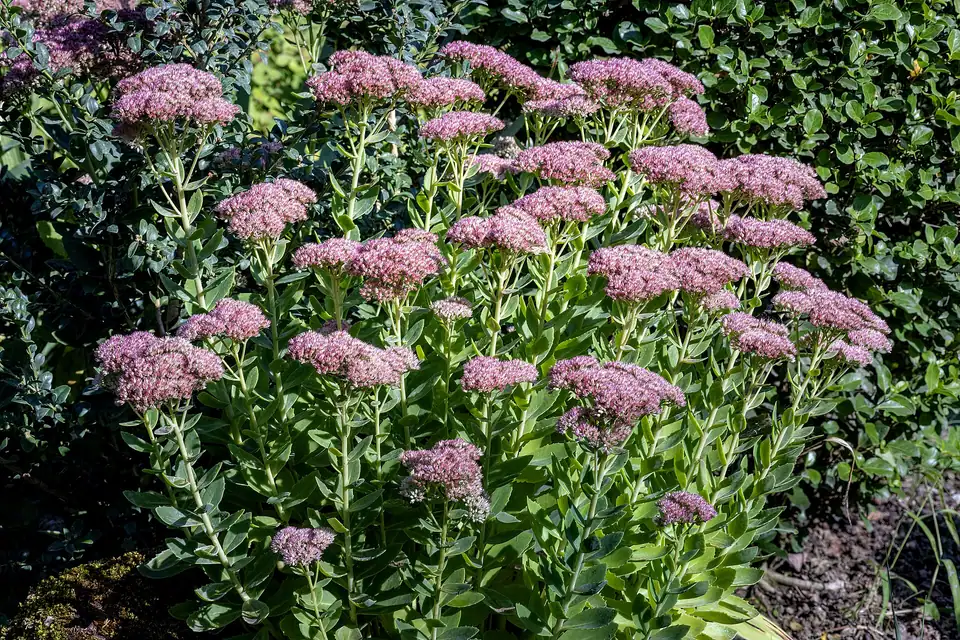


How to Grow and Care for Stonecrop
Hylotelephium telephium
Written by Emilio Marruso · last checked
At a glance
Orpine is a tough, easygoing perennial for a sunny spot. Its tap roots store water, so it rides out dry spells, and it needs little or no feeding in most garden soils. It can even grow back from a single leaf, so one plant can soon become many, in the ground or in a container.
- Sun
Full sun
What the sources say (1)
Light: Full sun
Stonecrop prefers full sun and medium to dry, sandy, or shallow-rocky soil with a neutral to alkaline pH.
— Hylotelephium telephium (Life-everlasting, Live-forever, Livelong, Orphan John, Orpine, Stonecrop) | North Carolina Extension Gardener Plant Toolbox [1] - Water
Likes medium to dry soil; its roots store water for dry spells
What the sources say (1)
Watering: Medium to dry soil; tap roots store water to survive dry spells
Stonecrop prefers full sun and medium to dry, sandy, or shallow-rocky soil with a neutral to alkaline pH. They form white, carrot-shaped tap roots, which store water to help the plant survive during dry spells.
— Hylotelephium telephium (Life-everlasting, Live-forever, Livelong, Orphan John, Orpine, Stonecrop) | North Carolina Extension Gardener Plant Toolbox [1] - Cold
Survives winters down to −40 °F (−40 °C)
Very hardy · USDA 3a · RHS H7 · Z3
What the sources say (2)
Hardiness, coldest zone: 3a [winter low −40 to −37.2 °C (−40 to −35 °F)]
USDA Plant Hardiness Zone: 3a, 3b, 4a, 4b, 5a, 5b, 6a, 6b, 7a, 7b, 8a, 8b, 9a, 9b
— Hylotelephium telephium (Life-everlasting, Live-forever, Livelong, Orphan John, Orpine, Stonecrop) | North Carolina Extension Gardener Plant Toolbox [1] Hardiness, warmest zone: 9b [winter low −3.9 to −1.1 °C (25 to 30 °F)]
USDA Plant Hardiness Zone: 3a, 3b, 4a, 4b, 5a, 5b, 6a, 6b, 7a, 7b, 8a, 8b, 9a, 9b
— Hylotelephium telephium (Life-everlasting, Live-forever, Livelong, Orphan John, Orpine, Stonecrop) | North Carolina Extension Gardener Plant Toolbox [1] - Feeding
Little or no feeding; too much nitrogen makes it floppy, sickly and poor in flowers
What the sources say (3)
How often: Little or no feeding needed in most garden soils
Your hylotelephiums will need little or no feeding in most garden soils.
— [4] Avoid: Too much plant food, especially nitrogen
Your hylotelephiums will need little or no feeding in most garden soils. Too much plant food, particularly nitrogen (which is in most plant fertilisers), will lead to lush floppy growth that can be disease prone and flower poorly.
— [4] Signs of excess: Lush, floppy growth that is disease prone and flowers poorly
Your hylotelephiums will need little or no feeding in most garden soils. Too much plant food, particularly nitrogen (which is in most plant fertilisers), will lead to lush floppy growth that can be disease prone and flower poorly.
— [4] - Pests
Slugs, aphids, scale, mealybugs and weevils; crown and root rot can strike
What the sources say (2)
Pests: slugs, scale, mealy bugs, nematodes, aphids, weevils
Insects, Diseases, and Other Plant Problems: Slugs, scale, mealy bugs, nematodes, aphids, and weevils may be seen. May develop fungal and bacterial crown rot and root rot.
— Hylotelephium telephium (Life-everlasting, Live-forever, Livelong, Orphan John, Orpine, Stonecrop) | North Carolina Extension Gardener Plant Toolbox [1] Diseases: fungal crown rot, bacterial crown rot, root rot
Slugs, scale, mealy bugs, nematodes, aphids, and weevils may be seen. May develop fungal and bacterial crown rot and root rot. Deer sometimes browse the foliage.
— Hylotelephium telephium (Life-everlasting, Live-forever, Livelong, Orphan John, Orpine, Stonecrop) | North Carolina Extension Gardener Plant Toolbox [1] - Watch out
Deer sometimes nibble the leaves
- Size
2 to 2.5 ft tall and 1.5 to 2 ft wide
What the sources say (2)
Mature height: 61-76 cm (2 to 2.5 feet)
Propagate stonecrop by division in the spring or stem cutting in the summer. It can regenerate from a single leaf. It is a low-maintenance plant that grows 2 to 2.5 feet tall 1.5 to 2 feet wide.
— Hylotelephium telephium (Life-everlasting, Live-forever, Livelong, Orphan John, Orpine, Stonecrop) | North Carolina Extension Gardener Plant Toolbox [1] Mature width: 46-61 cm (1.5 to 2 feet)
Propagate stonecrop by division in the spring or stem cutting in the summer. It can regenerate from a single leaf. It is a low-maintenance plant that grows 2 to 2.5 feet tall 1.5 to 2 feet wide.
— Hylotelephium telephium (Life-everlasting, Live-forever, Livelong, Orphan John, Orpine, Stonecrop) | North Carolina Extension Gardener Plant Toolbox [1] - Propagation
Divide in spring or take stem cuttings in summer; even a single leaf can grow
What the sources say (1)
Propagation: Division in spring; stem cutting in summer; can regenerate from a single leaf
Propagate stonecrop by division in the spring or stem cutting in the summer. It can regenerate from a single leaf.
— Hylotelephium telephium (Life-everlasting, Live-forever, Livelong, Orphan John, Orpine, Stonecrop) | North Carolina Extension Gardener Plant Toolbox [1] - Containers
Grows in containers too
What the sources say (1)
In containers: Yes
It can be sited in a meadow or grown in a container.
— Hylotelephium telephium (Life-everlasting, Live-forever, Livelong, Orphan John, Orpine, Stonecrop) | North Carolina Extension Gardener Plant Toolbox [1]
Overview
Stonecrop or orpine is a succulent, herbaceous perennial of the Crassulaceae, native to Europe, Russia and northern China. [1] It prefers full sun and medium to dry, sandy or shallow-rocky soil. [1] It is propagated by division in spring or stem cutting in summer. [1]
This record is incomplete: the sources we read do not cover every field yet.
Not yet covered by our sources: Pruning
Stonecrop care
How to water Stonecrop
Medium to dry soil; tap roots store water to survive dry spells
What the sources say (1)
Stonecrop prefers full sun and medium to dry, sandy, or shallow-rocky soil with a neutral to alkaline pH. They form white, carrot-shaped tap roots, which store water to help the plant survive during dry spells.How much light Stonecrop needs
Full sun
What the sources say (1)
Stonecrop prefers full sun and medium to dry, sandy, or shallow-rocky soil with a neutral to alkaline pH.How much cold Stonecrop can take
Hardiness, coldest zone
3a [winter low −40 to −37.2 °C (−40 to −35 °F)]
What the sources say (1)
USDA Plant Hardiness Zone:
3a, 3b, 4a, 4b, 5a, 5b, 6a, 6b, 7a, 7b, 8a, 8b, 9a, 9bHardiness, warmest zone
9b [winter low −3.9 to −1.1 °C (25 to 30 °F)]
What the sources say (1)
USDA Plant Hardiness Zone:
3a, 3b, 4a, 4b, 5a, 5b, 6a, 6b, 7a, 7b, 8a, 8b, 9a, 9bBest soil for Stonecrop
Soil pH, minimum
Under review: our second check questioned this value.
Soil pH, maximum
The sources give different values depending on region, zone or growing conditions.
What each source says
According to NC State Extension (H. telephium): (no maximum: lists alkaline >8.0 and neutral 6.0-8.0)
According to NC State Extension (genus Hylotelephium): 8.0
What the sources say (2)
According to NC State Extension (H. telephium): Soil Texture:
Sand
Shallow Rocky
Soil pH:
Alkaline (>8.0)
Neutral (6.0-8.0)According to NC State Extension (genus Hylotelephium): Soil pH:
Neutral (6.0-8.0)Where to grow Stonecrop
Yes
What the sources say (1)
It can be sited in a meadow or grown in a container.How to propagate Stonecrop
Division in spring; stem cutting in summer; can regenerate from a single leaf
What the sources say (1)
Propagate stonecrop by division in the spring or stem cutting in the summer. It can regenerate from a single leaf.How to grow Stonecrop
The plant
Life cycle
perennial
What the sources say (1)
Stonecrop or Orpine is a succulent, herbaceous perennial with an erect and clumping habit. It is in the stonecrop family (Crassulaceae) and is native to Europe, Russia, and northern China.Family
Crassulaceae
What the sources say (1)
Stonecrop or Orpine is a succulent, herbaceous perennial with an erect and clumping habit. It is in the stonecrop family (Crassulaceae) and is native to Europe, Russia, and northern China.Mature height
61-76 cm (2 to 2.5 feet)
What the sources say (1)
Propagate stonecrop by division in the spring or stem cutting in the summer. It can regenerate from a single leaf. It is a low-maintenance plant that grows 2 to 2.5 feet tall 1.5 to 2 feet wide.Mature width
46-61 cm (1.5 to 2 feet)
What the sources say (1)
Propagate stonecrop by division in the spring or stem cutting in the summer. It can regenerate from a single leaf. It is a low-maintenance plant that grows 2 to 2.5 feet tall 1.5 to 2 feet wide.Pests and diseases
Pests
slugs, scale, mealy bugs, nematodes, aphids, weevils
What the sources say (1)
Insects, Diseases, and Other Plant Problems: Slugs, scale, mealy bugs, nematodes, aphids, and weevils may be seen. May develop fungal and bacterial crown rot and root rot.Diseases
fungal crown rot, bacterial crown rot, root rot
What the sources say (1)
Slugs, scale, mealy bugs, nematodes, aphids, and weevils may be seen. May develop fungal and bacterial crown rot and root rot. Deer sometimes browse the foliage.Fertilizing
How often
Little or no feeding needed in most garden soils
What the sources say (1)
Your hylotelephiums will need little or no feeding in most garden soils.Avoid
Too much plant food, especially nitrogen
What the sources say (1)
Your hylotelephiums will need little or no feeding in most garden soils. Too much plant food, particularly nitrogen (which is in most plant fertilisers), will lead to lush floppy growth that can be disease prone and flower poorly.Signs of excess
Lush, floppy growth that is disease prone and flowers poorly
What the sources say (1)
Your hylotelephiums will need little or no feeding in most garden soils. Too much plant food, particularly nitrogen (which is in most plant fertilisers), will lead to lush floppy growth that can be disease prone and flower poorly.Stonecrop pests and problems
Pests and rots
Symptom: Slugs, scale, mealy bugs, nematodes, aphids and weevils may be seen; may develop fungal and bacterial crown rot and root rot.
What to do: No management given in the source.
What the sources say (1)
Slugs, scale, mealy bugs, nematodes, aphids, and weevils may be seen. May develop fungal and bacterial crown rot and root rot.
— Hylotelephium telephium (Life-everlasting, Live-forever, Livelong, Orphan John, Orpine, Stonecrop) | North Carolina Extension Gardener Plant Toolbox [1] Deer browsing
Symptom: Deer sometimes browse the foliage.
What to do: No management given in the source.
What the sources say (1)
May develop fungal and bacterial crown rot and root rot. Deer sometimes browse the foliage.
— Hylotelephium telephium (Life-everlasting, Live-forever, Livelong, Orphan John, Orpine, Stonecrop) | North Carolina Extension Gardener Plant Toolbox [1]
Remedies
Each remedy shows what official sources say about it; traditional remedies without an official source are marked as such. Harmful ones are listed so you know to avoid them.
Treating the plant
aphids
forceful stream of water Works
How: Dislodge the aphids with a forceful stream of water from the hose.
You can dislodge the aphids with a forceful stream of water from the hose if need be.
— ask.extension.org [5] What the evidence says You can dislodge the aphids with a forceful stream of water from the hose if need be.
— ask.extension.org [5] insecticidal soap Works
How: Spray the clusters of aphids with insecticidal soap every 2 to 3 days for 2 weeks.
If this doesn't solve the problem, spray the clusters of aphids with insecticidal soap every 2 to 3 days for 2 weeks.
— gardening.yardener.com [6] What the evidence says For example, insecticidal soap is a safe, effective organic insecticide with minimal environmental impact.
— extension.psu.edu [7]
slugs
beer trap Not verified
Traditional remedy, not verified by an official source.
How: Trap them in a plate baited with beer; set out traps at the first sign of holes in the leaves.
crown rot
removing infected plants and soil Not verified
Traditional remedy, not verified by an official source.
How: Remove infected plants and the soil around them and discard them in the trash.
Calendar
Pruning
Not stated in the sources we read.
Months as given by the sources, which are mostly from the United States (northern hemisphere). In the southern hemisphere they shift by about six months.
Indicative values
Values from a secondary source, not checked word for word like the rest of this page. Use them as a starting point.
- Drought tolerant
- yesIndicative value, adapt it to your climate · Secondary source
- Growth rate
- LowIndicative value, adapt it to your climate · Secondary source
- Pruning
- March, AprilIndicative value, adapt it to your climate · Secondary source
Similar plants
- Allegheny Stonecrop Hylotelephium telephioides
- Evergreen Orpine Hylotelephium anacampseros
- Stonecrop Hylotelephium cauticola
- Stonecrop Hylotelephium sieboldii
- Stonecrop Hylotelephium spectabile
- Carpet Sedum Sedum lineare
- Copper Rose Echeveria multicaulis
- Ghost Plant Graptopetalum paraguayense
Sources
Every value above is quoted from these documents. Links lead to the original publisher.
- Hylotelephium telephium (Life-everlasting, Live-forever, Livelong, Orphan John, Orpine, Stonecrop) | North Carolina Extension Gardener Plant Toolbox · plants.ces.ncsu.edu, consulted
- Hylotelephium (Live-forever, Orpine, Sedum, Stonecrop) | North Carolina Extension Gardener Plant Toolbox · plants.ces.ncsu.edu, consulted
- Life-everlasting - Hylotelephium telephium | North Carolina Extension Gardener Plant Toolbox · plants.ces.ncsu.edu, consulted
- rhs.org.uk · rhs.org.uk
- ask.extension.org · ask.extension.org
- gardening.yardener.com · gardening.yardener.com
- extension.psu.edu · extension.psu.edu
Written by Emilio Marruso · last checked