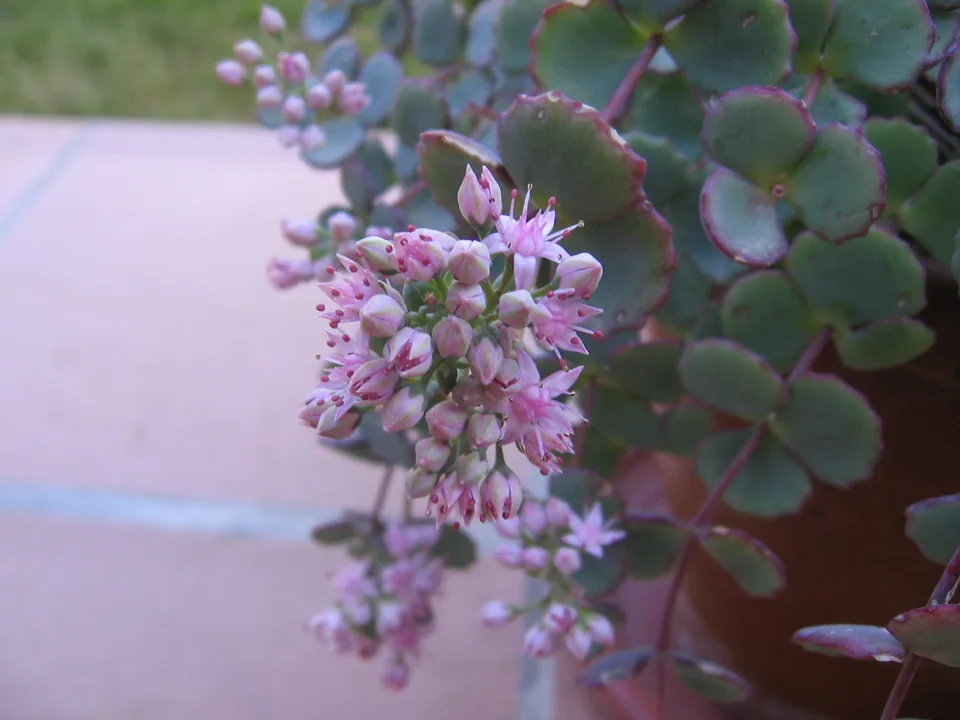

How to Grow and Care for Stonecrop
Hylotelephium sieboldii
Written by Emilio Marruso · last checked
Toxic to: People · Why
At a glance
This low, tough perennial forms a neat mound just 6–9 inches tall, perfect for the front of a bed or a pot. It loves full sun to partial shade, shrugs off dry spells and needs little or no feeding. Give it soil that drains very well, water sparingly, and it will reward you year after year.
- Sun
Full sun to partial shade
What the sources say (1)
Light: Full sun to partial shade
It grows best in full sun to partial shade and in loam or sandy soil with very good drainage and a neutral or alkaline pH.
— Hylotelephium sieboldii (Japanese Stonecrop, October Daphne Stonecrop, October Plant, October Stonecrop, Showy Stonecrop, Siebold's Sedum, Siebold's Stonecrop, Stonecrop) | North Carolina Extension Gardener Plant Toolbox [1] - Water
Handles drought well; too much water rots the roots
What the sources say (3)
Watering: Good drought tolerance; in containers, allow the soil to dry out before watering
It has good drought tolerance, making it suitable for xeriscaping. When grown in a container, allow the soil to dry out before watering.
— Hylotelephium sieboldii (Japanese Stonecrop, October Daphne Stonecrop, October Plant, October Stonecrop, Showy Stonecrop, Siebold's Sedum, Siebold's Stonecrop, Stonecrop) | North Carolina Extension Gardener Plant Toolbox [1] Watering notes: Overwatering or wet sites can lead to root and crown rot; needs very good drainage
Slugs, snails, aphids, mealybugs, and some scale insects can visit this plant. Overwatering or wet sites can lead to root and crown rot.
— Hylotelephium sieboldii (Japanese Stonecrop, October Daphne Stonecrop, October Plant, October Stonecrop, Showy Stonecrop, Siebold's Sedum, Siebold's Stonecrop, Stonecrop) | North Carolina Extension Gardener Plant Toolbox [1] in loam or sandy soil with very good drainage and a neutral or alkaline pH.
— Hylotelephium sieboldii (Japanese Stonecrop, October Daphne Stonecrop, October Plant, October Stonecrop, Showy Stonecrop, Siebold's Sedum, Siebold's Stonecrop, Stonecrop) | North Carolina Extension Gardener Plant Toolbox [1] - Cold
Survives winters down to −40 °F (−40 °C)
Very hardy · USDA 3a · RHS H7 · Z3
What the sources say (2)
Hardiness, coldest zone: 3a [winter low −40 to −37.2 °C (−40 to −35 °F)]
USDA Plant Hardiness Zone: 3a, 3b, 4a, 4b, 5a, 5b, 6a, 6b, 7a, 7b, 8a, 8b, 9a, 9b
— Hylotelephium sieboldii (Japanese Stonecrop, October Daphne Stonecrop, October Plant, October Stonecrop, Showy Stonecrop, Siebold's Sedum, Siebold's Stonecrop, Stonecrop) | North Carolina Extension Gardener Plant Toolbox [1] Hardiness, warmest zone: 9b [winter low −3.9 to −1.1 °C (25 to 30 °F)]
USDA Plant Hardiness Zone: 3a, 3b, 4a, 4b, 5a, 5b, 6a, 6b, 7a, 7b, 8a, 8b, 9a, 9b
— Hylotelephium sieboldii (Japanese Stonecrop, October Daphne Stonecrop, October Plant, October Stonecrop, Showy Stonecrop, Siebold's Sedum, Siebold's Stonecrop, Stonecrop) | North Carolina Extension Gardener Plant Toolbox [1] - Soil
Needs soil that drains very well; avoid wet spots
What the sources say (2)
Watering notes: Overwatering or wet sites can lead to root and crown rot; needs very good drainage
Slugs, snails, aphids, mealybugs, and some scale insects can visit this plant. Overwatering or wet sites can lead to root and crown rot.
— Hylotelephium sieboldii (Japanese Stonecrop, October Daphne Stonecrop, October Plant, October Stonecrop, Showy Stonecrop, Siebold's Sedum, Siebold's Stonecrop, Stonecrop) | North Carolina Extension Gardener Plant Toolbox [1] in loam or sandy soil with very good drainage and a neutral or alkaline pH.
— Hylotelephium sieboldii (Japanese Stonecrop, October Daphne Stonecrop, October Plant, October Stonecrop, Showy Stonecrop, Siebold's Sedum, Siebold's Stonecrop, Stonecrop) | North Carolina Extension Gardener Plant Toolbox [1] - Feeding
Little or no feeding; too much nitrogen makes it floppy and flower poorly
What the sources say (3)
How often: Little or no feeding needed in most garden soils
Your hylotelephiums will need little or no feeding in most garden soils.
— [7] Avoid: Too much plant food, especially nitrogen
Your hylotelephiums will need little or no feeding in most garden soils. Too much plant food, particularly nitrogen (which is in most plant fertilisers), will lead to lush floppy growth that can be disease prone and flower poorly.
— [7] Signs of excess: Lush, floppy growth that is disease prone and flowers poorly
Your hylotelephiums will need little or no feeding in most garden soils. Too much plant food, particularly nitrogen (which is in most plant fertilisers), will lead to lush floppy growth that can be disease prone and flower poorly.
— [7] - Pests
Slugs, snails, aphids, mealybugs and scale; root and crown rot in wet soil
What the sources say (2)
Pests: slugs, snails, aphids, mealybugs, scale insects
Slugs, snails, aphids, mealybugs, and some scale insects can visit this plant.
— Hylotelephium sieboldii (Japanese Stonecrop, October Daphne Stonecrop, October Plant, October Stonecrop, Showy Stonecrop, Siebold's Sedum, Siebold's Stonecrop, Stonecrop) | North Carolina Extension Gardener Plant Toolbox [1] Diseases: root rot, crown rot
Overwatering or wet sites can lead to root and crown rot.
— Hylotelephium sieboldii (Japanese Stonecrop, October Daphne Stonecrop, October Plant, October Stonecrop, Showy Stonecrop, Siebold's Sedum, Siebold's Stonecrop, Stonecrop) | North Carolina Extension Gardener Plant Toolbox [1] - Watch out
Too much shade makes it grow weak and floppy
- Size
6–9 in tall and 1–1.5 ft wide
What the sources say (2)
Mature height: 15.24-22.86 cm (6-9 in)
It grows 6 to 9 inches tall and 1 to 1.5 feet wide.
— Hylotelephium sieboldii (Japanese Stonecrop, October Daphne Stonecrop, October Plant, October Stonecrop, Showy Stonecrop, Siebold's Sedum, Siebold's Stonecrop, Stonecrop) | North Carolina Extension Gardener Plant Toolbox [1] Mature width: 30.48-45.72 cm (1-1.5 ft)
It grows 6 to 9 inches tall and 1 to 1.5 feet wide.
— Hylotelephium sieboldii (Japanese Stonecrop, October Daphne Stonecrop, October Plant, October Stonecrop, Showy Stonecrop, Siebold's Sedum, Siebold's Stonecrop, Stonecrop) | North Carolina Extension Gardener Plant Toolbox [1] - Propagation
By division, seed or stem cuttings
What the sources say (1)
Propagation: Division, seed, stem cutting
Life Cycle: Perennial Recommended Propagation Strategy: Division Seed Stem Cutting
— Hylotelephium sieboldii (Japanese Stonecrop, October Daphne Stonecrop, October Plant, October Stonecrop, Showy Stonecrop, Siebold's Sedum, Siebold's Stonecrop, Stonecrop) | North Carolina Extension Gardener Plant Toolbox [1] - Containers
Grows well in pots; let the soil dry out before watering
What the sources say (2)
In containers: Yes
When grown in a container, allow the soil to dry out before watering. Repot in spring.
— Hylotelephium sieboldii (Japanese Stonecrop, October Daphne Stonecrop, October Plant, October Stonecrop, Showy Stonecrop, Siebold's Sedum, Siebold's Stonecrop, Stonecrop) | North Carolina Extension Gardener Plant Toolbox [1] Watering: Good drought tolerance; in containers, allow the soil to dry out before watering
It has good drought tolerance, making it suitable for xeriscaping. When grown in a container, allow the soil to dry out before watering.
— Hylotelephium sieboldii (Japanese Stonecrop, October Daphne Stonecrop, October Plant, October Stonecrop, Showy Stonecrop, Siebold's Sedum, Siebold's Stonecrop, Stonecrop) | North Carolina Extension Gardener Plant Toolbox [1] - Safety
Poisonous to people
Overview
Hylotelephium sieboldii is a succulent perennial groundcover native to Japan. [1] It grows best in full sun to partial shade with very good drainage and has good drought tolerance. [1] The plant is listed as having low severity poison characteristics. [1]
This record is incomplete: the sources we read do not cover every field yet.
Not yet covered by our sources: Pruning
Stonecrop care
How to water Stonecrop
Watering
Good drought tolerance; in containers, allow the soil to dry out before watering
What the sources say (1)
It has good drought tolerance, making it suitable for xeriscaping. When grown in a container, allow the soil to dry out before watering.Watering notes
Overwatering or wet sites can lead to root and crown rot; needs very good drainage
What the sources say (2)
Slugs, snails, aphids, mealybugs, and some scale insects can visit this plant. Overwatering or wet sites can lead to root and crown rot.in loam or sandy soil with very good drainage and a neutral or alkaline pH.How much light Stonecrop needs
Full sun to partial shade
What the sources say (1)
It grows best in full sun to partial shade and in loam or sandy soil with very good drainage and a neutral or alkaline pH.How much cold Stonecrop can take
Hardiness, coldest zone
3a [winter low −40 to −37.2 °C (−40 to −35 °F)]
What the sources say (1)
USDA Plant Hardiness Zone:
3a, 3b, 4a, 4b, 5a, 5b, 6a, 6b, 7a, 7b, 8a, 8b, 9a, 9bHardiness, warmest zone
9b [winter low −3.9 to −1.1 °C (25 to 30 °F)]
What the sources say (1)
USDA Plant Hardiness Zone:
3a, 3b, 4a, 4b, 5a, 5b, 6a, 6b, 7a, 7b, 8a, 8b, 9a, 9bWhere to grow Stonecrop
Yes
What the sources say (1)
When grown in a container, allow the soil to dry out before watering. Repot in spring.How to propagate Stonecrop
Division, seed, stem cutting
What the sources say (1)
Life Cycle:
Perennial
Recommended Propagation Strategy:
Division
Seed
Stem CuttingHow to grow Stonecrop
The plant
Life cycle
perennial
What the sources say (1)
Japanese stonecrop is a succulent, perennial groundcover that is native to Japan, where it can be found growing along rocky outcrops and cliffs. It is a member of the stonecrop family (Crassulaceae).Family
Crassulaceae
What the sources say (1)
Japanese stonecrop is a succulent, perennial groundcover that is native to Japan, where it can be found growing along rocky outcrops and cliffs. It is a member of the stonecrop family (Crassulaceae).Mature height
15.24-22.86 cm (6-9 in)
What the sources say (1)
It grows 6 to 9 inches tall and 1 to 1.5 feet wide.Mature width
30.48-45.72 cm (1-1.5 ft)
What the sources say (1)
It grows 6 to 9 inches tall and 1 to 1.5 feet wide.Pests and diseases
Pests
slugs, snails, aphids, mealybugs, scale insects
What the sources say (1)
Slugs, snails, aphids, mealybugs, and some scale insects can visit this plant.Diseases
root rot, crown rot
What the sources say (1)
Overwatering or wet sites can lead to root and crown rot.Fertilizing
How often
Little or no feeding needed in most garden soils
What the sources say (1)
Your hylotelephiums will need little or no feeding in most garden soils.Avoid
Too much plant food, especially nitrogen
What the sources say (1)
Your hylotelephiums will need little or no feeding in most garden soils. Too much plant food, particularly nitrogen (which is in most plant fertilisers), will lead to lush floppy growth that can be disease prone and flower poorly.Signs of excess
Lush, floppy growth that is disease prone and flowers poorly
What the sources say (1)
Your hylotelephiums will need little or no feeding in most garden soils. Too much plant food, particularly nitrogen (which is in most plant fertilisers), will lead to lush floppy growth that can be disease prone and flower poorly.Stonecrop pests and problems
Root and crown rot
Symptom: Overwatering or wet sites can lead to root and crown rot.
What the sources say (1)
Slugs, snails, aphids, mealybugs, and some scale insects can visit this plant. Overwatering or wet sites can lead to root and crown rot.
— Hylotelephium sieboldii (Japanese Stonecrop, October Daphne Stonecrop, October Plant, October Stonecrop, Showy Stonecrop, Siebold's Sedum, Siebold's Stonecrop, Stonecrop) | North Carolina Extension Gardener Plant Toolbox [1] Slugs, snails, aphids, mealybugs and scale
Symptom: These pests can visit the plant.
What the sources say (1)
Slugs, snails, aphids, mealybugs, and some scale insects can visit this plant.
— Hylotelephium sieboldii (Japanese Stonecrop, October Daphne Stonecrop, October Plant, October Stonecrop, Showy Stonecrop, Siebold's Sedum, Siebold's Stonecrop, Stonecrop) | North Carolina Extension Gardener Plant Toolbox [1] Weak growth in shade
Symptom: Too much shade will result in weak, floppy plant growth.
What the sources say (1)
Too much shade will result in weak, floppy plant growth. It has good drought tolerance, making it suitable for xeriscaping.
— Hylotelephium sieboldii (Japanese Stonecrop, October Daphne Stonecrop, October Plant, October Stonecrop, Showy Stonecrop, Siebold's Sedum, Siebold's Stonecrop, Stonecrop) | North Carolina Extension Gardener Plant Toolbox [1]
Remedies
The sources we checked give no remedies for this plant.
Is Stonecrop poisonous?
Reported by the source, quoted verbatim. This is not medical or veterinary advice: if a person or an animal may have eaten this plant, contact a poison control centre or a veterinarian.
Resistance To Challenges: Drought Dry Soil Poor Soil Rabbits Problems: Poisonous to Humans
[1]- Poisonous parts
Poison Part: Bark Flowers Fruits Leaves Roots Sap/Juice Seeds Stems
[1]- Toxic principle
Poison Toxic Principle: Alkaloids sedine, sedamine, and others.
[1]- Symptoms
Poison Symptoms: Unknown, but possibly gastrointestinal symptoms. Poison Toxic Principle:
[1]- Severity
Poison Severity: Low Poison Symptoms: Unknown, but possibly gastrointestinal symptoms.
[1]
Calendar
Pruning
Not stated in the sources we read.
Months as given by the sources, which are mostly from the United States (northern hemisphere). In the southern hemisphere they shift by about six months.
Edibility
Reported by the source, quoted verbatim. Do not eat a plant on the basis of this page alone: identification mistakes can be dangerous.
when very young and tender, the stems and leaves can be eaten raw. Later, until they flower, they may be briefly cooked.
[1]
Indicative values
Values from a secondary source, not checked word for word like the rest of this page. Use them as a starting point.
- Drought tolerant
- yesIndicative value, adapt it to your climate · Secondary source
- Soil pH
- 6-7.5Indicative value, adapt it to your climate · Secondary source
- Care level
- MediumIndicative value, adapt it to your climate · Secondary source
- Growth rate
- LowIndicative value, adapt it to your climate · Secondary source
- Pruning
- October, FebruaryIndicative value, adapt it to your climate · Secondary source
Similar plants
- Allegheny Stonecrop Hylotelephium telephioides
- Evergreen Orpine Hylotelephium anacampseros
- Stonecrop Hylotelephium cauticola
- Stonecrop Hylotelephium spectabile
- Stonecrop Hylotelephium telephium
- Carpet Sedum Sedum lineare
- Chandelier Plant Kalanchoe delagoensis
- Copper Rose Echeveria multicaulis
Sources
Every value above is quoted from these documents. Links lead to the original publisher.
- Hylotelephium sieboldii (Japanese Stonecrop, October Daphne Stonecrop, October Plant, October Stonecrop, Showy Stonecrop, Siebold's Sedum, Siebold's Stonecrop, Stonecrop) | North Carolina Extension Gardener Plant Toolbox · plants.ces.ncsu.edu, consulted
- Siebold's Sedum - Hylotelephium sieboldii | North Carolina Extension Gardener Plant Toolbox · plants.ces.ncsu.edu, consulted
- Japanese Stonecrop - Hylotelephium sieboldii | North Carolina Extension Gardener Plant Toolbox · plants.ces.ncsu.edu, consulted
- Hylotelephium (Live-forever, Orpine, Sedum, Stonecrop) | North Carolina Extension Gardener Plant Toolbox · plants.ces.ncsu.edu, consulted
- October Daphne Stonecrop - Hylotelephium sieboldii | North Carolina Extension Gardener Plant Toolbox · plants.ces.ncsu.edu, consulted
- Orpine - Hylotelephium | North Carolina Extension Gardener Plant Toolbox · plants.ces.ncsu.edu, consulted
- rhs.org.uk · rhs.org.uk
Written by Emilio Marruso · last checked