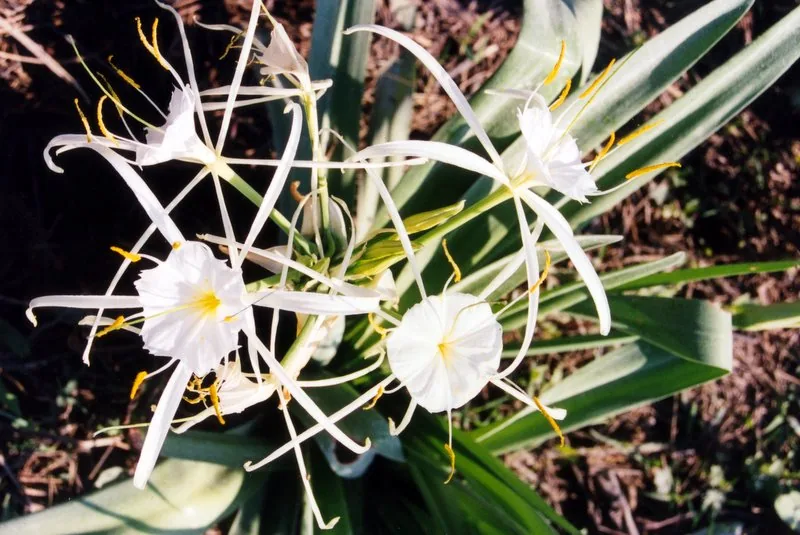


How to Grow and Care for Spider Lily
Hymenocallis occidentalis
Written by Emilio Marruso · last checked
Toxic to: Cats, Dogs · Why
At a glance
This perennial from the amaryllis family thrives where many plants struggle: it handles wet, boggy soil and grows in full sun or partial shade. It stays compact, up to 2 feet tall and wide, and can even be grown indoors. When the leaves turn yellow, just cut them off, and make new plants by dividing it or sowing its seeds.
- Sun
Full sun to partial shade
What the sources say (1)
Light: Full sun to partial shade
prefers full sun to partial shade in well-drained soil.
— Hymenocallis occidentalis (Hammock Spider Lily, Northern Spider Lily, Spider Lily, Summer Spider Lily, Woodland Spider Lily) | North Carolina Extension Gardener Plant Toolbox [1] - Water
Loves wet, boggy soil; never let it dry out
What the sources say (1)
Watering notes: Tolerates wet soils and boggy sites; intolerant of dry soils
#wet soils tolerant #wetland margins #swamps #boggy sites #dry soils intolerant
— Hymenocallis occidentalis (Hammock Spider Lily, Northern Spider Lily, Spider Lily, Summer Spider Lily, Woodland Spider Lily) | North Carolina Extension Gardener Plant Toolbox [1] - Cold
Survives winters down to −20 °F (−28.9 °C)
Very hardy · USDA 5a · RHS H7 · Z5
What the sources say (2)
Hardiness, coldest zone: 5a [winter low −28.9 to −26.1 °C (−20 to −15 °F)]
USDA Plant Hardiness Zone: 5a, 5b, 6a, 6b, 7a, 7b, 8a, 8b
— Hymenocallis occidentalis (Hammock Spider Lily, Northern Spider Lily, Spider Lily, Summer Spider Lily, Woodland Spider Lily) | North Carolina Extension Gardener Plant Toolbox [1] Hardiness, warmest zone: 8b [winter low −9.4 to −6.7 °C (15 to 20 °F)]
USDA Plant Hardiness Zone: 5a, 5b, 6a, 6b, 7a, 7b, 8a, 8b
— Hymenocallis occidentalis (Hammock Spider Lily, Northern Spider Lily, Spider Lily, Summer Spider Lily, Woodland Spider Lily) | North Carolina Extension Gardener Plant Toolbox [1] - Pruning
Cut off the leaves once they turn yellow
What the sources say (1)
Pruning: After foliage turns yellow (remove the foliage)
Remove the foliage after it turns yellow
— Hymenocallis occidentalis (Hammock Spider Lily, Northern Spider Lily, Spider Lily, Summer Spider Lily, Woodland Spider Lily) | North Carolina Extension Gardener Plant Toolbox [1] - Pests
Mealybugs, snails and caterpillars; otherwise no serious problems
What the sources say (1)
Pests: mealy bugs, snails, caterpillars
No serious issues; however, mealy bugs, snails and caterpillars can damage the plant.
— Hymenocallis occidentalis (Hammock Spider Lily, Northern Spider Lily, Spider Lily, Summer Spider Lily, Woodland Spider Lily) | North Carolina Extension Gardener Plant Toolbox [1] - Size
Up to 2 ft tall and 2 ft wide
What the sources say (2)
Mature height: up to 61 cm (2 ft)
The plant grows up to 2 feet tall and wide and prefers full sun to partial shade in well-drained soil.
— Hymenocallis occidentalis (Hammock Spider Lily, Northern Spider Lily, Spider Lily, Summer Spider Lily, Woodland Spider Lily) | North Carolina Extension Gardener Plant Toolbox [1] Mature width: up to 61 cm (2 ft)
The plant grows up to 2 feet tall and wide and prefers full sun to partial shade in well-drained soil.
— Hymenocallis occidentalis (Hammock Spider Lily, Northern Spider Lily, Spider Lily, Summer Spider Lily, Woodland Spider Lily) | North Carolina Extension Gardener Plant Toolbox [1] - Propagation
Divide the plant or sow its seeds
What the sources say (1)
Propagation: Division, Seed
Recommended Propagation Strategy: Division Seed
— Hymenocallis occidentalis (Hammock Spider Lily, Northern Spider Lily, Spider Lily, Summer Spider Lily, Woodland Spider Lily) | North Carolina Extension Gardener Plant Toolbox [1] - Containers
Can also be grown indoors
What the sources say (1)
Indoors: Yes
It is sometimes used as a conservatory plant or as an interiorscape plant.
— Hymenocallis occidentalis (Hammock Spider Lily, Northern Spider Lily, Spider Lily, Summer Spider Lily, Woodland Spider Lily) | North Carolina Extension Gardener Plant Toolbox [1] - Safety
Harmful to cats and dogs: keep pets away from it
Overview
Hammock spider lily is a bulbous herbaceous perennial native to the southeastern US, the most cold hardy of the spider lilies. [1] It prefers full sun to partial shade in well-drained soil and tolerates wet soils. [1] The plant is flagged as a problem for cats and dogs. [1]
This record is incomplete: the sources we read do not cover every field yet.
Not yet covered by our sources: Watering
Spider Lily care
How to water Spider Lily
Watering
Not stated in the sources we read.
Watering notes
Tolerates wet soils and boggy sites; intolerant of dry soils
What the sources say (1)
#wet soils tolerant #wetland margins #swamps #boggy sites #dry soils intolerantHow much light Spider Lily needs
Full sun to partial shade
What the sources say (1)
prefers full sun to partial shade in well-drained soil.How much cold Spider Lily can take
Hardiness, coldest zone
5a [winter low −28.9 to −26.1 °C (−20 to −15 °F)]
What the sources say (1)
USDA Plant Hardiness Zone:
5a, 5b, 6a, 6b, 7a, 7b, 8a, 8bHardiness, warmest zone
8b [winter low −9.4 to −6.7 °C (15 to 20 °F)]
What the sources say (1)
USDA Plant Hardiness Zone:
5a, 5b, 6a, 6b, 7a, 7b, 8a, 8bWhere to grow Spider Lily
Yes
What the sources say (1)
It is sometimes used as a conservatory plant or as an interiorscape plant.How to propagate Spider Lily
Division, Seed
What the sources say (1)
Recommended Propagation Strategy:
Division
SeedHow to grow Spider Lily
The plant
Life cycle
perennial
What the sources say (1)
Native to the southeastern US, this spider lily is a herbaceous perennial that is grown from a bulb.Family
Amaryllidaceae
What the sources say (1)
This is a genus of about 65 herbaceous or evergreen bulbous plants in the amaryllis family (Amaryllidaceae) native to the southern US and South America.Mature height
up to 61 cm (2 ft)
What the sources say (1)
The plant grows up to 2 feet tall and wide and prefers full sun to partial shade in well-drained soil.Mature width
up to 61 cm (2 ft)
What the sources say (1)
The plant grows up to 2 feet tall and wide and prefers full sun to partial shade in well-drained soil.Pests and diseases
Pests
mealy bugs, snails, caterpillars
What the sources say (1)
No serious issues; however, mealy bugs, snails and caterpillars can damage the plant.Spider Lily pests and problems
Pests
Symptom: Mealy bugs, snails and caterpillars can damage the plant
What to do: No serious issues otherwise
What the sources say (1)
No serious issues; however, mealy bugs, snails and caterpillars can damage the plant.
— Hymenocallis occidentalis (Hammock Spider Lily, Northern Spider Lily, Spider Lily, Summer Spider Lily, Woodland Spider Lily) | North Carolina Extension Gardener Plant Toolbox [1]
Remedies
The sources we checked give no remedies for this plant.
Is Spider Lily toxic to pets?
Reported by the source, quoted verbatim. This is not medical or veterinary advice: if a person or an animal may have eaten this plant, contact a poison control centre or a veterinarian.
#problem for dogs #problem for cats
[1]The source flags the risk for this animal but does not explain why.
Calendar
Pruning
After foliage turns yellow (remove the foliage)
What the sources say (1)
Remove the foliage after it turns yellowMonths as given by the sources, which are mostly from the United States (northern hemisphere). In the southern hemisphere they shift by about six months.
Similar plants
- Coastal Spiderlily Hymenocallis crassifolia
- African Blood Lily Scadoxus multiflorus
- African Blue Lily Agapanthus praecox
- Allium triquetrum Allium triquetrum
- Amazon Lily Urceolina amazonica
- Aztec Lily Zephyranthes formosissima
- Blue Globe Onion Allium caeruleum
- Broadleaf wild leek Allium ampeloprasum
Sources
Every value above is quoted from these documents. Links lead to the original publisher.
- Hymenocallis occidentalis (Hammock Spider Lily, Northern Spider Lily, Spider Lily, Summer Spider Lily, Woodland Spider Lily) | North Carolina Extension Gardener Plant Toolbox · plants.ces.ncsu.edu, consulted
- Summer Spider Lily - Hymenocallis occidentalis | North Carolina Extension Gardener Plant Toolbox · plants.ces.ncsu.edu, consulted
- Hymenocallis (Basket Flower, Ismene, Peruvian Daffodil, Sea Daffodil, Spider Lily) | North Carolina Extension Gardener Plant Toolbox · plants.ces.ncsu.edu, consulted
- Spider Lily - Hymenocallis | North Carolina Extension Gardener Plant Toolbox · plants.ces.ncsu.edu, consulted
- Basket Flower - Hymenocallis | North Carolina Extension Gardener Plant Toolbox · plants.ces.ncsu.edu, consulted
- Spider lilies are easy for home landscapes | Mississippi State University Extension Service · extension.msstate.edu, consulted
- Sea Daffodil - Hymenocallis | North Carolina Extension Gardener Plant Toolbox · plants.ces.ncsu.edu, consulted
Written by Emilio Marruso · last checked