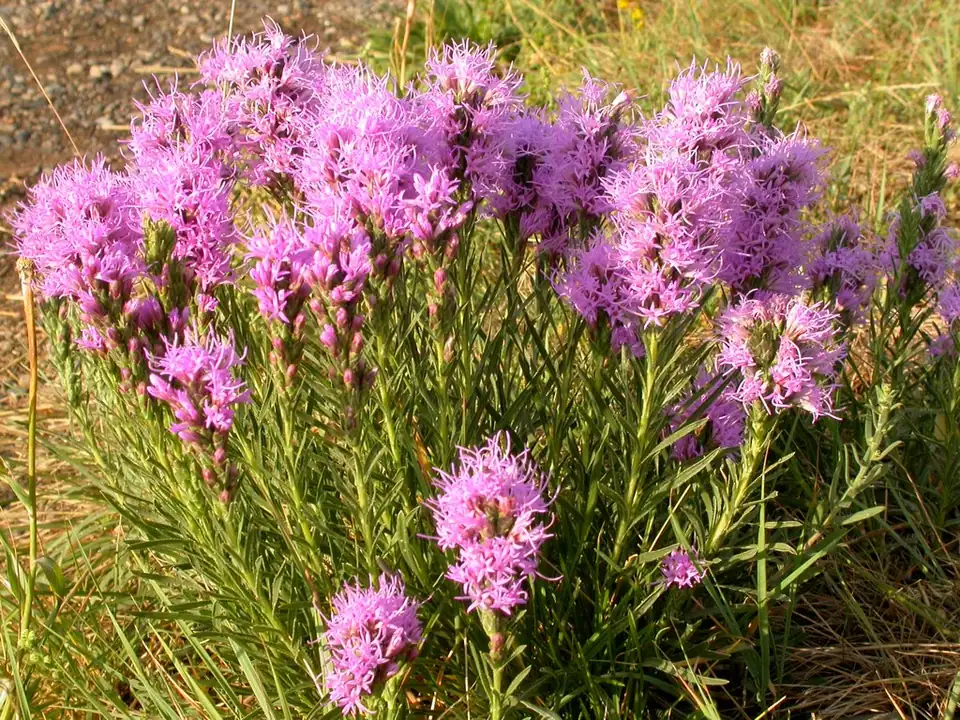

How to Grow and Care for Dotted blazing star
Liatris punctata
Written by Emilio Marruso · last checked
At a glance
Dotted blazing star is a tough perennial that loves the sun and shrugs off drought thanks to its long taproot. It asks for little: plant divided corms from late fall to early spring, and trim it in late winter before new growth starts. It even grows happily in containers, and Native Americans once ate its roots.
- Sun
Sun
- Water
Handles drought well thanks to its long root; prefers dry soil
What the sources say (3)
Watering: Drought tolerant (long taproot); medium water use, dry soil moisture
Water Use: Medium Light Requirement: Sun Soil Moisture: Dry
— Lady Bird Johnson Wildflower Center - The University of Texas at Austin [2] A long taproot makes this the most drought-tolerant of the gayfeathers.
— Lady Bird Johnson Wildflower Center - The University of Texas at Austin [2] Dotted gayfeather produces a taproot that can reach a depth of 15 feet, making it quite drought-resistant.
— blazing star | Kansas Wildflowers [4] - Cold
Survives winters down to −40 °F (−40 °C)
Very hardy · USDA 3 · RHS H7 · Z3
What the sources say (2)
Hardiness, coldest zone: 3 [winter low −40 to −34.4 °C (−40 to −30 °F)]
Light Requirements sun ## Cold Hardiness USDA zones 3-8
— Dotted Blazing Star [5] Hardiness, warmest zone: 8 [winter low −12.2 to −6.7 °C (10 to 20 °F)]
Light Requirements sun ## Cold Hardiness USDA zones 3-8
— Dotted Blazing Star [5] - Spacing
2 ft between plants
What the sources say (1)
Spacing: 61.0 cm (2 ft)
Allow 2 feet between plants in a perennial border.
— Lady Bird Johnson Wildflower Center - The University of Texas at Austin [2] - Planting
Plant divided corms from late fall to early spring
What the sources say (1)
Planting: Late fall to early spring (divided corms)
Gay feather can also be established by dividing corms in late fall to early spring.
— Lady Bird Johnson Wildflower Center - The University of Texas at Austin [2] - Pruning
Trim in late winter, before new growth; cut faded blooms to stop self-sown seedlings
What the sources say (3)
Pruning: Late winter, before new growth starts
According to Lady Bird Johnson Wildflower Center (limiting volunteer plants): Volunteer plants can be limited by cutting stalks to the ground after the bloom fades.
— Lady Bird Johnson Wildflower Center - The University of Texas at Austin [2] According to Lady Bird Johnson Wildflower Center (bushier plant): A bushier plant is formed if it is cut back or mowed during the growing season.
— Lady Bird Johnson Wildflower Center - The University of Texas at Austin [2] Cut to ground level in late winter before new growth starts.
— Dotted Blazing Star [5] - Harvest
Native Americans ate the roots and made a tea from them for stomachaches
- Watch out
In moist, rich soil the flower spikes flop over; keep it dry in July and August
What the sources say (1)
Watering notes: A moist, fertile soil may make the spikes flop over; keeping the plant dry in July and August may prevent it
A moist, fertile soil may cause a plant to develop long, slender spikes which flop over. They sometimes can be prevented from falling over by keeping the plant dry in July and August.
— Lady Bird Johnson Wildflower Center - The University of Texas at Austin [2] - Propagation
From seed or by dividing the corms
What the sources say (2)
Propagation: Seed (scarified and stratified); division of corms
Scarified seeds may be sown outside in late fall or stored, stratified and sown the following spring.
— Lady Bird Johnson Wildflower Center - The University of Texas at Austin [2] Gay feather can also be established by dividing corms in late fall to early spring.
— Lady Bird Johnson Wildflower Center - The University of Texas at Austin [2] - Sowing
Sow scuffed seed outdoors in late fall, or in spring after giving the seed a cold treatment
What the sources say (1)
Sowing: Late fall (scarified seed sown outside), or the following spring after stratification
Scarified seeds may be sown outside in late fall or stored, stratified and sown the following spring.
— Lady Bird Johnson Wildflower Center - The University of Texas at Austin [2] - Containers
Grows in containers too
What the sources say (1)
In containers: Yes
Gay feather is also a good choice for container gardens.
— Lady Bird Johnson Wildflower Center - The University of Texas at Austin [2]
Overview
Dotted blazing star (Liatris punctata) is a perennial native to the Great Plains. [5] It grows in sun on well-drained, sandy soils and is notably drought tolerant. [2] It can be propagated from scarified, stratified seed or by dividing corms. [2]
Dotted blazing star care
How to water Dotted blazing star
Watering
Drought tolerant (long taproot); medium water use, dry soil moisture
What the sources say (3)
Water Use: Medium
Light Requirement: Sun
Soil Moisture: DryA long taproot makes this the most drought-tolerant of the gayfeathers.Dotted gayfeather produces a taproot that can reach a depth of 15 feet, making it quite drought-resistant.Watering notes
A moist, fertile soil may make the spikes flop over; keeping the plant dry in July and August may prevent it
What the sources say (1)
A moist, fertile soil may cause a plant to develop long, slender spikes which flop over. They sometimes can be prevented from falling over by keeping the plant dry in July and August.How much light Dotted blazing star needs
How much cold Dotted blazing star can take
Hardiness, coldest zone
3 [winter low −40 to −34.4 °C (−40 to −30 °F)]
What the sources say (1)
Light Requirements
sun
##
Cold Hardiness
USDA zones 3-8Hardiness, warmest zone
8 [winter low −12.2 to −6.7 °C (10 to 20 °F)]
What the sources say (1)
Light Requirements
sun
##
Cold Hardiness
USDA zones 3-8Where to grow Dotted blazing star
In containers
Yes
What the sources say (1)
Gay feather is also a good choice for container gardens.Spacing
61.0 cm (2 ft)
What the sources say (1)
Allow 2 feet between plants in a perennial border.How to propagate Dotted blazing star
Seed (scarified and stratified); division of corms
What the sources say (2)
Scarified seeds may be sown outside in late fall or stored, stratified and sown the following spring.Gay feather can also be established by dividing corms in late fall to early spring.How to grow Dotted blazing star
The plant
Life cycle
perennial
What the sources say (1)
Origin | Native | Duration | Perennial | Distribution in the U.S. | Great Plains from Montana and North DakotaFamily
Asteraceae
What the sources say (1)
Species Name: Liatris punctata Plant Type: Forb Family Name: Asteraceae, Sunflower FamilyRemedies
The sources we checked give no remedies for this plant.
Calendar
Sowing
Late fall (scarified seed sown outside), or the following spring after stratification
What the sources say (1)
Scarified seeds may be sown outside in late fall or stored, stratified and sown the following spring.Planting
Late fall to early spring (divided corms)
What the sources say (1)
Gay feather can also be established by dividing corms in late fall to early spring.Pruning
Late winter, before new growth starts
What each source says
According to Lady Bird Johnson Wildflower Center (limiting volunteer plants): After the bloom fades
According to Lady Bird Johnson Wildflower Center (bushier plant): During the growing season
What the sources say (3)
According to Lady Bird Johnson Wildflower Center (limiting volunteer plants): Volunteer plants can be limited by cutting stalks to the ground after the bloom fades.According to Lady Bird Johnson Wildflower Center (bushier plant): A bushier plant is formed if it is cut back or mowed during the growing season.Cut to ground level in late winter before new growth starts.Months as given by the sources, which are mostly from the United States (northern hemisphere). In the southern hemisphere they shift by about six months.
Edibility
Reported by the source, quoted verbatim. Do not eat a plant on the basis of this page alone: identification mistakes can be dangerous.
Indicative values
Values from a secondary source, not checked word for word like the rest of this page. Use them as a starting point.
- Hours of sun
- 6-8 hoursIndicative value, adapt it to your climate · Secondary source
- Drought tolerant
- yesIndicative value, adapt it to your climate · Secondary source
- Soil
- Sandy, Loamy, RockyIndicative value, adapt it to your climate · Secondary source
- Soil pH
- 6-7.5Indicative value, adapt it to your climate · Secondary source
- Care level
- MediumIndicative value, adapt it to your climate · Secondary source
- Growth rate
- LowIndicative value, adapt it to your climate · Secondary source
Similar plants
- Appalachian Blazing Star Liatris squarrulosa
- Blazing Star Liatris scariosa
- Dwarf Blazing Star Liatris microcephala
- Gayfeather Liatris spicata
- Meadow Blazing Star Liatris ligulistylis
- Prairie Blazing Star Liatris pycnostachya
- Rough Blazing-star Liatris aspera
- Sandhills Blazing Star Liatris pilosa
Sources
Every value above is quoted from these documents. Links lead to the original publisher.
- Dotted Gayfeather | Oklahoma State University · extension.okstate.edu, consulted
- Lady Bird Johnson Wildflower Center - The University of Texas at Austin · wildflower.org, consulted
- Dotted Blazing Star and Bottlebrush Blazing Star | Missouri Department of Conservation · mdc.mo.gov, consulted
- blazing star | Kansas Wildflowers · kswildflower.org, consulted
- Dotted Blazing Star · csu.org, consulted
- Plants of Louisiana · warcapps.usgs.gov, consulted
Written by Emilio Marruso · last checked