
How to Grow and Care for Erect Prickly Pear
Opuntia stricta
Written by Emilio Marruso · last checked
Toxic to: People · Why
At a glance
This tough cactus asks for very little: a sunny spot and very little water. Its fruit is mild in flavor but very juicy, perfect for syrup, jam or jelly, and the young pads can be eaten raw or cooked as a vegetable. Plant it outdoors after the last frosts, or grow it happily in a container.
- Sun
Sunny spot
What the sources say (1)
Light: Sunny position
Requires a sunny position and a well-drained soil
— Opuntia stricta - Useful Temperate Plants [2] - Water
Very little water; don't water right after repotting or a new cutting, or the roots rot
What the sources say (2)
Watering: Very little water
All are desert cacti that need lots of sun, light, and very little water.
— Opuntia stricta (Erect Prickly Pear) - World of Succulents [4] Watering notes: Do not water a newly repotted plant or a new cutting, to avoid rotting the roots
As with a new cutting, do not briefly water a newly repotted Prickly Pear to avoid rotting its roots.
— Opuntia stricta (Erect Prickly Pear) - World of Succulents [4] - Cold
Survives winters down to 20 °F (−6.7 °C)
Hardy in average winters · USDA 9a · RHS H4 · Z9
What the sources say (2)
Hardiness, coldest zone: 9a [winter low −6.7 to −3.9 °C (20 to 25 °F)]
USDA hardiness zones 9a to 11b
— Opuntia stricta (Erect Prickly Pear) - World of Succulents [4] Hardiness, warmest zone: 11b [winter low 7.2 to 10 °C (45 to 50 °F)]
USDA hardiness zones 9a to 11b
— Opuntia stricta (Erect Prickly Pear) - World of Succulents [4] - Planting
Late spring or early summer, after the last frosts
What the sources say (1)
Planting: Late spring or early summer, after the last expected frosts
Plant them out into their permanent positions in late spring or early summer, after the last expected frosts.
— Opuntia stricta - Useful Temperate Plants [2] - Harvest
Juicy fruit for syrup, jam or jelly; young pads raw or cooked as a vegetable
- Propagation
From seed or from pad cuttings
- Sowing
Sow in early spring, in a greenhouse
What the sources say (1)
Sowing: Early spring, in a greenhouse
Seed - sow early spring in a very well-drained compost in a greenhouse.
— Opuntia stricta - Useful Temperate Plants [2] - Containers
Grows in containers too
What the sources say (1)
In containers: Yes
These cacti will grow just fine in a garden but can also be grown in pots.
— Opuntia stricta (Erect Prickly Pear) - World of Succulents [4] - Safety
Handle with care: it can cause considerable irritation and discomfort
Overview
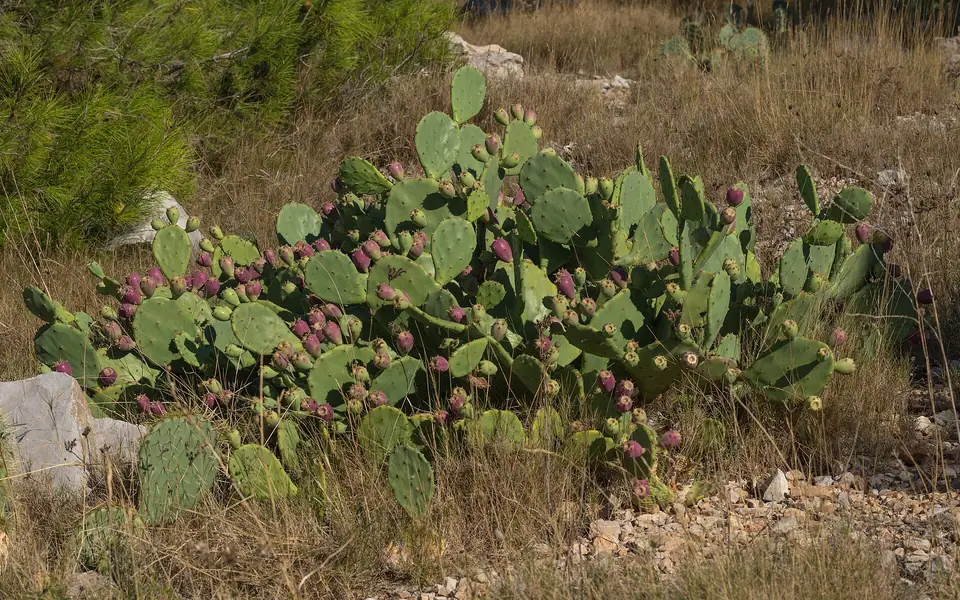
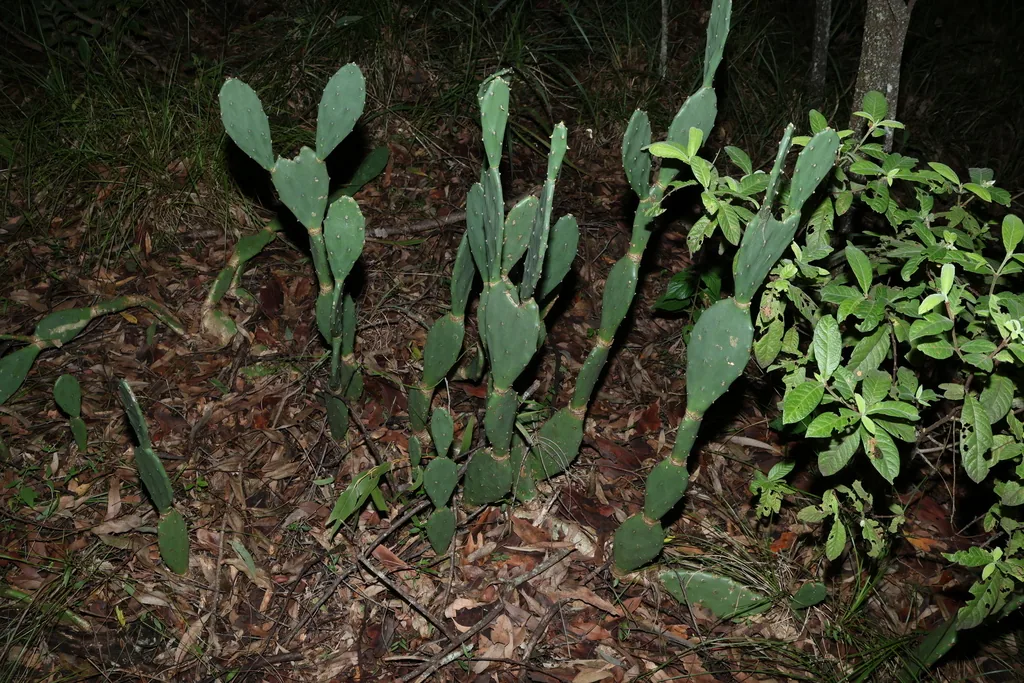
Opuntia stricta is a cactus that can grow up to 2 metres [6.6 ft] tall as an erect or spreading shrub. [6] It needs a sunny, well-drained position and can be grown in pots. [2] It is invasive in several regions and its glochids irritate the skin. [6]
This record is incomplete: the sources we read do not cover every field yet.
Not yet covered by our sources: Pruning
Erect Prickly Pear care
Measurements in square brackets are our conversion into the other unit system; the quoted text is unchanged.
How to water Erect Prickly Pear
Watering
Very little water
What the sources say (1)
All are desert cacti that need lots of sun, light, and very little water.Watering notes
Do not water a newly repotted plant or a new cutting, to avoid rotting the roots
What the sources say (1)
As with a new cutting, do not briefly water a newly repotted Prickly Pear to avoid rotting its roots.How much light Erect Prickly Pear needs
Sunny position
What the sources say (1)
Requires a sunny position and a well-drained soilHow much cold Erect Prickly Pear can take
Hardiness, coldest zone
9a [winter low −6.7 to −3.9 °C (20 to 25 °F)]
What the sources say (1)
USDA hardiness zones 9a to 11bHardiness, warmest zone
11b [winter low 7.2 to 10 °C (45 to 50 °F)]
What the sources say (1)
USDA hardiness zones 9a to 11bWhere to grow Erect Prickly Pear
Yes
What the sources say (1)
These cacti will grow just fine in a garden but can also be grown in pots.How to propagate Erect Prickly Pear
How to grow Erect Prickly Pear
The plant
Family
Cactaceae
What the sources say (1)
Family
CACTACEAE
Genus
Opuntia
Species
Opuntia stricta (Haw.)Haw.
Common Name
ERECT PRICKLYPEAR; SHELL-MOUND PRICKLYPEARRemedies
Each remedy shows what official sources say about it; traditional remedies without an official source are marked as such. Harmful ones are listed so you know to avoid them.
Treating the plant
cochineal scale
hose spray off Not verified
Traditional remedy, not verified by an official source.
How: spray them off the cactus pads with a power nozzle attached at the end of your hose
insecticidal soap scrub Not verified
Traditional remedy, not verified by an official source.
How: scrubbing the areas with insecticidal soap or unscented dish soap; a toothbrush for small areas, a long-handled brush for larger areas
cactus anthracnose
remove and destroy diseased pads Not verified
Traditional remedy, not verified by an official source.
How: removing and destroying diseased cladodes as soon as noticed
Getting rid of it
invasive prickly pear
dig up with a mattock Official source, not independently tested
Dispose of common pear plant parts by burying at least one metre deep or burning in a hot fire.
— weeds.dpi.nsw.gov.au [8] How: Dig up small or isolated plants using a mattock or other tools, with protective clothing and gloves
Dig up small or isolated plants using a mattock or other tools. Wear appropriate protective clothing and gloves to protect against injuries from spines or bristles.
— weeds.dpi.nsw.gov.au [8] hand pulling and grubbing Official source, not independently tested
Any form or physical removal must remove all parts of the plant as they can regenerate from small fragments.
— nt.gov.au [9] How: Weeds, including their roots, are physically pulled out of the ground by hand or using hand tools
Weeds, including their roots, are physically pulled out of the ground by hand or using hand tools
— nt.gov.au [9] stacked cut pads to attract cactoblastis moth Official source, not independently tested
How: cut and stack the pads in a pile about 2m x 2m and 1 m high in spring or summer; the moths will multiply quickly in the stack
To help attract the moths to a site, cut and stack the pads in a pile about 2m x 2m and 1 m high in spring or summer. The moths will multiply quickly in the stack.
— weeds.dpi.nsw.gov.au [8]
Is Erect Prickly Pear poisonous?
Reported by the source, quoted verbatim. This is not medical or veterinary advice: if a person or an animal may have eaten this plant, contact a poison control centre or a veterinarian.
Calendar
Sowing
Early spring, in a greenhouse
What the sources say (1)
Seed - sow early spring in a very well-drained compost in a greenhouse.Planting
Late spring or early summer, after the last expected frosts
What the sources say (1)
Plant them out into their permanent positions in late spring or early summer, after the last expected frosts.Pruning
Not stated in the sources we read.
Months as given by the sources, which are mostly from the United States (northern hemisphere). In the southern hemisphere they shift by about six months.
Edibility
Reported by the source, quoted verbatim. Do not eat a plant on the basis of this page alone: identification mistakes can be dangerous.
Similar plants
- Bunny Ears Opuntia microdasys
- Devil's Tongue Opuntia humifusa
- Plains Prickly Pear Opuntia macrorhiza
- Indian Fig Opuntia ficus-indica
- Dragon Fruit Selenicereus undatus
- Easter Cactus Rhipsalidopsis gaertneri
- Eve's Needle Austrocylindropuntia subulata
- Pink Star Cactus Rhipsalidopsis rosea
Sources
Every value above is quoted from these documents. Links lead to the original publisher.
- Opuntia stricta / [Species detail] / Plant Atlas · florida.plantatlas.usf.edu, consulted
- Opuntia stricta - Useful Temperate Plants · temperate.theferns.info, consulted
- Opuntia stricta - Useful Tropical Plants · tropical.theferns.info, consulted
- Opuntia stricta (Erect Prickly Pear) - World of Succulents · worldofsucculents.com, consulted
- Opuntia stricta - Leon Levy Native Plant Preserve · levypreserve.org, consulted
- GISD · iucngisd.org, consulted
- Opuntia stricta · apps.lucidcentral.org, consulted
- weeds.dpi.nsw.gov.au · weeds.dpi.nsw.gov.au
- nt.gov.au · nt.gov.au
Written by Emilio Marruso · last checked