
How to Grow and Care for Eve's Needle
Austrocylindropuntia subulata
Written by Emilio Marruso · last checked
Toxic to: Cats, Dogs, People · Why
At a glance
This sculptural cactus is easy to love: it thrives in full sun or partial shade, and indoors it's happy in a bright spot. Water it well, then let the soil dry out completely before the next drink. It grows happily in a pot, and it can even give you edible fruit, which can be fermented into cactus wine.
- Sun
Full sun to partial shade; bright light indoors
What the sources say (2)
Light: Full sun to partial shade; bright light indoors
This plant requires full sun or bright indoor light, good drainage, and infrequent watering.
— Austrocylindropuntia subulata (Eve's Needle, Eve's Needle Cactus, Eve's Pin, Eve's Pin Cactus, Eve's-Pin Prickleypear, Long Spine Cactus) | North Carolina Extension Gardener Plant Toolbox [1] Light: Full sun (6 or more hours of direct sunlight a day) Partial Shade (Direct sunlight only part of the day, 2-6 hours)
— Austrocylindropuntia subulata (Eve's Needle, Eve's Needle Cactus, Eve's Pin, Eve's Pin Cactus, Eve's-Pin Prickleypear, Long Spine Cactus) | North Carolina Extension Gardener Plant Toolbox [1] - Water
Water well, then let the soil dry out completely; too much water rots the roots
What the sources say (3)
Watering: Infrequent watering; water well and allow the soil to dry out completely between waterings
Water the plant well and allow the soil to completely dry out between waterings.
— Austrocylindropuntia subulata (Eve's Needle, Eve's Needle Cactus, Eve's Pin, Eve's Pin Cactus, Eve's-Pin Prickleypear, Long Spine Cactus) | North Carolina Extension Gardener Plant Toolbox [1] This plant requires full sun or bright indoor light, good drainage, and infrequent watering.
— Eve's Needle - Austrocylindropuntia subulata | North Carolina Extension Gardener Plant Toolbox [2] Watering notes: Overwatering or inadequate drainage can result in root rot; high humidity can cause stem rot
Overwatering or inadequate drainage can result in root rot, and high humidity can causes stem rot.
— Austrocylindropuntia subulata (Eve's Needle, Eve's Needle Cactus, Eve's Pin, Eve's Pin Cactus, Eve's-Pin Prickleypear, Long Spine Cactus) | North Carolina Extension Gardener Plant Toolbox [1] - Cold
Survives winters down to 20 °F (−6.7 °C)
Hardy in average winters · USDA 9a · RHS H4 · Z9
What the sources say (2)
Hardiness, coldest zone: 9a [winter low −6.7 to −3.9 °C (20 to 25 °F)]
USDA Plant Hardiness Zone: 9a, 9b, 10a, 10b, 11a, 11b
— Austrocylindropuntia subulata (Eve's Needle, Eve's Needle Cactus, Eve's Pin, Eve's Pin Cactus, Eve's-Pin Prickleypear, Long Spine Cactus) | North Carolina Extension Gardener Plant Toolbox [1] Hardiness, warmest zone: 11b [winter low 7.2 to 10 °C (45 to 50 °F)]
USDA Plant Hardiness Zone: 9a, 9b, 10a, 10b, 11a, 11b
— Austrocylindropuntia subulata (Eve's Needle, Eve's Needle Cactus, Eve's Pin, Eve's Pin Cactus, Eve's-Pin Prickleypear, Long Spine Cactus) | North Carolina Extension Gardener Plant Toolbox [1] - Harvest
The fruit is edible and can be fermented into cactus wine
- Pests
Watch for mealybugs and scale; wet soil or high humidity cause root and stem rot
What the sources say (2)
Pests: mealybugs, scale
Eve's needle cactus is usually resistant to most pests and diseases; however, monitor the plant for mealybugs and scale.
— Austrocylindropuntia subulata (Eve's Needle, Eve's Needle Cactus, Eve's Pin, Eve's Pin Cactus, Eve's-Pin Prickleypear, Long Spine Cactus) | North Carolina Extension Gardener Plant Toolbox [1] Diseases: root rot, stem rot
Overwatering or inadequate drainage can result in root rot, and high humidity can causes stem rot.
— Austrocylindropuntia subulata (Eve's Needle, Eve's Needle Cactus, Eve's Pin, Eve's Pin Cactus, Eve's-Pin Prickleypear, Long Spine Cactus) | North Carolina Extension Gardener Plant Toolbox [1] - Size
Up to 13 ft tall in the wild; the 'Monstruosa' form stays under 3 ft
What the sources say (2)
Mature height: 396 cm (13 ft) in native habitat
cultivar 'Monstruosa': smaller habit, up to 3.3 feet tall, densely branched, has a main stem and many upright cylinder-like shoots
— Austrocylindropuntia subulata (Eve's Needle, Eve's Needle Cactus, Eve's Pin, Eve's Pin Cactus, Eve's-Pin Prickleypear, Long Spine Cactus) | North Carolina Extension Gardener Plant Toolbox [1] Eve's needle cactus may grow up to 13 feet tall in its native habitat, but is much smaller in cultivation.
— Austrocylindropuntia subulata (Eve's Needle, Eve's Needle Cactus, Eve's Pin, Eve's Pin Cactus, Eve's-Pin Prickleypear, Long Spine Cactus) | North Carolina Extension Gardener Plant Toolbox [1] - Propagation
Easy to multiply from stem cuttings or by layering
What the sources say (1)
Propagation: Layering, stem cutting
Recommended Propagation Strategy: Layering Stem Cutting
— Austrocylindropuntia subulata (Eve's Needle, Eve's Needle Cactus, Eve's Pin, Eve's Pin Cactus, Eve's-Pin Prickleypear, Long Spine Cactus) | North Carolina Extension Gardener Plant Toolbox [1] - Containers
Grows well in pots, indoors too
What the sources say (2)
In containers: Yes
If used as a container or houseplant make sure the container or clay pot has adequate drainage holes.
— Austrocylindropuntia subulata (Eve's Needle, Eve's Needle Cactus, Eve's Pin, Eve's Pin Cactus, Eve's-Pin Prickleypear, Long Spine Cactus) | North Carolina Extension Gardener Plant Toolbox [1] Indoors: Yes
For cactus enthusiasts, it could be used as an indoor houseplant.
— Austrocylindropuntia subulata (Eve's Needle, Eve's Needle Cactus, Eve's Pin, Eve's Pin Cactus, Eve's-Pin Prickleypear, Long Spine Cactus) | North Carolina Extension Gardener Plant Toolbox [1] - Safety
Not poisonous to cats, dogs or horses, but its spines can hurt children and pets
Overview
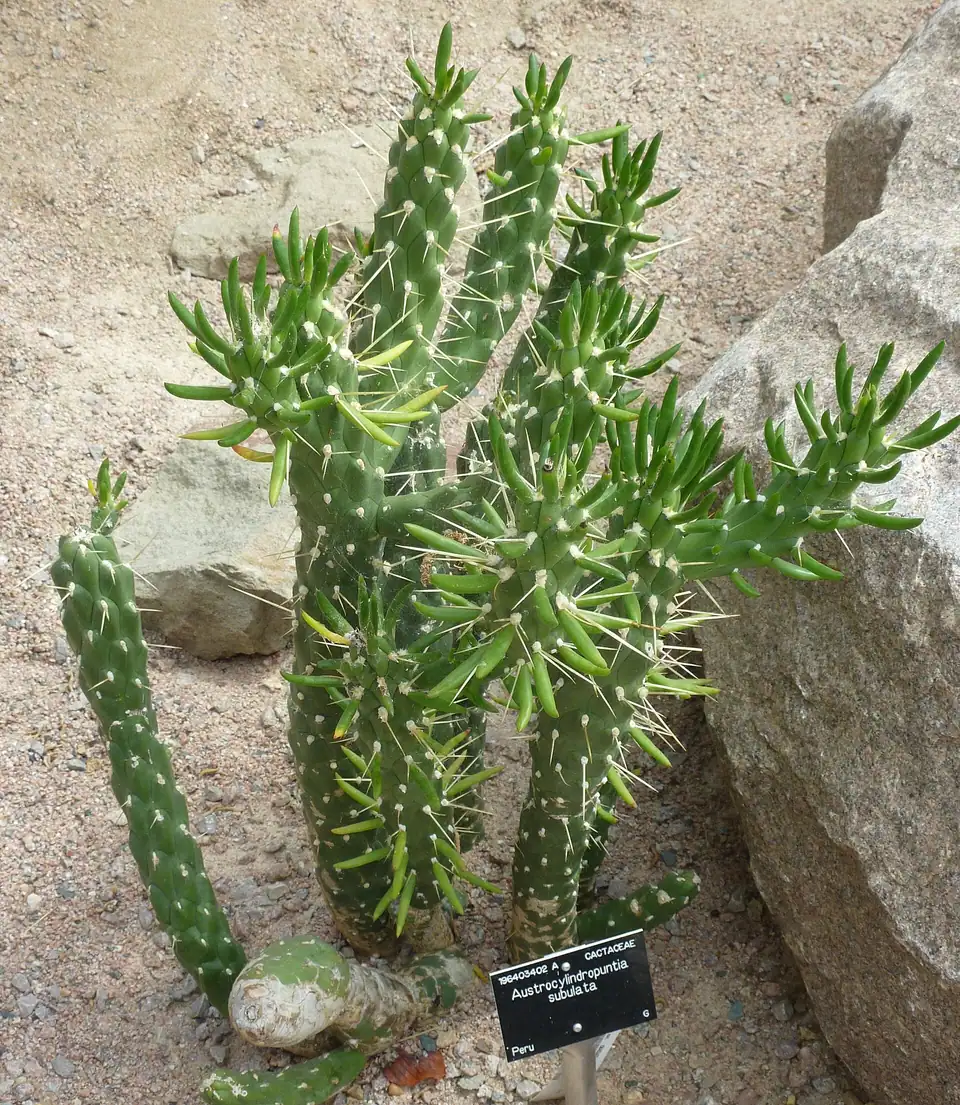
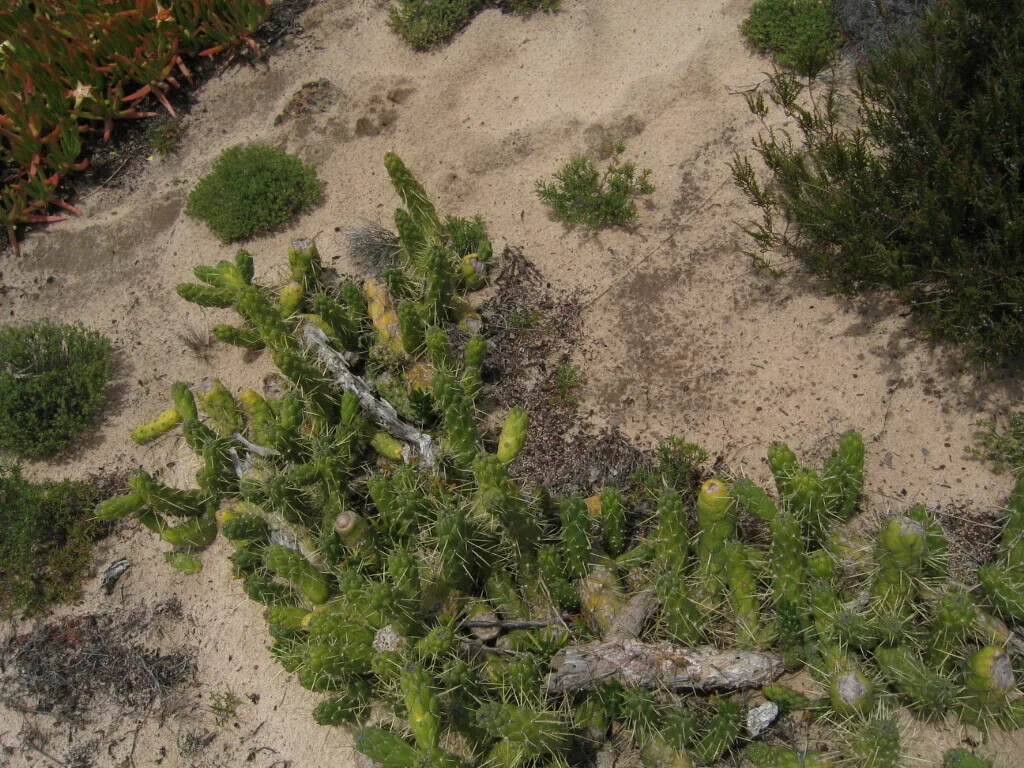
Eve's needle cactus is a spiny, shrub or tree-like cactus native to the Andes that suits cactus enthusiasts as an indoor houseplant. [1] It needs full sun or bright indoor light, good drainage and infrequent watering, and it will not survive freezing temperatures or high humidity. [1]
Eve's Needle care
How to water Eve's Needle
Watering
Infrequent watering; water well and allow the soil to dry out completely between waterings
What the sources say (2)
Water the plant well and allow the soil to completely dry out between waterings.This plant requires full sun or bright indoor light, good drainage, and infrequent watering.Watering notes
Overwatering or inadequate drainage can result in root rot; high humidity can cause stem rot
What the sources say (1)
Overwatering or inadequate drainage can result in root rot, and high humidity can causes stem rot.How much light Eve's Needle needs
Full sun to partial shade; bright light indoors
What the sources say (2)
This plant requires full sun or bright indoor light, good drainage, and infrequent watering.Light:
Full sun (6 or more hours of direct sunlight a day)
Partial Shade (Direct sunlight only part of the day, 2-6 hours)How much cold Eve's Needle can take
Hardiness, coldest zone
9a [winter low −6.7 to −3.9 °C (20 to 25 °F)]
What the sources say (1)
USDA Plant Hardiness Zone:
9a, 9b, 10a, 10b, 11a, 11bHardiness, warmest zone
11b [winter low 7.2 to 10 °C (45 to 50 °F)]
What the sources say (1)
USDA Plant Hardiness Zone:
9a, 9b, 10a, 10b, 11a, 11bWhere to grow Eve's Needle
Indoors
Yes
What the sources say (1)
For cactus enthusiasts, it could be used as an indoor houseplant.In containers
Yes
What the sources say (1)
If used as a container or houseplant make sure the container or clay pot has adequate drainage holes.How to propagate Eve's Needle
Layering, stem cutting
What the sources say (1)
Recommended Propagation Strategy:
Layering
Stem CuttingHow to grow Eve's Needle
The plant
Family
Cactaceae
What the sources say (1)
It has long, slender stems with sharp spines and thrives in arid, desert-like conditions, and it is a member of the cactus family (Cactaceae).Mature height
396 cm (13 ft) in native habitat
What each source says
cultivar 'Monstruosa': fino a 100 cm (3.3 ft)
What the sources say (2)
cultivar 'Monstruosa': smaller habit, up to 3.3 feet tall, densely branched, has a main stem and many upright cylinder-like shootsEve's needle cactus may grow up to 13 feet tall in its native habitat, but is much smaller in cultivation.Pests and diseases
Pests
mealybugs, scale
What the sources say (1)
Eve's needle cactus is usually resistant to most pests and diseases; however, monitor the plant for mealybugs and scale.Diseases
root rot, stem rot
What the sources say (1)
Overwatering or inadequate drainage can result in root rot, and high humidity can causes stem rot.Eve's Needle pests and problems
Root rot
Symptom: Overwatering or inadequate drainage can result in root rot
What to do: Avoid overwatering and provide adequate drainage; allow the soil to dry out completely between waterings
What the sources say (2)
Overwatering or inadequate drainage can result in root rot, and high humidity can causes stem rot.
— Austrocylindropuntia subulata (Eve's Needle, Eve's Needle Cactus, Eve's Pin, Eve's Pin Cactus, Eve's-Pin Prickleypear, Long Spine Cactus) | North Carolina Extension Gardener Plant Toolbox [1] Water the plant well and allow the soil to completely dry out between waterings.
— Austrocylindropuntia subulata (Eve's Needle, Eve's Needle Cactus, Eve's Pin, Eve's Pin Cactus, Eve's-Pin Prickleypear, Long Spine Cactus) | North Carolina Extension Gardener Plant Toolbox [1] Mealybugs and scale
Symptom: The plant is usually resistant to most pests and diseases, but mealybugs and scale can occur
What to do: Monitor the plant for mealybugs and scale
What the sources say (1)
usually resistant to most pests and diseases; however, monitor the plant for mealybugs and scale.
— Austrocylindropuntia subulata (Eve's Needle, Eve's Needle Cactus, Eve's Pin, Eve's Pin Cactus, Eve's-Pin Prickleypear, Long Spine Cactus) | North Carolina Extension Gardener Plant Toolbox [1]
Remedies
Each remedy shows what official sources say about it; traditional remedies without an official source are marked as such. Harmful ones are listed so you know to avoid them.
First aid
First aid: not a substitute for a doctor
glochid skin contact
remove a single glochid with tweezers Official source, not independently tested
do not bring the injured part of your body anywhere near your mouth.
— pbssocal.org [4] How: For a single glochid, removal can be done with tweezers.
For a single glochid, removal can be done with tweezers.
— pmc.ncbi.nlm.nih.gov [3] household glue peel Official source, not independently tested
Thus the best approach for deeply lodged spines you can't remove on your own is to see a doctor, trained First Aid provider, or other person who knows what she's doing to remove those spines for you.
— pbssocal.org [4] How: Apply a layer of household glue over the site of injury and then peel it away.
For injuries with multiple glochidia, the removal can be done by applying a layer of household glue over the site of injury and then peeling it away, hopefully taking the spines with it.
— pmc.ncbi.nlm.nih.gov [3]
Treating the plant
mealybugs
rubbing alcohol swab Not verified
Traditional remedy, not verified by an official source.
How: Use a cotton swab or a paintbrush to dab the mealybugs with rubbing alcohol, then remove the dead bugs.
dish soap and water spray Partly works
Spot-treat a small part of your cactus before spraying the entire plant. Some cacti are sensitive to soap and water solutions.
— plantcaretoday.com [5] How: Start off with about a tablespoonful per gallon of water; reapply every couple of days.
Soaps containing vegetable oil or animal fat can be mixed with water to create a spray that breaks down mealybugs’ fuzzy defenses and smothers them.
— plantcaretoday.com [5] What the evidence says Despite being made of common household materials like dish soap and vinegar and having seemingly fewer risks, these concoctions may have unforeseen consequences and cannot be relied upon to have the same effectiveness as a registered pesticide.
— extension.unh.edu [6] neem oil spray Partly works
Remove your cactus from direct sunlight when you apply this product mixture because the oil can magnify the sun’s rays and cause burning.
— plantcaretoday.com [5] How: Dilute as per packaging instructions; generally about an ounce of neem oil concentrate per gallon of water.
Neem Oil contains a natural insecticide for plants called Azadirachtin, which does have a residual effect. One application will last about a week.
— plantcaretoday.com [5] What the evidence says However, neem oil is not effective against every insect and disease, and often must be frequently reapplied to reach the desired outcome.
— extension.unh.edu [6] strong water spray Not verified
Traditional remedy, not verified by an official source.
Cactus and succulents that tend to drop leaves or plantlets might not respond well to this sort of aggressive treatment, but those that don’t can benefit from it.
— plantcaretoday.com [5] How: Blast the pests with a strong spray of water; then unpot, wash thoroughly including roots, and repot in clean mix.
Is Eve's Needle toxic to pets?
Reported by the source, quoted verbatim. This is not medical or veterinary advice: if a person or an animal may have eaten this plant, contact a poison control centre or a veterinarian.
Animals
#non-toxic for cats
[1]The source flags the risk for this animal but does not explain why.
#non-toxic for dogs
[1]The source flags the risk for this animal but does not explain why.
#non-toxic for horses
[1]The source flags the risk for this animal but does not explain why.
Problems: Problem for Cats Problem for Children Problem for Dogs Spines/Thorns
[1]- Poisonous parts
The fruits are dark green to red, 5 inches long, egg-shaped, and have fine irritating hairs (glochids).
[1]
Problem for Dogs Spines/Thorns
[1]- Poisonous parts
The fruits are dark green to red, 5 inches long, egg-shaped, and have fine irritating hairs (glochids).
[1]
People
Edibility
Reported by the source, quoted verbatim. Do not eat a plant on the basis of this page alone: identification mistakes can be dangerous.
The fruit is edible and can also be fermented to make cactus wine.
[1]
Similar plants
- Bunny Ears Opuntia microdasys
- Devil's Tongue Opuntia humifusa
- Dragon Fruit Selenicereus undatus
- Easter Lily Cactus Echinopsis oxygona
- Mistletoe Cactus Rhipsalis baccifera
- Old Man Cactus Cephalocereus senilis
- Pink Star Cactus Rhipsalidopsis rosea
- Plains Prickly Pear Opuntia macrorhiza
Sources
Every value above is quoted from these documents. Links lead to the original publisher.
- Austrocylindropuntia subulata (Eve's Needle, Eve's Needle Cactus, Eve's Pin, Eve's Pin Cactus, Eve's-Pin Prickleypear, Long Spine Cactus) | North Carolina Extension Gardener Plant Toolbox · plants.ces.ncsu.edu, consulted
- Eve's Needle - Austrocylindropuntia subulata | North Carolina Extension Gardener Plant Toolbox · plants.ces.ncsu.edu, consulted
- pmc.ncbi.nlm.nih.gov · pmc.ncbi.nlm.nih.gov
- pbssocal.org · pbssocal.org
- plantcaretoday.com · plantcaretoday.com
- extension.unh.edu · extension.unh.edu
Written by Emilio Marruso · last checked