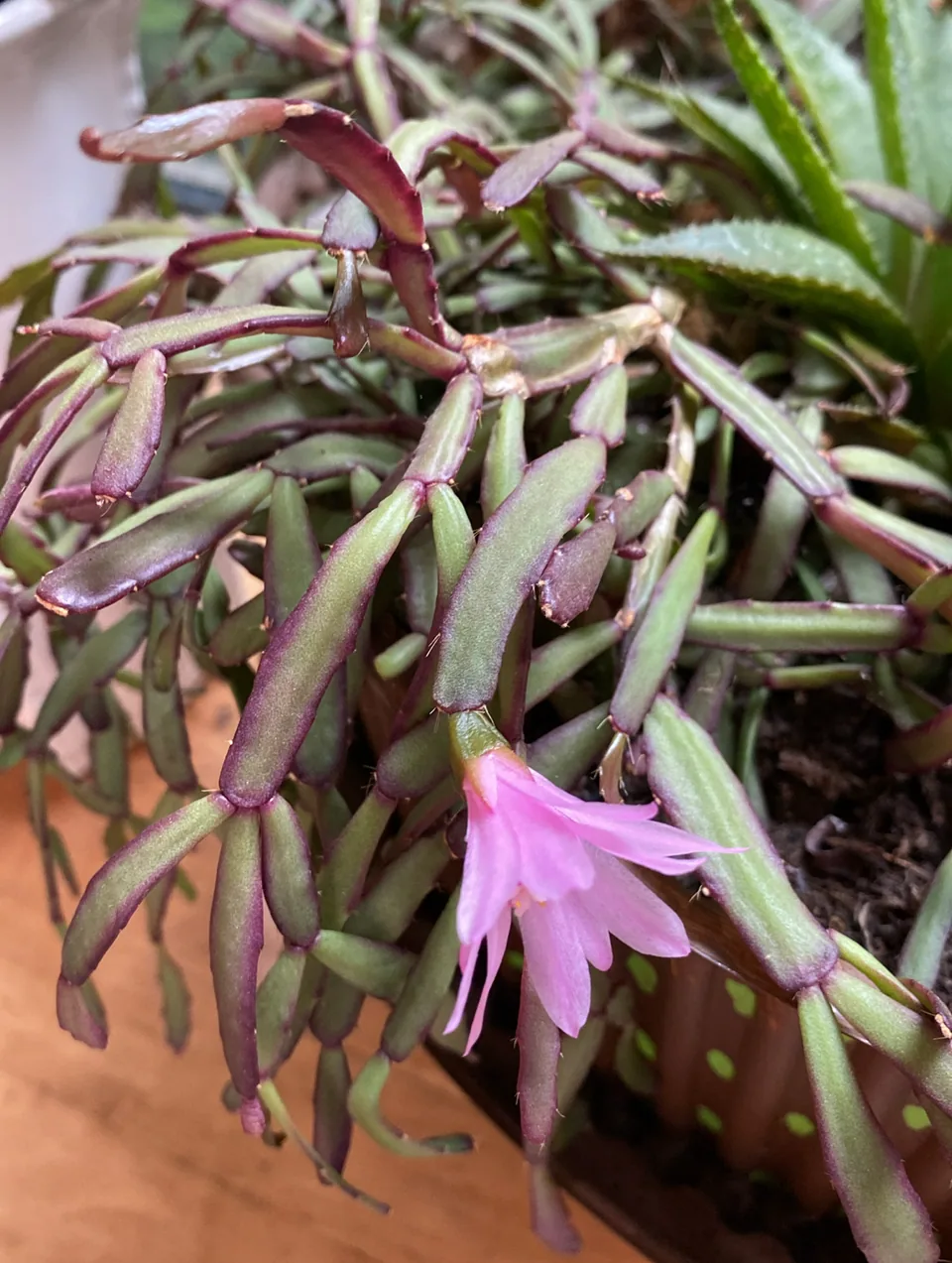

How to Grow and Care for Pink Star Cactus
Rhipsalidopsis rosea
Written by Emilio Marruso · last checked
Not toxic to cats and dogs, according to the sources · Sources
At a glance
This compact cactus makes a gentle houseplant: it grows happily indoors or in a pot, reaching just 4 inches to 1.5 feet tall and wide. Give it bright indirect light, let the soil dry slightly between waterings, and keep it moist while it flowers. It's safe for cats and dogs, and you can grow new plants from stem cuttings.
- Sun
Bright indirect light or part shade, with 2–6 hours of direct sun
What the sources say (2)
Light: Bright indirect light; partial shade (direct sunlight only part of the day, 2-6 hours)
This plant thrives bright indirect light, and moist, well-drained, cactus potting mix, and high humidity.
— Rhipsalidopsis rosea (Pink Star Cactus, Rose Easter Cactus) | North Carolina Extension Gardener Plant Toolbox [1] Light: Partial Shade (Direct sunlight only part of the day, 2-6 hours)
— Rhipsalidopsis rosea (Pink Star Cactus, Rose Easter Cactus) | North Carolina Extension Gardener Plant Toolbox [1] - Water
Let the soil dry slightly between waterings; keep it moist while it flowers, then water less
What the sources say (2)
Watering: Allow the soil to dry out slightly between waterings; keep the soil moist during flowering, then cut back on frequency after the flowers fade
It is best to allow the soil to dry out slightly between waterings. During flowering, keep the soil moist, but after the flowers fade cut back on the frequency.
— Rhipsalidopsis rosea (Pink Star Cactus, Rose Easter Cactus) | North Carolina Extension Gardener Plant Toolbox [1] Watering notes: Overwatering can cause root rot
Monitor for mealybugs and spider mites. Overwatering can cause root rot.
— Rhipsalidopsis rosea (Pink Star Cactus, Rose Easter Cactus) | North Carolina Extension Gardener Plant Toolbox [1] - Cold
Survives winters down to 30 °F (−1.1 °C)
Half hardy: mild winters or an unheated greenhouse · USDA 10a · RHS H3 · Z10
What the sources say (2)
Hardiness, coldest zone: 10a [winter low −1.1 to 1.7 °C (30 to 35 °F)]
USDA Plant Hardiness Zone: 10a, 10b, 11a, 11b
— Rhipsalidopsis rosea (Pink Star Cactus, Rose Easter Cactus) | North Carolina Extension Gardener Plant Toolbox [1] Hardiness, warmest zone: 11b [winter low 7.2 to 10 °C (45 to 50 °F)]
USDA Plant Hardiness Zone: 10a, 10b, 11a, 11b
— Rhipsalidopsis rosea (Pink Star Cactus, Rose Easter Cactus) | North Carolina Extension Gardener Plant Toolbox [1] - Pests
Watch for mealybugs and spider mites; too much water causes root rot
What the sources say (2)
Pests: mealybugs, spider mites
Insects, Diseases, and Other Plant Problems: Monitor for mealybugs and spider mites. Overwatering can cause root rot.
— Rhipsalidopsis rosea (Pink Star Cactus, Rose Easter Cactus) | North Carolina Extension Gardener Plant Toolbox [1] Diseases: root rot
Insects, Diseases, and Other Plant Problems: Monitor for mealybugs and spider mites. Overwatering can cause root rot.
— Rhipsalidopsis rosea (Pink Star Cactus, Rose Easter Cactus) | North Carolina Extension Gardener Plant Toolbox [1] - Size
4 inches to 1.5 feet tall and wide
What the sources say (2)
Mature height: 10.16-45.72 cm (4 in-1.5 ft)
Dimensions: Height: 0 ft. 4 in. - 1 ft. 6 in. Width: 0 ft. 4 in. - 1 ft. 6 in.
— Rhipsalidopsis rosea (Pink Star Cactus, Rose Easter Cactus) | North Carolina Extension Gardener Plant Toolbox [1] Mature width: 10.16-45.72 cm (4 in-1.5 ft)
Dimensions: Height: 0 ft. 4 in. - 1 ft. 6 in. Width: 0 ft. 4 in. - 1 ft. 6 in.
— Rhipsalidopsis rosea (Pink Star Cactus, Rose Easter Cactus) | North Carolina Extension Gardener Plant Toolbox [1] - Propagation
Grow new plants from stem cuttings
What the sources say (1)
Propagation: Stem cuttings
It also prefers long periods of darkness, up to 14 hours. It can be propagated by stem cuttings.
— Rhipsalidopsis rosea (Pink Star Cactus, Rose Easter Cactus) | North Carolina Extension Gardener Plant Toolbox [1] - Containers
Grows well in pots and indoors
What the sources say (2)
In containers: Yes
Landscape Location: Container Hanging Baskets
— Rhipsalidopsis rosea (Pink Star Cactus, Rose Easter Cactus) | North Carolina Extension Gardener Plant Toolbox [1] Indoors: Yes
It can be grown indoors or outdoors in mild climates.
— Rhipsalidopsis rosea (Pink Star Cactus, Rose Easter Cactus) | North Carolina Extension Gardener Plant Toolbox [1] - Safety
Not toxic to cats or dogs
Overview
Rhipsalidopsis rosea is a bushy, epiphytic cactus popular as an ornamental house plant. [1] It thrives in bright indirect light and should dry out slightly between waterings. [1] It is tagged as non-toxic for cats and dogs. [1]
Pink Star Cactus care
How to water Pink Star Cactus
Watering
Allow the soil to dry out slightly between waterings; keep the soil moist during flowering, then cut back on frequency after the flowers fade
What the sources say (1)
It is best to allow the soil to dry out slightly between waterings. During flowering, keep the soil moist, but after the flowers fade cut back on the frequency.Watering notes
Overwatering can cause root rot
What the sources say (1)
Monitor for mealybugs and spider mites. Overwatering can cause root rot.How much light Pink Star Cactus needs
Bright indirect light; partial shade (direct sunlight only part of the day, 2-6 hours)
What the sources say (2)
This plant thrives bright indirect light, and moist, well-drained, cactus potting mix, and high humidity.Light:
Partial Shade (Direct sunlight only part of the day, 2-6 hours) How much cold Pink Star Cactus can take
Hardiness, coldest zone
10a [winter low −1.1 to 1.7 °C (30 to 35 °F)]
What the sources say (1)
USDA Plant Hardiness Zone:
10a, 10b, 11a, 11bHardiness, warmest zone
11b [winter low 7.2 to 10 °C (45 to 50 °F)]
What the sources say (1)
USDA Plant Hardiness Zone:
10a, 10b, 11a, 11bWhere to grow Pink Star Cactus
Indoors
Yes
What the sources say (1)
It can be grown indoors or outdoors in mild climates.In containers
Yes
What the sources say (1)
Landscape Location:
Container
Hanging BasketsHow to propagate Pink Star Cactus
Stem cuttings
What the sources say (1)
It also prefers long periods of darkness, up to 14 hours. It can be propagated by stem cuttings.How to grow Pink Star Cactus
The plant
Life cycle
perennial
What the sources say (1)
Life Cycle:
Perennial
Recommended Propagation Strategy:
Stem CuttingFamily
Cactaceae
What the sources say (1)
It is popular as an ornamental house plant and is a member of the cactus family (Cactaceae).Mature height
10.16-45.72 cm (4 in-1.5 ft)
What the sources say (1)
Dimensions:
Height: 0 ft. 4 in. - 1 ft. 6 in.
Width: 0 ft. 4 in. - 1 ft. 6 in.Mature width
10.16-45.72 cm (4 in-1.5 ft)
What the sources say (1)
Dimensions:
Height: 0 ft. 4 in. - 1 ft. 6 in.
Width: 0 ft. 4 in. - 1 ft. 6 in.Pests and diseases
Pests
mealybugs, spider mites
What the sources say (1)
Insects, Diseases, and Other Plant Problems: Monitor for mealybugs and spider mites. Overwatering can cause root rot.Diseases
root rot
What the sources say (1)
Insects, Diseases, and Other Plant Problems: Monitor for mealybugs and spider mites. Overwatering can cause root rot.Pink Star Cactus pests and problems
Pests
Symptom: Mealybugs and spider mites
What to do: Monitor for them
What the sources say (1)
Monitor for mealybugs and spider mites. Overwatering can cause root rot.
— Rhipsalidopsis rosea (Pink Star Cactus, Rose Easter Cactus) | North Carolina Extension Gardener Plant Toolbox [1] Root rot
Symptom: Caused by overwatering
What to do: Avoid overwatering
What the sources say (1)
Monitor for mealybugs and spider mites. Overwatering can cause root rot.
— Rhipsalidopsis rosea (Pink Star Cactus, Rose Easter Cactus) | North Carolina Extension Gardener Plant Toolbox [1]
Remedies
The sources we checked give no remedies for this plant.
Is Pink Star Cactus poisonous?
Reported by the source, quoted verbatim. This is not medical or veterinary advice: if a person or an animal may have eaten this plant, contact a poison control centre or a veterinarian.
Similar plants
- Easter Cactus Rhipsalidopsis gaertneri
- Bunny Ears Opuntia microdasys
- Easter Lily Cactus Echinopsis oxygona
- Eve's Needle Austrocylindropuntia subulata
- Mistletoe Cactus Rhipsalis baccifera
- Devil's Tongue Opuntia humifusa
- Dragon Fruit Selenicereus undatus
- Erect Prickly Pear Opuntia stricta
Sources
Every value above is quoted from these documents. Links lead to the original publisher.
- Rhipsalidopsis rosea (Pink Star Cactus, Rose Easter Cactus) | North Carolina Extension Gardener Plant Toolbox · plants.ces.ncsu.edu, consulted
Written by Emilio Marruso · last checked