
How to Grow and Care for Proso millet
Panicum miliaceum
Written by Emilio Marruso · last checked
Toxic to: Sheep · Why
At a glance
Proso millet is a tough grain that asks for very little: full sun, and water only when the soil is dry. Once established, it tolerates drought. Start the seeds in a greenhouse in spring and plant out after the last frosts. Cook the grain like rice, grind it into flour for bread, or make the porridge loved in Russian, German and Chinese kitchens.
- Sun
Full sun
- Water
Very little water: water only when the soil is dry; it tolerates drought once established
What the sources say (5)
Watering: Very low water requirement; water only if the soil is dry
Panicum miliaceum has one of the lowest water requirements of all cereals.
— Proso millet (Panicum miliaceum), forage | Feedipedia [4] Water is needed only if the soil is dry.
— What Is Wild Proso Millet: Wild Millet Plant Care And Concerns | Gardening Know How [5] Watering notes: Produces grain under limited water conditions; tolerates drought when established; average annual rainfall of 200-450 mm [7.9–17.7 in] is sufficient
This is due to its ability to produce grain under limited water conditions on marginal soil with low agronomic inputs.
— [1] Tolerates heat and also drought when it is established
— Panicum miliaceum - Useful Temperate Plants [6] An average annual rainfall of 200-450 mm is sufficient
— Proso millet (Panicum miliaceum), forage | Feedipedia [4] - Soil
Tolerates fairly acidic soil, down to pH 5.2
What the sources say (1)
Soil pH, minimum: 5.2
Prefers a pH in the range 6 - 6.5, tolerating 5.2 - 8.2
— Panicum miliaceum - Useful Temperate Plants [6] - Planting
Plant out after the last expected frosts
What the sources say (1)
Planting: After the last expected frosts
plant them out after the last expected frosts
— Panicum miliaceum - Useful Temperate Plants [6] - Harvest
Cook the grain like rice, grind it into flour for bread, or make porridge
- Watch out
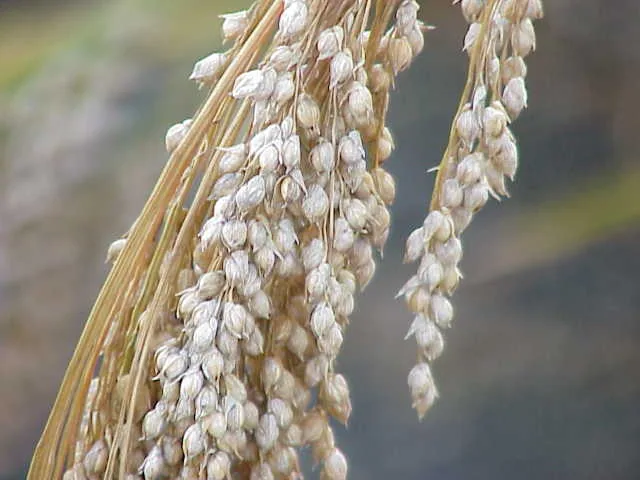
Watch for weedy wild millet: its seeds are dark brown or black, not golden or light brown
- Propagation
Grows from seed
What the sources say (1)
Propagation: Seed
Seed - sow spring in a greenhouse and only just cover the seed.
— Panicum miliaceum - Useful Temperate Plants [6] - Sowing
Sow in a greenhouse in spring
What the sources say (1)
Sowing: Spring, in a greenhouse
Seed - sow spring in a greenhouse and only just cover the seed.
— Panicum miliaceum - Useful Temperate Plants [6] - Safety
Can be deadly to sheep that graze on it
Overview
Proso millet is a warm-season grass grown for its grain, with a short growing season and low moisture requirement. [4] It produces grain under limited water conditions on marginal soil with low agronomic inputs. [1] The grain is eaten by people, fed to livestock and poultry, and sold mainly as bird food. [1] Wild forms of proso millet are considered a problematic weed by many farmers. [5]
This record is incomplete: the sources we read do not cover every field yet.
Not yet covered by our sources: Harvest, Spacing
Proso millet care
Measurements in square brackets are our conversion into the other unit system; the quoted text is unchanged.
How to water Proso millet
Watering
Very low water requirement; water only if the soil is dry
Watering notes
Produces grain under limited water conditions; tolerates drought when established; average annual rainfall of 200-450 mm [7.9–17.7 in] is sufficient
What the sources say (3)
This is due to its ability to produce grain under limited water conditions on marginal soil with low agronomic inputs.Tolerates heat and also drought when it is establishedAn average annual rainfall of 200-450 mm is sufficientHow much light Proso millet needs
Best soil for Proso millet
5.2
What the sources say (1)
Prefers a pH in the range 6 - 6.5, tolerating 5.2 - 8.2Where to grow Proso millet
Not stated in the sources we read.
How to propagate Proso millet
Seed
What the sources say (1)
Seed - sow spring in a greenhouse and only just cover the seed.How to grow Proso millet
Fertilizing
Mineral fertilizers
The sources give different values depending on region, zone or growing conditions.
What each source says
field trial in Emilia-Romagna: Urea at 150 kg [330.7 lb]/ha (reduced plan) or 230 kg [507.1 lb]/ha (full plan)
What the sources say (1)
field trial in Emilia-Romagna: Piano di concimazione ridotto (250 Kg/ha di urea in mais e sorgo; 150 Kg/ha in miglio) Piano di concimazione completo (460 Kg/ha di urea in mais e sorgo; 230 Kg/ha in miglio)Proso millet pests and problems
Weedy wild proso millet
Symptom: Reduces crop yields, resists many herbicides and spreads rapidly through prolific seed production
What to do: Weedy millet produces dark brown or black seeds, while cultivated varieties have golden or light brown seeds
What the sources say (2)
Causes reduced crop yields which results in the loss of income for farmers - Resistant to many herbicides - Adaptive seed producing strategy, which produces seeds even in poor growing conditions - Spreads rapidly due to prolific seed production
— What Is Wild Proso Millet: Wild Millet Plant Care And Concerns | Gardening Know How [5] Weedy millet produces dark brown or black seeds, while cultivated varieties of wild proso millet have golden or light brown seeds.
— What Is Wild Proso Millet: Wild Millet Plant Care And Concerns | Gardening Know How [5]
Remedies
Each remedy shows what official sources say about it; traditional remedies without an official source are marked as such. Harmful ones are listed so you know to avoid them.
Getting rid of it
wild proso millet seedlings
rotary hoeing Works
How: Rotary hoe just before the seedlings emerge, about 7-10 days after the last tillage for seedbed preparation.
Rotary hoeing can kill a substantial proportion of the first flush of seedlings. Time the hoeing for just before the seedlings emerge, about 7-10 days after last tillage
— cals.cornell.edu [8] What the evidence says Rotary hoeing can kill a substantial proportion of the first flush of seedlings. Time the hoeing for just before the seedlings emerge, about 7-10 days after last tillage
— cals.cornell.edu [8] inter-row cultivation Works
How: Cultivate between the rows of row crops when most young plants have emerged.
Inter-row cultivation of row crops often catches the young wild-proso millet after most have emerged, and can provide up to 95% control
— cals.cornell.edu [8] What the evidence says Inter-row cultivation of row crops often catches the young wild-proso millet after most have emerged, and can provide up to 95% control
— cals.cornell.edu [8]
wild proso millet outbreaks
pulling up plants by hand Official source, not independently tested
How: Pull up new outbreaks and, if the plants have flowered, remove them from the field.
Pull up new outbreaks and if the plants have flowered, remove them from the field
— cals.cornell.edu [8]
wild proso millet seed bank
crop rotation with alfalfa Works
How: Rotate to alfalfa, where emerging plants are mowed before they can produce seeds.
a Wisconsin study found that four years of alfalfa reduced seedlings emerging in a following corn crop by 80%
— cals.cornell.edu [8] What the evidence says a Wisconsin study found that four years of alfalfa reduced seedlings emerging in a following corn crop by 80%
— cals.cornell.edu [8]
wild proso millet plants
repeated mowing Not proven
How: Mowing alone does not kill established plants.
Crushing young plants with tractor tires or repeated mowing had little effect on survival or subsequent growth.
— cals.cornell.edu [8] What the evidence says Crushing young plants with tractor tires or repeated mowing had little effect on survival or subsequent growth.
— cals.cornell.edu [8]
Is Proso millet toxic to pets?
Reported by the source, quoted verbatim. This is not medical or veterinary advice: if a person or an animal may have eaten this plant, contact a poison control centre or a veterinarian.
In Iran, a severe case of lethal toxicosis was reported in a flock of sheep grazing proso millet.
[4]- Poisonous parts
Some occasional cases of poisoning with proso millet forage occurred in small ruminants
[4]- Toxic principle
which may have been caused by the presence of steroidal saponins associated with photosentization
[4]- Symptoms
Clinical signs included fever, photosensitization, severe head swelling, decreased appetite and jaundice
[4]
Calendar
Sowing
Spring, in a greenhouse
What the sources say (1)
Seed - sow spring in a greenhouse and only just cover the seed.Planting
After the last expected frosts
What the sources say (1)
plant them out after the last expected frostsHarvest
Not stated in the sources we read.
Months as given by the sources, which are mostly from the United States (northern hemisphere). In the southern hemisphere they shift by about six months.
Edibility
Reported by the source, quoted verbatim. Do not eat a plant on the basis of this page alone: identification mistakes can be dangerous.
Proso millet porridge is a traditional food in Russian, German, and Chinese cuisines.
[1]Seed - cooked as a whole grain in ways similar to rice, or ground into a powder and used as a flour for making breads
[6]can be used for calves, growing and finishing cattle, dairy cows, sheep, swine, and poultry.
[1]The current market for proso millet is mostly limited to bird food
[1]
Indicative values
Values from a secondary source, not checked word for word like the rest of this page. Use them as a starting point.
- Life cycle
- AnnualIndicative value, adapt it to your climate · Secondary source
- Mature height
- 91.4-121.9 cm (3-4 ft)Indicative value, adapt it to your climate · Secondary source
- Hours of sun
- 6-8 hoursIndicative value, adapt it to your climate · Secondary source
- USDA hardiness zones
- 2-11 [winter low −45.6 to 10 °C (−50 to 50 °F)]Indicative value, adapt it to your climate · Secondary source
- Growth rate
- LowIndicative value, adapt it to your climate · Secondary source
Similar plants
- Bitter Panicgrass Panicum amarum
- Switchgrass Panicum virgatum
- Abraham Trachystemon orientalis
- Abyssinian banana Ensete ventricosum
- Acacia longifolia Acacia longifolia
- African Blue Lily Agapanthus praecox
- African lily Dietes bicolor
- African lovegrass Eragrostis curvula
Sources
Every value above is quoted from these documents. Links lead to the original publisher.
- · extensionpubs.unl.edu, consulted
- 1 - DESCRIZIONE DELLO STATO DI AVANZAMENTO DEL PIANO .............................. 3 · agricoltura.regione.emilia-romagna.it, consulted
- Frontiers | Proso Millet (Panicum miliaceum L.) and Its Potential for Cultivation in the Pacific Northwest, U.S.: A Review · frontiersin.org, consulted
- Proso millet (Panicum miliaceum), forage | Feedipedia · feedipedia.org, consulted
- What Is Wild Proso Millet: Wild Millet Plant Care And Concerns | Gardening Know How · gardeningknowhow.com, consulted
- Panicum miliaceum - Useful Temperate Plants · temperate.theferns.info, consulted
- Millet, PANICUM MILIACEUM · backyardnature.net, consulted
- cals.cornell.edu · cals.cornell.edu
Written by Emilio Marruso · last checked