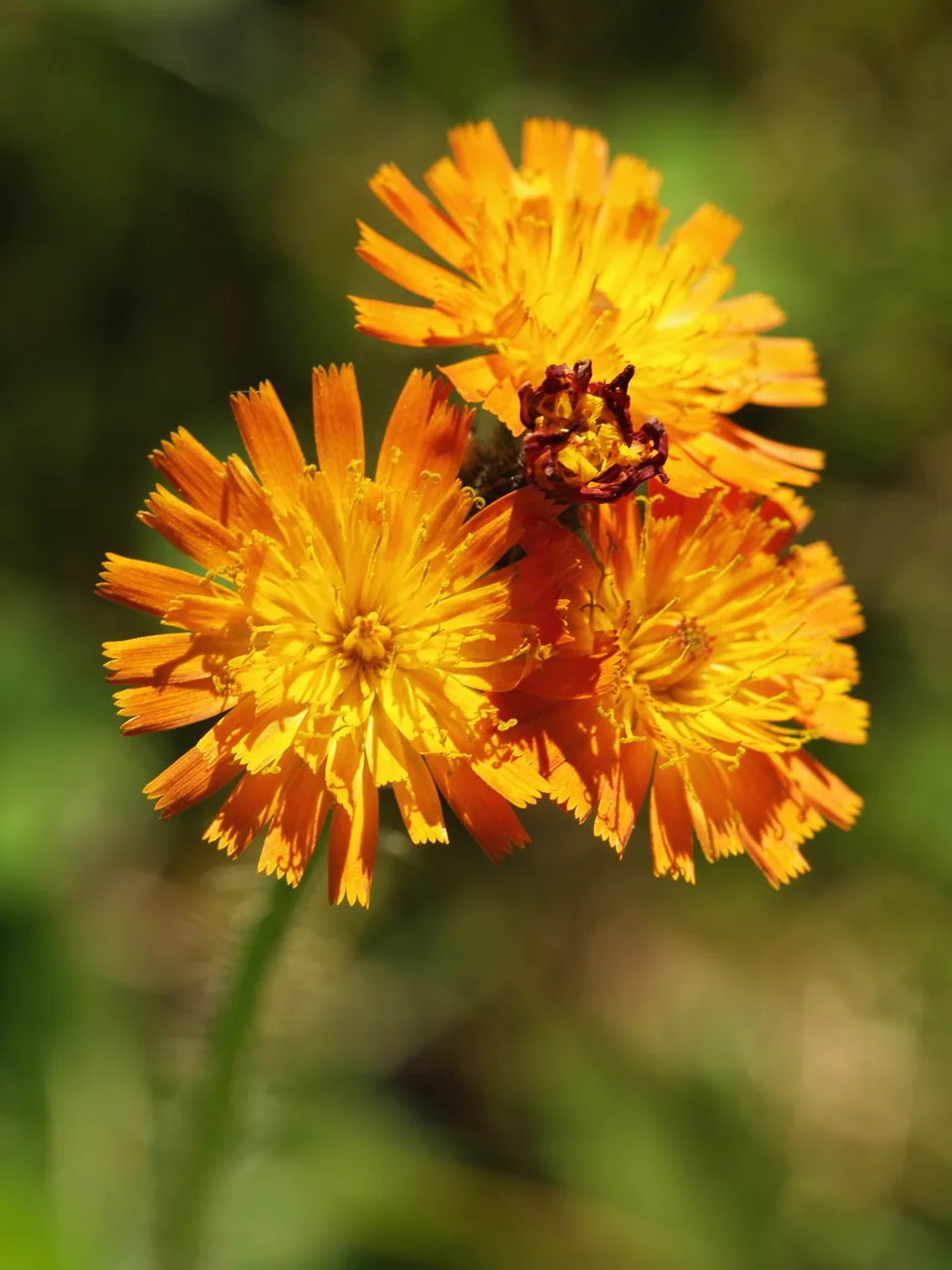

How to Grow and Care for Pilosella aurantiaca
Pilosella aurantiaca
Written by Emilio Marruso · last checked
Toxic to: Cats, Dogs, Birds · Why
At a glance
This easygoing perennial fits almost anywhere in the garden, happy in full sun, partial shade or dappled shade. Give it average water and moist, well-drained soil, and it grows 10–24 inches tall. Sow it from March to May once frost has passed, or plant it in March–May or September–November, then snip off spent flowers to keep it looking fresh.
- Sun
Full sun, partial shade or dappled shade
What the sources say (2)
Light: Dappled shade, full sun, partial shade
Sun Exposure: Dappled shade, full sun, partial shade
— Pilosella aurantiaca (Fox and Cubs) | BBC Gardeners World Magazine [4] Choose an area with well-draining soil in full sun for growing fox and cubs plants.
— Information On Growing Fox And Cubs Plants - Tips For Planting Fox And Cubs Seeds | Gardening Know How [5] - Water
Average water; young seedlings don't like drying out
What the sources say (3)
Watering: Average water
The plants need average water and soil fertility.
— Information On Growing Fox And Cubs Plants - Tips For Planting Fox And Cubs Seeds | Gardening Know How [5] Watering notes: Moist, well-drained soil; seedlings are sensitive to dry conditions
grow Pilosella aurantiaca in full sun in moist, well-drained soil for flowers in June and July
— Pilosella aurantiaca (Fox and Cubs) | BBC Gardeners World Magazine [4] It prefers an annual rainfall above 500 mm and the seedlings are sensitive to dry conditions.
— NSW WeedWise [1] - Soil
Moist, well-drained soil
What the sources say (2)
Watering notes: Moist, well-drained soil; seedlings are sensitive to dry conditions
grow Pilosella aurantiaca in full sun in moist, well-drained soil for flowers in June and July
— Pilosella aurantiaca (Fox and Cubs) | BBC Gardeners World Magazine [4] It prefers an annual rainfall above 500 mm and the seedlings are sensitive to dry conditions.
— NSW WeedWise [1] - Planting
Plant in March–May or September–November
What the sources say (1)
Planting: March-May; September-November
| Plant | | | yes | yes | yes | | | | yes | yes | yes |
— Pilosella aurantiaca (Fox and Cubs) | BBC Gardeners World Magazine [4] - Pruning
After flowering, remove spent flowers promptly
What the sources say (1)
Pruning: After flowering (remove spent flowers promptly)
To prevent spreading, promptly cut off spent flowers.
— Information On Growing Fox And Cubs Plants - Tips For Planting Fox And Cubs Seeds | Gardening Know How [5] - Size
10–24 in tall
What the sources say (1)
Mature height: 25–61 cm (10–24 in)
Orange hawkweed ( Hieracium aurantiacum ) is a perennial herbaceous plant, 10–24 inches high.
— Orange hawkweed [6] - Propagation
From seed or by dividing the clumps
- Sowing
Sow March–May, once all danger of frost has passed
What the sources say (4)
Sowing: March-May, after all danger of frost has passed
According to BBC Gardeners' World: | Sow | | | yes | yes | yes | | | | | | |
— Pilosella aurantiaca (Fox and Cubs) | BBC Gardeners World Magazine [4] According to Gardening Know How: Sow fox and cub seeds after all danger of frost has passed.
— Information On Growing Fox And Cubs Plants - Tips For Planting Fox And Cubs Seeds | Gardening Know How [5] | Sow | | | yes | yes | yes | | | | | | |
— Pilosella aurantiaca (Fox and Cubs) | BBC Gardeners World Magazine [4] Sow fox and cub seeds after all danger of frost has passed.
— Information On Growing Fox And Cubs Plants - Tips For Planting Fox And Cubs Seeds | Gardening Know How [5] - Safety
No toxic effects reported for cats, dogs or birds
Overview
Orange hawkweed is a perennial herb with rosette leaves and orange flower clusters on stems up to 40 cm [16 in] tall. [1] It spreads by seed, stolons and rhizomes and is difficult to eradicate once established. [2][8] Where it is grown, a large area such as a damp, sunny meadow suits it best. [4]
This record is incomplete: the sources we read do not cover every field yet.
Not yet covered by our sources: Hardiness, coldest zone, Hardiness, warmest zone
Pilosella aurantiaca care
Measurements in square brackets are our conversion into the other unit system; the quoted text is unchanged.
How to water Pilosella aurantiaca
Watering
Average water
What the sources say (1)
The plants need average water and soil fertility.Watering notes
Moist, well-drained soil; seedlings are sensitive to dry conditions
What the sources say (2)
grow Pilosella aurantiaca in full sun in moist, well-drained soil for flowers in June and JulyIt prefers an annual rainfall above 500 mm and the seedlings are sensitive to dry conditions.How much light Pilosella aurantiaca needs
Dappled shade, full sun, partial shade
What the sources say (2)
Sun Exposure:
Dappled shade, full sun, partial shadeChoose an area with well-draining soil in full sun for growing fox and cubs plants.How much cold Pilosella aurantiaca can take
Hardiness, coldest zone
Not stated in the sources we read.
Hardiness, warmest zone
Not stated in the sources we read.
How to propagate Pilosella aurantiaca
How to grow Pilosella aurantiaca
The plant
Life cycle
perennial
What the sources say (1)
Orange hawkweed ( Hieracium aurantiacum ) is a perennial herbaceous plant, 10–24 inches high.Family
Asteraceae
What the sources say (1)
Hawkweeds are members of the sunflower (Asteraceae) family and are closely related to dandelion, chicory, prickly lettuce and sowthistle.Mature height
25–61 cm (10–24 in)
What the sources say (1)
Orange hawkweed ( Hieracium aurantiacum ) is a perennial herbaceous plant, 10–24 inches high.Roots
Root system
The sources give different values depending on region, zone or growing conditions.
What each source says
Pilosella in general (invasive hawkweeds): Shallow fibrous root system with underground creeping stems (rhizomes)
What the sources say (1)
Pilosella in general (invasive hawkweeds): The invasive hawkweeds have shallow fibrous root systems and underground creeping stems called rhizomes.Remedies
Each remedy shows what official sources say about it; traditional remedies without an official source are marked as such. Harmful ones are listed so you know to avoid them.
Getting rid of it
invasive weed
pulling and digging out roots and runners Partly works
Pulling or digging the plants leaves tiny root fragments and disturbs the soil, resulting in new hawkweed plants.
— Invasive Plant Issues: Control of orange hawkweed | Cooperative Extension Service [8] Never place plants or seeds in your compost or yard debris.
— portland.gov [9] How: From March to August pull plants, dig up roots and runners and cut off flowers; remove as many roots and runners as possible. Best for small patches.
Manual. Digging orange hawkweed can be effective, but remove as many roots and runners as possible. Digging is the best way to manage small patches.
— portland.gov [9] What the evidence says Pulling or mowing is not recommended unless you are dealing with one or two plants and can dig out the entire area.
— Invasive Plant Issues: Control of orange hawkweed | Cooperative Extension Service [8] hand pulling with an iron rake Partly works
How: Spotty infestations can be hand-pulled using an iron rake to pull up plants and roots, removing as much root as possible; combine with fertilization so grass outgrows the hawkweed.
Spotty infestations can be hand-pulled. Use an iron rake to pull up the plants and roots. Hand removal can be effective if care is taken to remove as much of the root as possible.
— extension.umaine.edu [10] What the evidence says Hand removal can be effective if care is taken to remove as much of the root as possible. Intensive hand removal on lawns is more effective if used in conjunction with fertilization, which can help the grass to outgrow the hawkweed.
— extension.umaine.edu [10] covering with weed barrier fabric Works
How: Cover small areas with weed barrier fabric extending at least one foot beyond the edge of the infestation; leave it for several years and control hawkweed that sprouts at the edges.
Cover is recommended for small areas. Use a weed barrier fabric, leaving enough fabric to cover at least one foot beyond the edge of the infestation. Fabric must stay on for several years. Control hawkweed that sprouts at the edges.
— Invasive Plant Issues: Control of orange hawkweed | Cooperative Extension Service [8] What the evidence says Cover is recommended for small areas. Use a weed barrier fabric, leaving enough fabric to cover at least one foot beyond the edge of the infestation.
— Invasive Plant Issues: Control of orange hawkweed | Cooperative Extension Service [8] collecting flower heads Partly works
How: Collect flower heads at the bud-flower stage to prevent seed dispersal to new areas.
Collecting flower heads can prevent seed dispersal to new areas.
— Invasive Plant Issues: Control of orange hawkweed | Cooperative Extension Service [8] What the evidence says Pull/Mow/Dig — Do not do it unless you are dealing with one or two plants. Collecting flower heads can prevent seed dispersal to new areas.
— Invasive Plant Issues: Control of orange hawkweed | Cooperative Extension Service [8] mowing Not proven
How: Mowing removes flowering stems but misses the low rosettes.
In lawns, mowing of hawkweeds is ineffective because the low-lying rosettes are missed by mower blades.
— MontGuide [7] What the evidence says Mowing is ineffective because rosettes are so close to the ground. Although mowing prevents seed production by removing flowering stems, repeated mowing encourages faster vegetative spread.
— extension.umaine.edu [10] fertilizer and grass reseeding Partly works
How: Test the soil, add lime, fertilizer or compost as needed so grass outcompetes hawkweed; reseed bare spots where hawkweed was removed and keep moist.
Soil nutrients need to be added to encourage grass to outcompete hawkweed. Spread soil nutrients as needed on the whole lawn. (lime, fertilizer, compost, etc.)
— extension.umaine.edu [10] What the evidence says Fertilizer alone has been effective in reducing hawkweed density in some areas of the United States.
— MontGuide [7]
Is Pilosella aurantiaca toxic to pets?
Reported by the source, quoted verbatim. This is not medical or veterinary advice: if a person or an animal may have eaten this plant, contact a poison control centre or a veterinarian.
Pilosella ‘Aurantiaca’ has no toxic effects reported. No reported toxicity to: Is not known to attract Birds Birds
[4]The source flags the risk for this animal but does not explain why.
No reported toxicity to: Is not known to attract Birds Birds Is not known to attract Cats Cats
[4]The source flags the risk for this animal but does not explain why.
No reported toxicity to: Is not known to attract Birds Birds Is not known to attract Cats Cats Is not known to attract Dogs Dogs
[4]The source flags the risk for this animal but does not explain why.
Calendar
March-May, after all danger of frost has passed
What each source says
According to BBC Gardeners' World: March-May
According to Gardening Know How: After all danger of frost has passed
What the sources say (4)
According to BBC Gardeners' World: | Sow | | | yes | yes | yes | | | | | | | According to Gardening Know How: Sow fox and cub seeds after all danger of frost has passed.| Sow | | | yes | yes | yes | | | | | | | Sow fox and cub seeds after all danger of frost has passed.March-May; September-November
What the sources say (1)
| Plant | | | yes | yes | yes | | | | yes | yes | yes | After flowering (remove spent flowers promptly)
What the sources say (1)
To prevent spreading, promptly cut off spent flowers.Months as given by the sources, which are mostly from the United States (northern hemisphere). In the southern hemisphere they shift by about six months.
Similar plants
- Meadow Hawkweed Pilosella caespitosa
- Mouse-ear Hawkweed Pilosella officinarum
- African Daisy Dimorphotheca pluvialis
- African Marigold Tagetes erecta
- Ageratum Ageratum houstonianum
- Alpine aster Aster alpinus
- American Burnweed Erechtites hieraciifolius
- Appalachian Blazing Star Liatris squarrulosa
Sources
Every value above is quoted from these documents. Links lead to the original publisher.
- NSW WeedWise · weeds.dpi.nsw.gov.au, consulted
- Pilosella aurantiaca, Fox and Cubs: identification, distribution, habitat · first-nature.com, consulted
- Flora of New Zealand | Taxon Profile | Pilosella aurantiaca · nzflora.info, consulted
- Pilosella aurantiaca (Fox and Cubs) | BBC Gardeners World Magazine · gardenersworld.com, consulted
- Information On Growing Fox And Cubs Plants - Tips For Planting Fox And Cubs Seeds | Gardening Know How · gardeningknowhow.com, consulted
- Orange hawkweed · extension.umn.edu, consulted
- MontGuide · montana.edu, consulted
- Invasive Plant Issues: Control of orange hawkweed | Cooperative Extension Service · uaf.edu, consulted
- portland.gov · portland.gov
- extension.umaine.edu · extension.umaine.edu
Written by Emilio Marruso · last checked