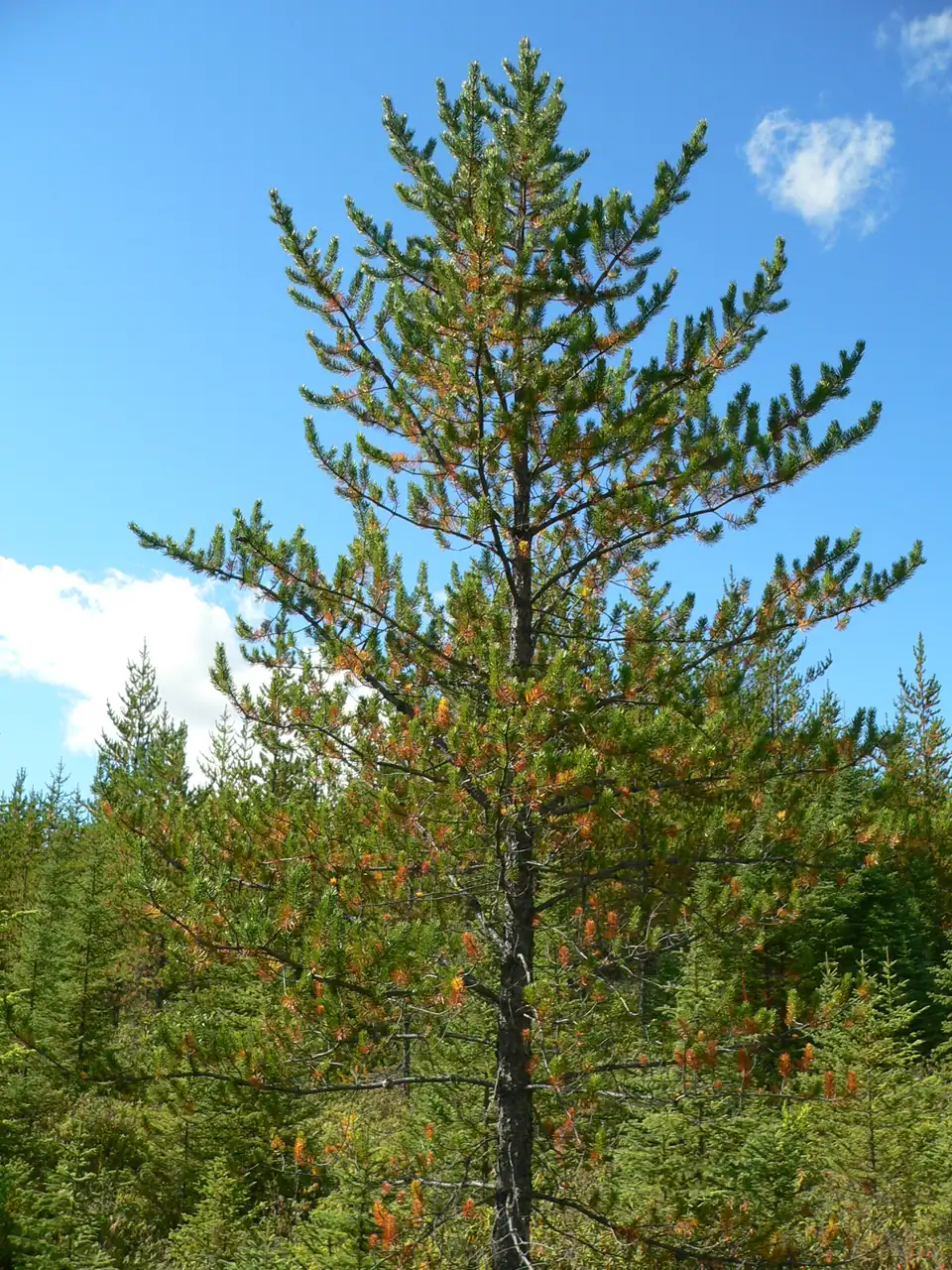


How to Grow and Care for Jack pine
Pinus banksiana
Written by Emilio Marruso · last checked
At a glance
Jack pine is a tough, easygoing tree for sunny spots. It is highly drought tolerant and does especially well on dry, sandy soils, surviving even on the driest ground, while still growing best with steady moisture. Give it full sun: lower branches left in the shade die but stay on the tree.
- Sun
Full sun; shaded lower branches die
What the sources say (2)
Light: Full sun
Jack Pine grows in full sun in a variety of soils, including deep sand and other poor soils.
— Pinus banksiana (Jack Pine) | North Carolina Extension Gardener Plant Toolbox [1] Light: Full sun. Water: Requires consistent moisture for best growth, but highly drought tolerant.
— Jack Pine | NDSU Agriculture [3] - Water
Grows best with steady moisture, but handles drought very well
What the sources say (1)
Watering: Requires consistent moisture for best growth, but highly drought tolerant
Water: Requires consistent moisture for best growth, but highly drought tolerant.
— Jack Pine | NDSU Agriculture [3] - Cold
Survives winters down to −50 °F (−45.6 °C)
Very hardy · USDA 2a · RHS H7 · Z2
What the sources say (2)
Hardiness, coldest zone: 2a [winter low −45.6 to −42.8 °C (−50 to −45 °F)]
USDA Plant Hardiness Zone: 2a, 2b, 3a, 3b, 4a, 4b, 5a, 5b, 6a, 6b, 7a, 7b
— Pinus banksiana (Jack Pine) | North Carolina Extension Gardener Plant Toolbox [1] Hardiness, warmest zone: 7b [winter low −15 to −12.2 °C (5 to 10 °F)]
USDA Plant Hardiness Zone: 2a, 2b, 3a, 3b, 4a, 4b, 5a, 5b, 6a, 6b, 7a, 7b
— Pinus banksiana (Jack Pine) | North Carolina Extension Gardener Plant Toolbox [1] - Soil
Any well-drained soil; does especially well on dry, sandy ground
What the sources say (2)
Watering notes: Especially hardy on dry sandy soils but adaptable on most well drained soils; survives on the driest soils
Site Requirements: Especially hardy on dry sandy soils but adaptable on most well drained soils
— Jack Pine | Natural Resources [2] It will survive on the driest soils in the state, and makes rapid growth during the first 10 to 15 years.
— Jack Pine | Natural Resources [2] - Pests
Can get needle cast, root rot and rust
What the sources say (1)
Diseases: needle cast, root rot, rust
It does best in areas with cool summers, it cannot tolerate heat. May develop needle cast, root rot, and rust.
— Pinus banksiana (Jack Pine) | North Carolina Extension Gardener Plant Toolbox [1] - Watch out
Easily damaged by wind; dead shaded lower branches stay on the tree
- Propagation
From seed or root cuttings
What the sources say (1)
Propagation: Root cutting, seed
Recommended Propagation Strategy: Root Cutting Seed Country Or Region Of Origin: Northern North America
— Pinus banksiana (Jack Pine) | North Carolina Extension Gardener Plant Toolbox [1]
Overview
Jack pine is a needled evergreen tree native to the Lake states, the northern New England states and much of Canada. [2] It grows in full sun in a variety of soils including deep sand and poor soils, and is highly drought tolerant. [1][3]
This record is incomplete: the sources we read do not cover every field yet.
Not yet covered by our sources: Pruning
Jack pine care
How to water Jack pine
Watering
Requires consistent moisture for best growth, but highly drought tolerant
What the sources say (1)
Water: Requires consistent moisture for best growth, but highly drought tolerant.Watering notes
Especially hardy on dry sandy soils but adaptable on most well drained soils; survives on the driest soils
How much light Jack pine needs
Full sun
What the sources say (2)
Jack Pine grows in full sun in a variety of soils, including deep sand and other poor soils.Light: Full sun.
Water: Requires consistent moisture for best growth, but highly drought tolerant.How much cold Jack pine can take
Hardiness, coldest zone
2a [winter low −45.6 to −42.8 °C (−50 to −45 °F)]
What the sources say (1)
USDA Plant Hardiness Zone:
2a, 2b, 3a, 3b, 4a, 4b, 5a, 5b, 6a, 6b, 7a, 7bHardiness, warmest zone
7b [winter low −15 to −12.2 °C (5 to 10 °F)]
What the sources say (1)
USDA Plant Hardiness Zone:
2a, 2b, 3a, 3b, 4a, 4b, 5a, 5b, 6a, 6b, 7a, 7bHow to propagate Jack pine
Root cutting, seed
What the sources say (1)
Recommended Propagation Strategy:
Root Cutting
Seed
Country Or Region Of Origin:
Northern North AmericaHow to grow Jack pine
The plant
Family
Pinaceae
Mature height
Pests and diseases
Diseases
needle cast, root rot, rust
What the sources say (1)
It does best in areas with cool summers, it cannot tolerate heat. May develop needle cast, root rot, and rust.Jack pine pests and problems
Needle cast, root rot and rust
Symptom: May develop these diseases
What the sources say (1)
It does best in areas with cool summers, it cannot tolerate heat. May develop needle cast, root rot, and rust.
— Pinus banksiana (Jack Pine) | North Carolina Extension Gardener Plant Toolbox [1] Wind damage
Symptom: Susceptible to wind damage
What the sources say (1)
Insect, Diseases, and Other Plant Problems: This tree is susceptible to wind damage.
— Pinus banksiana (Jack Pine) | North Carolina Extension Gardener Plant Toolbox [1] Shade
Symptom: Lower branches covered with shade die but remain on the tree
What to do: Plant in full sun
What the sources say (1)
It cannot tolerate shade, the lower branches that are covered with shade will die, but remain on the tree.
— Pinus banksiana (Jack Pine) | North Carolina Extension Gardener Plant Toolbox [1]
Remedies
Each remedy shows what official sources say about it; traditional remedies without an official source are marked as such. Harmful ones are listed so you know to avoid them.
Treating the plant
european pine sawfly
handpicking larvae Works
How: Inspect all conifers in early to mid-spring for groups of hatching larvae.
Non-chemical: Handpicking the larvae is effective. Inspect all conifers in early to mid-spring for groups of hatching larvae.
— extension.illinois.edu [5] What the evidence says Non-chemical: Handpicking the larvae is effective. Inspect all conifers in early to mid-spring for groups of hatching larvae.
— extension.illinois.edu [5] forceful water spray Official source, not independently tested
How: Dislodge the larvae from the plants by using a forceful water spray.
dealing with sawfly larvae involves hand-picking (you can wear gloves if you wish) or dislodging larvae from plants by using a forceful water spray.
— k-state.edu [6] horticultural oil spray Works
Follow label directions very carefully -- summer applications of oil are at a lower rate than dormant applications.
— yardandgarden.extension.iastate.edu [7] How: Horticultural oil sprays can be used against small larvae; detect colonies early.
Early detection of sawfly larval colonies is an advantage because horticultural oil sprays can be used against small larvae with good results.
— yardandgarden.extension.iastate.edu [7] What the evidence says Early detection of sawfly larval colonies is an advantage because horticultural oil sprays can be used against small larvae with good results.
— yardandgarden.extension.iastate.edu [7]
Calendar
Pruning
Not stated in the sources we read.
Months as given by the sources, which are mostly from the United States (northern hemisphere). In the southern hemisphere they shift by about six months.
Indicative values
Values from a secondary source, not checked word for word like the rest of this page. Use them as a starting point.
- Life cycle
- PerennialIndicative value, adapt it to your climate · Secondary source
- Drought tolerant
- yesIndicative value, adapt it to your climate · Secondary source
- Soil
- Sandy Loamy Clay RockyIndicative value, adapt it to your climate · Secondary source
- Soil pH
- 4.5-6.5Indicative value, adapt it to your climate · Secondary source
- Care level
- MediumIndicative value, adapt it to your climate · Secondary source
- Growth rate
- LowIndicative value, adapt it to your climate · Secondary source
- Pruning
- May, June, JulyIndicative value, adapt it to your climate · Secondary source
Similar plants
- Aleppo Pine Pinus halepensis
- Armand Pine Pinus armandi
- Austrian Pine Pinus nigra
- Bristlecone Pine Pinus aristata
- Chinese Pine Pinus yunnanensis
- Himalayan Pine Pinus wallichiana
- Japanese Black Pine Pinus thunbergii
- Japanese Red Pine Pinus densiflora
Sources
Every value above is quoted from these documents. Links lead to the original publisher.
- Pinus banksiana (Jack Pine) | North Carolina Extension Gardener Plant Toolbox · plants.ces.ncsu.edu, consulted
- Jack Pine | Natural Resources · naturalresources.extension.iastate.edu, consulted
- Jack Pine | NDSU Agriculture · ndsu.edu, consulted
- Pines for North Dakota | NDSU Agriculture · ndsu.edu, consulted
- extension.illinois.edu · extension.illinois.edu
- k-state.edu · k-state.edu
- yardandgarden.extension.iastate.edu · yardandgarden.extension.iastate.edu
Written by Emilio Marruso · last checked