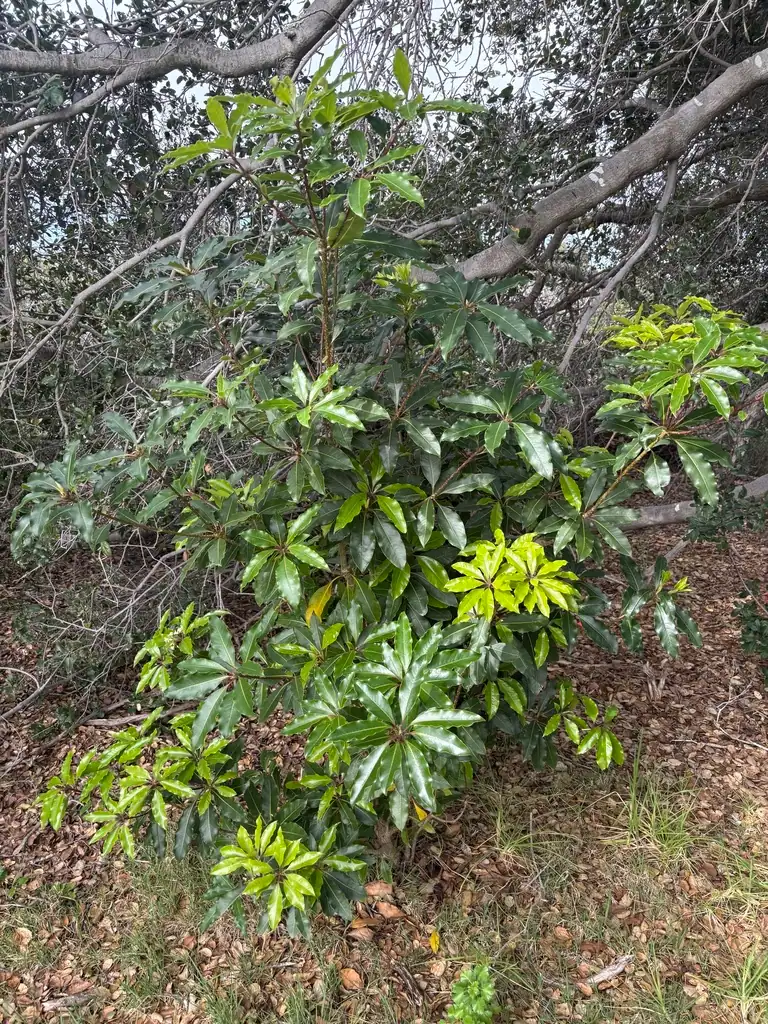
How to Grow and Care for Australian cheesewood
Pittosporum undulatum
Written by Emilio Marruso · last checked
At a glance
This plant is easy to start: its seeds sprout readily with no special treatment, and half-ripe cuttings root too. Once established, it handles long dry spells, though it appreciates extra moisture. Give it well-drained soil and prune it after flowering. Just keep an eye on its seedlings, since birds spread them and they can crowd out native plants.
- Water
Likes extra moisture, but once established it handles long dry spells
What the sources say (2)
Watering: Appreciates extra moisture; withstands extended dry periods once established
It is a hardy and adaptable plant which appreciates most acidic soils and extra moisture, yet can also withstand extended dry periods once established.
— Pittosporum undulatum - Australian Native Plants Society (Australia) [5] It is a hardy and adaptable plant which appreciates most acidic soils and extra moisture, yet can also withstand extended dry periods once established.
— Pittosporum undulatum | Australian Plants Society [4] - Soil
Well-drained soil; it also does well in dry soil
What the sources say (1)
Watering notes: Well-drained soil; succeeds in dry soils
Succeeds in most well-drained soils of reasonably good quality in full sun or light shade
— Pittosporum undulatum - Useful Temperate Plants [2] - Planting
Plant out in late spring, the year after sowing
What the sources say (1)
Planting: Late spring of the year after sowing
move the plants to a cold frame as soon as they are established and plant out late in the following spring
— Pittosporum undulatum - Useful Temperate Plants [2] - Pruning
Prune after flowering has finished
What the sources say (1)
Pruning: After flowering has finished
You could grow this plant, if desired, but ideally plants should be pruned after flowering has finished with all spent flowering parts removed.
— Pittosporum undulatum | Australian Plants Society [4] - Pests
Watch for leaf miners and sudden dieback: milky sap leaks and all the leaves drop
- Watch out
Can spread and crowd out native plants: hand pull its seedlings
- Propagation
From seed, half-ripe cuttings or ripe-wood cuttings taken from the base
What the sources say (2)
Propagation: Seed (germinates readily without treatment); half-ripe cuttings; basal ripewood cuttings
Propagation can be carried out from seed which germinates readily without treatment. Cuttings are also successful.
— Pittosporum undulatum - Australian Native Plants Society (Australia) [5] Cuttings of half-ripe wood, 5 - 7cm with a heel, mid summer in a frame. Poor to fair percentage
— Pittosporum undulatum - Useful Temperate Plants [2] - Sowing
Sow in autumn when ripe, or in late winter in a warm greenhouse; seeds sprout readily
What the sources say (3)
Sowing: Autumn when ripe, or late winter in a warm greenhouse
Seed - sow when ripe in the autumn or in late winter in a warm greenhouse
— Pittosporum undulatum - Useful Temperate Plants [2] Propagation: Seed (germinates readily without treatment); half-ripe cuttings; basal ripewood cuttings
Propagation can be carried out from seed which germinates readily without treatment. Cuttings are also successful.
— Pittosporum undulatum - Australian Native Plants Society (Australia) [5] Cuttings of half-ripe wood, 5 - 7cm with a heel, mid summer in a frame. Poor to fair percentage
— Pittosporum undulatum - Useful Temperate Plants [2] - Safety
Not toxic to animals; it is even used as fodder
Overview
Sweet pittosporum is an evergreen tree from eastern Australia with wavy-edged leaves and fragrant white flowers followed by orange fruits. [7][2] It is quick growing, can be clipped into hedges and withstands extended dry periods once established. [5] Its bird-dispersed seeds make it an invasive weed in several regions, and planting near natural bushland is not recommended. [5][8]
This record is incomplete: the sources we read do not cover every field yet.
Not yet covered by our sources: Hardiness, coldest zone, Hardiness, warmest zone
Australian cheesewood care
How to water Australian cheesewood
Watering
Appreciates extra moisture; withstands extended dry periods once established
What the sources say (2)
It is a hardy and adaptable plant which appreciates most acidic soils and extra moisture, yet can also withstand extended dry periods once established.It is a hardy and adaptable plant which appreciates most acidic soils and extra moisture, yet can also withstand extended dry periods once established.Watering notes
Well-drained soil; succeeds in dry soils
What the sources say (1)
Succeeds in most well-drained soils of reasonably good quality in full sun or light shadeHow much light Australian cheesewood needs
The sources give different values depending on region, zone or growing conditions.
What each source says
According to Useful Temperate Plants: Full sun or light shade
Portugal, as an invasive: Develops well in shade
What the sources say (3)
According to Useful Temperate Plants: Succeeds in most well-drained soils of reasonably good quality in full sun or light shadePortugal, as an invasive: It develops well in the shade, even though it’s a shade-intolerant species .Succeeds in most well-drained soils of reasonably good quality in full sun or light shadeHow much cold Australian cheesewood can take
Hardiness, coldest zone
Not stated in the sources we read.
Hardiness, warmest zone
Not stated in the sources we read.
How to propagate Australian cheesewood
Seed (germinates readily without treatment); half-ripe cuttings; basal ripewood cuttings
What the sources say (2)
Propagation can be carried out from seed which germinates readily without treatment. Cuttings are also successful.Cuttings of half-ripe wood, 5 - 7cm with a heel, mid summer in a frame. Poor to fair percentageHow to grow Australian cheesewood
Pruning
When to prune
The sources give different values depending on region, zone or growing conditions.
What each source says
Pittosporum in general (garden shrubs): Free-standing shrubs in mid-spring.
Pittosporum in general (garden shrubs): Hedges and clipped shapes from mid-spring to late summer.
What the sources say (2)
Pittosporum in general (garden shrubs): Stand-alone shrubs Prune in mid-spring The aim is to help the plant develop a strong central stemPittosporum in general (garden shrubs): Hedges and clipped shapes These are best pruned from mid-spring to late summerHard pruning
The sources give different values depending on region, zone or growing conditions.
What each source says
Pittosporum in general (garden shrubs): Responds well to hard pruning in spring (late March to early April) if you do not cut into the older wood.
Pittosporum in general (garden shrubs): Spread the pruning over two to three years.
What the sources say (2)
Pittosporum in general (garden shrubs): Pittosporums generally respond well to hard pruning in spring (late March to early April), if you don’t prune into the older wood.Pittosporum in general (garden shrubs): Spread the pruning over two to three years for the best results.Australian cheesewood pests and problems
Sudden dieback
Symptom: Milky-white sap leaks from stems and trunk and all the leaves quickly fall off; cause unknown
What the sources say (1)
Trees can succumb to a quick death where a lot of milky-white sap is leaked out of the stems and trunk and all the leaves quickly fall off.
— Pittosporum undulatum | Australian Plants Society [4] Leaf miner
Symptom: Circular leaf miner damage along the central parts of the leaves
What the sources say (1)
Most leaves will also have distinctive circular leaf miner damage along the central parts.
— Pittosporum undulatum | Australian Plants Society [4] Invasive spread
Symptom: Bird-dispersed seedlings and root sprouts form dense stands that shade out native plants
What to do: Hand pull seedlings; ring-bark or cut-stump adult plants and remove regrowth
What the sources say (1)
Hand pulling : preferential methodology for seedlings and small plants. When in more compacted substrates, hand pulling must be made during the rainy season as to facilitate the removal of the root system.
— Pittosporum undulatum | Invasive plant species in Portugal [8]
Remedies
Each remedy shows what official sources say about it; traditional remedies without an official source are marked as such. Harmful ones are listed so you know to avoid them.
Getting rid of it
invasive sweet pittosporum seedlings
hand pulling seedlings and small plants Works
How: Hand pull seedlings and small plants; in compacted soil do it in the rainy season so the root system comes out.
Hand pulling : preferential methodology for seedlings and small plants. When in more compacted substrates, hand pulling must be made during the rainy season as to facilitate the removal of the root system.
— Pittosporum undulatum | Invasive plant species in Portugal [8] What the evidence says Management focuses on preventing seed production and removing established plants. Small seedlings can be hand-pulled or grubbed out when the soil is moist.
— landscape.sa.gov.au [10]
invasive sweet pittosporum trees
ring-barking adult plants Not verified
Traditional remedy, not verified by an official source.
How: On adult plants with smooth, unwounded bark, cut a continuous ring around the trunk and remove all the bark (and the vascular cambium).
seed spread
removing male or female plants to stop seed set Not verified
Traditional remedy, not verified by an official source.
Fire : Fire can help control some infestation, however low intensity burns will not kill plants and are likely to promote vigorous re-shooting.
— weeds.org.au [11] How: If removal has to be gradual over several years, strategically remove male or female plants to help prevent seed set.
Is Australian cheesewood poisonous?
Reported by the source, quoted verbatim. This is not medical or veterinary advice: if a person or an animal may have eaten this plant, contact a poison control centre or a veterinarian.
- No evidence of field allelopathy - Not toxic to animals (used as fodder)
[7]The source flags the risk for this animal but does not explain why.
Calendar
Sowing
Autumn when ripe, or late winter in a warm greenhouse
What the sources say (1)
Seed - sow when ripe in the autumn or in late winter in a warm greenhousePlanting
Late spring of the year after sowing
What the sources say (1)
move the plants to a cold frame as soon as they are established and plant out late in the following springPruning
After flowering has finished
What the sources say (1)
You could grow this plant, if desired, but ideally plants should be pruned after flowering has finished with all spent flowering parts removed.Months as given by the sources, which are mostly from the United States (northern hemisphere). In the southern hemisphere they shift by about six months.
Similar plants
- Chinese Pittosporum Pittosporum heterophyllum
- Pittosporum Pittosporum tobira
- Aaron's Beard Hypericum calycinum
- Abies grandis Abies grandis
- Abraham Trachystemon orientalis
- Abyssinian banana Ensete ventricosum
- Acacia longifolia Acacia longifolia
- Acacia retinodes Acacia retinodes
Sources
Every value above is quoted from these documents. Links lead to the original publisher.
- Pittosporum undulatum Profile – California Invasive Plant Council · cal-ipc.org, consulted
- Pittosporum undulatum - Useful Temperate Plants · temperate.theferns.info, consulted
- Pittosporum undulatum, Victorian box | Trees of Stanford & Environs · trees.stanford.edu, consulted
- Pittosporum undulatum | Australian Plants Society · resources.austplants.com.au, consulted
- Pittosporum undulatum - Australian Native Plants Society (Australia) · anpsa.org.au, consulted
- Bean's Trees and Shrubs · beanstreesandshrubs.org, consulted
- Pittosporum undulatum | Plant Pono · plantpono.org, consulted
- Pittosporum undulatum | Invasive plant species in Portugal · invasoras.pt, consulted
- rhs.org.uk · rhs.org.uk
- landscape.sa.gov.au · landscape.sa.gov.au
- weeds.org.au · weeds.org.au
Written by Emilio Marruso · last checked