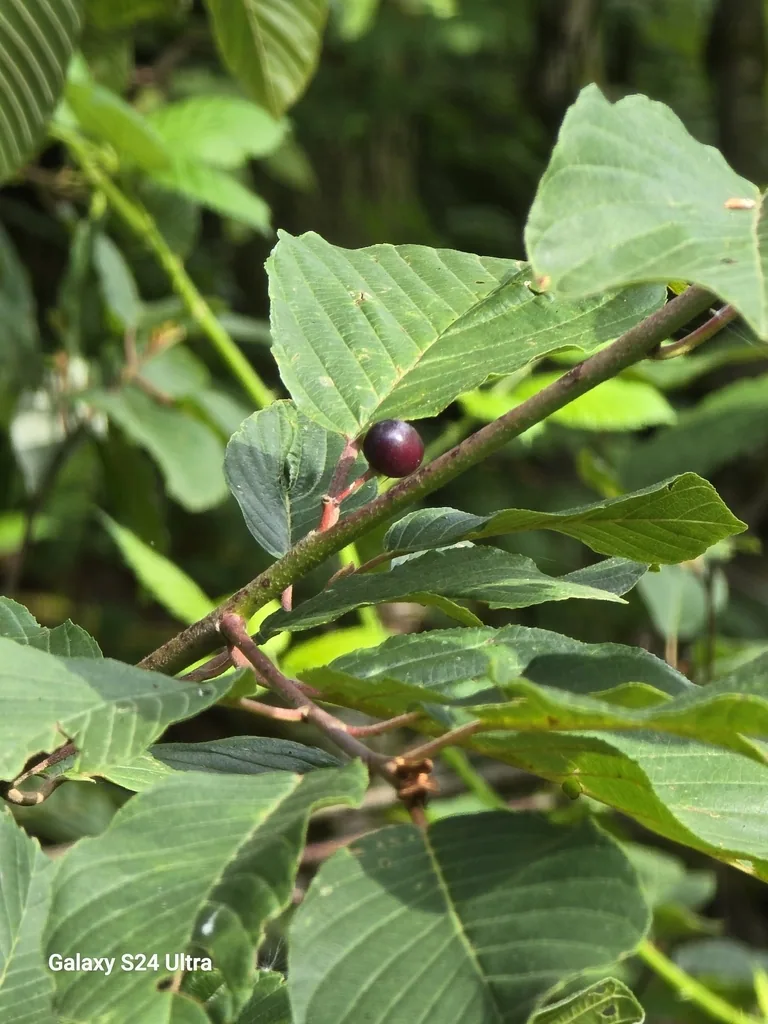
How to Grow and Care for Cascara buckthorn
Rhamnus purshiana
Written by Emilio Marruso · last checked
Toxic to: People · Why
At a glance
This easygoing plant tolerates both wet and dry soils, though it is happiest in moist ground with a little extra water when needed. You can raise new plants yourself from seed sown outdoors in fall, from cuttings, or by layering in early spring. The young seedlings move into the garden in late spring or early summer, after their first winter.
- Water
Likes moist soil but tolerates wet to dry; give extra water when needed
What the sources say (2)
Watering: Moist soil; supplemental watering may be required
supplemental watering may be required
— Plant Data Sheet [1] Watering notes: Tolerates wet to dry soils
It tolerates wet to dry soils, and is very tolerant of shady conditions.
— Plant Propagation Protocol for Frangula purshiana [2] - Cold
Survives winters down to 0 °F (−17.8 °C)
Hardy in very cold winters · USDA 7 · RHS H6 · Z7
What the sources say (1)
Hardiness, coldest zone: 7 [winter low −17.8 to −12.2 °C (0 to 10 °F)]
Hardiness Zone 7+
— Cascara Sagrada (Rhamnus purshianus) — Practical Plants [4] - Planting
Plant seedlings out in late spring or early summer, after their first winter
What the sources say (1)
Planting: Late spring or early summer (seedlings, after their first winter)
Plant them out in late spring or early summer of the following year.
— Cascara Sagrada (Rhamnus purshianus) — Practical Plants [4] - Harvest
Berries were once eaten fresh in July and August, but some say they may be slightly toxic
- Propagation
Seed, hardwood cuttings in September–October, softwood cuttings, or layering in early spring
What the sources say (3)
Propagation: Seed (cold stratification); hardwood cuttings taken in September-October; softwood cuttings; layering in early spring
Hardwood cuttings can be taken in September and October
— Plant Propagation Protocol for Frangula purshiana [2] Begin layering plants in early spring
— Plant Propagation Protocol for Frangula purshiana [2] Cold moist stratification is required at 1-5 ˚C for 12-16 weeks.
— Plant Propagation Protocol for Frangula purshiana [2] - Sowing
Sow outdoors in fall, best in a cold frame; the seeds need a cold spell to sprout
What the sources say (4)
Sowing: Fall, outdoors (preferably in a cold frame)
Seeds are sown outdoors in the fall, preferably in a cold frame
— Plant Propagation Protocol for Frangula purshiana [2] Propagation: Seed (cold stratification); hardwood cuttings taken in September-October; softwood cuttings; layering in early spring
Hardwood cuttings can be taken in September and October
— Plant Propagation Protocol for Frangula purshiana [2] Begin layering plants in early spring
— Plant Propagation Protocol for Frangula purshiana [2] Cold moist stratification is required at 1-5 ˚C for 12-16 weeks.
— Plant Propagation Protocol for Frangula purshiana [2] - Safety
It may be mildly poisonous to people: don't eat it
Overview
Cascara (Rhamnus purshiana, now Frangula purshiana) is a slow-growing deciduous shrub or tree native to western North America. [2][7] Its bark is a strong laxative, used medicinally. [7]
This record is incomplete: the sources we read do not cover every field yet.
Not yet covered by our sources: Hardiness, warmest zone, Pruning
Cascara buckthorn care
How to water Cascara buckthorn
Watering
Moist soil; supplemental watering may be required
What the sources say (1)
supplemental watering may be requiredWatering notes
Tolerates wet to dry soils
What the sources say (1)
It tolerates wet to dry soils, and is very tolerant of shady conditions.How much light Cascara buckthorn needs
The sources give different values depending on region, zone or growing conditions.
What each source says
According to University of Washington plant data sheet: Full shade
According to Practical Plants: Sun or partial shade
What the sources say (2)
According to University of Washington plant data sheet: Plant in full shade and in moist soil conditions;According to Practical Plants: Succeeds in any reasonably good soil in sun or partial shadeHow much cold Cascara buckthorn can take
Hardiness, coldest zone
7 [winter low −17.8 to −12.2 °C (0 to 10 °F)]
What the sources say (1)
Hardiness
Zone 7+Hardiness, warmest zone
Not stated in the sources we read.
How to propagate Cascara buckthorn
Seed (cold stratification); hardwood cuttings taken in September-October; softwood cuttings; layering in early spring
What the sources say (3)
Hardwood cuttings can be taken in September and OctoberBegin layering plants in early springCold moist stratification is required at 1-5 ˚C for 12-16 weeks.Remedies
Each remedy shows what official sources say about it; traditional remedies without an official source are marked as such. Harmful ones are listed so you know to avoid them.
Treating the plant
leaf spots
raking and destroying fallen leaves Official source, not independently tested
How: Rake and destroy fallen leaves; the fungi overwinter in fallen leaves.
Rake and destroy fallen leaves. - Avoid overhead irrigation or any practice that keeps plants wet for extended periods of time.
— pnwhandbooks.org [9] avoiding overhead irrigation Official source, not independently tested
How: Avoid overhead irrigation or any practice that keeps plants wet for extended periods of time.
Avoid overhead irrigation or any practice that keeps plants wet for extended periods of time.
— pnwhandbooks.org [9]
Is Cascara buckthorn poisonous?
Reported by the source, quoted verbatim. This is not medical or veterinary advice: if a person or an animal may have eaten this plant, contact a poison control centre or a veterinarian.
There is the suggestion that this species could be mildly poisonous
[4]
Calendar
Sowing
Fall, outdoors (preferably in a cold frame)
What the sources say (1)
Seeds are sown outdoors in the fall, preferably in a cold framePlanting
Late spring or early summer (seedlings, after their first winter)
What the sources say (1)
Plant them out in late spring or early summer of the following year.Pruning
Not stated in the sources we read.
Months as given by the sources, which are mostly from the United States (northern hemisphere). In the southern hemisphere they shift by about six months.
Edibility
Reported by the source, quoted verbatim. Do not eat a plant on the basis of this page alone: identification mistakes can be dangerous.
Indicative values
Values from a secondary source, not checked word for word like the rest of this page. Use them as a starting point.
- Life cycle
- PerennialIndicative value, adapt it to your climate · Secondary source
- Soil
- Sandy, Loamy, Clay, Humus, RockyIndicative value, adapt it to your climate · Secondary source
- Soil pH
- 5.5-7.5Indicative value, adapt it to your climate · Secondary source
- Care level
- MediumIndicative value, adapt it to your climate · Secondary source
- Growth rate
- LowIndicative value, adapt it to your climate · Secondary source
- Pruning
- February, March, April, February, March, AprilIndicative value, adapt it to your climate · Secondary source
Similar plants
- Common Buckthorn Rhamnus cathartica
- Mediterranean Buckthorn Rhamnus alaternus
- Aaron's Beard Hypericum calycinum
- Abies grandis Abies grandis
- Abraham Trachystemon orientalis
- Abyssinian banana Ensete ventricosum
- Acacia longifolia Acacia longifolia
- Acacia retinodes Acacia retinodes
Sources
Every value above is quoted from these documents. Links lead to the original publisher.
- Plant Data Sheet · depts.washington.edu, consulted
- Plant Propagation Protocol for Frangula purshiana · courses.washington.edu, consulted
- Indicator Plants – Coastal Indicator Plants of BC (FRST 201) · blogs.ubc.ca, consulted
- Cascara Sagrada (Rhamnus purshianus) — Practical Plants · practicalplants.org, consulted
- Flora of New Zealand | Taxon Profile | Frangula purshiana · nzflora.info, consulted
- Rhamnus - Trees and Shrubs Online · treesandshrubsonline.org, consulted
- Cascara, Frangula purshiana | Native Plants PNW · nativeplantspnw.com, consulted
- Frangula purshiana | Encyclopedia of Puget Sound · eopugetsound.org, consulted
- pnwhandbooks.org · pnwhandbooks.org
Written by Emilio Marruso · last checked